SPINY PUMPKIN

Florence, 21 November 2025

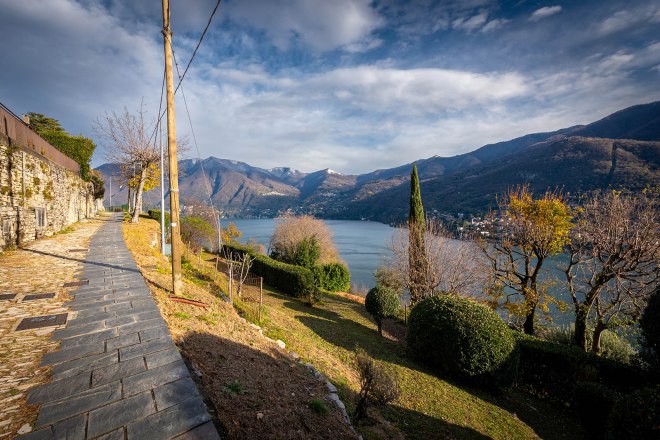
A week or so ago, my wife and I were doing a gentle hike on Lake Como. We’ve both been a bit under the weather, so a hike with none of the brutal climbs required of many of the hikes around Lake Como were just what we needed. We had also done a few other, rougher hikes along the lake in the previous days and had discovered to our dismay that heavy rains back in late September had made a number of them impassable. So as I say, a nice gentle hike along a well-kept path was just what we needed. For any of my readers who might want to know which hike we did, it was the “Via Verde”, which runs between the villages of Moltrasio and Laglio (and is not to be confused with the rival “Green Way”, which runs further north along the same shoreline of the lake). Here is a photo of the typical view one enjoys along this path at this time of the year.

Source

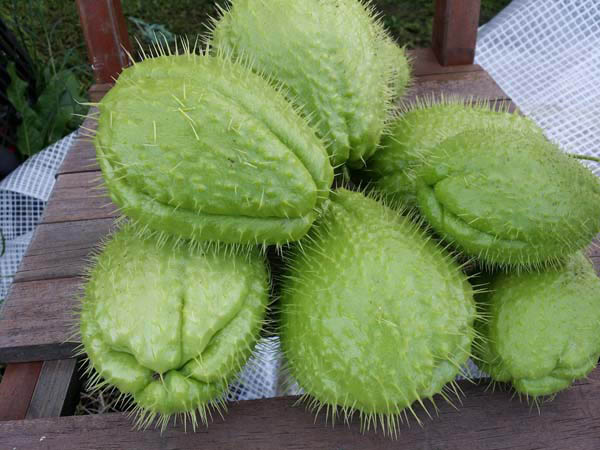
Towards the end, we were walking into the village of Carate Urio when we came across a table set up along the path and on which were placed two crates holding a dozen or so of these strange-looking vegetables – or were they fruits?

Source

My wife trained her iPhone camera on one of these vegetables (or fruits?) and promptly identified it. In Italian, it is called “zucca spinosa”, or spiny pumpkin. They were certainly spiny, but the relationship to pumpkins wasn’t immediately obvious. And being a pumpkin, it’s sort of both a fruit and vegetable: botanically a fruit but culinarily a vegetable given the way it is eaten (as we shall see in a minute). For the purposes of this post, I will henceforth refer to it as a vegetable.

Different parts of the world have different names for this vegetable. It’s called chayote in the US. Here we have a lady from Louisiana showing off two of them (although, reflecting that State’s French heritage, they are often called mirlitons there, as they are in nearby Haiti).

Source

The Americans have actually just borrowed the Spanish name for the vegetable; we’ll come back to the Spanish name in a minute.

It’s called chocho or chuchu or some variant thereof in places as varied as Mauritius, India, Sri Lanka, Brazil, and Jamaica. This is thought to be the Pidgin English version of chayote. Here we have a farmer in Assam with his crop of chocho.

Source

The vegetable is called choko in Cantonese (am I wrong in thinking that this ultimately derives from chocho?), which later became the name used in Australia and New Zealand thanks to the Cantonese who emigrated there in the 19th Century. Here we have an Australian proudly showing off the chokos growing in his garden (note that his variety is without spines).

Source

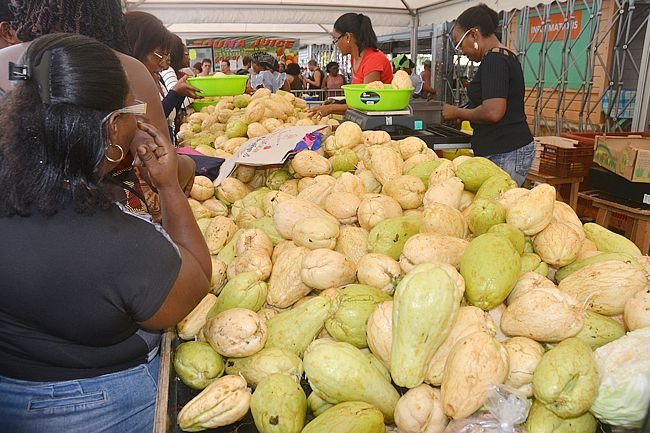
Meanwhile, in the islands of the eastern Caribbean, the vegetable is called christophine or christophene. Here we have early risers in a market in the island of Martinique searching for their choice christophenes.

Source

There are more names used for this spiny pumpkin, but the ones I’ve cited give us an indication of where it originally came from. It is one of those foodstuffs which make up the great Columbian exchange: that massive movement of foodstuffs, people and diseases which occurred after Christopher Columbus stumbled across the Americas. I’ve mentioned this exchange several times already in these posts, when writing about the prickly pear, the Jerusalem artichoke, vanilla, and turkeys. And now I can add to the list the spiny pumpkin, or christophene (which reflects the connection to Christopher Columbus), or chayote, which is a Spanish transliteration of the Nahuatl name chayohtli. In fact, modern studies indicate that the chayote was first cultivated in Mesoamerica, between southern Mexico (in the states of Oaxaca, Puebla, and Veracruz) and Honduras, with the most genetic diversity being present in both Mexico and Guatemala. Here, we have a field of chayote in Mexico.

Source

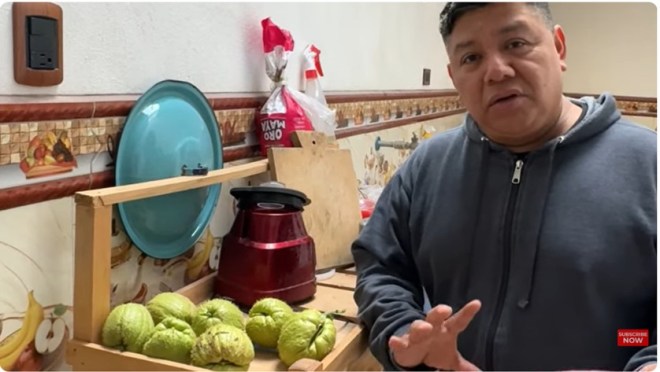
Just to finish my elongated riff on names, another name for the vegetable which is used in Guatemala and El Salvador is güisquil or huisquil, which is derived from another Nahuatl name for it, huitzli. Here we have a Guatemalan singing the praises of the güisquil.

Source

But to come back to my wife and me, standing in front of that table on the Via Verde. The vegetables’ anonymous grower was offering them for free to passers-by. I was hesitant, but my wife was bolder. She reminded me that we were having some old friends over for dinner the next day, why not try the spiny pumpkins out on them? But we don’t know how to prepare them, I objected. My wife waved off that objection, immediately doing a search on the internet. Hey presto, she found what sounded like a pretty easy recipe, explained in a video by a lady from Calabria in southern Italy, who mentioned in passing that the spiny pumpkin was particularly popular in her region – readers should note this link of the spiny pumpkin to Calabria, as we shall come back to it in a minute. My doubts brushed aside, we picked up five of these little spiny pumpkins and loaded them up in our rucksacks.

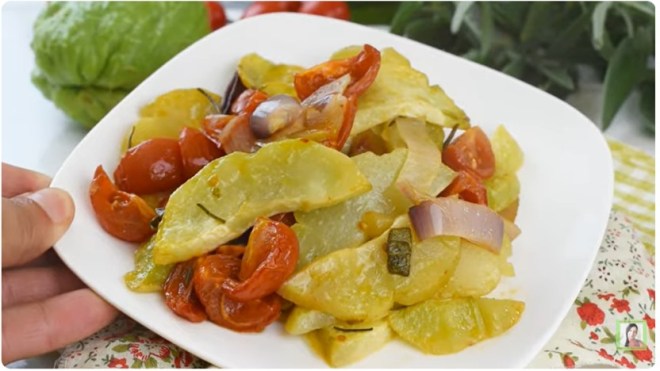
The next day, preparations started early. As recommended by the Calabrian lady, I peeled the pumpkins with a potato peeler – the spines were a little annoying but no more than that. Then I opened them up to take out the stone, after which I cut the halves into thin slices. Then I could start on the other two ingredients, tomatoes and onions. I divided up six large tomatoes, and sliced up one small onion (the recipe called for more but I’m not a fan of onions). At which point, I handed over to my wife, who threw all the ingredients into a big bowl, added the herbs, salt, and oil, and mixed everything up thoroughly. At the right moment, she ladled the mix out into a pan and put it into the oven for 40 minutes at 180 degrees Centigrade. I throw in a photo of what the result looked like – this is actually from the Calabrian lady’s video; we forgot to take a photo since we were so busy with preparations of the dinner.

Source

Because what we had prepared was a side dish. The main course, the pièce de resistance, was cotechino with lentils and mashed potatoes. Like that, if the side dish turned out to be a disaster, we still had the main dish to fall back on. Luckily, it all turned out well. When I carried in the side dish, I explained the whole back-story. None of our guests – three Italians and one American – had ever heard of zucche spinose (in the case of the Italians) or chayote (in the case of the American). We all tried the dish with a little trepidation, but luckily it tasted really good. To me, the spiny pumpkins tasted like a cross between zucchini and cucumber. They went well with the tomatoes.

We didn’t finish the dish, so my wife froze the remains. When we get back from Florence where we are at the moment (to see an exhibition on Fra’ Angelico), we’ll try it out on our son too.

I fear we’ll never make the dish again, unless our anonymous grower on Lake Como is kind enough to make next year’s crop available to passers-by, because you cannot grow spiny pumpkins in the north of Italy (except, as we have seen, in Lake Como’s microclimate). As a result, northern Italians have no culinary experience with it – which is why our three Italian guests, all from Milan, had never heard of it. Of course, we could travel down to Calabria. Because, I discovered, Calabria is a “hot spot” for the growth and consumption in Italy of the spiny pumpkin. This is a consequence of one of the many individual rivulets that made up the giant global flow of plants out of the Americas after the continent’s accidental discovery by Columbus. When, in 1502, the Spaniards took over the Kingdom of Naples, of which Calabria was part, they carried the spiny pumpkin from their new dominions in Mesoamerica to their new dominions in southern Italy. And the plant took particular root in Calabria.

But we can’t go to Calabria just to eat spiny pumpkin! I’ll have to come up with an exciting trip full of new things that we’ve never done before if I’m ever going to persuade my wife. I have one or two things in mind. There’s the Riace Bronzes in Reggio Calabria, which we’ve never seen. There’s some old Christian mosaics in a monastery up in the Calabrian mountains, mentioned by John Julius Norwich in one of his books, which we’ve never seen. I’ve got the whole winter to come up with some more things to see and do …

INCREASE THE CALCIUM INTAKE!

Vienna, 1 August 2025

That was a low point in my annual medical check-up: my calcium values. Going into the discussion of my lab tests with our doctor, my concern had been my ferritin levels. As I’ve written in an earlier post, these have been too high for a number of years, and this year was no exception. But now I also had a problem with my calcium levels! They’ve generally been low ever since I had my thyroid removed some 15 years ago. This year, though, the levels dropped below the minimum acceptable level. But, I protested, I’ve been taking calcium supplements every day for years. Ah, the doctor replied, but if you rely too much on supplements your body doesn’t work so actively to extract calcium from your food. You have to try to meet your calcium needs through the food you eat and only take supplements if you really cannot reach the necessary values through your food. To help me, she gave me a sheet listing various foodstuffs and their calcium content.

My photo

I started looking at it. Aha, I cried, I can greatly increase my calcium content by eating a lot of cheese! As I’ve noted in an earlier post, I have a great fondness for hard cheeses from the Alps. Ah no, the doctor said, I wouldn’t rely solely on cheese, that could well have negative impacts on your cholesterol level – and here she pointed at my cholesterol results, which did indeed come in a tad high this year. You’re damned if you do, you’re damned if you don’t, I thought to myself …

Once home, I glumly took out the sheet and started scanning it again. First thing to figure out: how much calcium do I need to ingest every day? A quick surf of the net shows some discrepancy here. The Europeans suggest 950 mg/day, while the Americans suggest 1,200 mg/day for oldies like me. Given the weakening of my calcium glands after the removal of my thyroid, I decided to use the higher American value as my target. But I immediately began to panic. How am I going to meet this high daily target?

Even a cursory look at the list clearly indicates that if I can’t gorge on cheese I will need to eat other milk products. The product with the highest levels of calcium is cow’s milk (“Kuhmilch”). So I could just drink five glasses of milk a day and Bob’s my uncle (but only low-fat milk; cholesterol levels! … damned if you do, damned if you don’t).

The milk industry has certainly been pushing milk drinking for decades.

Source
Source
Source
Source

But I really, really don’t like drinking milk! I stopped knocking back glasses of milk when I was a child. So I’ve decided that unless I have my back to the wall, I will just use milk as a support, adding it to the teas and coffees which I consume during the day; I will have very milky teas and coffees from now on.

What else? Well, I see that kefir has high levels of calcium, maybe I can eat loads of that. But what on earth is kefir? I’d never heard of the stuff before looking at the list. As usual, Wikipedia has come to the rescue. It tells me that kefir is a sour, slightly carbonated, slightly alcoholic beverage, with a consistency and taste similar to a thin, drinkable yogurt. Of course, I got caught up in the Wikipedia article and continued reading. I learned that kefir is prepared by inoculating milk (cow, goat or sheep milk) with so-called kefir grains, which ferment the lactic acid. These “grains” are quite intriguing. They are actually a mix of various type of bacteria and yeasts and look like this.

Source

It sounds like the milky equivalent to kombucha-making.

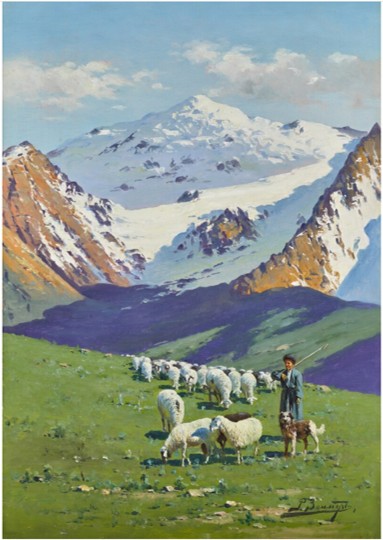
It seems that kefir was invented somewhere out in Central Asia; here is a painting of a shepherd in the Caucasus by a Russian artist.

Source

The Russians then adopted it (presumably after their conquest of Central Asia), and from there it spread to Central Europe – which no doubt is why I found it in our local supermarket in Vienna.

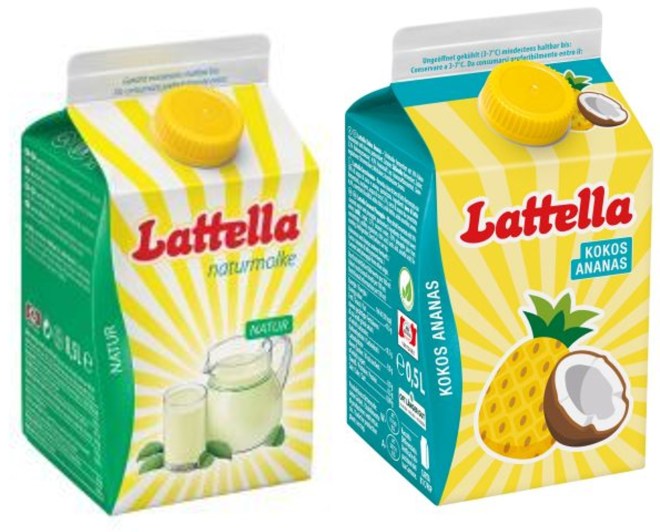
Could I drink this instead of milk? Not sure I could, at least not in its natural state – its sourness is not for me. However, I see that the local supermarket sells not only kefir in the natural state but also sweetened.

Source

That sounded good. But then I had a horrible doubt: what are these kefir drinks sweetened with? I have to control my sucrose and fructose intake! Or so my doctor told me a few years ago, to avoid becoming diabetic … damned if you do, damned if you don’t … I have made a mental note to check this.

Going back to the list, I see that something called “molke” in German has pretty high calcium levels. What is molke, though? Google Translate to the rescue! Molke, it turns out, is whey.

Whey … the only connection I have ever had with whey is through the nursery rhyme:

Little Miss Muffet
Sat on her tuffet,
Eating her curds and whey;
There came a big spider
Which sat down beside her
And frightened Miss Muffet away.

Source

Otherwise, I have never, ever seen hide nor hair of whey in my entire life. But contrary to kefir at least I know what it is, because I once wrote a post about cheese making for my daughter. Whey is basically the liquid that’s left over when you curdle milk, the curds going on to become cheese.

That’s all fine and dandy, but does my supermarket stock whey? It turns out that it does, either in natural form or sweetened.

Source

I have put it on my list of things to try (why I haven’t tried it yet will become apparent in a minute). In the case of the sweetened version, and for reasons I have just mentioned, I also have to check what it is sweetened with.

This was all very well, but how about some milk-derived product I can eat rather than drink? (apart from cheese, of course!) Well, looking at the list I have concluded that yogurt is the obvious choice, even if its calcium levels are somewhat lower than those in kefir and whey.

Yogurt is certainly a much-loved part of the cuisine of the countries running from the Balkans all the way east to the Indian subcontinent. Surely there could be some yogurt dishes for me in all those riches?

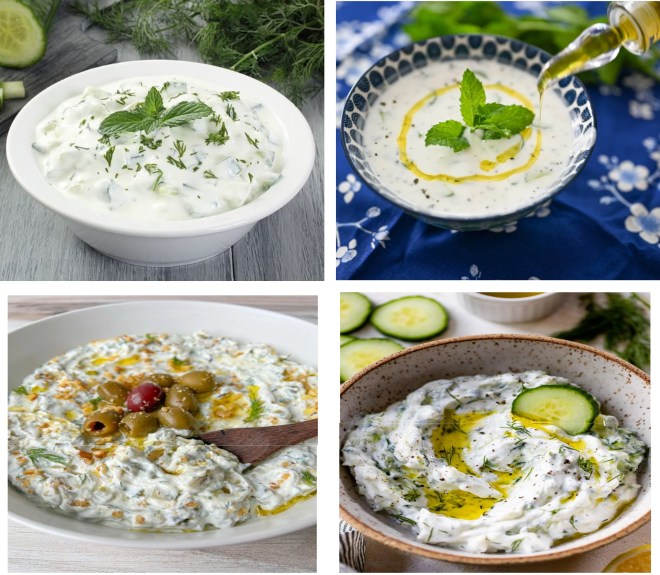
A quick whip around the internet has brought to light some intriguing possibilities. For instance, many of these countries have a “salad” where yogurt is a main ingredient, along with two other ingredients, cucumber and garlic. The Turkish version, called Cacik, simply adds mint to this trinity of ingredients. In the Lebanese and Syrian version, called Khyar bi Laban, mint is also added, but so is lemon juice. As for the Greeks, their version, which is called Tzatziki, uses the same four ingredients of Cacik (and derives its name from it) but then mirrors Khyar bi Laban by adding an acid to the mix, vinegar in this case rather than lemon juice. It goes one step further by adding dill and parsley, before drizzling the whole with olive oil. Even the Bulgarians have got into the act with a dish they call Snezhanka (which translates as snow-white salad – not surprising, given its dominant colour). It has the trinity of yogurt, cucumber and garlic. It has no mint, though, but it does – like the Greeks – include dill and (sometimes) parsley and a drizzle of olive oil.

Since these four salads all look rather similar, I decided to make a collage of photos of the four dishes, with Cacik in the top left followed, clockwise, by Khyar bi Laban, Tzatziki, and Snezhanka.


Source      Source      Source      Source

Were I to go for this dish – and I would have to see if my wife would follow me; it would be a bit sad to eat it alone – I would skip the garlic, for reasons I have given in an earlier post. I would also leave out the dill; I’m no fan of this herb. But I would, like some Bulgarians do, add roasted walnuts.

Many of these countries also have yogurt-based soups, which can be eaten either hot or cold depending on the season. Given that it is currently summer, I’ll start with some examples of cold soups. One of the simplest comes from Türkiye, where the Turks turn Cacik into a cold soup by using watery yogurt instead of a strained yogurt. Iranians have a similar soup, Abdoogh khiar, where yogurt and ice cubes are mixed together with cucumbers, raisins, salt, pepper and onions, the whole topped with some croutons made of Persian traditional bread. Bulgaria and other Balkan countries also have a similar cold soup, Tarator, where a watery yogurt is mixed with cucumber, garlic, walnut, dill, and olive or other vegetable oil. It can, like Abdoogh khiar, even be served with ice to really chill it. The peoples living in the border area between Azerbaijan and Iran eat a cold soup called Dovga, which, unlike the previous examples, does not include cucumber or garlic. Instead, the yogurt is mixed with a variety of herbs. These change seasonally and regionally, but usually will include coriander, dill, and mint; spinach can also be added. Cooks sometimes go one step further and add rice or chickpeas, or even meatballs, to the mix.

As in the case of the salads, and for the same reason, I show here a collage of these soups, with Cacik at the top left followed, clockwise, by Abdoogh khiar, Tarator, and Dovga.

Source      Source      Source      Source

Not surprisingly, all these soups can also be eaten warm in winter. Which allows me to introduce other yogurt-based soups normally eaten warm. Since we are in the Iranian-Azerbaijani border area, let me mention another soup from that region, Aash-e doogh. To the yogurt are added different kind of herbs (such as coriander, leek, tarragon, mint, and parsley), vegetables (such as spinach, purslane, chickpeas, peas, onion and garlic), but also lamb meatballs, eggs, rice, salt and several types of spices.

Source

There are many other types of yogurt-based soup, but I think we all get the gist: take yogurt, add the herbs you like, add some vegetables if you want, or pulses, and maybe if you’re feeling adventurous some eggs or meat. Again, before starting to make yogurt-based soups, I will have to see if my wife will follow me on this culinary adventure.

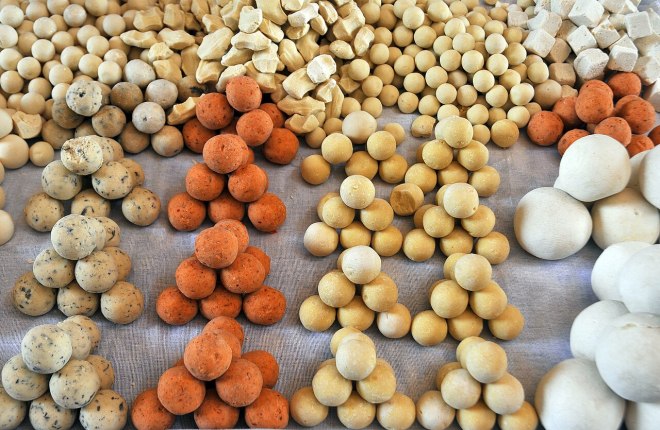
There’s a whole other variety of soups from this part of the world to which yogurt is added, but in a rather special guise: the yogurt is first turned into a form appropriate for long-term storage by fermenting and drying it, and maybe mixing it with other ingredients like crushed bulgur wheat. This is popular in the cuisines of Iran, the Caucasus, and Central Asia, and known variously as kashk, kishk, qurut, qurt, kurut, kurt, qqet, jameed, shilanch, chortan, aaruul or khuruud. Here is an example of the genre.

Source

A ball of this stuff can be crumbled into soups (among other dishes) to give them some whoomph. Fascinating as it sounds, I think I’ll probably give this particular culinary exploration a miss. I’m certainly not going to start drying and fermenting yogurt, and anyway taken this way I wonder how much calcium I would be ingesting – the whole point of this exercise. I’ll just limit myself to checking if a soup prepared this way is on the menu of the next Turkish or Iranian restaurant we go to in Vienna, just to see what it tastes like (I’m not sure I’ve ever seen an Azerbaijani restaurant in Vienna).

And then there are all the dishes from the Indian subcontinent made with yogurt! They all sound incredibly delicious but require many ingredients that I would be hard-pressed to source in Vienna (or in Milan, for that matter). I’ll just mention one dish – a drink actually – from that part of the world, and that is lassi. My wife and I discovered the sweetened version of lassi several decades ago, during an outing to an Indian restaurant, and ever since we always look for it on the menu of Indian restaurants we go to. The yogurt has to be thin enough to drink, and it is sweetened with sugar and flavoured with mango or other fruit juice. Delicious!

Source

I think I could just about manage to prepare this – although I would need to use sweetener rather than sugar.

This is all in a possible future. In the here and now, I’m eating yogurt the way I’ve always eaten it, sweetened. My wife and I have just come back from Los Angeles, where we were visiting our daughter, partner, and grandson. We arrived there shortly after that fateful visit to the doctor (which is why I still haven’t tried some of the possibilities I’ve mentioned earlier). She is very interested in nutrition and came up with a yogurt-based calcium bomb: a big dollop of low-fat yogurt (good for the cholesterol levels!), seasoned with blueberries (good for the ferritin levels!), sprinkled with a generous dose of chia seeds, and sweetened with artificial sweetener. It doesn’t look all that great but it’s really quite tasty.

My photo

The key to this mixture is the chia seeds. My daughter discovered that these seeds are absolutely packed with calcium, at levels five times higher, gram per gram, than yogurt! In fact, nuts and seeds – particularly seeds – are generally good sources of calcium, as readers can see if they go back to the sheet the doctor gave me (under the section entitled “Nüsse, Samen”).

Source

Well, that’s a turn up for the books! I’m quite partial to nuts and am pleased to now have a good excuse to munch on them (although they also contain quite a lot of fat – cholesterol levels! … damned if you do, damned if you don’t). Seeds are even better, calcium-wise, than nuts, although I don’t see myself putting a fistful of seeds into my mouth; they’ll have to be added to something else. Looking at that list of nuts and seeds, I see that “Mohn” has very high levels of calcium, even higher than chia. What is this mohn? Time to wheel out Google Translate again! And it turns out that mohn are poppy seeds! Well now, that is interesting! I know that poppy seeds are a popular ingredient in Austrian cuisine and the cuisine of Central Europe more generally. I’ve eaten them sprinkled on pastries or cakes.

Source

Now that I’m back in Vienna, I need to see if I can buy poppy seeds in large quantities. If I can, I’ll have them take the place of the chia seeds in my daughter’s yogurt concoction – think global, act local!

I can’t just eat yogurt, though, to maximize my calcium intake. What else could I eat? Well, I can forget about meats and fish as significant sources of calcium; there’s so little calcium in them that they’re not even on the list. My daughter said I could eat the bones of fish when they’re small, but once, when I was a boy, I got a fish bone stuck in my throat, such an unpleasant experience that I keep as far away as possible from fish bones. Fruits aren’t brilliant either. As for vegetables, a few stand out as having a good amount of calcium: fennels, broccoli, green cabbage, and chard (“mangold” in German).

Source      Source      Source      Source

I’m pleased to see that fennels pack a good calcium punch; I’m very fond of this vegetable, as I’ve related in a previous post. I’m also extremely fond of chard, about which I’ve written enthusiastically in the past. It makes me think that other greens like beetroot greens, kale, and spinach might also be full of calcium; to be checked (but what about the iron they also contain? Ferritin levels! … damned if you do, damned if you don’t). Broccoli is also a favourite of mine, as long as it is steam-cooked. I’m doubtful about green cabbage, though; I find it too bitter to eat raw and it smells too much when cooked. Maybe red cabbage, which I will gladly eat raw in salad, also packs a good calcium punch? I will need to check; Savoy cabbage, for instance, which is on the list (“wirsing kohl” in German), has much lower calcium levels than green cabbage.

Well, it’s now time to create meals around all this that give me enough protein, that don’t exaggerate on the carbs and fats, that give me the calcium I need, that give me lots of polyphenols to help control my ferritin levels but at the same time don’t exaggerate on the iron, … It’s like solving a multi-dimensional algebraic equation. Let’s see what we can do.

ALEXANDERS

Milan, 23 April 2025

It was an article in the Guardian that started me off on this post. The writer was describing an expedition of his into the countryside in Kent to go foraging. He mentioned having seen dandelion, common sorrel, lady’s smock, stinging nettle, goosegrass, reedmace … plants I have never eaten; in fact, apart from dandelion and stinging nettle, I’ve never even heard of them. The writer goes on:

“Further along the hedge, the large glossy leaves of alexanders stand in ragged clumps above the dull, wintered sward; yet another superb edible and the main reason for my visit. This plant, most likely introduced by the Romans, comes from the Mediterranean where it was once known as Petroselinum Alexandrium – the parsley of Alexandria. Like many members of the carrot tribe, they present a huge amount of culinary potential – all parts of the plant can be eaten, offering complex floral flavours and harmonising notes of bittersweet. The root is particularly delicious, something akin to a fragrant parsnip once roasted. … I get to work harvesting a few alexander crowns, the burgeoning flower stems still sheathed in soft green leaves. Later I’ll roast them with feta and sun-dried tomatoes, returning the unmistakable smell of spring fare to the kitchen.”

I have to admit to also never having heard of alexanders, let alone eaten it. In the face of such ignorance, I might have moved on to another article in the Guardian were it not for the fact that something in the article’s description – the mention of a Mediterranean origin perhaps? – intrigued me, and I decided to investigate.

The first thing I did was to pull up some photos of this plant, because I had no idea what it looked like. Here’s a nice example of what I found.

Source

As I studied this and other photos, I said to myself “hang on a minute, I think I’ve seen this plant recently. Wasn’t it at some point half choking the path on that last hike we did?” This was in Liguria, when my wife and I were taking the high path which snakes along the contours of the hills between Sori (where we have our apartment) and Recco (where we were going to eat focaccia al formaggio). As always, I turned to my go-to source, Wikipedia, for further information. I was not disappointed.

Let me start with a map of the plant’s current distribution.

Source

It seems that it can be found throughout Italy and Greece, as well as much of the UK and Ireland. Otherwise, it is more of a coastal plant. So there is a good chance that what I saw on that walk was alexanders. There is some discussion as to whether, as suggested by the writer of the Guardian article, this is a Mediterranean plant which was brought to the UK and elsewhere in Northern Europe (the Romans being a popular possible vector as far as the UK is concerned) or whether it is actually native to all the places in Europe where it is currently found.

I’ll leave that question to the experts to hash out. What caught my eye in the Wikipedia entry instead was a sentence: “Inland [in the UK], it is often found close to the sites of medieval monastery gardens and other historical places such as castles.” And suddenly, a vision of Brother Cadfael working his herb garden floated up in my mind’s eye. For any readers who might not be familiar with Brother Cadfael, he is the main character in twenty books set in a Benedictine monastery in Shrewsbury, England. The stories take place between the years 1135 and 1145, and have Cadfael solving all sorts of murders and other Medieval mayhem. He is also the monastery’s herbalist, making up medicines for sick monks, using herbs he grows in the monastery’s herb garden where he grows the plants he needs to make up his potions. I throw in a photo of the cover of the 20th book in the series, where he seems to be in his herb garden.

My photo

I have to say, I’m extremely fond of the Cadfael stories. As the photo intimates, I have all twenty of the series. I’m not so fond of the TV show starring Derek Jacobi as Cadfael. Normally, I’m a great fan of his, but this show didn’t really grip me.

In any event, I throw in here a painting by Fra Angelico showing monks at work on their garden.

Source

I don’t know if Cadfael would have grown alexanders in his herb garden. The plant was mostly grown to eat, but Wikipedia does say that it also had therapeutic uses. So I’m happy to think that his herb garden would have contained alexanders.

Another sentence in the Wikipedia entry caught my eye: “It was once highly valued in northern Europe as an early vegetable: one of the few fresh plants that can be eaten in February or March”. If it was so highly valued, what happened? Well, it seems that in the 18th Century (or maybe even in the century before that) it lost out to celery. John Evelyn (whom I’ve had cause to mention in an earlier post) had this to say in his book Acetaria. A Discourse of Sallets [Salads] published in 1699: “Sellery … was formerly a stranger with us (nor very long since in Italy) [It] is a hot and more generous sort of Macedonian Persley [Macedonian parsley being another name for alexanders] … and for its high and grateful Taste is ever plac’d in the middle of the Grand Sallet, at our Great Men’s tables, and Praetors feasts, as the Grace of the whole Board”. The Wikipedia entry confirms (in slightly more sober language) this similarity in taste between alexanders and celery, at least as far as the leaves are concerned: “the young foliage is intermediate in flavour between celery and parsley”.

And so, abandoned by monk and lord of the castle, domesticated alexanders went feral, spreading out from the old monastic and aristocratic herb and vegetable gardens into the surrounding countryside. I suppose in the UK in particular the tidy plantings of alexanders in monastic gardens were victim of Henry VIII’s dissolution of the monasteries in the late 1530s, which left behind only a few ruins like this one, of Byland Abbey in Yorkshire.

Source

(I chose this particular ruin because it happens to be down the road from my old school; I did some very basic archaeological mapping there but don’t remember ever seeing any alexanders).

Is there any chance of seeing alexanders back on our plates? Well, Wikipedia holds out some hope: “It … has found some renewed use in exotic “foraged” food recipes and restaurants.” A first, timid step to its journey back onto supermarket shelves next to celery, perhaps. Maybe I should forage it and try it. But the Guardian article does contain a warning: “care must be taken with identification … [nearby] hemlock water dropwort is growing in great profusion. This deadly relative and a half-hearted imposter of alexanders is easy to distinguish with experience … but surviving long enough to gain such confidence requires a little care”. That makes me gulp. Right now, I think I’ll just take photos of the plant, like this one I took recently on a hike on the Monte di Portofino starting from San Rocco.

My photo

BREAD

Sori, Easter Sunday 2025

I suppose every person on this planet will rave about a foodstuff made from the grain which got domesticated in their corner of the planet. I’ve seen Chinese and Japanese go misty-eyed about various rice-based foodstuffs.

Source

I’m sure Central Americans do the same for foodstuffs made with maize.

Source

Or Africans for foodstuffs made with sorghum.

Source

Because my roots are in Europe, where wheat reigns supreme, I go dreamy about foodstuffs made with wheat, a grass that was domesticated in the Middle East. And I go very dreamy about one particular foodstuff made with wheat: bread.

Source

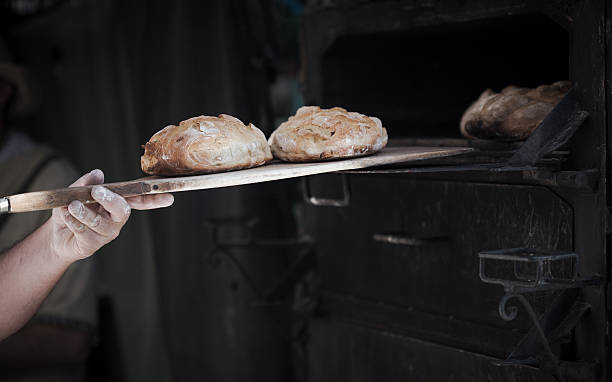
Aaah, that wonderful smell that emanates from local bakeries!

Source

I remember still the delicious scents that wafted out of a bakery in Edinburgh, where I was a student in the early 1970s. It was halfway between my halls of residence and the hall where I was rehearsing plays with the university’s drama society. I would whizz by that bakery on my moped, passing through this cloud of deliciousness.

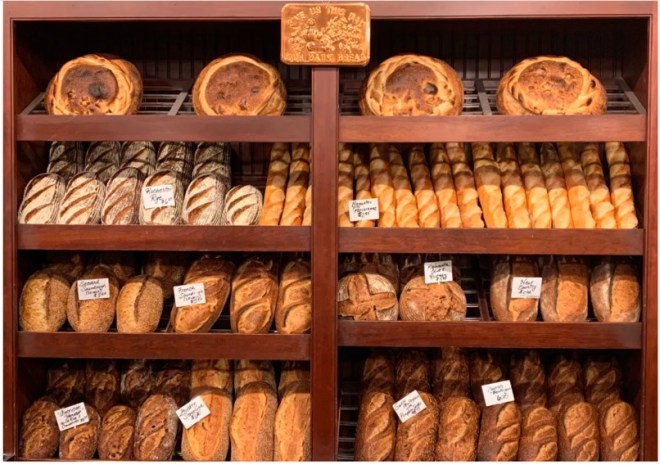
And the wonderful smell that will greet you as you step into a local bakery’s shop and are confronted by rows of freshly baked loaves!

Source

And the delicious taste as you sink your teeth into a loaf still warm from the oven!

Source

And even when the bread is cold the wonderful taste it will have after you’ve used it to mop up the sauce on your plate.

Source

Or the way it will heighten the taste of a hunk of cheese.

Source

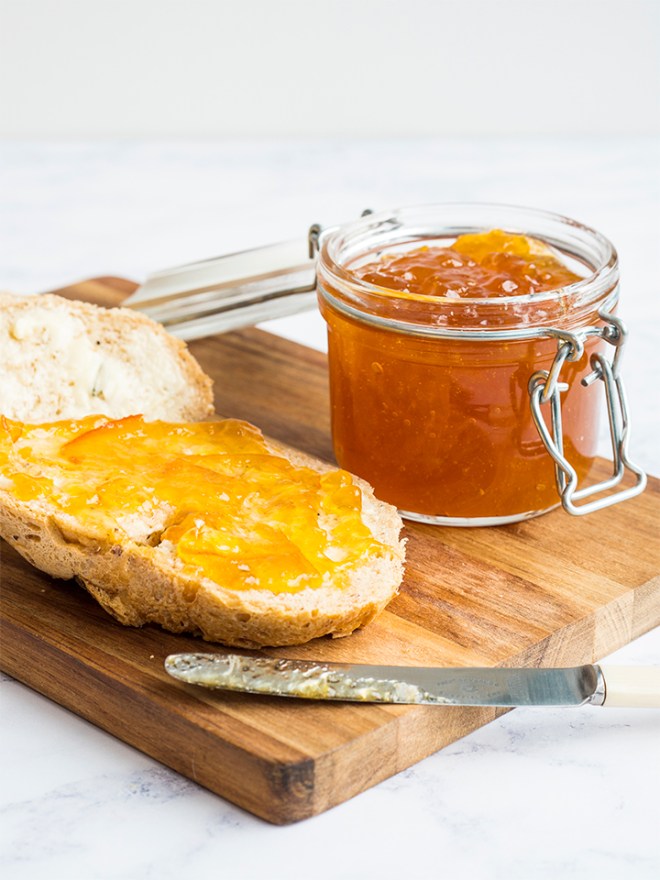
Or of the butter and marmalade you’ve spread onto it.

Source

Mm, yes, bread … (I should note in passing that my heightened appreciation of bread comes from the fact that I eat little of it now – the diet, you know …)

It seems that we have the Ancient Egyptians to thank for these sensory wonders. It is the leavening of bread with yeast that gives bread that very special smell and taste.

Source

And leavening is a discovery the Ancient Egyptians stumbled across. Quite how they did so is a matter of lively debate, at least in certain circles. The theory I most approve of (although no-one is asking for my approval) suggests a serendipitous cross-over from beer making. The making of beer was (and of course still is) another yeast-aided process working on a mash of grains from another grass domesticated in the Middle East, in this case barley. The theory goes that some Ancient Egyptian involved in the making of both unleavened flatbread and beer accidentally splashed some of the beer’s yeast-laden froth (which goes by the delightful name of barm) onto some dough they had prepared. Then for some reason they left the dough to rest for a while (maybe it was evening). When they came back, they saw that the dough had risen. Instead of throwing it away as spoilt, they baked it anyway (maybe supplies of food were limited and they were hungry), and they saw what a marvel resulted.

It can’t have been that simple, there must have been a lot of tinkering after that first leavening of bread, but this story satisfies my fervid imagination. Here, we have small models showing the making of bread, which Ancient Egyptians placed in a tomb, presumably to ensure that the dead person would get to eat bread in the afterlife.

Source

Here we have a similar set of small models from another tomb, showing the brewing of beer.

Source

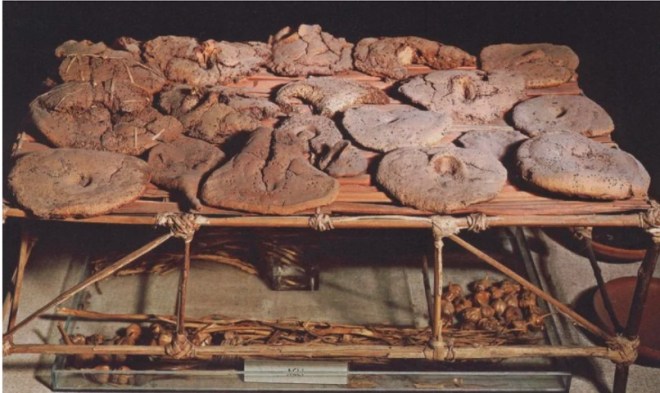
And here we have some real Ancient Egyptian bread loaves found as grave goods.

Source

I grant you they don’t look terribly edible, but they have been sitting in a grave for several thousands of years after all.

At some point, someone – yet again an Ancient Egyptian, I’m thinking – came up with the idea of keeping back a piece of the leavened dough to inoculate the next batch of unleavened dough. And at some other point, I’m guessing also in Ancient Egypt, leavened dough got contaminated with lactic acid bacteria. Maybe the bacteria were on the hands of the people kneading the dough; they had picked them up touching milk products. Or maybe another pathway came into play. However the contamination occurred, it led to the creation of sourdough; it is these bacteria that give sourdough bread its characteristic sour taste. And so nearly all the pieces were in place for the making of sourdough bread for the next five millennia or so – because until the middle of the 19th Century sourdough bread dominated bread making with wheat.

The last piece of the puzzle was the baking oven. It seems that we have the Ancient Greeks to thank for that. What they came up with must have looked quite similar to the wood-fed ovens which any self-respecting pizzeria will install today.

Source

The cupola shape of these ovens concentrates the heat radiating from the bricks onto the oven’s centre, making it more efficient (and thereby lessening the chore for our ancestors of having to go out to collect wood). And progress in oven-building meant that large ovens could be built, in which multiple loaves could be baked at the same time. Thus was born the profession of the baker (which, among many other things, eventually led centuries later to that delightfully ridiculous nursery rhyme “Rub-a-dub-dub, three maids in a tub, And who do you think were there? The butcher, the baker, the candlestick-maker, And all of them gone to the fair”).

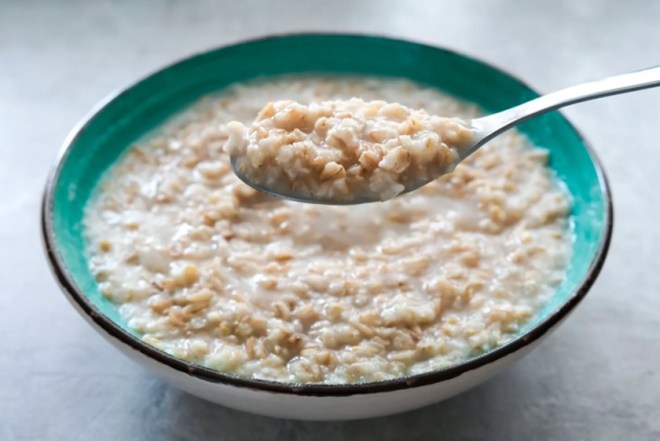
The Ancient Greeks seem also to have taught the uncouth Romans to eat leavened wheat bread. In fairness to the Romans, they weren’t really that different from anyone else in this uncouthness. Originally, they baked flatbread with their grains, or simply ate them in gruel like our Neolithic ancestors had done – but also like many, mostly poor, people have done ever since. I don’t claim to be poor, but the only way I eat oats – another of the grasses domesticated in the Middle East – is as a viscous gruel known to all and sundry as porridge.

Source

And the Italians have what is now a chi-chi dish, zuppa di farro, which originally was just a gruel made with grains of spelt, an early form of wheat which has now all but disappeared.

Source

However, once introduced to the joys of leavened wheat bread, the Romans got into it with a vengeance. And of course evidence of this new enthusiasm of theirs came to light in the ruins of Pompeii, in the form of now burnt loaves of bread abandoned in the town’s bakeries as Mount Vesuvius erupted and the workers ran for their lives.

Source

Perhaps it had already happened elsewhere, but certainly in Rome class reared its ugly head in the matter of bread eating: bread made with the most refined, and so costly, wheat flour, was eaten by the rich, while the poor made do with bread made with poorly sifted whole wheat flour or even a mix of wheat flour and the flour of other grains like barley or oats. That translated into a colour bar: the crumb of the most expensive bread was white while that of the least expensive bread was various shades of brown.

Source

It’s ironic, really, that the rich were eating the nutritionally poorest bread … But at least they were eating other things which could make up for the loss of nutrition in their expensive bread. The poor, on the other hand, had little but bread to eat. Which is why already from the times of the late Republic the Roman governing class was handing out free or subsidised wheat to the poor in Rome, to keep them happy – and politically passive. The Roman poet Juvenal decried this in one of his Satires: “Already long ago, from when we sold our vote to no man, the People abdicated their duties; for the People who once handed out military command, high civil office, legions – everything, now restrains itself and anxiously hopes for just two things: bread and circuses” (it’s a comment that George Orwell updated in his novel 1984 when he described “the Proles”: “Heavy physical work, the care of home and children, petty quarrels with neighbours, films, football, beer and, above all, gambling filled up the horizon of their minds. To keep them in control was not difficult.”)

Fast forward another thousand years or so and we are in Europe’s Middle Ages. The rich were still eating white bread and the poor brown-to-black bread, and bread was still the most important part of the poor’s diet. So nothing much had changed. But if I pause here, it’s because of a very interesting habit we find in rich households regarding tableware. Basically, bread was not just a food, it was also used as a plate. A round piece of, often stale, bread was cut from a large loaf – hence the English name of this tableware, trencher, from the French “trancher”, to cut. The food was ladled onto the trencher, which would absorb any juice or gravy. The illustration below shows trenchers being prepared. It comes from “Les Tres Riches Heures du Duc de Berry”, a prayer book put together during the first half of the 1400s for the said Duke, who we see sitting at the table.

Source

Once the food had been eaten, the trencher, now softened, was cut up and also eaten.

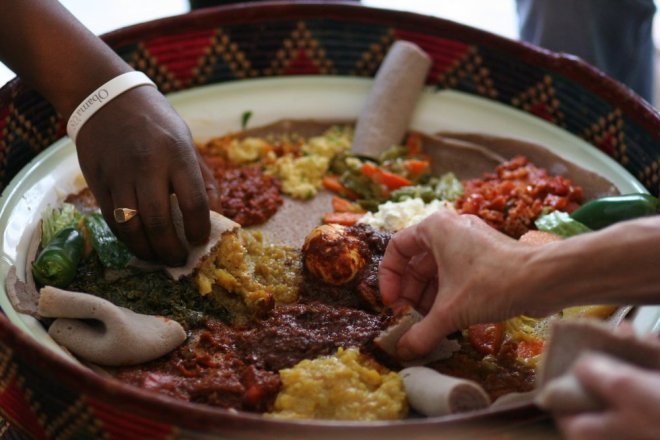
I find this a wonderful way of eating bread. It’s sad that trenchers began to be made of metal or wood, later to be replaced by the plates we are all familiar with today. The only culture that I know of which uses bread in this way is that of the Ethiopian Highlands, where the food is placed on injera, made with flour from the local grain, teff (although, as this photo shows, nowadays the injera is in turn placed on a plate).

Source

Injera is also used as the utensils to pick up the food.

Source

But back to the bread trencher, where there was a similar relation between rich and poor as there had been in Rome over free supplies of bread. If the harvests had been good, if food in the household was plentiful, if the lady of the house was feeling generous or pious, rather than being eaten the used trencher could instead be given to the poor for them to eat. Or it could be fed to the dogs (which is what the Duc de Berry’s servants seem to be doing in the bottom right-hand corner of the illustration). I suppose when supplies were tight and household ate their own trenchers, the poor were just left to starve.

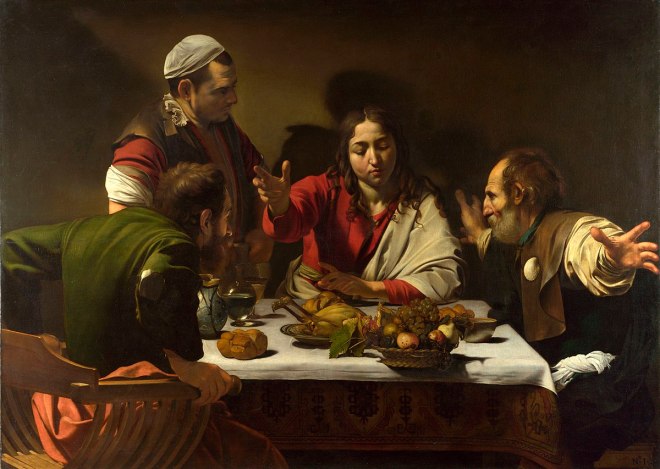
Bread had now also taken on strong religious overtones in Christian lands, because of the role which bread played in the Last Supper. Many are the paintings of the Last Supper, probably the most famous being the fresco by Leonardo da Vinci. But I won’t show a photo of that fresco. It’s too well known, and anyway you can hardly see anything, it’s in such a bad state of conservation. I’ll throw in a painting by Caravaggio instead, and not of the Last Supper but of the Supper at Emmaus. As recounted in St. Luke’s Gospel (in the King James Version):

And, behold, two of them went that same day [the day of the resurrection] to a village called Emmaus, which was from Jerusalem about threescore furlongs. And they talked together of all these things which had happened. And it came to pass, that, while they communed together and reasoned, Jesus himself drew near, and went with them. But their eyes were holden that they should not know him. … And they drew nigh unto the village, whither they went: and he made as though he would have gone further. But they constrained him, saying, Abide with us: for it is toward evening, and the day is far spent. And he went in to tarry with them. And it came to pass, as he sat at meat with them, he took bread, and blessed it, and brake, and gave to them. And their eyes were opened, and they knew him; and he vanished out of their sight.

Source

You can see the bread loaves Jesus is blessing on the table in front of each of them (I should note in passing that my timing here is excellent, today being Easter Sunday, the day this meeting in Emmaus would have taken place).

The formal theme of Caravaggio’s painting might be religious, but what I see in it is companionship: the Latin roots of the word “companion” are cum and panis, “together with bread”. I find it deeply satisfying that bread was considered not just a food but also a strong binder of friends.

And so we whizz on through the centuries, to stop again at the International Exposition of 1867, which was held in Paris.

Source

It was here that Austria presented the first breads made not with sourdough but with much purer strains of yeast uncontaminated with lactic acid bacteria (later known as baker’s yeast). I will show just one of these breads, the Kaisersemmel, for the simple reason that I eat this from time to time during our sojourns in Vienna.

Source

Many people tried the Austrians’ bread at the Exposition and liked it. Why? Because it tasted “sweet”; it didn’t have that characteristic sour taste of bread made with sourdough. This new, exciting way of making bread, the so-called Vienna Process, caught on. And so, perhaps without anyone really noticing, a fundamental shift started taking place for the peoples in Europe, North Africa, and the Middle East who ate leavened wheat bread: they slowly abandoned the sourdough bread which their ancestors had eaten for thousands of years for “sweet” bread. Today, sourdough bread is a niche product.

Was the switch away from sourdough bread a tragedy? I don’t think so. But then, I like sweet bread. I’m quite partial to a Kaisersemmel, for instance, and I will kill for a warm, crusty baguette.

Source

What was definitely a tragedy was the tinkering that went on from the mid-180Os onwards to find ways to make bread faster. “Time is money!” we are told, and never was this aphorism truer than in breadmaking. Making a loaf of sourdough bread takes 24 hours or more from start to finish. Anything to speed this up meant more loaves could be made, and sold, every 24 hours; already the Vienna Process was faster than the traditional method. This tinkering eventually led the British to invent the Chorleywood bread process in 1961. Without going into the technical details, this process can make a loaf of bread from start to finish (sliced and packaged) in about three and a half hours. It results in this hideous kind of product.

Source

A soft, limp crumb, a miserably thin crust, a thing that you don’t need teeth to eat. Dreadful. The only thing it’s good for is to make toast, which probably explains why toast is so popular in the UK.

Source

And so we have followed the rise – literal as well as metaphorical – of leavened wheat bread and its fall into limpness, softness, and general yuckiness. Luckily, it seems that there is a revival of Real Bread, sourdough bread. Rise (again) Sour-dough!

Source

A LOMBARD CHRISTMAS DINNER

Milan 31 December, 2024

It is a sad fact of life that most of the time we fail to follow through on our New Year’s resolutions. I am no different. In fact, I have such a dismal track record on this topic that I stopped many years ago making these resolutions – I did not want to add so many paving stones to my private road to Hell.

Source

But there is one end-of-year resolution on which my wife and I seem to be holding the course, one I explained in my first post of this year. Summarizing quickly, the two of us decided that we – and any children or grandchildren who may be visiting – would, for a period of eight years, use the traditional Christmas lunch or dinner to honour our mixed genetic pool: Puglia and Lombardy: the heritage of my wife; Burgundy, England, Scotland and Norway: my heritage; – and, if we are still around, Ireland and the old Pale of Settlement: the heritage of our son-in-law. Specifically, for each of those eight years, we would cook a typical Christmas lunch or dinner from each of these regions.  I decided to start at the southern end of the genetic pool and move north, so last year we cooked ourselves a Christmas lunch from Puglia, which we shared with our son.

Contrary to previous attempts, we did not forget this resolution, and so this year now found us cooking a typical Christmas dinner from Lombardy, which we shared again with our son as well as with his girlfriend. I’m so proud that we managed – at least this year – to keep to the resolution, that I’ve decided to share this year’s menu with my readers.

We started with ravioli in brodo. As far as I can make out, each province in Lombardy has its special type of raviolo, but we didn’t get that subtle. We just took a packet of ravioli stuffed with braised meat which was being sold in our local supermarket, and we cooked them in a chicken broth made with cubes. Since we are most definitely not part of the Instagram generation, we have never got into the habit of taking photos of the food we eat. We just wolf it down and then say “damn, we should have taken a photo”. So I throw in a photo I found on the internet to give readers an idea of what we were eating.

Source

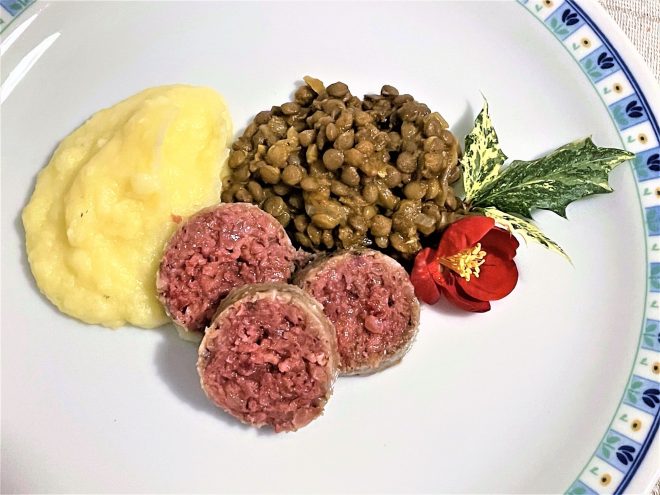
Next, as the main dish we had cotechino with lentils and mashed potatoes. I throw in another photo of this dish from the internet.

Source

I refer any of my readers who wish to know more about this typical Lombard dish to a post I wrote several years ago, where I go into probably too much detail about it; I have no desire to repeat myself here.

For dessert, we had that great, that splendid, Lombard delicacy, the panettone. I’ve also covered this miracle of Lombard cuisine in an earlier post, so I won’t go into further details here. I just refer my readers to that post and throw in a photo of a slice of panettone. I deliberately chose a photo which shows a large dollop of mascarpone, because for the first time ever, we had our panettone with mascarpone.

Source

We decided to add mascarpone because we read that the Lombards are known to slather this extra bit of yumminess onto their panettone during the Christmas season.

Since I’ve never mentioned mascarpone in any of my previous posts – for the simple reason that we hardly ever eat it – let me use this occasion to say a few words about it. It’s a Lombard cheese, originally from the area around Lodi to the south of Milan. Like cotechino, it used to be made with the left-overs from the production of more remunerative dairy foodstuffs, in this case cheeses. It is a smooth, spreadable cheese, with a an ever so slight sweet taste to it and a hint of the aroma of cream.
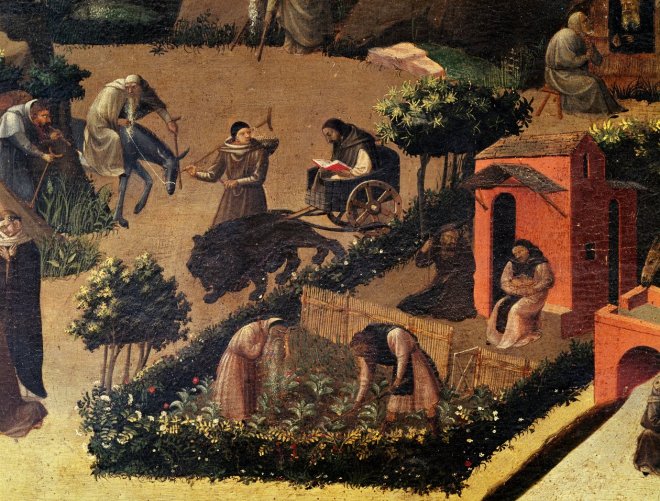
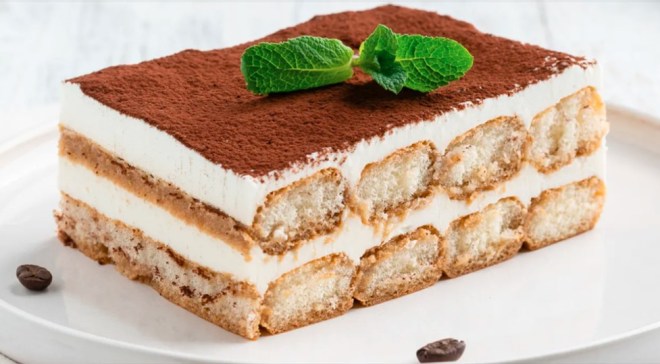
Mascarpone is now well-known worldwide because it is one of the main ingredients in the famous tiramisù – which, I was surprised to learn, is a very recent creation, from the 1960s, with its place of birth being somewhere in the Veneto or Friuli-Venezia-Giulia regions of Italy.

Source

Mascarpone is actually used in tiramisù in the form of crema al mascarpone, which is a mix of a syrup of sugar, egg yolk, and mascarpone. This is but one variant of sweetened mascarpone which Italians have been eating since at least the 1400s and possibly earlier.

If I am dwelling a little on crema al mascarpone it’s because I have a horrible doubt: should we have eaten our panettone with crema al mascarpone rather than just with mascarpone? Both ways are promoted by different sites on the internet. I have to say, my wife and I found that mascarpone alone combined well with panettone. But might crema al mascarpone have combined better? There’s only really one way to find out – make (or buy) crema al mascarpone and slather it on a couple of slices of panettone. Something to work on next year.

Of course, there wasn’t just food. There were wines, too! Staying in theme, we chose two Lombard wines, a red and a white. The red was a Bonarda, one of the sparkling red wines that are common in the north and centre of Italy. This is a topic I’ve covered in an earlier post, so any readers interested to find out more about this intriguing family of sparkling reds can go there. Here, I’ll just insert a photo of some of the vineyards where Bonarda’s grapes are grown.

Source

As for the white wine, we chose a Lugana, whose grapes are grown on the far eastern edges of Lombardy, looking over the southern shores of Lake Garda.

Source

I suppose we could have finished with some digestivi or some grappa made in Lombardy, but we left it at that. Sometimes, especially at our age, one can have too much of a good thing and spend the night regretting it.

So that’s Lombard Christmas dinner done! Next year, we venture into a Burgundian Christmas lunch – or maybe a Beaujolais Christmas lunch, if there is a difference; my mother was specifically from Beaujolais. We shall see, a happy year of research awaits me.

Happy New Year to all my readers! May 2025 bring you and your families peace and happiness.


LENTILS FOR MY FERRITIN LEVELS

Milan, 4 November 2024

It is a sad fact of life that as one gets older, the machine that is our body begins to falter. Machine parts begin to show signs of wear and tear, leading to unfavourable results in blood, urine or other samples of our vital fluids. One such unfavourable result which has been dogging me for a number of years is the levels of ferritin in my blood. My old doctor had been monitoring it, and shortly before he retired he decided that the time had probably come for me to do some regular blood-letting to bring the ferritin levels down. Luckily, the liver specialist which he sent me to – high ferritin levels being normally due to some malfunction in the liver – didn’t agree, recommending continuing monitoring. At which point, I decided to see what I could do to bring down my ferritin levels naturally, through my diet. I had already pretty much completely eliminated red meat, which is high in heme iron. That was pretty sad, but I comforted myself with the thought that it was good for the planet. My daughter found a scientific article online, which recommended a diet high on berries, especially blueberries, and the liberal use of cocoa powder – it seems that the polyphenols which these contain can help bring ferritin levels down. I did that for several months and then did the blood tests again. There was a modest decrease in my ferritin levels. I asked my new doctor what else I could do. She suggested imbibing lots of tea and eating lots of pulses – they, too, contain high levels of polyphenols. Well, my wife and I are already regular tea-drinkers, carrying on a fine British tradition.

Source

So I didn’t see much scope for improvement there. Pulses were a different story. Quite frankly, we don’t eat many of those; we’re not terribly, terribly fond of them. We’ll eat pasta e fagioli once or twice a year, normally when winter sets in; this particular version has used penne rigate and cannellini beans.

Source

And come Christmas time, we’ll often have ourselves a popular Christmas dish in northern Italy, cotechino e lenticchie, a type of sausage with lentils. I’ve already covered this dish exhaustively in a previous post, so I won’t say any more here. I just invite readers to drool over this photo.

Source

That is pretty much the sum total of our annual pulse intake. After some discussion, my wife and I agreed that I could go with lentils. I quite like lentils in salad, so I’ve been regularly eating a lentil salad for lunch and dinner. But I fear I’ll get rather bored with having this all the time, and might need to branch out. What other lentil dishes could I try?

Well, for starters, I could eat nice mixed salads like this one, of fennels and lentils.

Source

But that is really just a modest change to the original dish. What else?

Well, given that the original wild lentil plant comes from the Middle East and was domesticated there (like so many of our foodstuffs), I’m thinking I should start by looking there for a lentil dish I could try. And in fact, it so happens that there is a very popular lentil dish in the Middle East which goes by the name of mujaddara. It’s a very simple dish: it’s a mix of lentils and rice, with a topping of caramelised onions. You can season it with cumin, mint, or coriander (although I would skip the coriander, which I don’t like).

Source

It’s considered a poor person’s dish, but if you’ve got money to burn you can add meat to the mix. The dish is generally served with a side of yoghurt or a salad.

Going off on a tangent, I’m blown away by the etymology of the dish’s name. Mujaddara means “pockmarked”, a reference to the look of the dish, brown lentils pockmarking the white rice. It would be nice to think that whoever came up with this name was thinking of a face pockmarked by bad acne, but I rather fear that they were referring instead to pockmarks caused by the dreaded smallpox, like in this recreation from earlier centuries.

Source

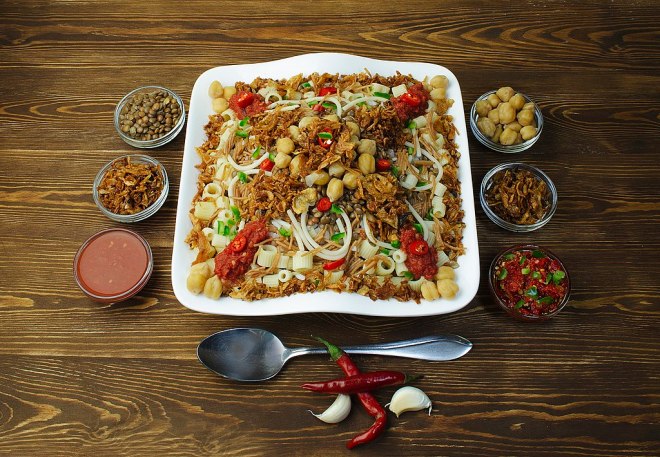
But back to mujaddara. I have to say, I’m intrigued by the Egyptian variant, koshari. To the rice, lentils and caramelised onions, the Egyptians add pasta (macaroni or vermicelli), and tomato sauce. You can make it even more complicated, by adding other odds and ends as this photo shows.

Source

In all of this, it’s the tomato sauce that attracts me, I’m a great fan of the tomato in all its forms. But this is not the type of tomato sauce I’m used to. To the basic sauce base is added garlic vinegar or even a lemon sauce. Garlic vinegar I will forget, but the addition of a lemon sauce … that’s worth considering.

Hang on, though. I think I’m getting rather far away from the lentils, which is the whole point here but which seems to be getting drowned out by all the other stuff that’s being added in. In Obelix’s day, it did indeed seem much simpler in Egypt; it was just lentils – although Obelix is finding that a tough diet to keep to.

my photo

In any event, I need to keep my eye fixed on the simpler mujaddara.

Talking of which, it seems that the simple, no-frills mujaddara has a long, long history. It looks like the Palestinian version of mujaddara is closer to the original version of this dish. Instead of the rice, they use bulgur, which is parboiled and cut durum wheat – rice probably wasn’t in common use in the Middle East until Roman times. It would seem, then, that mujaddara is a member of the broad family of pottages, where various grains are boiled up together to form a sort of porridge (various vegetables can be added, too). So it must be a descendant of the “mess of pottage” for which Esau gave away his birthright to his twin brother Jacob. Here is how the story is recounted in the King James version of the Old Testament (I always find the KJV text so much more satisfying to read; it’s rather like Shakespeare):

And Jacob sod [prepared] pottage. And Esau came from the field, and he was faint. And Esau said to Jacob, “Feed me, I pray thee, with that same red pottage; for I am faint” … And Jacob said, “Sell me this day thy birthright”. And Esau said, “Behold, I am at the point to die: and what profit shall this birthright do to me?” And Jacob said, “Swear to me this day”; and he sware unto him. And he sold his birthright unto Jacob. Then Jacob gave Esau bread and pottage of lentiles; and he did eat and drink, and rose up, and went his way. Thus Esau despised his birthright.

Just for the hell of it, I throw in a painting by the Dutch painter Jan Victors that depicts this scene; Jacob is to the right, Esau to the left.

Source

As much as domesticated rice travelled westward from India to the Middle East (and beyond), so the domesticated lentil travelled eastward from the Middle East to India. The peoples along the way continued mixing lentils with rice, with some changes to the basic recipe. Which means that there are possible mujaddara variants for me to try. For instance, Iranians have a dish they call adas polo, where dates, raisins, cinnamon and saffron are added to the basic lentil-rice mix.

Source

The sites I’ve read up on adas polo say that it has a very different flavour profile from mujaddara, which, looking at the ingredients, I can well believe. Adas polo certainly looks enticing, but I feel that, like koshari, it’s too complicated. Maybe I’ll just leave it to the next time I go to a Persian restaurant (there are some really good Persian restaurants in Vienna).

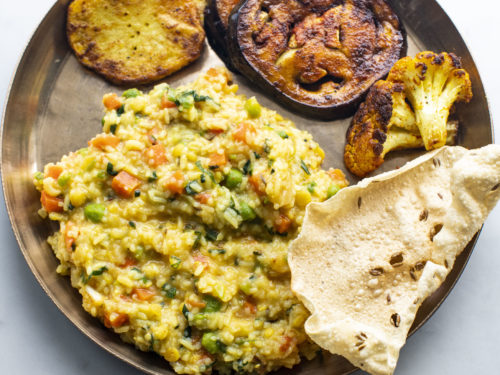
Going further east, the Indians also have their lentil-rice dish, khichdi. I mentioned khichdi in a post I wrote a number of years ago about a pale British imitation of this dish, kedgeree. Basically, you bring together rice, lentils in the form of a dal, some vegetables like cauliflower or peas or potato, and spices.

Source

Bringing in khichdi has allowed me to surreptitiously slip in that glory of Indian cuisine, dal. Quite honestly, there are probably as many variations of dal as there are Indian families. The base is always the same: lentils or other pulses like peas or beans which are cooked with turmeric until mushy. The endless variations come with the fried garnish which is added at the end of the cooking process. I throw in a photo of a moong dal, where the garnish has been made by frying asafoetida, cumin seeds, chopped green chilies, and chopped garlic in ghee.

Source

If I go for dal, I would have to find a garnish with no – and I mean no – hot spices in it; as I’ve recalled several times in this blog, I actively dislike hot spices.

Which would also create me a problem with another dish, misir wot or kik wot, which hails from Ethiopia.

Source

Just as domesticated lentils travelled east and west out of the Middle East, they must have travelled south, too. I suspect they got to Ethiopia via Yemen. In any event, here, too, you cook the lentils (or other pulses) with a garnish made of onions, garlic, ginger, tomatoes and berbere fried in niter kibbeh (the Ethiopian equivalent to ghee). The red flag here is berbere, which is a spice mixture liberally used throughout the Ethiopian highlands and usually containing “chili peppers, coriander, garlic, ginger, Ethiopian holy basil seeds, korarima, rue, ajwain or nadhuni, nigella and fenugreek”, according to berbere‘s Wikipedia entry. I’m not sure what some of the more local spices taste like, but chili peppers … that’s bad news for me.

Stepping back here and reviewing all the alternatives I’ve mentioned makes me realise that most if not all of them are based on making a soupy or slurry-like lentil dish. Remembering the adage “East, West, Home’s best“, maybe I should just opt for a simple lentil soup like my mother used to make (she actually didn’t, but readers get the idea). The internet is stuffed with recipes for lentil soups without horrible, nasty, hot spices in them; without onions and garlic, which don’t agree with my digestive system; without a bunch of spices which, if we buy, would mean a row of bottles that would sit on our kitchen shelves for ever more. Maybe this is the way I should go when I get bored with my lentil salads. And maybe, when the world just gets too much for me, I could retreat into my infancy and eat my lentils in milk, a comfort food which my mother actually did make for me and my siblings years and years ago.

Source

PLUMS – IT’S AUTUMN

Vienna, 23 September 2024

It’s that time of the year again. The time of plums here in Central Europe (or strictly speaking, European plums; there are so many different types of plums). On our hikes now we often see small plum trees covered in the dark purple fruit.

Source

I can never understand if these trees have seeded wild after the passage of some plum-munching, stone-spitting person, or if they were part of now abandoned communal orchards which were once a common feature in this part of the world (the so-called Streuobstwiesen, the scattered-fruit-meadows, meadows through which villages have sprinkled plum and other fruit trees for their communal use – a nice idea, I think).

Source
Source

However the plum trees got there, they are welcome indeed. When we come across them, we will fill our rucksacks with a few days’ worth of dessert and walk on.

Normally, when the plums arrive the weather is turning towards Autumn here. The days are drawing in, the temperatures are beginning to bite, it’s time to wear trousers when I hike and take a sweatshirt with me in case a cold wind picks up; time, too, to carry a waterproof jacket to counter the occasional shower.

As I eat my plums, I will often feel a pang of regret that the Summer is drawing to a close. But this Summer has been ferociously hot in Central Europe. So it is with a certain sense of relief that I bite into my plums these days, even as I grieve the massive damage caused by the recent floods to man, beast, and vegetation (including plum trees, no doubt).

Source

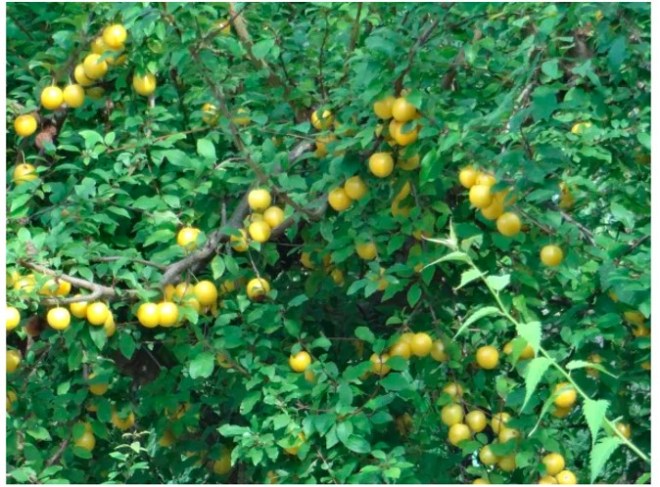
About a month ago, during our hikes we were coming across what looked like mirabelle plums: small, round, yellowish.

Source

They seemed to be wild, or at least feral, being used as fencing around gardens or just mixed up with other trees and bushes on the side of the paths. There were never any plums within reach, evidence that other gatherers had hiked these paths before us. All we were left with were plums that had been knocked off by wind or the heavy rains that we have been having this summer (a result of the intense heat). Many of these little plums were damaged and, judging by the taste, not necessarily all that ripe. We picked them up anyway; it breaks our heart to see this free bounty from Nature just being trampled underfoot. Our gatherer ancestors would never have countenanced such waste.

Talking of our ancestors, it seems that we human beings have been chomping on plums and spitting out the stones for a long, long time.  Archaeologists digging in Neolithic sites in Bulgaria, for instance, have found plum stones from 8,000 years ago. Some of the stones seem to belong to a wild plum called cherry plum.

Source

They do indeed look cherry-like, small and red. I don’t think I’ve ever seen this plum tree on our hikes. But that’s not too surprising since its natural range is South-West Europe (which includes Bulgaria, of course) and West Asia. So the Neolithic farmers who were drifting into Europe from Anatolia must have been very familiar with this tree. From articles I’ve read, I sense that most cherry plums tend to be on the sour side. But I also get the sense that our ancestors, until not too, too long ago, before the massive production of sugar, preferred sourer food, or at least were more tolerant of sourer food. That sourness still resonates with the descendants of our Neolithic ancestors in Romania and Georgia. They use cherry plums in their recipes as a souring note. The Georgians, for instance, use cherry plums to make Tkemalu sauce, a sour sauce, which is then a main ingredient in kharcho soup (mmm, looks good, I wonder if there’s a Georgian restaurant here in Vienna where I could try it?).

Source

Some other stones in those Bulgarian Neolithic sites, no doubt in the more recent archaeological layers, seem to show that domestication of the plum had begun to occur. It’s not very clear what species exactly got domesticated to give us the various types of plums we have in Europe: European plums, damsons, bullaces, egg plums, greengages, spillings, mirabelle plums, just to give the names we use in English. It could have been the cherry plum alone whose DNA was manipulated. Or it could have been that cherry plums were crossed with sloe plums.

Source

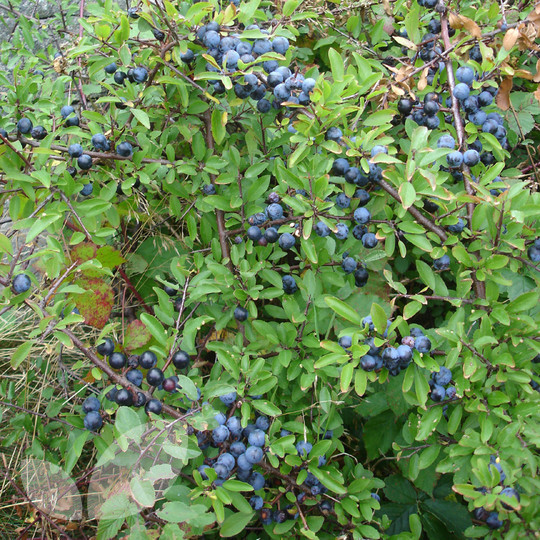
I came across a couple of bushes of sloe plums this summer as we crossed a meadow or two – not scattered-fruit-meadows, I should add, just ordinary meadows. The bushes were on the edges of these meadows, in that indeterminate zone between meadow and woods. I looked at them, thinking “they look like miniature plums” and wondering if they were edible. I went back and forth on trying them, but in the end I felt that discretion was the better part of valour. I didn’t want to keel over in a meadow, poisoned by some unknown plant. But now that I’ve done a bit of reading on plums, next time I come across them – next year at this point, God willing – I’ll give them a little nibble. I don’t expect the experience to be all that pleasant, I have read that sloe plums are quite tart. Maybe I’ll just drink sloe gin, a gin in which sloe plums have been marinated. That sounds a much more pleasant experience.

Source

PAWPAWS, NOT PAPAYAS

Vienna, 20 July 2024

My wife and I recently had our annual check-up with our GP in Vienna. He’s been our doctor here for nigh on 20 years. The first thing he told us was that he was retiring at the end of the week. Tutto cambia, tutto su transforma, everything changes, everything is transformed, as I mournfully intoned in an earlier post. After he had given us our prescriptions for the routine blood and other tests we do every year (the results of which, though, will be reviewed this year by his partner in the medical practice), we chatted a bit about his retirement plans. He told us that he and his partner would be selling their apartment in Vienna (which is how we met him; they lived on the floor below ours), and they would be moving to a house which they have spent the last couple of years restoring, out in the countryside in southern Styria.

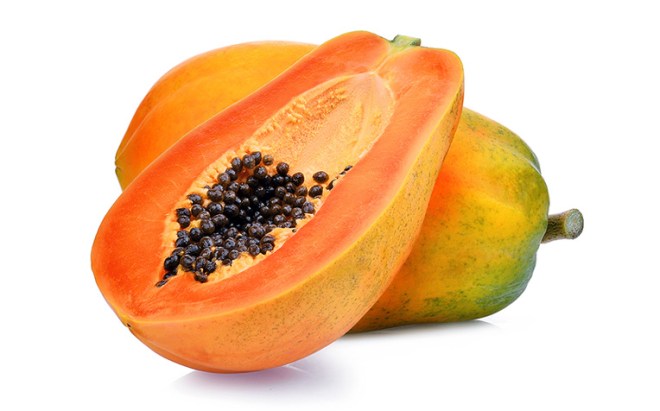
He was especially enthusiastic about its garden. He told us that he has filled it with all sorts of exotic plants, which have been flourishing. It doesn’t surprise me, he has exceedingly green fingers; we would gaze down with wonderment (and not a little envy) at the terrace of their apartment, a riot of flowers and plants, which he would lovingly curate in the evenings during the spring and summer. He told us with a note of pride in his voice that he had even successfully planted a pau-pau tree. A what tree, my wife and I both asked? After some toing and froing, we finally understood he was talking about a tree that produces a fruit called pawpaw. But the confusion wasn’t over yet. Since neither of us had ever heard of pawpaw fruits, my wife fished out her iPad and undertook a rapid Google search to see what they looked like. The search term “pawpaw” resulted in this image.

Source

You mean papaya, we asked? This is what we call this fruit. No, no, our doctor said, not papayas; pawpaws. More Google searching and my wife came up with this.

Source

Yes, the good doctor said, that’s the one.

Well, well, they say you learn something new every day (who coined that phrase, I wonder? Must Google it). My wife and I certainly did that day, along with the distressing news about our doctor’s retirement. After promising to visit the two of them in Styria one of these days, we said our emotional goodbyes.

Of course, I couldn’t leave it there. I was just like my little grandson picking at a scab (did I mention that he’s been staying with us?). I just had to find out more about this pawpaw. Which was fine, because it turned out to be a really interesting fruit.

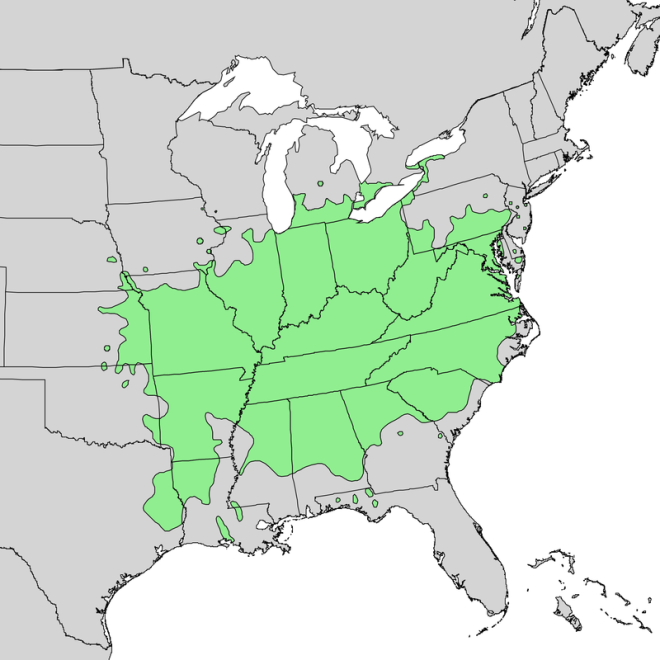
First of all, as this map shows, pawpaws are native to the US, and more specifically to the eastern, southern, and midwestern states – the push into southern Ontario is probably man-induced, as we shall see in a minute.

Source

It’s intriguing that the pawpaw tree is found this far north, in temperate climes, because it actually belongs to a family nearly all of whose members are tropical. It’s a nice example of environmental adaptation. It would seem that the ancestor of the pawpaw developed on what is now the North American continent when the climate was tropical. As the climate cooled, the plant reacted by adapting to the chillier temperatures. Nevertheless, it never quite lost its earlier tropical “look”. Its leaves, for instance, have drip tips, a typical feature of tropical plants which are subjected to heavy rains.

Source

And the fruit itself looks quite tropical; looking at the photo above one could easily mistake it for a mango, for instance.

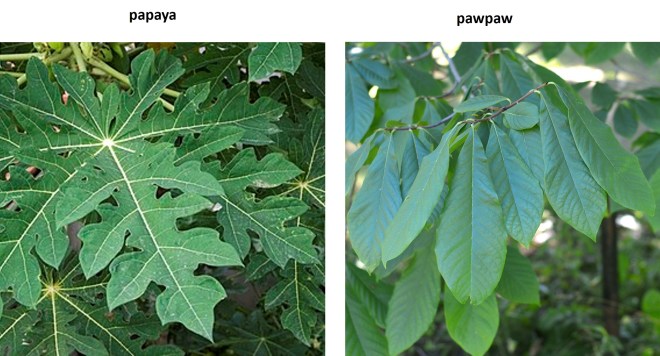
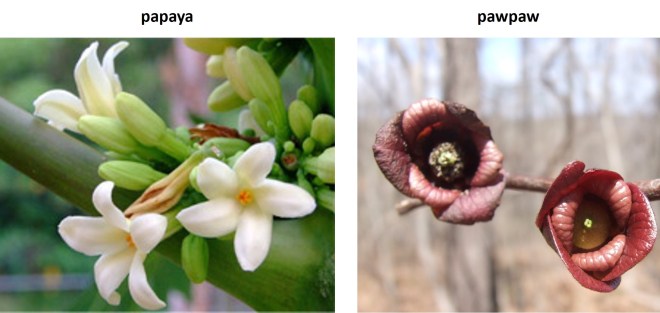
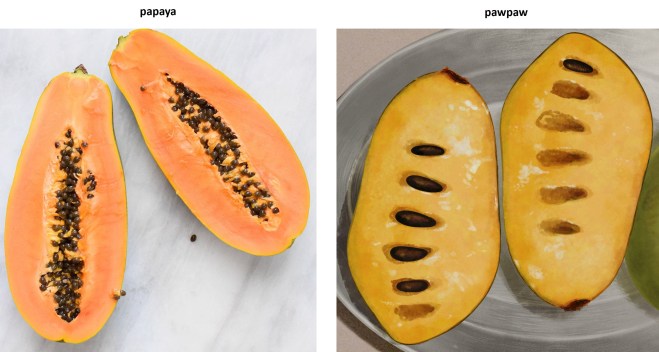
The name “pawpaw” is a bit of a puzzle. It seems that there was a confusion between the pawpaw and the papaya. Down in the British Caribbean colonies, the papaya was known as the pawpaw – and still today, in the UK and in many ex-British colonies, the papaya is called pawpaw. There was a brisk trade between the Caribbean and American colonies, and the thinking goes that when Brits coming from the Caribbean landed in the more southerly American colonies and first set eyes on this tree and its fruit they said “Ooh, look, those look like pawpaws” and the name stuck. Those Brits must have had very poor eyesight, though. In these next few photos, I invite my readers to compare various aspects of the two plants. Here’s what the tree looks like.

Source                                                                            Source

Here’s what the leaves look like

Source                                                                              Source

Here’s what the flower looks like.

Source                                                                                 Source

Here’s what the fruits look like on the outside.

Source                                                                             Source

And here is what they look like on the inside.

Source                                                                           Source

I think my readers will agree that, with the possible exception of the whole fruits, the two really don’t look like each other at all. Maybe those Brits from the Caribbean were actually comparing the taste of the two fruits? For reasons that will become clear in a minute, neither I nor my wife have ever eaten pawpaw, so I am relying here on other people’s impressions of the fruit’s taste. This description, from its entry in Wikipedia, seems to summarise quite well various attempts I have found around the internet to describe the taste : “a flavour somewhat similar to banana, mango, and pineapple”. I haven’t eaten piles of papaya, but that description doesn’t fit with my sense of the papaya’s taste. I rather agree with one person’s assessment that the papaya tastes like a cross between a cantaloupe and a mango.

So the mystery remains: what the hell were those initial namers thinking?! They just created a big confusion. Why didn’t the colonists in the American colonies adopt the name given to the fruit by the local First Nations tribes? The Virginians did it with persimmons, after  all (a transliteration of the Algonquian name for the fruit: “pessamin”).

Source

The coureurs des bois (roamers of the woods), French Canadians who traded for furs with the First Nations and who were a key figure in the North American fur trade, were often the first Europeans to explore the part of the US which is the fruit’s natural range. They sensibly adopted the Algonquian name for the fruit, “assimin”, giving it a French twist, though, coming up with “asiminier”. Here we have an etching of a heroic-looking coureur des bois which appeared in a French Canadian magazine from 1871.

Source

Taking a leaf from the Virginian colonists’ book, I shall start a campaign to have the fruit’s name changed to assimmon. Readers are welcome to join me in this futile tilting at windmills; just for the hell of it, I insert Picasso’s take on the original tilter at windmills, Don Quixote, with his faithful sidekick, Sancho Panchez.

Source

I have to say, I do have a sort-of official approval for this effort: the plant’s proper botanical name is Asimina triloba, where the first part of the name picked up the coureurs des bois’s name. In fact, I shall start right now. I shall call the fruit assimon in the rest of this post.

As readers can imagine, the pawpaw – sorry, the assimon – was very popular with the First Nation tribes who occupied the fruit’s range. Here you have what turns out to be the largest edible fruit that is indigenous to the US, and it’s delicious to boot! The tribes loved it so much that they extended the fruit’s original range by carrying it with them when they moved into new territories (as they did with the Jerusalem artichoke – and of course maize). This most probably explains the fruit’s presence in Southern Ontario, brought there, it is theorised, by the Erie and Onondaga tribes. To bring us back to those far-off times, I throw in a photo of a figure that appeared in Samuel de Champlain’s books on his voyages in what is now Canada and the US. It relates to an attack Champlain carried out together with the Hurons on an Onondaga village, situated on what is now called Onondaga lake, close to the modern city of Syracuse in the northern New York State.

Source

It’s lucky that the First Nations did move the assimon tree around, because it had evolved into a cul-de-sac. If readers go back to the photo of the open assimon fruit, they will notice its large stones. Fruit stones have evolved to be swallowed by the animals which consume the fruit, to be then expelled in a nice, fertilising pile of poo somewhere else as the animal in question wanders around. The bigger the fruit stone, the larger must be the animals eat the fruit – otherwise, they can’t swallow it. It’s been theorised that the assimon’s very large stone means that it evolved to be eaten by the American continent’s megafauna. Here is a photo of these large beasts, also showing humans, to give an idea of their enormous size.

Source

Only the omnivores amongst them ate fruit, of course, but those which did spread the assimon around.

About 10,000 years ago, though, America’s megafauna died out. Quite why this happened is hotly debated, but the arrival of human beings, the ancestors of the First Nations, from across the Bering Straits was in all probability a big factor in this wave of extinctions. The modern bear is now the only animal big enough to swallow the stones of the assimon without choking. So it was just as well for the plant that humans stepped in and moved the plant around – and it was only fair that they did so, given the role they had played in the extinction of the megafauna.

As I said earlier, even though my wife and I lived something like eight years all told in the assimon’s range, we never tried it. We never even saw it being sold in supermarkets. How can it be that the US’s largest indigenous fruit is not readily available in every supermarket in the country? How can it be that enterprising Americans didn’t bring the plant to Europe, China, Japan, and anywhere else with the same temperate climate and establish assimon orchards?

The sad fact is that the assimon, in contrast to more popular – and non-American – commercial fruits like apples, pears, or peaches, stores poorly, primarily because the fruit ripens to the point of fermentation very quickly after it is picked. An assimon only keeps for 2–3 days at room temperature, about double that if it is refrigerated. This short shelf-life and therefore difficulty in shipping the fruit any distance means that the food industry is simply not interested in it. I have commented unfavourably in an earlier post about the fact that many of the foodstuffs eaten in the US are not native there, suggesting that native foodstuffs should be eaten. But in this case it really seems that the assimon is simply unsuited to our modern way of life. The best one can hope for is to find it in farmers’ markets held in the fruit’s range. And they will only offer it during the month of September, which is when the fruit ripens (there is a niche market for the shipping of the fruit over longer distances, but it must be a risky business).

Or you plant a tree in your garden if you live in the right climate. Which brings me back to my good doctor! We said we would go and see them. Maybe we could go and see them in September, when his assimons are ripe. But we need to know very precisely when they are ripe and then immediately go down to visit them and try this delectable fruit. But how to do this without sounding crass? “Hello, are your assimons ripe? If not, we’re not interested in coming.” I shall have to discuss this with my wife and try and find a more subtle way of doing this.

GIN

Vienna, 26 January 2024

I’ve been meaning to write this post for a while. But for reasons that I cannot explain, I have procrastinated. Nevertheless, I have finally got myself to put pen to paper and get to work.

The germ for the post was planted several years ago during a hike my wife and I were taking along the edges of Lake Como. We dropped into a café to have ourselves a cappuccino. There, on a shelf, the café owner had lovingly placed a long row of bottles of gin, all of them some strange colour: pastel yellow, blue, or even – I think – pink. I say “I think”, because the memory of it all is somewhat fuzzy now. At the time, I took a photo of that row of bottles to show to my readers – as I say, I thought immediately of writing a post about gin – but somewhere along the line I decided to delete it, convincing myself I would never get around to writing the post. This photo, which I created with a bit of photoshopping, will have to stand in for that initial vision of mine.

many sources

All those coloured gins startled me. I have since read on the internet that this is the latest fad in gin making – or perhaps, to put it a little more cynically, the latest way for gin makers to differentiate themselves from their competitors. As one internet entry puts it, “coloured gins are having a moment, the latest phase in the great craft gin revival. You can now choose from a whole spectrum, including pink grapefruit gin, Amalfi lemon gin the colour of a pale sunrise, bitter orange gin like alcoholic marmalade and lavender gins that change colour on contact with tonic. But the most popular is violet.”

I dislike to think of  myself as a traditionalist, I’ve always been suspicious of tradition, but hello! coloured gin! what is the world coming to?! I am firmly of the opinion that gin should be a colourless liquid to which you add things to enhance its basic taste and possibly – just possibly – add colour.

Talking of gin’s basic taste, I think we all know that this primarily comes from the addition of juniper berries, from juniper trees like this beautiful example.

Source

Juniper is after all in the drink’s name. The ancestor of British gin is Flemish/Dutch jenever. Jenever making was brought to England by traders or by English soldiers returning from fighting in the Low Countries. Linguistic laziness eventually shortened jenever to gin. But my surfing has shown me that today’s gin makers add other “botanicals” to their gin, to distinguish it from everyone else’s. Citrus “notes” seem to be important, imparted by the addition of the peels of lemon, or bitter orange, or lime, or grapefruit. Then small amounts of all manner of spices can be added: anise, fennel, caraway, coriander, licorice, orris, longan, baobab, savory, angelica, cardamom, grains of paradise, cubeb, cinnamon, cassia, nutmeg, almond, saffron … the mind whirls in front of this veritable cornucopia of spices.

Source

And it doesn’t finish there. Even pine needles and cones can be added, or frankincense! Of course, which extra “botanicals” are added are closely guarded secrets.

I wouldn’t want readers to think I am a frequent drinker of gin – unlike the late Queen Elizabeth, who was, I was somewhat astonished to learn, still knocking back two gin-based drinks daily in her nineties: a gin and Dubonnet with lots of ice before lunch, and a dry martini after it.

Several sources

I will just have a gin and tonic from time to time, when the fancy takes me – and when the ingredients are available. Harking back to my earlier harrumphing, readers will see that a G&T is satisfactorily colourless.

Source

I am glad to see that I am in good company in my fondness for G&T. Philip Larkin, a poet whom I greatly admire, was an aficionado. We have him here nursing a G&T.

Source

He once wrote to his lover: “life is very narrow without glasses OF GIN AND TONIC”. Note the capital letters and the plural “glasses” – he imbibed considerably more gin and tonic than I do. He even devoted several lines of one of his poems, Sympathy in White Major, to the making of a gin and tonic:

When I drop four cubes of ice
Chimingly in a glass, and add
Three goes of gin, a lemon slice,
And let a ten-ounce tonic void
In foaming gulps until it smothers
Everything else up to the edge,
I lift the lot in private pledge:
He devoted his life to others.

But in my mind the G&T is also firmly anchored to the colonial period of India, where it was particularly popular among the British colonialists. I’ve read that their excuse for quaffing large amounts of G&T was to ingest quinine as a prophylactic against malaria – tonic water contains quinine. Malaria was certainly a problem in India – my father contracted it while a colonialist in India – but I’ve also read that actually this can only have been an excuse, because there isn’t enough quinine in tonic water to work as a prophylactic. In any event, I throw in a photo of two British colonialists languidly seated and being fanned by an Indian servant. On the table, one can make out what seems to be a glass of G&T.

Source

Although I am now firmly in the G&T camp, my gin drinking habit didn’t start there. I began knocking back gin when I was 17, maybe even 16 – yes, it was easier to get served in pubs when I was young – and my gin drink of choice was what I remember being called a gin and lime, although the proper name for this drink seems to be a gimlet. Again, I am pleased to know that I was in good company. Gimlets play a not insignificant role in Raymond Chandler’s book “The Long Goodbye”.

Source

Early on in the story, the hero, or maybe we should call him the anti-hero, the “hard-boiled” detective Philip Marlowe, meets a friend, who happens to be British, in a bar:

We sat in a corner of the bar at Victor’s and drank gimlets. “They don’t know how to make them here,” he said. “What they call a gimlet is just some lime or lemon juice with a dash of sugar and bitters. A real gimlet is half gin and half Rose’s Lime Juice and nothing else. It beats martinis hollow.”

Rose’s Lime Juice cordial … an icon of my youth:

Source

My British grandmother often had a bottle, but not for making gimlets; I don’t remember her ever drinking anything stronger than a dry sherry. She would make lime drinks for us grandchildren, adding water to a generous portion of Rose’s Lime Juice. Yes, I have very fond memories of that cordial. My reading tells me, though, that today’s mixologists (strange word …) pooh-pooh on Rose’s Lime Juice in its modern form, considering it far sweeter than the Lime Cordial made by the original Mr. Rose. As a result, there is a cottage industry in the production of lime cordials considered to be closer to the Real Thing, and the gimlets made with these revisited cordials are claimed to taste much better. If ever I end up in some bar offering one of these alternative lime cordials, I might try a gimlet. Otherwise, I’ll stick with my G&T, thank you.

Chandler’s tales of Marlowe are great, by the way. If any of my readers have never dipped into them, I highly recommend they pick up a copy. And of course, a good number of his books have been turned into films over the decades. Liam Neeson is the latest well-known actor to play Marlowe, but there have been a number of others before him: Elliott Gould, Robert Mitchum, James Garner, Robert Montgomery. But to my mind by far the best Marlowe was Humphrey Bogart, who back in 1946 played him in “The Big Sleep”.

Source

It was also Bogart who, in “Casablanca”, after Ingrid Bergman has entered his nightclub, talked to him, and left, utters the anguished phrase: “of all the gin joints in all the towns in all the world, she walks into mine.”

Source

Which brings us back to gin.

Marlowe’s friend in “The Long Goodbye” says gimlets beat martinis hollow. I wouldn’t know, I don’t think I’ve ever had a martini. But I’m sure James Bond – who must be the best known martini drinker in the world – would have disagreed. Here, turning to films again, we have Sean Connery, the greatest of all the James Bonds (at least that’s what I think), preparing himself a martini.

Source

Mind you, I don’t think Bond’s martini is quite the Real Thing, which I read should be a mix of gin and dry vermouth – the precise ratio is of course a source of heated debate in certain mixological circles but the current consensus seems to be around 5 parts gin to one part vermouth. The two should be poured onto ice cubes, stirred not shaken, strained into a chilled cocktail glass, and served with a green olive or twist of lemon peel as garnish.

In his book “Casino Royale”, however, Ian Fleming has Bond ordering another kind of dry martini at the bar in the casino:

‘A dry martini,’ he said. ‘One. In a deep champagne goblet.’
‘Oui, monsieur.’
‘Just a moment. Three measures of Gordon’s, one of vodka, half a measure of Kina Lillet. Shake it very well until it’s ice-cold, then add a large thin slice of lemon peel. Got it?’

Sounds like a bit of a Frankenstein martini, if you ask me. And Bond’s well known comment “shaken, not stirred” has mixologists shaking their head in disapproval; it should be the other way around. I’m sure that other famous martini drinker, the late Queen, would have pursed her lips in disapproval, even though, as we know since the 2012 London Olympics, she and Bond were BFFs.

Source
Source

This mention of the House of Windsor lets me segue smoothly to another gin-based drink which I have also never tried, a fruit-based punch using Pimm’s No. 1 Cup as the base. To make it, get a bottle of Pimm’s No. 1 Cup.

Source

This is basically gin in which a whole lot of herbs and some citrus have been macerated; quite what herbs and citrus we are talking about is – of course, as usual – a closely guarded secret. Pour a slug of this potion into a jug, add a generous portion of lemonade, and then bung in sliced and diced vegetables and fruit; which vegetables and fruit exactly is up to you, but I’ve seen mention of cucumbers and celery on the vegetable side and orange and strawberries on the fruit side. The end result will look something like this.

Source

This seems to be quite a posh drink. For instance, we see here King Charles, at a time when he was still a young Prince Charles, gulping down a Pimm’s at a polo game – note polo game, not a football game or rugby game or some other game which we normal mortals take part in or watch.

Source

Here he is again, “a little bit older, a little more bent” as the song goes, pensively clutching his glass of Pimm’s.

Source

It’s very popular at Royal Ascot, which – obviously, given its name – the Royals attend.

Source
Source

Following suit from the Royals, the other race goers deck themselves out in their finest, the ladies with those ridiculous hats English women love to wear, the gents in morning suits, which are equally ridiculous.

Source

Everyone has a flutter on the horses.

Source

And the Pimm’s flows freely all day.

Source

These two drinkers of Pimm’s seem to have backed the wrong horse, though.

Source

It’s also very popular at the Henley Royal Regatta, where anyone who is anyone wears a blazer (I think to signal that they belong to a boat club somewhere).

Source

And of course Pimm’s flows freely.

Source

Although not quite in the same posh league these days, Pimm’s is also quaffed in large quantities at Wimbledon. Just because I find him very simpatico, I throw in a photo of Stanley Tucci at Wimbledon clutching his Pimm’s.

Source

I think readers will get the general idea from what I have written above that gin is a very respectable drink these days. Which was certainly not the case a mere three hundred years ago. In the early 1700s, the British government decided – as an anti-French move (so what’s new…) – to greatly increase import duties on French brandy. At the same time, it made it much, much easier for people to get into the business of making gin: it broke the monopoly of the London Guild of Distillers on the making of spirits, it reduced taxes on the distillation of spirits, and it revoked the need for a license to make spirits. Add to this the fact that this was a period which saw a drop in the prices of barley – used to make the mash, which was then distilled to obtain the spirits – which very much helped to make the final product cheap. Add also to this the fact that there was a general rise in salaries (from absolutely wretched to slightly less so) and a concomitant general drop in food prices, which meant that the poor had somewhat more disposable income to spend on liquor. Add all of that up and you have the makings of a perfect storm. Thousands of people all over the country got themselves a pot still and started making gin. This is a pretty simple type of pot still.

Source

This pot still is a little more sophisticated.

Source

Many of these new gin makers opened gin-shops to sell their rot-gut. Here, we have a print of a gin shop made towards the end of the 1700s (note that it’s all women and one child; commentators of the time were particularly exercised that this was not just a problem with men).

Source

Many others simply made it at home in their kitchen for their personal consumption.

And rot-gut it was! Pot stills produced a very coarse product, and some pretty awful things were added to make it more palatable. Turpentine was one, to give the stuff “woody notes”. Sulphuric acid was another, although luckily the acid didn’t distill over with the ethanol; it merely reacted with it to form diethyl ether, which added a sweetish taste to the product.

The awful taste didn’t seem to matter very much. People, especially the poor, began drinking huge amounts of gin. What came to be known as the Gin Craze had started. Quite soon, the authorities realised they had a serious social problem on their hands as drunkenness and disorderly behaviour – especially among the poor and involving women as much as men – became endemic. William Hogarth’s print, “Gin Lane”, gives an idea of how the governing classes saw the problem.

Source

By 1736, the Middlesex Magistrates had this to say: “It is with the deepest concern your committee observe the strong Inclination of the inferior Sort of People to these destructive Liquors, and how surprisingly this Infection has spread within these few Years … it is scarce possible for Persons in low Life to go anywhere or to be anywhere, without being drawn in to taste, and, by Degrees, to like and approve of this pernicious Liquor.”

Already in 1734, the story of one Judith Defour had shocked the nation – or at least the superior Sort of People. Judith had taken her two year old daughter out of the workhouse, where she had placed her earlier, for a visit of a few hours, and had met up with her friend Sukey. The court records document what followed:

“On Sunday night we took the child into the fields, and stripp’d it, and ty’d a linen handkerchief hard about its neck to keep it from crying, and then laid it in a Ditch. And after that, we went together and sold the coat and stay for a shilling, and the petticoat and stockings for a groat. We parted the money, and join’d for a quartern of gin.”

The little girl died in the ditch. Defour was found guilty of murder and sentenced to death, and hanged at Tyburn (note the grandstands; this was spectacle indeed).

Source

The public outrage over this story forced Parliament to act. Over the next fifteen years, various laws were passed which eventually brought gin drinking under control.

It’s hard not to read about the Gin Craze and think about today’s opioid crisis, or the crack epidemic of the 1980s, or the many previous epidemics of heroin, amphetamines, morphine, and on and on. Different chemicals, same problem: the desire – the need – to dull the pain of living, and a ready supply of cheap chemicals to do it.

And on that sombre note, I will finally crack open a bottle of – colourless – craft gin someone gave us, aromatised – so the label informs me – with juniper of course, but also orange peel, cardamom, angelica root, coriander, ginger, cinnamon, and maybe a few other things, and, more or less in Larkin’s words:
I’ll drop four cubes of ice / Chimingly in a glass, and add / Three goes of gin, a lemon slice, / And let a ten-ounce tonic void / In foaming gulps until it smothers / Everything else up to the edge. / And then I’ll lift the lot and ask myself:
“Am I a superior Sort of Person or an inferior Sort of Person?”

AN APULIAN CHRISTMAS LUNCH

Vienna, 12 January 2024

This past Christmas, my wife and I were debating what we should cook for Christmas lunch. We finally decided to adopt a programme in honour of our children, whereby over the coming years we will use Christmas lunches to celebrate our children’s rich and varied heritage. This will mean that over the course of the next six Christmases we will prepare typical Christmas lunches starting with Puglia in the south of Italy, going on to Lombardy, Beaujolais, England, Scotland, and finally Norway. After Norway, we will extend the programme at least several more years, by celebrating the extra heritage of our currently only grandchild, which will take us to Ireland and to Lithuania and Bielorussia. If there are further grandchildren with other heritages to bring – literally – to the table, we will tack on more years to the programme (assuming we haven’t popped our clogs before that).

With this multi-year framework programme agreed upon, we got to work and started our research: what would be a typical Christmas lunch in Puglia? Just to get us into an Apulian mood, I throw in here a photo of an Apulian olive grove with millenarian olive trees.

Source

Unfortunately, my wife had never been brought up in Apulian traditions: it was her maternal grandfather who had been the Apulian of the family; he had immigrated to Milan as a young man before World War I, and like many immigrants before and after him he had wanted to blend in to the local, northern Italian, culture. So we had to fall back on the internet. Our initial surfing showed us that there are actually several traditional Apulian Christmas lunches to choose from, broadly divided between fish and meat. After some to-ing and fro-ing, we plumped for roast lamb and potatoes, with something called lampascioni on the side, and we left hanging the question of what to do about dessert.

Well, lamb and potatoes aren’t particularly Apulian, nor did any of the articles we read say that a particular cut of lamb was required for the Apulian Christmas lunch, so we took whatever cuts of lamb were available at our local supermarket. What was truly Apulian about the lunch were the lampascioni. No doubt like us, many of my readers will have no idea what these lampascioni are. I certainly had no idea whatsoever, and my wife had only heard of them but had never tried them. They are the bulb of a flower which goes by the English name of tassel hyacinth. Its natural range is the Mediterranean basin, although it is also found as far east as Iran and as far west as the Canary Islands. It naturalizes quite easily, though, and over the centuries it has moved northward to Poland. Now, of course, with globalisation, it’s also found in many other parts of the world. As this photo shows, the flower is really quite handsome.

Source

This has led to its being planted in many a garden, although I think I prefer them in the wild, like these tassel hyacinths in an olive grove.

Source

They may be handsome flowers, but the inhabitants of the heel, instep, and toe of Italy’s boot, namely the regions of Puglia, Basilicata and Calabria, have other ideas. They have taken to eating the bulb of the plant (a habit, I should say in passing, that they share with the inhabitants of the island of Crete).

Source

The bulbs are not an obvious candidate for the dining table since in their natural state they have an unpleasantly bitter taste. But at some point in the distant past (there is evidence that the bulbs were already being eaten in Neolithic times), this problem was solved. To be edible, the bulbs have to be left to steep in water for a significant period of time (one day should do it, with a change of water in between) and then cooked. At which point, they look like this.

Source

It was all very well to want to have lampascioni for lunch, but where were we going to buy them? A very regional foodstuff like this was only going to be sold in a specialist shop. As luck would have it, I discovered that a long urban walk we had planned (to a modern church on the outskirts of Milan – perhaps the subject of a later post) happened to take us by a small shop selling Apulian foodstuffs. So I persuaded my wife to make a small detour to check the shop out. When we reached it, we entered with our hearts in our mouths – and there on the shelf were jars of lampascioni! They were immersed in a lovely Apulian olive oil.

Source

This is the normal way of selling lampascioni; the bulbs are only harvested in the early months of the year. So, to be able to eat them all year round, they are kept in olive oil (the Cretans instead, I can once again mention in passing, keep them in vinegar on which is floated a thin layer of olive oil).

So we had our lampascioni to accompany the lamb and potatoes! We were moving along nicely. Most satisfactorily, the same shop also solved our dessert problem. They were selling trays of something called cartellate con vincotto di fichi. I had certainly never heard of these cartellate, and neither had my wife. Nevertheless, they were obviously Apulian and obviously a dessert. So a decision was rapidly taken and a tray of cartellate joined the jar of lampascioni.

Source

I think I need to explain what these cartellate are. I had to look it up on the internet because just looking at them didn’t help. They are made with thin, long and narrow slices of dough (with, interestingly enough, a local white wine taking the place of water). These are rolled up into the shape of rosettes, and the rosettes are then deep-fried in oil. Into the little cups of the rosettes is poured a thick syrup made by boiling figs over a long, long time and sieving out the solids. I think I should add in a photo of the these cartellate out of the packaging, so that readers can get a better idea of what they look like (in passing, I find it strange that they call this syrup vincotto di fichi, which translates as “cooked wine of figs”, because no wine is involved).

Source

So now we had all the ingredients we needed! 25 December dawned, and it was time to start cooking the lamb and potatoes. Our son, who was going to eat lunch with us, joined us for the preparations.

Since our internet sources hadn’t mentioned a typically Apulian way of roasting the lamb, we chose a recipe from the Italian cookery site Giallo Zafferano. The only thing which, to us at least, was untoward about this recipe was its insistence on adding a lot of water to the pan in which the lamb and potatoes were being roasted.

After an hour or so, the lamb and potatoes were ready.

Source

It was time for us to sit ourselves down at the table. The lamb and potatoes were ceremoniously brought to the table, my wife served us, we fished the lampascioni out of their jar, and we tucked in.

The lamb was delicious. The addition of water worked really well. The lamb was juicy and tender, with just a bit of crispiness on the top where the meat was above the water, and the potatoes were done to perfection.

And how about the lampascioni? What did they taste like? Well, they tasted slightly bitter, as one might imagine, but also slightly sweet. So there was an interesting sweet-and-sour thing going on with the taste buds. They also had a most interesting texture, almost melting in the mouth. I have to say, they were an excellent accompaniment to the lamb and spuds. And the oil that was left after we had polished off the lampascioni was exquisite. Apulian olive oil is anyway very good, but now it had a slight umami taste to it, which made it an excellent oil to put on my post-Christmas salads, adding an evanescent flavour to otherwise rather staid vegetables. I would buy another jar of lampascioni just for its oil.

I’m afraid the cartellate were a different story. I don’t want to badmouth them, but we won’t be buying them again, at least not if they are made with fig syrup. All that boiling meant that the syrup actually had a somewhat bitter taste to it, which rather ruined the experience of eating the cartellate. Internet sites suggest that alternatives can be used: grape syrup (but I suspect there would be the same problem of bitterness), honey, or icing sugar. If ever we come across cartellate made with any of these alternatives, we might give the dish a second chance.

So there we have it. Apulian Christmas lunch: done! Next year: Lombard Christmas lunch.