POSTS

SACRO MONTE DI OSSUCCIO

Milan, 24 December 2020

As is our habit, my wife and I have been spending these dying days of 2020 hiking around the edges of Lake Como. We did the Green Way again recently (this is a walk which goes from Colonno to Griante).
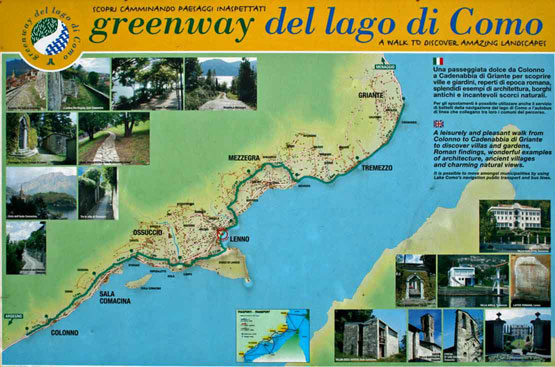
Source

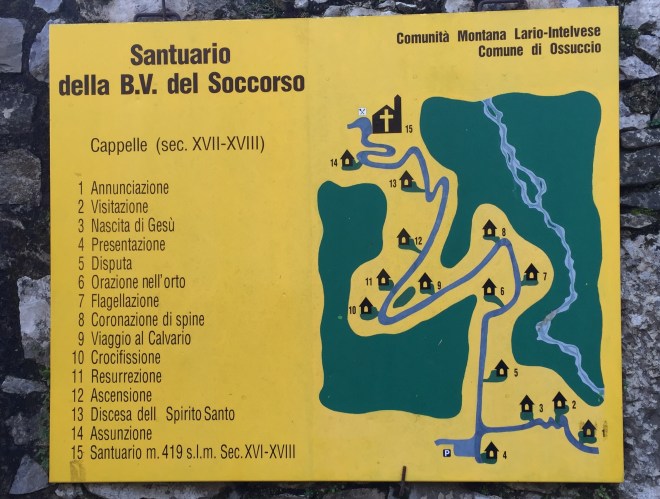
And once again, as we passed through the village of Ossuccio, we noticed this sign on a wall.
My photo

It was advertising (if that’s the right word) some kind of pilgrims’ path which snaked its way up from the village to a church, the Sanctuary of Our Lady of Perpetual Help, located high above it.

My photo

The path was studded with 14 little chapels, which the pilgrim could stop at and pray – or the modern hiker like us could inspect.

My wife and I debated whether or not we should take the path. The last time we had passed through Ossuccio we had been running late. But this time, we were ahead of schedule, and anyway we needed to do a bit of climbing – the Green Way is quite flat. So we decided to make a little detour up the hill.

I had thought that we would be doing a Stations of the Cross – a common thing to find on hills and mountains in this part of the world. But no, the whole enterprise is actually dedicated to the Virgin Mary, and the fourteen chapels plus the church are built around the mysteries of the Rosary. I’m afraid I’m getting into a Catholic tradition which is quite foreign to anyone who has not been brought up a Catholic, but I have to explain these mysteries a little if readers are to understand the iconography of what I am about to describe.

If any of my readers have ever entered a Catholic church in the early evening, they may have encountered the following scene: a darkened church with a pool of light in the first few rows of pews, a handful of older women (and, rarely, a few men) sitting in the light, possibly a priest acting as MC, and a steady drone emanating from the group. They are reciting the Rosary (capital “r”), which is the recital of a couple of different prayers in a certain order. To help them recite the Rosary correctly, the little group in the church will be using a rosary (little “r”). This is a string of beads which looks like this.

Source

The point of a rosary is to help its users recite the right number of prayers in the right order. The drone emanating from the group in the church is the result of them repeating the prayers over and over again, with the rosary beads slipping through their fingers as they keep count of the prayers.

This litany of prayers is built around the so-called four mysteries of the Virgin Mary: the joyful, luminous, sorrowful, and glorious mysteries. In turn, each mystery is based on five episodes in the life of the Virgin Mary and her son Jesus. As the name of the mysteries imply, these episodes are joyful, luminous, sorrowful, and glorious. As the picture above shows, a rosary normally consists of five groups of ten small beads separated by one bead. Readers with an arithmetical bent will no doubt have understood that one tour of the rosary through the fingers of that little droning group in the church covers the five episodes of a mystery, with one set of prayers being droned out for each episode (somehow, as they drone their way through the prayers, the members of the little group are meant to meditate on the episode in question). Which mystery the droners will be covering when you walk into that darkened church depends on which day of the week it is: Mondays or Saturdays, the joyful mystery; Tuesdays or Fridays, the sorrowful mystery; Wednesdays or Sundays, the glorious mystery; Thursdays, the luminous mystery (as readers can see, the whole Rosary programme is very well organized).

Coming back to the fourteen chapels and church on the hill behind Ossuccio, they are built around three of the four mysteries: the joyful, sorrowful, and glorious mysteries (the luminous mystery is not included, but simply because it didn’t exist when the chapels and church were built; it was only added by Pope John-Paul II in 2002). My arithmetically inclined readers will of course have figured out that fourteen chapels plus a church is 15, which equals the three times five episodes in the mysteries. And in fact it turns out that each chapel (plus the church) are dedicated to one of the episodes covered by the three mysteries.

“But what are these episodes?!” I can hear my readers cry. Well, for that it is best that we visit the chapels and the church. But before we set out on our visit, I just want to say that we are about to see mises-en-scène, pieces of theatre frozen in place by the use of life-sized painted terracotta statues: 230 in all, 163 of people, 52 of angels, and 15 of animals.

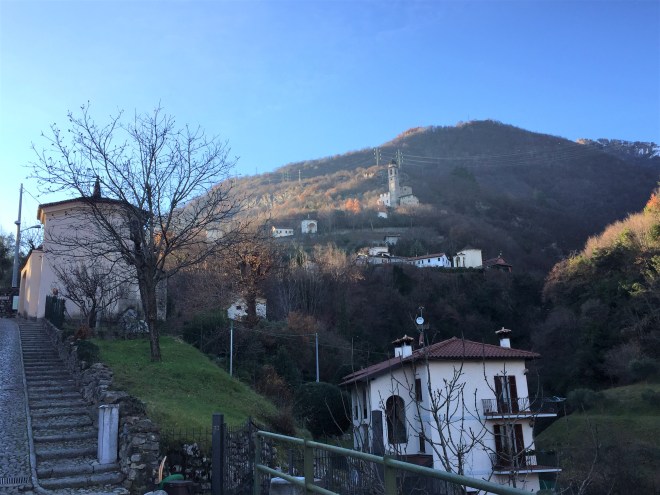
Let me start with an overview picture of the chapels and the church.
My photo

The small white structure up the stairs and behind the tree is one of the chapels. In the background on the hill we see the church, the end-point of the pilgrim path. Sharp-eyed readers can spy similar chapels on the hillside below the church – unfortunately, modern houses have also been built on the hillside, so the view is not as harmonious today as it must have been in the late 17th, early 18th centuries when the chapels were first built.

When pilgrims – or modern hikers – approach a chapel, they will see a very closed building: a blank wall, with a locked door and a couple of grated windows on either side of the door.
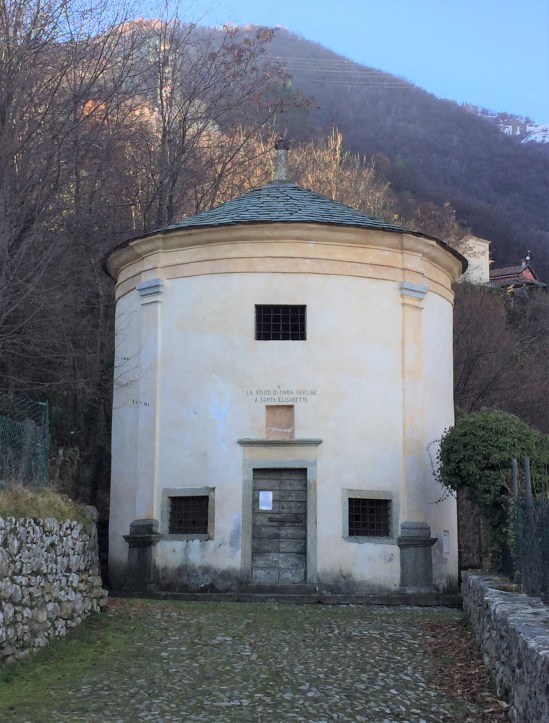
My photo

It is those grated windows which allow pilgrims – and hikers – to see what’s going on inside the chapels. Peering through them, they will behold a mise-en-scène of statues describing an episode of the mysteries. The grates on the windows are often of fine mesh. On the one hand, this is a good thing, in that it stops birds, rodents, and other pesky animals from entering the chapels and making a mess of the statues and everything else. On the other hand, this is a bad thing, in that it made it difficult for me to take good photos of the mises-en-scène with my i-Phone’s camera.

My photo

So I shall be relying heavily on photos taken by other photographers who were given permission to go inside the chapels and posted their photos online.

Now, finally, we can visit the individual chapels and the church!

We start with five chapels which are dedicated to the five episodes making up the joyous mystery. Thus, we have:

Chapel 1: the Annunciation, where an Angel announces to Mary that she has been chosen to be the mother of Jesus.
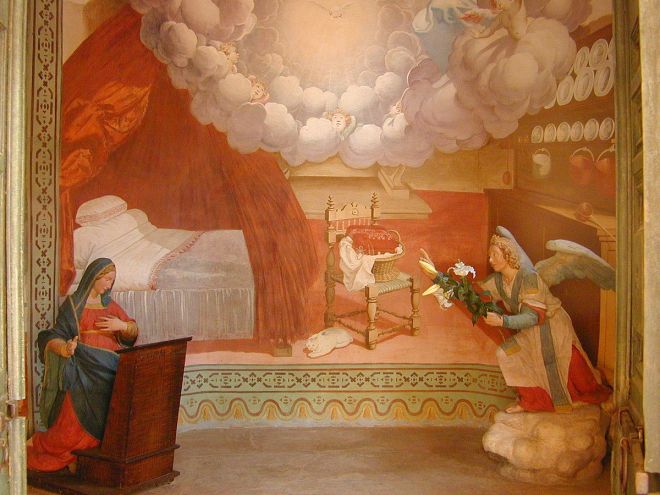
Source

Chapel 2: the Visitation, where Mary visits her much older cousin Elizabeth, who is pregnant with John the Baptist, and where Elizabeth recognizes Mary as the mother of the long-awaited Messiah.

Source

Chapel 3: the Nativity, where Jesus is born in a manger.
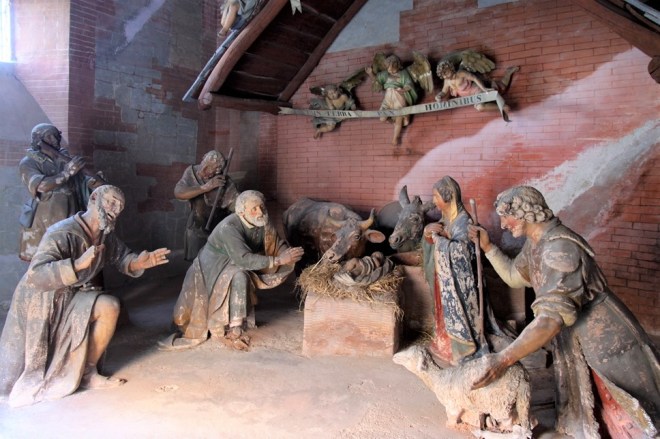
Source

Chapel 4: the Presentation, where Mary and Joseph present the baby Jesus in the Temple of Jerusalem.

Source

Chapel 5: Finding Jesus in the Temple at age 12, discussing Mosaic Law with the elders.
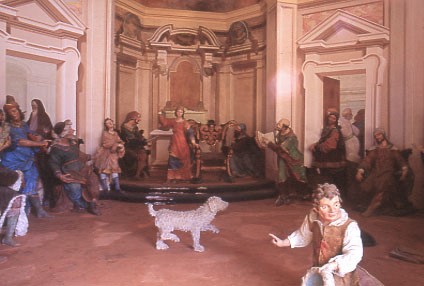
Source

This chapel has the amusing detail of having a young boy sitting in the foreground who seems to be laughing at all these wise old men, and a dog which is crossing the scene. Presumably the artist who created this chapel wanted to give pilgrims a bit of light relief. I also like a detail at the back of the scene, in the dialogue between the young Jesus and the elder next to him.
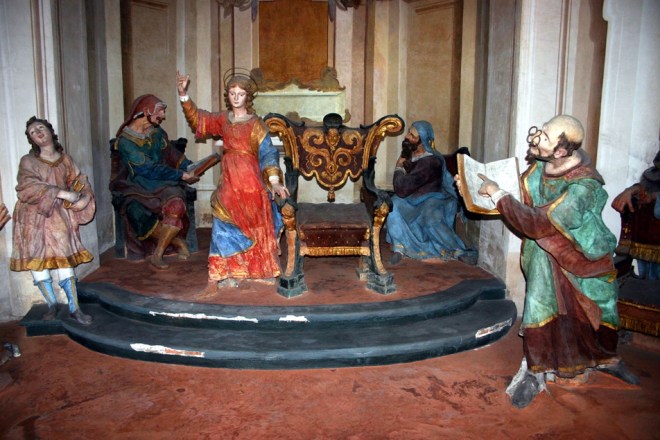
Source

That elder is wearing a pince-nez, no doubt as much a symbol in the late 17th, early 18th Centuries of the bookish type as it is today (and on a darker note, let’s remember the Khmer Rouge’s decision to kill anyone who wore glasses, because they clearly had to be bourgeois intellectuals).

The next five chapels are dedicated to the episodes of the sorrowful mystery. So we have:

Chapel 6: the Agony in the garden of Gesthemane, where Jesus prays that he might be spared his impending death.
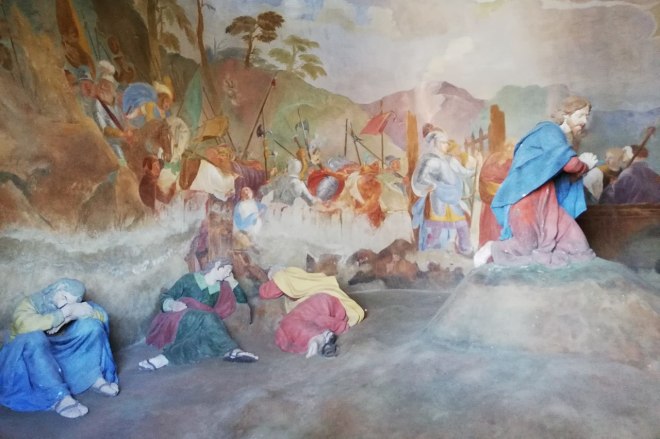
Source

Chapel 7: the Scourging, where Jesus is whipped before his execution.
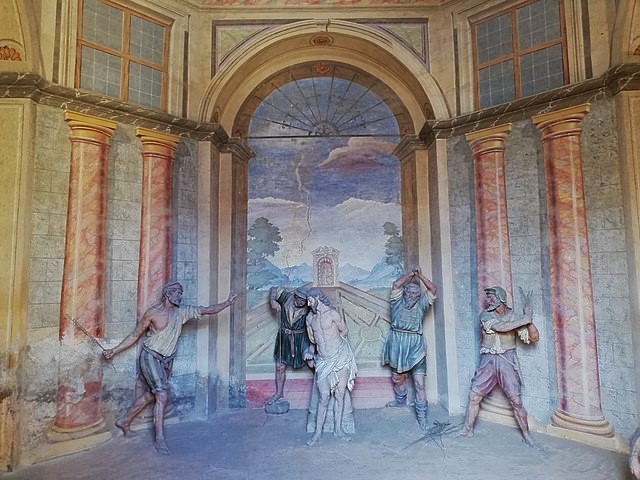
Source

Chapel 8: the Crown of Thorns, where Jesus is mocked by being crowned “king” with a crown made of branches with long, sharp thorns.
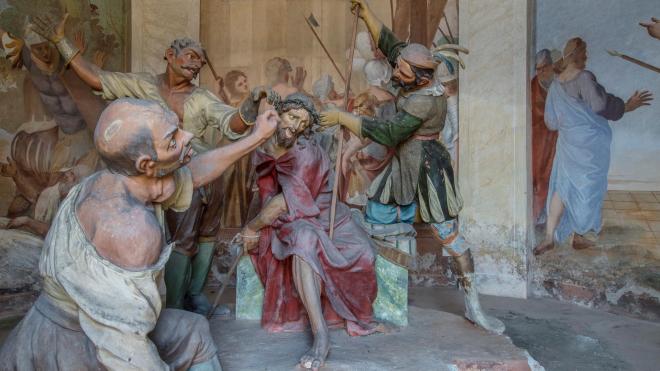
Source

Chapel 9: Jesus carries the Cross to the place of execution.

Source

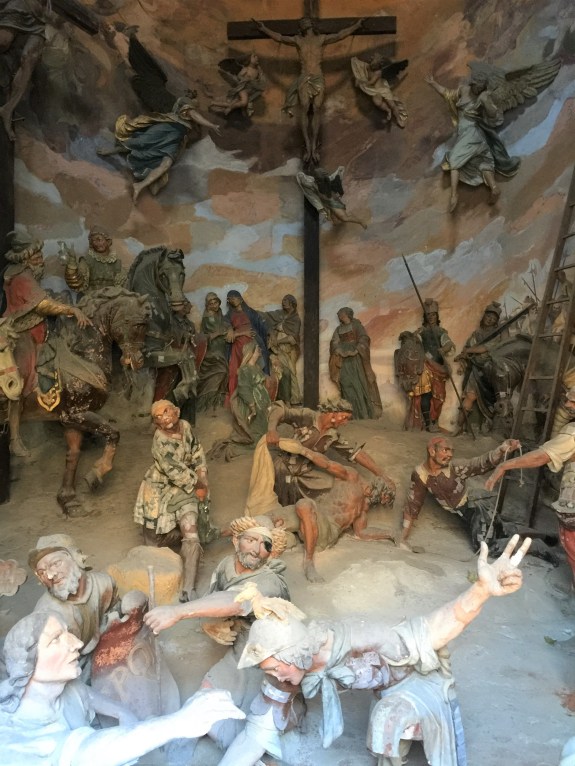
Chapel 10: the Crucifixion, where Jesus dies on the cross.
My photo

I’m sure the pilgrims’ attention would have rapidly shifted from the crucifixion in the background to the soldiers throwing dice for Jesus’s cloak in the foreground. The sculptor created some very interesting-looking characters there. It’s certainly where my attention went.

The final four chapels and the church are dedicated to the five episodes of the glorious mystery:

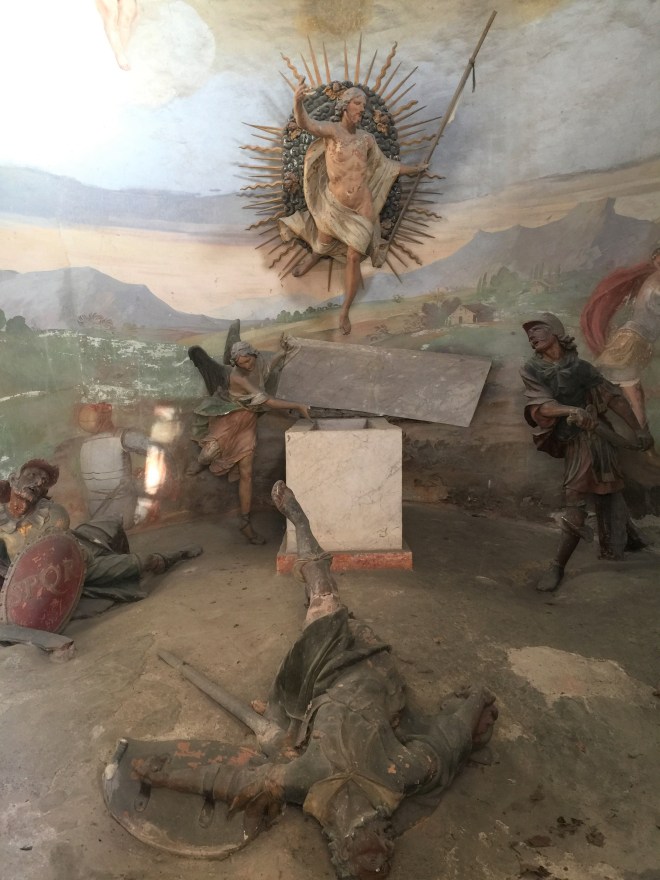
Chapel 11: the Resurrection, where Jesus rises from the dead.
My photo

The soldier sprawled on the ground in the foreground with his leg in the air is a nice touch, although the statue is in dire need of restoration.

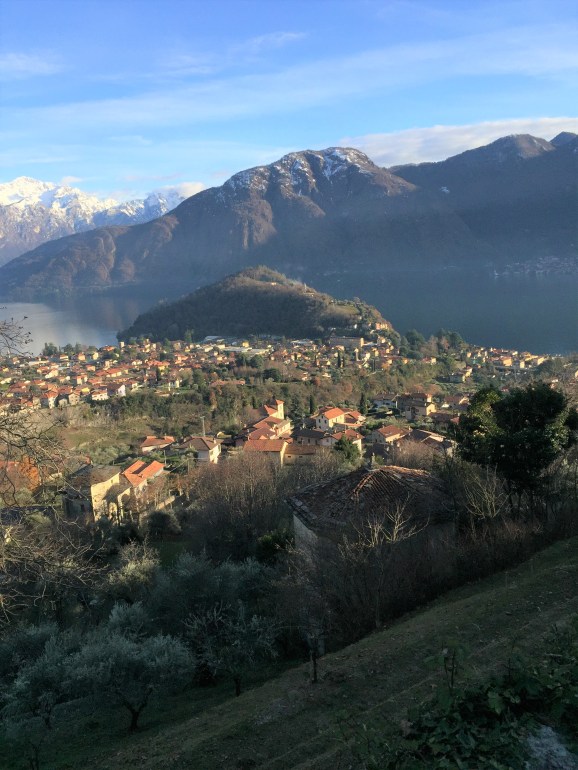
By now, we are high enough to get a good view across the lake and of the mountains – snow-capped at this time of the year – behind it.
My photo

Chapel 12: the Ascension, where Jesus ascends into heaven.

My photo

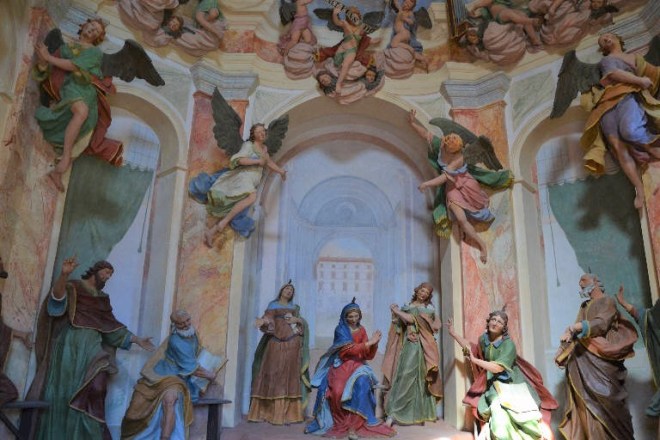
Chapel 13: the Descent of the Holy Ghost on Mary and the Apostles.
Source

As we toil our way up to the next chapel, another lovely view opens up across the lake.
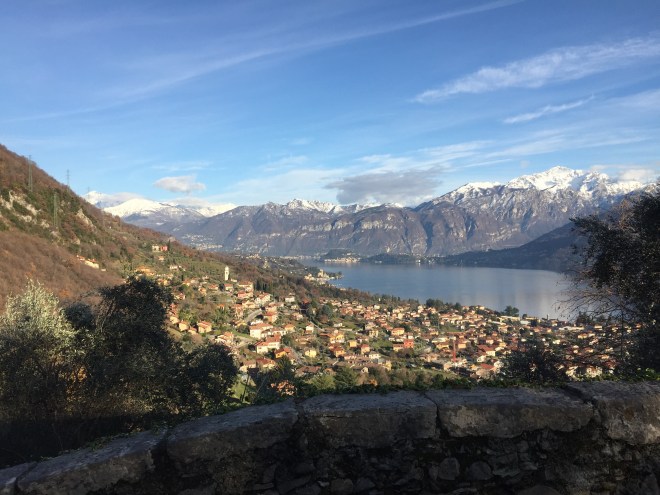
My photo

Chapel 14: The Assumption of Mary into heaven after her death.
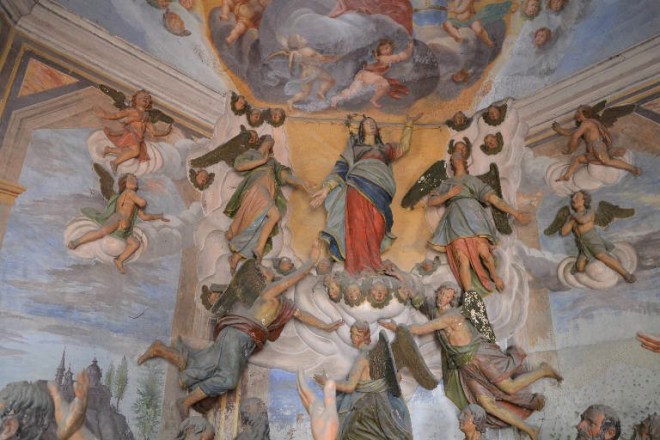
Source

Finally, after having huffed and puffed our way up the sometimes very steep path, we reach the church.
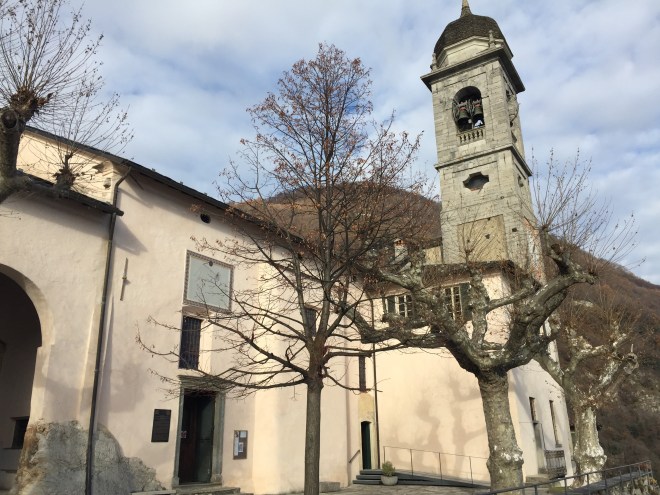
My photo

A typically baroque church greets us when we enter – the chairs set at the required safety distances in these times of Covid-19.
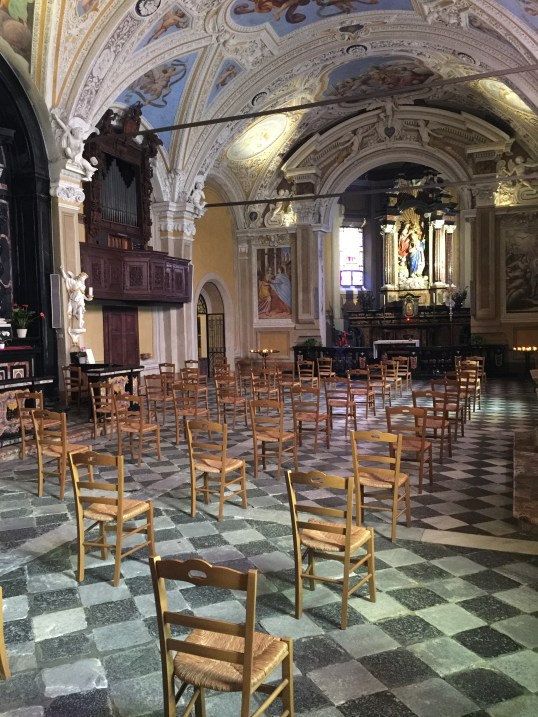
my photo

At the far end, over the main altar, we have the representation of the last episode of the glorious mystery, the Crowning of Mary as queen of heaven and earth.
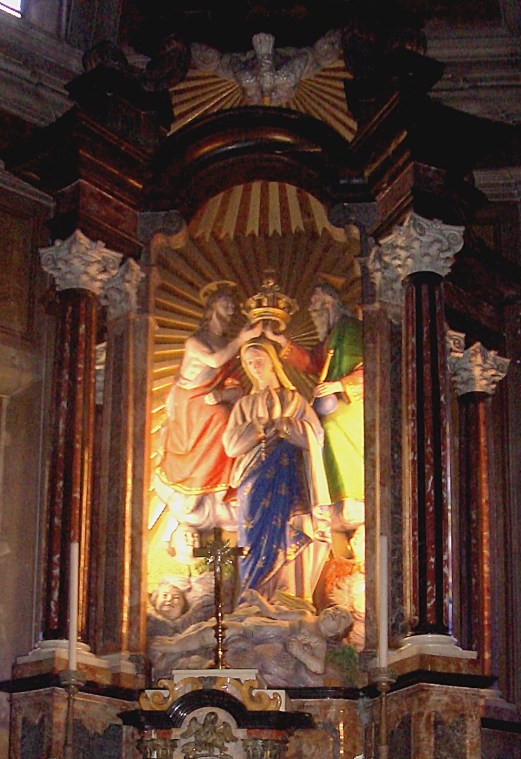
Source

These little scenes we’ve witnessed as we’ve climbed up the hill are really wonderful pieces of theatre. In fact, that was their purpose, to teach a largely illiterate population the main stories from the New Testament through pictures: another example of the Poor Man’s Bible, which I commented on in a post long ago about San Gimignano in Tuscany.

Set-ups like this one in Ossuccio were very much promoted by San Carlo Borromeo, Archbishop of Milan (known affectionately as “el Nasùn” because of his very large nose).

Source

He saw these as an important way of reaching out to the poor and downtrodden, who might otherwise be tempted by Protestantism, and as a way to talk to them about Christianity in a “language” which they understood. As a result, Ossuccio is one of a good number of so-called Sacred Mountains that dot the landscape of northern Italy; it bordered Protestant lands in Switzerland and was in danger of Protestant infection. The religious passions have died away but these masterpieces of baroque sculpture have remained. They have been declared a group UNESCO World Heritage site.

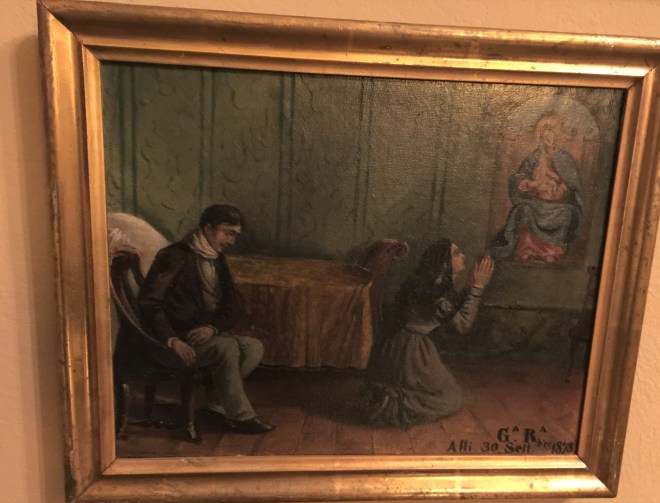
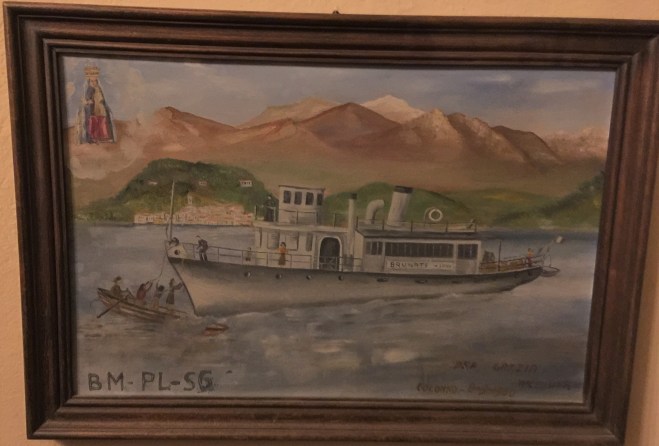
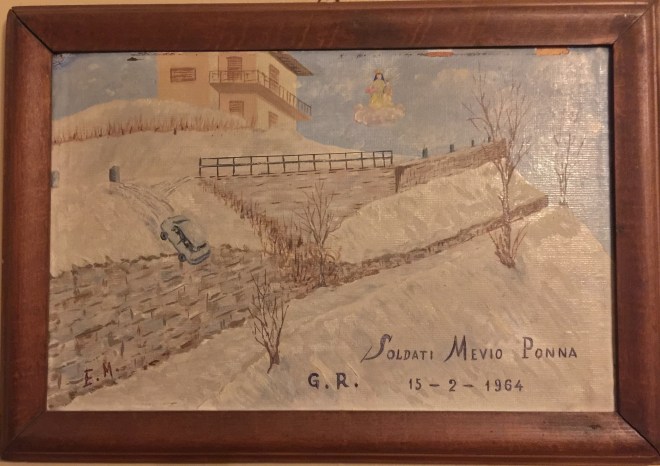
The funny thing is, this whole programme was tacked over a much earlier veneration of the Virgin Mary on the site of the church. The current church replaced an earlier church, which archaeological digs have shown in turn replaced an even earlier Roman temple to the goddess Ceres (Ossuccio was originally a Roman township by the name of Ausucium). She was the goddess of agriculture and by extension fertility. But since crop failures could have calamitous repercussions, she was also prayed to to avert catastrophes and was given thanks when catastrophes were averted. Somehow, in the shift to Christianity, this latter aspect of the cult of Ceres was transferred to the only “goddess” which Christians had, the Virgin Mary. It was to her that you prayed if something terrible happened to you, and if you survived you would often donate an ex-voto to her shrine as a memento of her presumed intercession. Since remotest time, then, the church high on the hill above Ossuccio has been a shrine dedicated to the Virgin Mary and it has continued to be a place where people have come to pray for her intercession in times of danger. As a result, there is a little chapel off the main nave of the church which is stuffed full of ex-voto. I love these ex-voto, which tell us, sometimes in touching detail, of terrible misfortunes averted. I include here just some of the ex-voto which lined the walls of that little chapel.

The earlier ones seem to focus on recovery from grave illnesses.
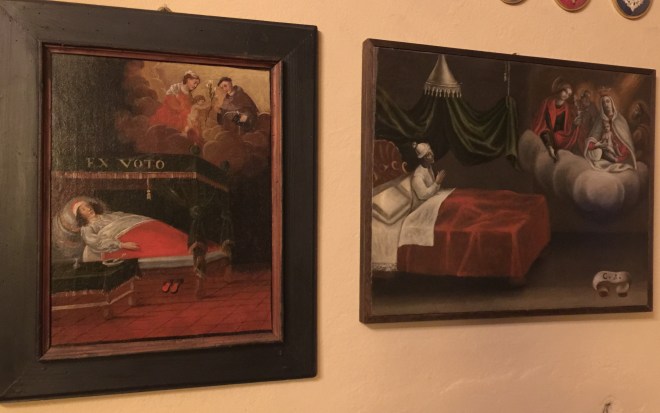
My photo
My photo

Later ones seem to focus more on run-ins with modern technologies of one sort or another – I suppose people were getting healthier while their environment was getting more dangerous.
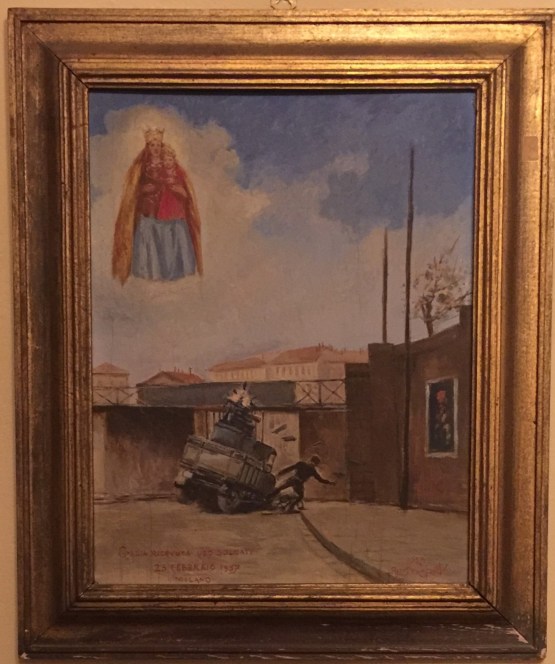
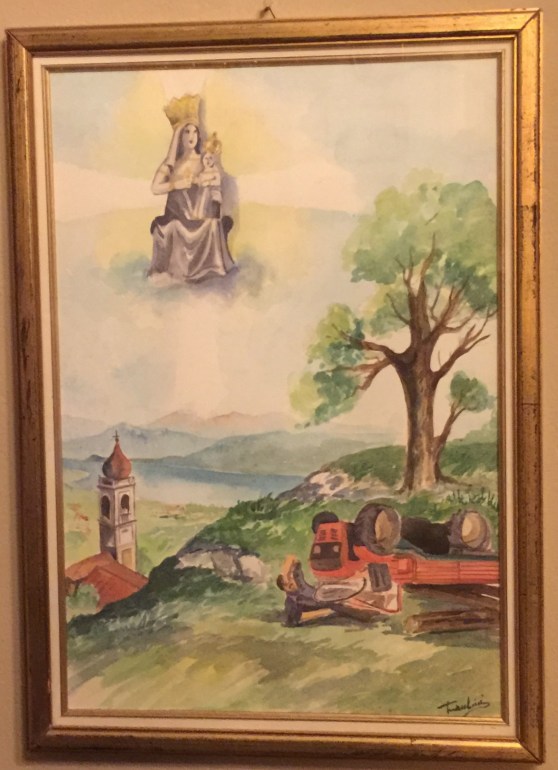
My photo
My photo
My photo

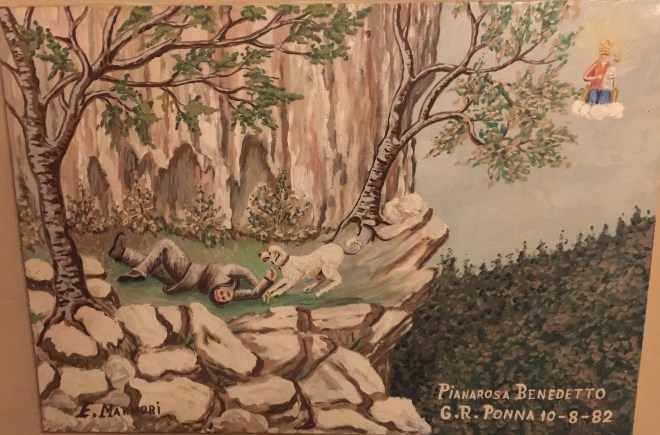
A couple have to do with falling from great heights.
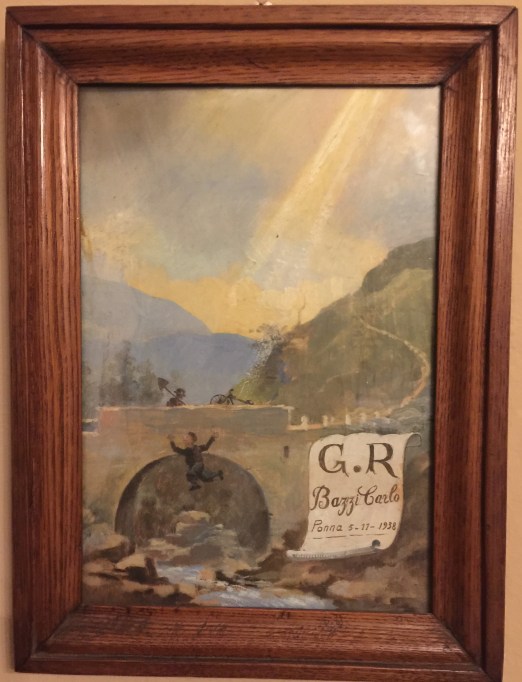
My photo
My photo

This last one speaks to us in particular. I presume the poor man has fallen from some sort of cliff. The area is littered with old quarries, and the slopes can anyway often be very steep. As my wife and I hike above and below these old quarries and along some very steep slopes, we are uncomfortably aware of the steep drops to our sides. One foot wrong …. Oh Blessed Virgin, keep us safe! (hey, you never know, a little prayer might help.)

HOLLY AND CHRISTMAS

Milan, 12 December 2020

It’s that time of the year again! Time to drink nice hot toddies, time to put up the Christmas tree and other sundry decorations, time to set up the nativity, time to put on the CD of Christmas carols and sing along (in my case, somewhat off-key).

“The holly and the ivy,
When they are both full grown,
Of all the trees that are in the wood,
The holly bears the crown.”

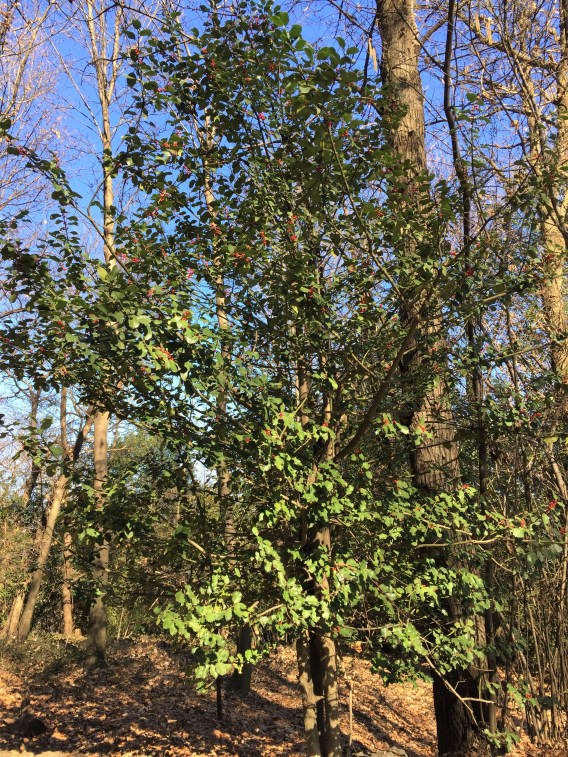
Holly is a nice plant. With its lovely shiny green leaves and strongly red berries, it really does bring a brightness to our lives just when we most need it. I was struck by this most forcefully last December, when my wife and I were hiking through the woods around Lake Maggiore and Lake Como (a pleasure that is currently denied us by the latest round of Covid lockdowns). The trees were all bare and drear, the rustling underfoot as we trod over dead leaves reminding us of the lovely greenery that had covered them just a few months before. Suddenly, we spied a bright cheerful green among the trees. It was a holly tree.

My photo

Quite soon, a few more popped up between the bare trees.

my photo
My photo

No doubt we were traversing a zone where soil and climate conspired to give the holly a competitive advantage.

It was a pleasure to see holly in the wild. Before then, I’d only ever seen holly trees tamed and manicured to within an inch of their lives in a garden, a splash of dark green against the lighter green of lawn

Source

Or used as a well-trained, well-trimmed hedge.

Source

And of course I’d seen holly as part of the wreaths which people hang on their doors at Christmastime.

Source

This connection between Christmas and holly is very old. When you strip away all the layers of religiosity that envelop Christmas, it’s really a feast about the winter solstice, a celebration of when the sun, which has been dying and allowing the days to get ever shorter and nature to die, is reborn, slowly making the days become longer and nature come alive again. In our festivities welcoming the rebirth of the sun, it made perfect sense for us to use plants like holly which are still green at the winter solstice, to remind the sun of the job it had to do to make everything else green again.

Thus we have the Romans decorating their homes with holly during their feast of Saturnalia, a winter solstice feast where there was a lot of gift-giving, feasting and merrymaking (a lot of other things happened during Saturnalia which need not detain us here, but any reader interested in Roman goings on can read about them here).

Source

Funnily enough, when early Christians followed Roman practice and hung holly in their homes and churches, the pagans around them told them not to – I suppose they thought these bloody Christians were desecrating their festival. But at the same time the Church Fathers were also telling them not to, finding this ritual really too pagan for words. Luckily for us, the Christian-on-the- street ignored both the pesky pagans and kill-joy Church Fathers and continued to hang holly in their homes and houses of worship. Which in turn has allowed us to sing over the ages (in my case, somewhat off-key),

“Deck the halls with boughs of holly
Fa la la la la, la la la la
‘Tis the season to be jolly
Fa la la la la, la la la la”

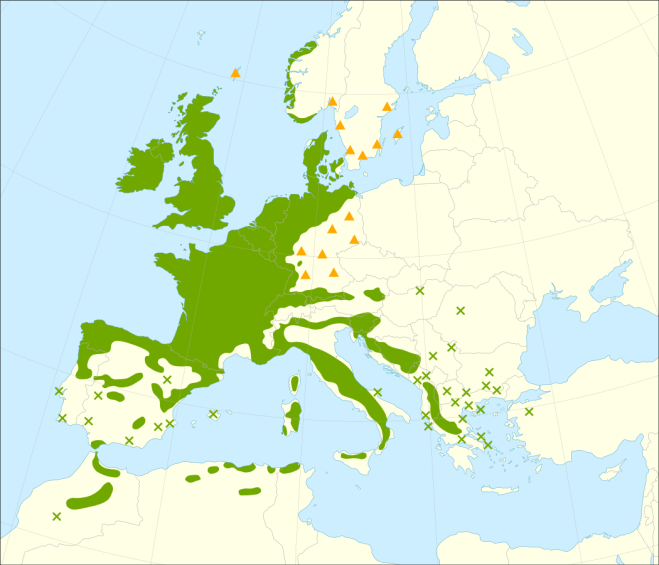
Presumably, as the legions marched outwards from the Roman heartlands they took with them their Saturnalia festival. Holly (at least the species which grows around Rome) is present in just about all the European regions and some of the North African regions which the Romans conquered (the green crosses mean isolated populations, and the orange triangles indicate places where the holly was introduced and became naturalized).
Source

So no doubt halls were also decked with holly in the Roman colonies of western Europe and North Africa. In fact, it is possible that our Christmas love affair with holly in Western Europe has its roots in the Romans’ Saturnalia festival.

Or perhaps not. Because holly was also a special plant for the Celtic tribes of Northern Europe: the map above shows that holly was very much present in their heartlands. They too decked their halls with holly, and for much the same reasons as the Romans: the plant’s evergreen leaves and bright red berries brought cheer to an otherwise dreary time of the year, and they were a reminder that greenery had not disappeared for ever, that it would soon be back, warmed by a re-born and newly vigorous sun.

The Celts saw holly as a symbol of fertility and eternal life, and imparted many magical powers to the plant. Hanging holly in homes was believed to bring good luck. During winter, branches of holly in the house would provide shelter from the cold for fairies, who in return would be kind to those who lived in the dwelling. In the same vein, holly was believed to guard people against evil spirits. So Druids wore holly garlands on their heads, as did chieftains. Holly trees were often planted around homes; because holly was believed to repel lightning this would protect homes from lightning strikes. Just as the oak tree was considered the ruler of summer, so the holly was seen as the ruler of winter, the dark time. As such, holly was associated with dreams and Druids would often invoke the energy of holly to assist them in their dream work and spiritual journeying. Here is one rather fanciful modern depiction of the magical powers of holly.

Source

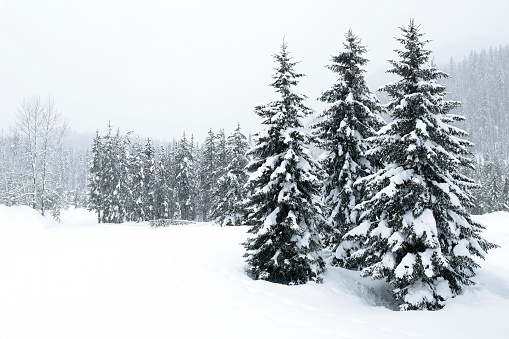
Holly is not the only evergreen plant which has been caught up in our Christmas celebrations. There’s the Christmas tree, of course.

Source

“O Christmas tree, o Christmas tree
Thy leaves are so unchanging
Not only green when summer’s here
But also when it’s cold and drear”

The custom of using pine trees in Christmas celebrations started in modern-day Estonia and Latvia, by the way, during the Middle Ages and spread out from there. The trees were traditionally decorated with flowers made of colored paper, apples, wafers, tinsel and sweetmeats. I would say that the original idea was to remind us that trees would soon be a-fruiting again.

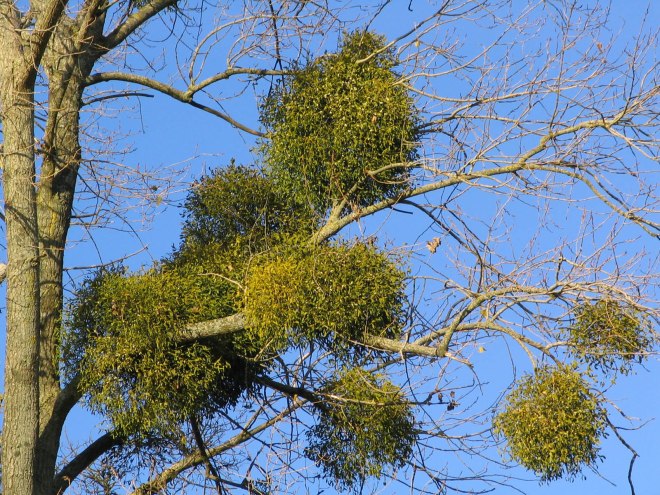
Then there’s the mistletoe.

Source

“When I close my eyes
It’s just you and I
Here under the mistletoe
Magic fills the air
Standin’ over there
Santa hear my prayer
Hеre under the mistlеtoe”

Our wanting to steal a kiss under the mistletoe is a pale reflection of an ancient belief that mistletoe brought fecundity into a home – its white berries were considered to be the sperm of the oak tree.

Source

Kissing under the mistletoe will never feel the same again now that I’ve read that.

I actually have a sense that just about any evergreen plant was made part of Christmas celebrations in some place and at some time – after all, if the point of having evergreen plants around was to remind us of the newly green world just around the corner, any evergreen plant should surely do the trick. I rather like a Christmas decoration that was once popular and summed up all the ideas around the use of evergreens in a celebration of the re-birth of the sun. This was the Kissing Bough. It was a popular Christmas decoration before the pine tree dethroned it and came to dominate our Christmases. To make one, five wooden hoops were tied together in the shape of a ball (four hoops vertical to form the ball and the fifth horizontal to go around the middle). The hoops were then covered with whatever evergreen plants were at hand: holly, ivy, rosemary, bay, fir or anything else (signifying the vegetation to come). An apple was hung inside the ball (signifying the fruits to come) and a candle was placed inside the ball at the bottom (signifying the re-birth of light). The Bough was finished by hanging a large bunch of mistletoe from the bottom of the ball (signifying the fecundity to come).

Source

Coming back to holly, before we get carried away with all this magical imagery and mystical meanings (and let me tell you, the Internet is awash with reams of magico-mystico stuff on holly), let’s go back even beyond our Celtic and Roman forebears to a time when we were mere hunter-gatherers. Etymologists believe that the word “holly” has its origins in the Old English word hole(ġ)n. This is related to the Old Low Franconian word *hulis, and both are related to Old High German hulis, huls. These Germanic words appear to be related to words for holly in the Celtic languages, such as Welsh celyn, Breton kelen(n) and Irish cuileann. Probably all come from Proto-Indo-European root *kel- “to prick”.

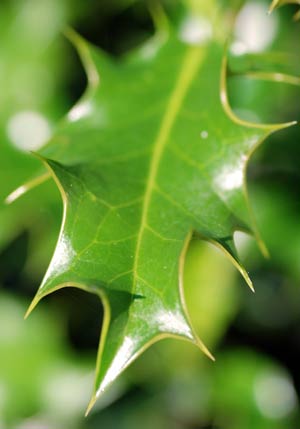
What an eminently sensible lot, the hunter-gatherers were, to give this plant a name which stressed its prickliness! Yes, holly is nice to look at, but get close and you immediately notice something else: its leaves have very sharp spines.

Source

This is not a tree to hide under or climb: something I learned as a child when I was once violently pushed into a holly hedge by another, very nasty, child. Ouch, it bloody hurt!

WHAT’S IN A NAME?

Vienna, 30 November 2020

Wagram: A region close to the River Danube upstream of Vienna, where there are steep terraces made up of deposits of loess laid down millions of years ago.

Source

“Wagram” is a composite of two Middle High German words: “wac” (moving water, river) and “rain” (meadow, slope). So Wagram means Slope by the Water or Bank. No doubt these terraces were created centuries ago by a meander of the Danube which then changed course at some point, because there’s not much water by these slopes now. Vineyards have been planted on many of the terraces where the slopes are not too abrupt.

Source
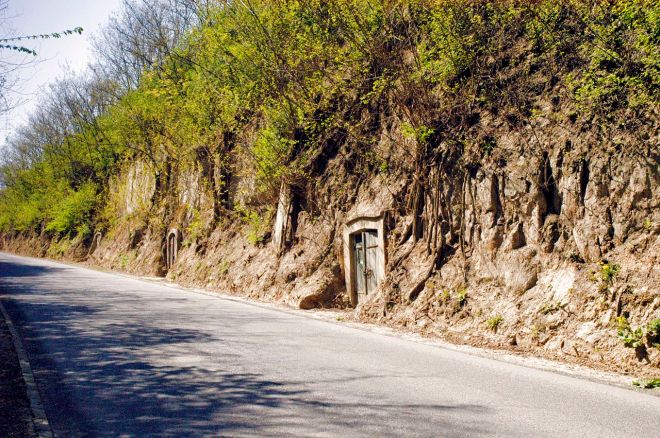
I suppose the sandy soil of the loess is good for vines. The wine – mostly made with Grüner Veltliner grapes – is good enough to have given the region its own wine name, “Wagram”. In some of the steeper slopes wine cellars have been dug directly into the loess.

Source

We’ve been climbing up and down these terraces throughout the summer, principally because we’ve been hiking along sections of the pilgrim path to St. James of Compostela, known as Jacobsweg in this part of the world. The path happens to run along the loess terraces.

Source

Many a village which stands at the foot of these terraces has added “Wagram” to its name. So we’ve walked through Fels am Wagram, Kirchberg am Wagram, Königsbrunn am Wagram, Stetteldorf am Wagram, Eggendorf am Wagram, … (there’s even a Wagram am Wagram, which seems a bit exaggerated).

Deutsch-Wagram: Sharp-eyed readers will no doubt have noticed that on the map above, a village of this name is marked. It is across the Danube from Vienna and a little to the north-east of it.  It too sits on deposits of loess, although the slopes of the terraces here are very gentle, almost imperceptible. The village stands on the northern edge of a flat plain, the Marchfeld plain, which is rich agricultural land. There’s really nothing much to say about this village. I’ve looked at its Wikipedia entry and sifted through photos of the place online, but I could find nothing of any substance to report – except for one thing: it gave half of its name to one of Napoleon I’s major battles.

Battle of Wagram: It was fought in early July 1809 not too far from where I’m writing this. Napoleon had captured Vienna in May, but the Austrian Emperor had not capitulated, and the bulk of the Austrian army was undefeated and was camped on the Marchfeld plain across the Danube from Vienna. Napoleon concluded that until he had beaten this army no peace could be concluded. He therefore decided to get his army across the Danube onto the Marchfeld plain and give battle. His first attempt, in May, using the island of Lobau as his entry point into the plain, was a costly failure. This has come down in history as the battle of Essling, taking its name from the village of Essling around which much of the fighting took place.

Source

Learning from his mistakes, Napoleon prepared his army’s crossing of the Danube through Lobau with far more care and this time the crossing was successful. And so by the early hours of 5 July the two armies were facing each other across the Marchfeld plain. This rather fine old map shows the battleground nicely.

Source

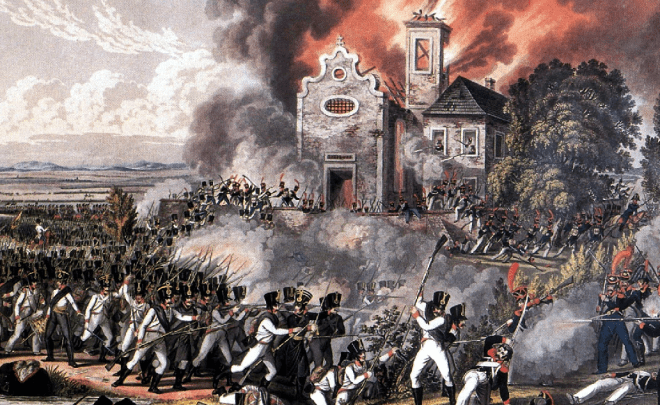
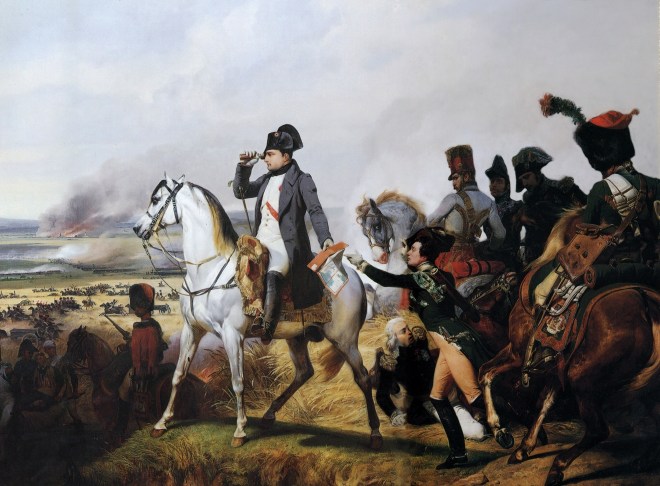
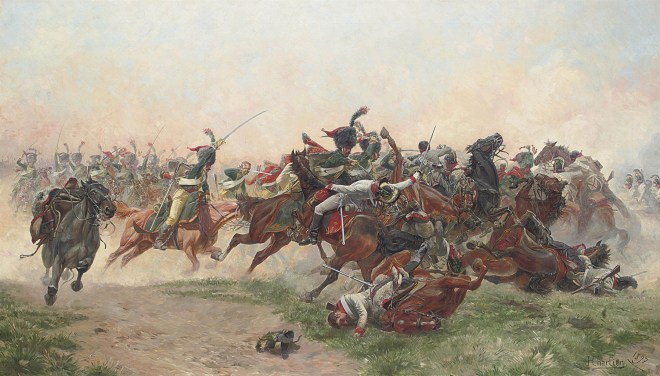
The Austrian commander, Archduke Charles, knew that Napoleon would cross again at Lobau and had set up his positions along the slight ridge of loess, placing himself at the centre of the Austrian line, in the village of Deutsch-Wagram. That slight ridge, along with a marshy stream which ran at its foot and which acted as a fine defensive barrier, put the Austrians in a good position. I do not propose to give a detailed blow-by-blow account of the battle. A few fanciful paintings of a propagandist nature will suffice.

Source
Source
Source

The reality of the battle was grimmer. After two days of hard fighting, the Austrian army retired in good order while the French army was too knackered to properly pursue it. The French claimed victory, and although that was technically correct the “victory” didn’t change the strategic situation. After another inconclusive battle 5 days later at Znaïm, the two sides agreed to an armistice.

The battle of Wagram and the previous battle of Essling had been very costly. The casualties were very high on both sides, but for the French, after more than 10 years of almost continuous fighting, it was harder to make up the losses. Napoleon’s enemies had finally understood his strategies and were beginning to emulate them. There were going to be no more spectacular victories with relatively light losses as there had been in the past. Many see the battle of Wagram as the beginning of the end for Napoleon.

Avenue de Wagram: One of the twelve avenues that radiate out from the Arc de Triomphe in Paris. Although now largely forgotten, the avenue’s naming in 1864 was originally a piece of propaganda by the-then Emperor Napoleon III. It was always useful for him to glorify the deeds of his uncle Napoleon I, it was a way of burnishing his rather more doubtful credentials. Baron Haussmann was busy creating a new urban landscape for Paris at the time, which, among other things, meant that the area around the Arc de Triomphe was being remodeled. The Arc had originally been built as a memorial to one of Napoleon I’s greatest victories, the battle of Austerlitz. When his ashes were returned from the island of St. Helena in 1840, they passed through the Arc de Triomphe on their way to his final resting place in Les Invalides.

Source

Why not, then, turn the area around the Arc into a memorial to the first Napoleon’s military genius? And so, in 1864, a number of the new avenues radiating out from the Arc were named after Emperor Napoleon’s more famous battles (his earlier battles when he was a mere revolutionary general or even First Consul were ignored): along with the Avenue de Wagram, there was the Avenue d’Essling which I’ve already mentioned, the Avenue d’Iéna, celebrating the battle of 1806 fought at Jena in Thuringia, during which Napoleon pulverized the Prussian army, the Avenue de Friedland, celebrating the battle of 1807 fought in what was then eastern Prussia, during which Napoleon decisively beat the Russian army, and the Avenue d’Eylau, commemorating a battle fought four months prior to Friedland in the same neck of the woods. One other avenue was named the Avenue de la Grande Armée, to commemorate Napoleon’s imperial army which had fought in all of these battles and more during his campaigns from 1804 to 1814. To cap it off, a circular road which runs around the Arc de Triomphe had one half of the circle named rue de Presbourg, commemorating the treaty of Presbourg signed with Austria after the victory at Austerlitz, and the other half named rue de Tilsit, commemorating the treaty of Tilsit signed with Russia after the victory at Friedland. As a cherry on the Napoleonic propaganda cake, a number of the remaining avenues were named after members of the Napoleonic clan. Quite understandably, all these last avenues had their names changed later when Napoleon III was toppled, along with the avenues commemorating the battles of Essling and Eylau (not surprising really; as we’ve seen, Napoleon actually lost the battle of Essling and he only just won the battle of Eylau).

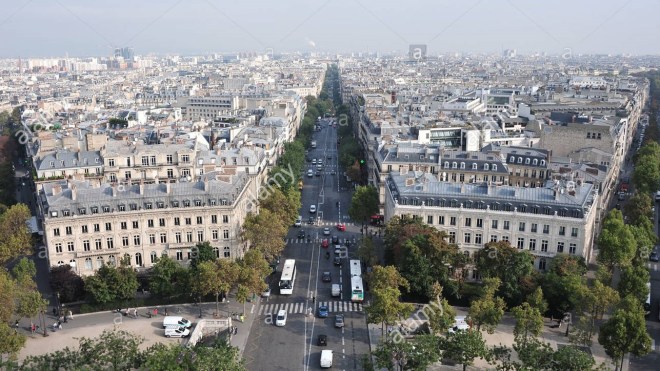
I’m sure all this propaganda from the past is lost on the avenue’s current inhabitants. The only thing that seems to matter today is that Avenue de Wagram is a very chic place to live. While not situated in the “seizième arrondissement”, the 16th district of Paris, the city’s toniest district, it is still a very desirable place to put on your calling card. Real estate on the avenue is eyewateringly expensive. This is a view of the avenue from the top of the Arc de Triomphe.

Source

As befits such a moneyed area, it is represented in Parliament by a member of the right-of-centre party Les Républicains, Ms. Brigitte Kuster.

Source

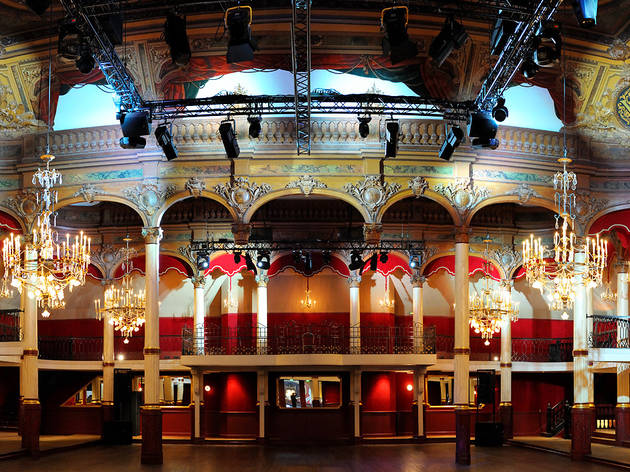
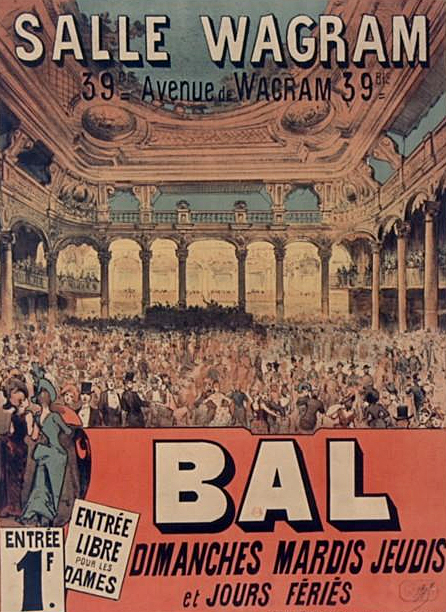
Salle Wagram: Whatever the Napoleonic propagandists might have wanted, for the people of Paris the area around what became Avenue de Wagram near the Arc de Triomphe had been a place where you went and had fun ever since the Revolution. The ball got rolling with a drinking hole where you could also dance. Then came theatres, music halls, concert-cafés, and then cinemas.  Perhaps the most famous of these palaces of fun was the Salle Wagram, a large hall built in 1865. It was located at 39bis, avenue de Wagram.

Source

It was famous as a place where Gay Paree went to dance the night away.

Source
Source

But it was also a place for exhibitions and other “serious” shows, like the First Cycling Exhibition of 1894.

Source

The money took over from the fun. All the places of entertainment other than Salle Wagram and a couple of others have disappeared, leaving space for expensive offices and apartments. C’est la vie, as the French philosophically remark.

Station Wagram: The name of a station in Paris’s subway system, one of many.

Source

It serves Avenue de Wagram, although it’s actually located on a small street that crosses the avenue – the avenue’s greater name recognition decided the station’s naming. Opened in 1911, many of the initial travellers no doubt used the station to go to Salle Wagram or the other entertainment spots in the area. But now it probably only services workers whose offices are in the area and the cleaners and other domestics who work in the surrounding rich apartments.  The station itself is nothing to write home about. Perhaps it was more interesting architecturally when first opened, but the modernizations of the 1960s have left it a bog-standard station.

Source

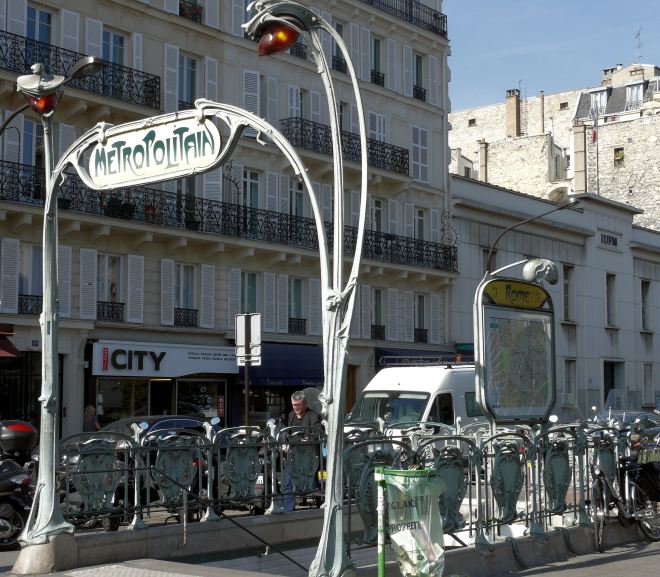
Its one saving grace is its entrance, which harbours one of Hector Guimard’s delightful Art Nouveau floral designs.

Source

So it is that by the vagaries of history, loess terraces in eastern Austria were transmuted into a dot on the Parisian subway map 1200 km away.

Source                                                                                     Source

C’est la vie, as the French say.

YELLOW AND RED

Vienna, 21 November 2020

Just look at that maple! What a magnificent yellow its leaves turned!

my photo
my photo

My wife and I walked under it during a hike we did a couple of weeks ago. We were following the edge of a wood and lo and behold! there it was.

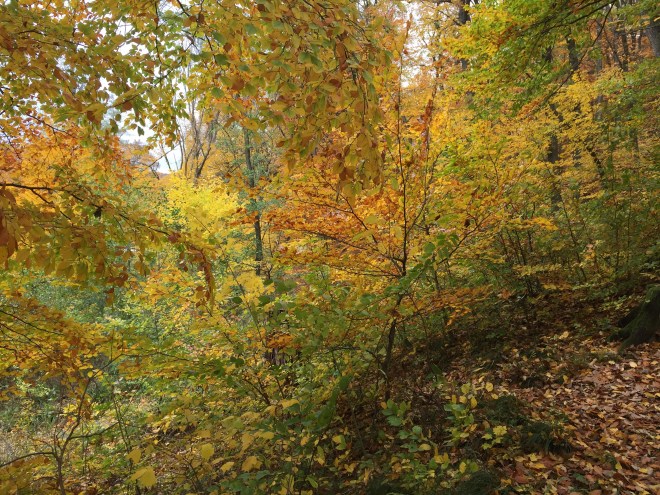
As I mentioned in an earlier post, as we have been walking the woods these last few weeks the trees have been putting on their autumnal colours. We have been bathed in yellows of all hues, turning to russet, and finally to dark brown.

My photo
my photo
My photo

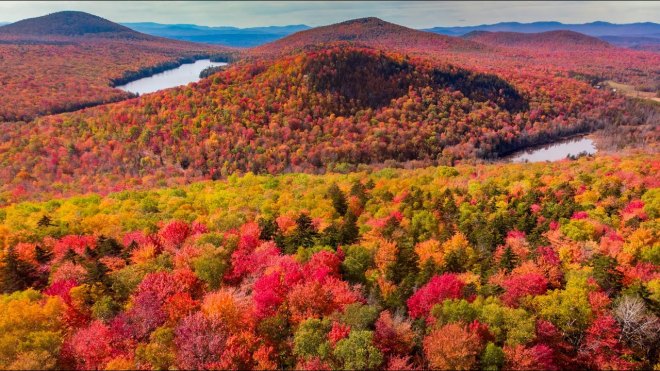
But what we have not been bathed in is reds. We have not witnessed the wonders of a North American Fall

Source

or the splendour of an East Asian Autumn.

Source

“Why is that?” I asked myself as I sat there gazing at my photo of that yellow maple tree, “why is it that North Americans and East Asians have splendid red hues in their autumn colours and we in Europe do not?”

To answer this, we are going to use a version of Root Cause Analysis called the “5 Whys”. This was something invented by Sakichi Toyoda, the father of the founder of Toyota, who claimed that you had to ask “Why?” (more or less) five times before you got to the root cause of something. His son used it extensively in his car factories as a quality control tool, to discover the fundamental reason – the root cause – for a quality failure (and at a much more modest scale I have used it to discover the root cause of a source of pollution or waste). A simple example goes as follows:

“Why the hell isn’t my car working?!”
Because the alternator isn’t functioning.
“Well why is the bloody alternator not functioning?!”
Because the alternator belt has broken.
“Oh. Why did the alternator belt break?”
Because it was well beyond its useful service life but has never been replaced.
“Ah. Why wasn’t it ever replaced?”
Because you, idiot that you are, didn’t maintain your car according to the recommended service schedule.
“Ah, right, OK, sorry about that.”

OK, so now we can start using the method on our little problem:

“Why do the leaves of many species in North America and East Asia go red, whereas so few do so in Europe?”

We see leaves as green because of the chlorophyll they contain. But leaves also contain other pigments, which if the chlorophyll were not there would make the leaves look yellow, orange, or all hues in between. The chlorophyll simply masks them.

In Europe, when autumn comes and the chlorophyll begins to disappear, these other pigments are finally allowed to “express themselves”, giving the leaves the beautiful hues of yellow that we see. This explains the fact that the maple we came across went from green to lovely canary yellow.

Source and source

In North America and East Asia, something else happens when the chlorophyll begins to disappear from the leaves. There, trees begin to produce – from scratch – a red pigment, anthocyanin, in their leaves. This pigment masks – or perhaps “mixes with” – the yellow or orange pigments already there, to give various shades of red. Thus do North American and East Asian maples go from green to red.

Source and source

“OK, but why do North American and East Asian species produce this red pigment at the end of their leaves’ lives?”

Yes indeed, it does seem that the trees and bushes which do this are penalizing themselves. Just when their leaves are about to fall off, part of the general shut-down for their winter slumber, the trees start expending precious energy to pump their dying leaves full of red pigment. The reason for this apparently foolish behaviour has to do with pest control and especially control of aphids (which I happened to mention in an earlier post on wood ants). Aphids have this nasty habit (as far as trees are concerned) of sucking amino acids from them in the Fall season, and then laying their eggs on them; the eggs hibernate along with the trees and give birth to a new generation of aphids in the Spring. So the trees get hit twice: they lose precious amino acids to those pesky aphids, and then the next year they have to endure attacks by the next generation of aphids! Now, it so happens that aphids believe that a brightly-coloured tree is a tree that is chemically well defended against predators, so they tend to avoid laying their eggs on such trees. So of course trees in North America and East Asia have evolved to turn themselves bright red in the Fall, just when the aphids are laying their eggs, by pumping their dying leaves full of anthocyanin.

“Why do aphids think a brightly-coloured tree is a chemically well defended tree?

I thought you might ask that. The answer is, I don’t know. Stop being a smart-ass and move on to the next question.

“A bit touchy are we? Well OK, why don’t European trees make their leaves go red then?”

Because they don’t they have aphids which prey on them.

“Why is that? How can it be that aphids prey on the North American and East Asian trees and not on the European trees? What’s so special about European trees?”

Yes indeed, this is where it gets really interesting. To answer this, we have to go back 35 million years. At about this time, the northern hemisphere began to go through a series of ice ages and dry spells. Most trees reacted to this by going from being evergreen to deciduous. They also retreated southwards when the ice sheets advanced and returned northwards when the ice sheets retreated. In North America and East Asia, their predators of course went with them, evolving to deal with the fact that trees now lost their leaves and went dormant during the winter. In turn, the trees evolved to fight off these predators by, among other things, turning their leaves red in the Fall. This struggle between tree and predator continued even as the trees moved northwards or southwards as the ice sheets advanced or retreated. Thus, still today, the trees in those parts of the world go a glorious red in the Fall.

But in Europe, there were the Alps and their lateral branches, which ran east-west. In North America and East Asia, the mountain ranges, where they existed, ran north-south, so the trees in their periodic advances and retreats could “flow around” these mountains. In Europe, though, as the trees moved southwards to escape the ice sheets they hit the barrier of the Alps; there, they could go no further and so perished in the piercing cold. And so of course did the predators which they harboured. Only seeds were carried southwards, by birds or the wind or in some other fashion, and of course these seeds harboured no predators. Thus it was that European trees did not need to make red leaves and so they give us glorious shades of yellow in the Autumn.

There is at least one exception to this rule, and these are dwarf shrubs that grow in Scandinavia. They still colour their leaves red in autumn. Unlike the trees, dwarf shrubs managed to survive the ice ages; in the winter they would be covered by a layer of snow, which protected them from the extreme conditions above. But that blanket of snow also protected the insect predators! So the plants had to continue their struggle with their predators, and thus evolved to colour their leaves red. We have here an example, the smooth dwarf birch.

Source

Well, that was an interesting use of the 5 Whys method! I must see if there are other issues I could use it on.

WOOD AND FIRE

Vienna, 14 November 2020
Updated: 13 June 2025
Updated again: 23 September 2025

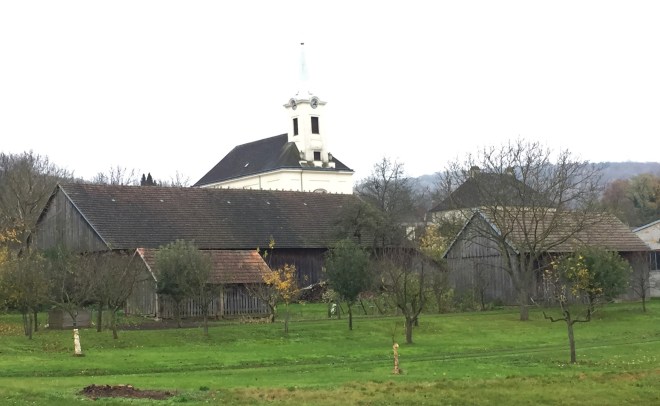
As befits a mountainous country with a coolish climate, Austria has acres of forests covering its many hills and mountains. As a consequence, it once had a vibrant tradition of building in wood. Nowadays, of course, wood as a building material has been almost completely superseded by stone, brick and concrete. The only places you still see wooden buildings are in the small villages which dot the countryside, wooden barns being still quite common there. My wife and I come across them quite often on our hikes, as these photos taken on a couple of recent hikes attest.

my photo
my photo
my photo

I love these old barns. My French grandmother had one just like them attached to the side of her house. We went in there often because that was where the bicycles and the ping-pong table were kept. It was – to the small me – a vast, cavernous place. All sorts of weather-beaten garden tools and other odds-and-ends lurked in the shadows. There was a pile of hay – quite why I don’t know; my grandmother had no animals. But it made the barn smell of hay, into which was mixed the smell of beaten earth rising from the floor. Then one summer I arrived for the summer holidays, only to find the barn gone. My grandmother told me that it had been sagging sideways and threatening to pull the rest of the house down with it. But this perfectly rational explanation didn’t take away the desolation I felt at the disappearance of this wonderful building.

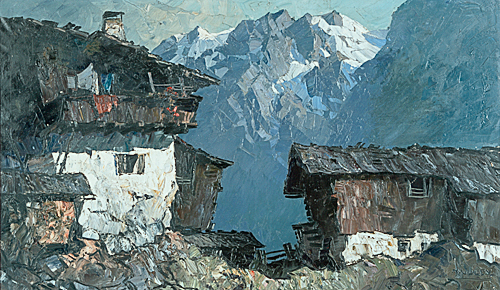
As I say, there was a time when many more buildings in this country were made of wood, especially in the mountain regions. A number of Austrian artists have captured them on their canvases. Oskar Mulley was especially assiduous in his painting of mountain huts and barns, partly or wholly made of wood.

Source
Source

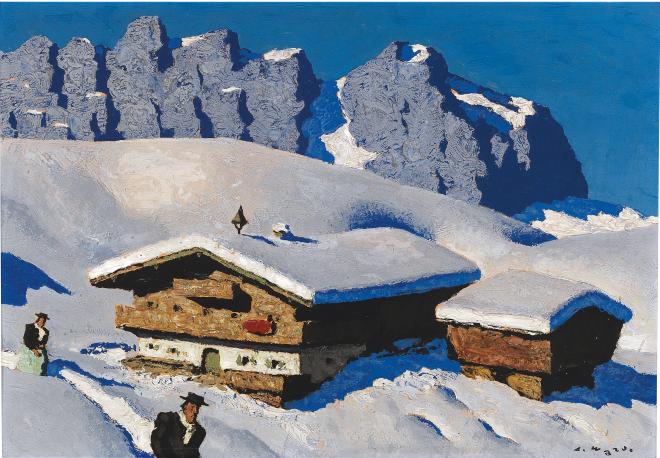
Alfons Walde also often included these buildings in his paintings, although snow was more his thing.

Source
Source

Alas, as we all know only too well, wood burns very well. The older and drier it is, the better it burns, as we all learnt watching the roof of the cathedral of Notre-Dame in Paris go up in smoke.

Source

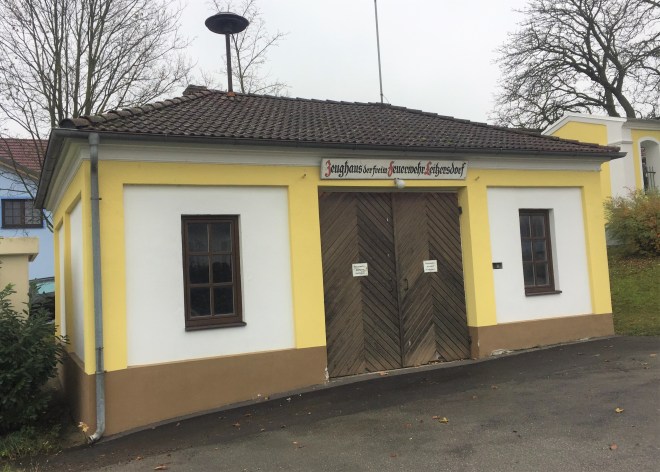
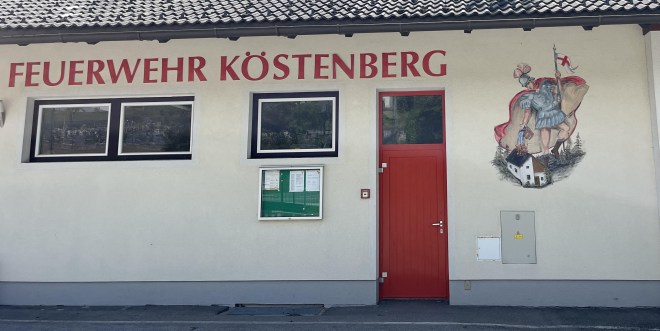
The previously common use of wood in construction in Austria and its tendency to burn well must explain why every municipality in this country, down to the smallest village it would seem, has a fire station. As an extreme example, a couple of days ago my wife and I passed through a small village on one of our hikes, which had not one

my picture

not two

my photo

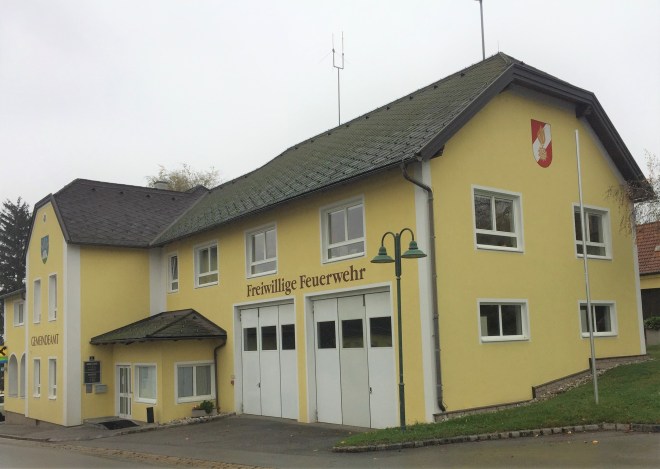
but three fire stations!

my photo

And each one is bigger than the last. Are fires getting bigger in this village, I wonder, or is it that fire engines are getting bigger and need a more spacious building to house them, or (a somewhat uncharitable thought) have municipal budgets been growing?

Of course, as befits a traditionally Catholic country, Austrians have a saint whom they can invoke to protect them from fire: St. Florian. Austrians should be particularly proud of this saint since he is a native son. The annals tell us that he was born in the latter part of the 3rd Century C.E. in Lorch, near Linz, on what was then the edges of the Roman Empire – the Danube River, which flows just north of Lorch, was the frontier of that Empire. Since so many Roman army units were garrisoned along the frontier his father could have been an army officer. Florian was active, possibly also as an army officer, in St. Pölten (or Aelium Cetium, as it was then called) when one of the periodic rounds of persecution against Christians broke out. This one occurred in 303–304 C.E., under the Emperor Diocletian (the same round of persecution that put paid to St. Pancras, about whom I wrote an earlier post). Without going into the details, which are anyway of dubious validity, it is recorded that Florian was arrested as a Christian. After a trial and various tortures, he was drowned in the Danube by being thrown off a a bridge with a stone tied around his neck. Thus did he become a martyr and a saint.

Sensibly enough, Florian was initially invoked to protect people from the dangers of water. At some point, though, he was pivoted (to use that most modern of terms) and used instead to protect people from fire. My theory – for which I have absolutely no evidence – is that another saint, John of Nepomuk, about whom I’ve written in an earlier post and who died in almost exactly the same way as Florian – thrown from a bridge and drowned – won the competition for protecting people from the dangers of water, leaving Florian without a role. Well of course, one critical use of water was to put out fires, so hey presto! he became the protector from the dangers of fire.

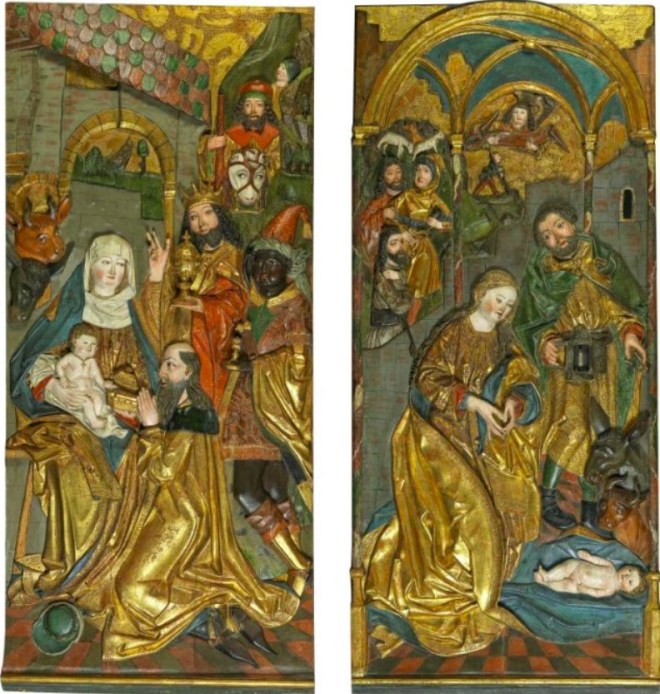
The Austrians have not only used wood to build, they have used it to carve, and their churches (and museums) are full of wonderfully carved statues and bas-reliefs. I throw in here a couple of bas-reliefs (from southern Germany in this case) which were recently auctioned at Vienna’s Dorotheum auction house.

Source

Naturally enough, the saints who got a place in churches tended to be people’s favourites, ones whom they prayed to regularly. Given the ever-present danger of fire, one of these is St. Florian. My wife and I came across this lovely example of a St. Florian statue during one of our hikes this Autumn, down by Neusidler See (the same hike where we picked up bagfuls of walnuts).

my photo

We see here all the typical attributes of such a statue. Florian is dressed as a Roman soldier and gripping a banner, he is holding a bucket of water, and he is thoughtfully pouring that water over a little burning house situated at his feet. Delightful! My wife and I have come across scores of such statues during our wanderings over Austria’s hills and dales. In fact, we came across a fresco of him on the wall of a house just this afternoon.

my photo

One statue of St. Florian which we haven’t seen, though, and which I have put on my bucket list stands in the town of Bad Tölz in Upper Bavaria. The statue was set up in a square, in front of the town’s tax office. Since the statue gave its back to the tax office the sculptor thought it fitting to have the saint flash his bum to the tax men, to show them what he – and the rest of the town – thought of them.

Source

I think we can all sympathize with the citizens of Bad Tölz, especially since St. Florian’s feast day is 4th May, a few days after 30th April, which for many in the world is the deadline for turning in their income tax returns.

Luckily, making statues of St. Florian has continued into the modern age. Down the street from us is a modern church dedicated to St. Florian. Outside the parish offices is this bronze statue of the saint.

My photo

It must be obvious by now that the firemen and women of Austria (and I’m guessing Germany) have Saint Florian as their patron saint. And in fact many of Austria’s fire stations have a depiction of Saint Florian on their walls. Here’s a very traditional depiction.

My photo

Here’s a more modern take.

My photo

By extension of his duties as heavenly fireman, St. Florian is also the patron saint of many trades where fire was once used: bakers, brewers, coopers (the staves which coopers used to make barrels were steamed to make them pliable), potters, forges, soap boilers (who knew that was once a profession?). He is also, naturally enough, the patron saint of chimney sweeps, which, dear readers, contrary to coopers, soap boilers, and the rest is not a profession that has disappeared – not in Austria, at least. They are alive and well and thriving here.

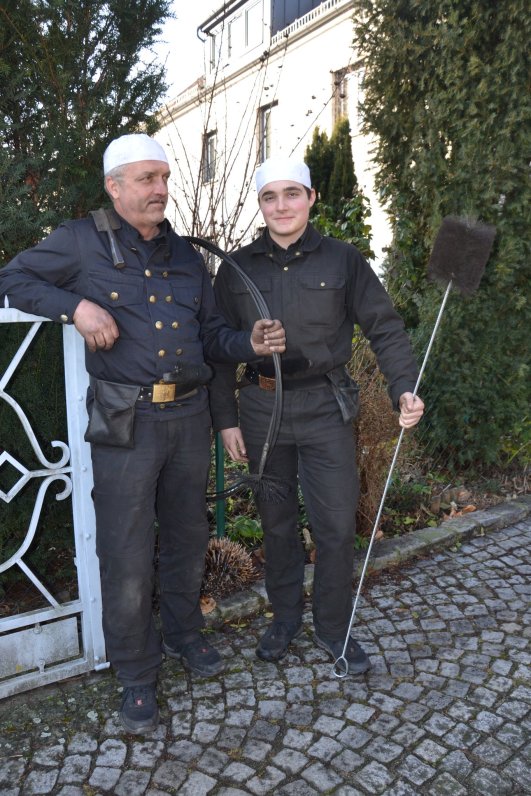
When my wife and I first came to Austria, we were struck by these young blokes we would see (there have also been some young ladies in recent years) walking the streets and wearing this strange outfit: black overalls with a white head covering.

Source

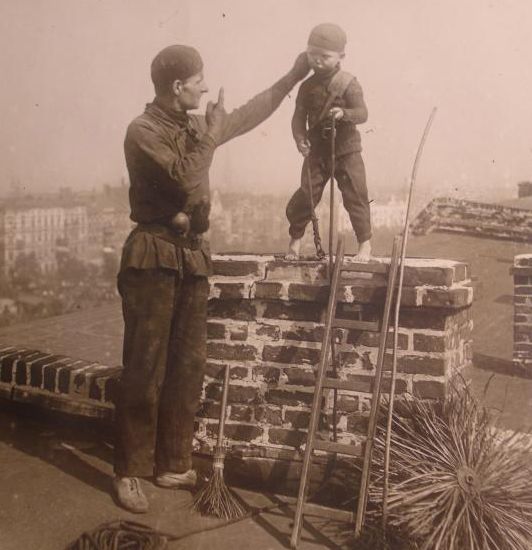
Upon enquiry, we were told that they were chimney sweeps. Chimney sweeps?! Well, both my wife and I have been around the block a couple of times (I won’t admit to how many) and neither of us have any memory of our parents calling in chimney sweeps. I don’t know about my readers, but to me the term “chimney sweeps” conjures up a Dickensian vision of little boys being forced to climb down narrow chimneys by a nasty master and getting stuck and dying.

Source

At a minimum, chimney sweeps should be dirty-looking, like coal miners.

Source

In fact, they should have died out along with the coal industry. But no, these Austrian fellows are around in large numbers and are lick-spittle clean; they don’t give the impression of ever getting within a mile of an actual chimney. What is going on here?

I don’t want to be uncharitable, but I rather get the impression that we have here a great example of a union using its political muscle to avoid extinction. The way I see it, when chimney sweeps saw that their days were numbered, they got the governments – municipal, for the most part – to pass laws requiring homeowners to have their chimneys – used for gas water heaters for the most part these days – as well as the water heaters themselves checked at least once a year by a “chimney sweep”. As a homeowner in Vienna, I have had the doubtful pleasure of having Viennese “chimney sweeps” come over, solemnly open a little trap door in the wall, perfunctorily take a look in, declare all to be well, and require to be paid handsomely for this service. And on top of it all they expect a tip at Christmas! This year, I found this “service” particularly grating because just a few days before the “chimney sweep” had come around we’d had the water heater maintained by a man who spent a good deal more time on the job and got paid proportionately a good deal less. But we can’t get out of it, because if we were to have a fire – Oh St. Florian, spare us this disaster! – and if it turned out to have been due to something the chimney sweep would have checked if we had called him, then the insurance wouldn’t pay – they have you over a barrel (made by one of those coopers who have since disappeared).

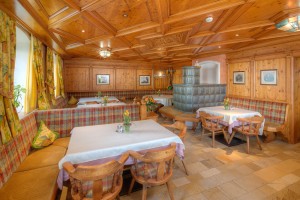
Not wishing to end on this sour note, writing about chimney sweeps reminds me that in the old days, when they really did sweep chimneys out, they would have cleaned chimneys connected to those wonderful tiled stoves which they used to have here in Austria. Some places actually still have them. We came across one this summer while staying in a hotel on a hike near Innsbruck; the stove is at the back of the room in the picture.

Source

As readers can see, they have a bench around the bottom where one can sit with one’s back against the stove wall keeping nice and warm. I understand people would even sleep on these benches. But what is really lovely about these stoves is their decoration. I throw in a few pictures of such stoves.

Source
Source
Source

Once, when we were looking for an apartment in Vienna to rent, my wife and I were shown one with such a stove. For one mad moment, we thought of taking the apartment just for the stove. But good sense prevailed; it would have been too small, the children wouldn’t have had their own rooms. Sometimes, though, my wife and I reminisce about that stove we never had. Another thing on our bucket list.

MARTIN’S GOOSE

Vienna, 11 November 2020

Often in past years, on this day – 11 November, the day on which the First World War ended on the Western Front – I have published a post in memory of those who died in that war or who were permanently scarred by it. But this year, since my wife and I are spending November in Vienna, I published this year’s memorial post a few days ago, in recognition of the fact that the war ended about a week earlier for the Austro-Hungarian Empire. So instead, I shall use this post to celebrate rather than grieve. I shall write about a food dish, the Martinsgans (which for some strange reason becomes Martinsgansl in Austria).

Martinsgans is a dish from the German lands and is traditionally eaten today, 11 November (but of course nowadays, as a way of increasing sales, it gets offered in restaurants for a couple of weeks around that date – although this year, because of Covid, all the restaurants are now closed in Vienna). It is a dish based on goose – Martinsgans translates into English as Martin’s goose. Why Martin’s goose rather than anyone else’s goose? Well, that’s because 11 November happens to be feast day of St. Martin in the Christian calendar.

A Martinsgans made according to tradition consists of roast goose served with cooked red cabbage and potato dumplings. This is what it will look like when it is placed on the table to the oohs and aahs of the assembled family and guests.

Source

For those of my readers who feel the need for an adventure in the kitchen, here is a recipe for making Martinsgans.

The goose:

Wash the goose thoroughly inside and out and dry.  Cut a couple of apples and an orange into eights, mix well with some thyme and marjoram, and stuff the goose with the mix. Tie the goose up and seal with wooden skewers. Rub the goose well on the outside with salt, pepper, marjoram and thyme, and then place the bird, breast side down, in a large greased roasting pan or baking dish. Roast the goose in the oven, preheated to 220°C, for about half an hour. Brush the goose with honey several times and pour a bottle of beer over it. Turn the oven down to 180°C, deglaze with a little water, and roast the goose in the oven for about 2 hours. Pour its own juice over the goose while it is roasting. Take the roasted goose out of the oven, and let it rest for a while before serving.

While the goose is roasting, you can prepare the red cabbage and the potato dumplings.

Red cabbage:

Clean, wash and finely chop the red cabbage. Mix with some orange juice and red wine, a dash of lemon juice, salt and caraway seeds, and let it all steep for a while. Then cook in a saucepan over medium heat until soft (30 minutes or so).

Potato dumplings:

Peel some potatoes, cook them until soft, then squash them. Mix in some potato starch, semolina, salt and nutmeg. Let the dough rest for half an hour. Then form the dumplings, and let them simmer in a saucepan with salted water for 15 minutes.

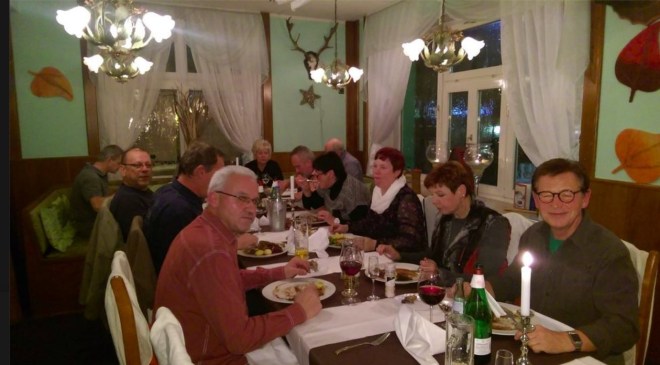
I could leave it there and invite my readers to go celebrate life with a Martinsgans night out, as these folk are.

Source

But I’m afraid I can’t. Too many questions were buzzing through my mind when I was reading up on Martinsgans. Why is the goose eaten on 11 November and not 11 October or 11 December, or indeed the 11th of any other month? And why goose rather than duck or swan – or chicken or turkey or any other fowl? I had to investigate further, and as is my habit I feel a bursting desire to share what I have learned with my readers (and I fervently hope that they have a bursting desire to listen).

On the question of why November 11. As usual, there are several reasons given on the net. The one which I think makes most sense is that it is the result of the Catholic Church’s liturgical calendar. There was a time, long, long ago (from the 7th to 12th centuries CE, to be precise), when the Church required all good Christians to do three days of fasting a week from St. Martin’s day (i.e., 11 November) to Christmas, to prepare themselves for that great feast. Very sensibly in my opinion, people decided that they would have one last good meal before starting to fast. Thus was born the tradition of having a slap-up meal on St. Martin’s day.

What’s odd, though, is that the Church authorities eventually decided to cut this period of preparation before Christmas – which is now called Advent – to four weeks, with the start date being in the very last days of November. So why didn’t the slap-up meal migrate to the end of November?

It could be because, together with the decision to shorten the Advent period, the Church authorities dropped the requirement to fast (a very sensible decision in my opinion; I never could understand why fasting would make you more religious). So perhaps there was no longer any need (or excuse) to have a slap-up meal just before Advent started.

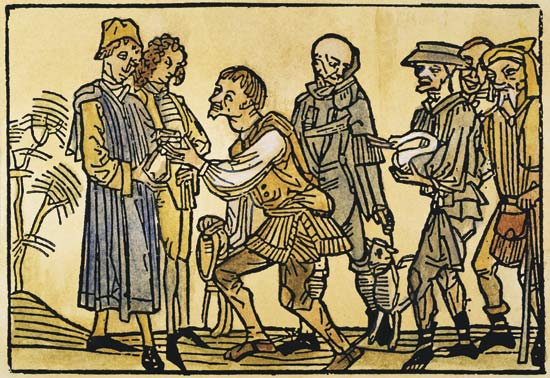
But then why continue with the slap-up meal on St. Martin’s day? And here I think we have to look to some of the other reasons proposed on the net. In the old agricultural calendar, the beginning of November was when in many European countries excess livestock was slaughtered and the meat salted or otherwise preserved (I wrote about one such product, the Italian cotechino, in an earlier post). As a result, it was also a period when many peasants (I dare hardly call them farmers) paid some of the rents which they owed to their lords, payments nearly always made in kind rather than in cash.

Source

St. Martin’s day was traditionally the day when these payments were made. Early November also happens to be the time when domesticated geese are at their fattest. Hence, payments were often made in live geese (in the picture above, one of the peasants is making his payment with what looks suspiciously like a swan).

It’s a little off the point, but I remember well a story which my mother used to tell us when we were young. My maternal grandparents owned some lands, which they rented out to local farmers. The day when the farmers paid their rents was St. Martin’s day. One such farmer was a farmer with red hair (this point was stressed in the story, because – quite unfairly, I think – my mother considered red-haired people to be excitable). In my imagination, I see him something like this.

Source

Like many rural folk of the time (we’re talking the late 1920s, early 1930s), this farmer had received little formal education – probably primary school, if that – before starting to work the land. The discussion would always start pleasantly enough. My grandfather would work his way through the accounts, showing the farmer, let’s call him Mr. Dupont, how he had arrived at the amounts due. As long as my grandfather kept to addition Mr. Dupont could follow. But whenever my grandfather strayed into multiplication, Mr. Dupont got nervous, he would go red in the face, raise his voice, and start objecting vociferously, with my grandfather vainly trying to placate him: “but no, Mr. Dupont, really, if you multiply 20 by 5 you get 100” – all to no avail. My grandfather had to keep to addition with Mr. Dupont.

But back to the subject at hand. Since the lords now had live geese on their hands, and since lords were always eager to eat fresh meat, we can understand that at least a few of the geese would have been sent to the lord’s kitchen for neck-wringing (or throat-cutting?), plucking and roasting, with a fine feast to follow.

Source

Luckily for us (because most of us had peasants as ancestors, no?), the industrial revolution came along and wealth got much better distributed. So it’s not only lords now who can afford to eat goose on 11 November, it’s most of us. Which is a Good Thing – except, of course, for the poor geese which end up roasted on our dining room tables.

Source

As I look these geese waddling to their roasted fate, I am reminded of a song in Carmina Burana (admittedly about a swan, but the principle is the same). The original is in Latin, but I will spare the readers the trauma of reading the original and give them an English translation:

Verse 1:
Once I lived on lakes,
Once I looked beautiful
When I was a swan.

Chorus:
Misery me!
Now black
And roasting fiercely!

Verse 2:
The servant is turning me on the spit;
I am burning fiercely on the pyre:
The steward now serves me up.

Chorus

Verse 3:
Now I lie on the platter,
And can fly no longer,
I see bared teeth.

Chorus

Spare a thought for the goose as you bare your teeth to tuck into your Martinsgans.

THE EASTERN FRONT

Vienna, 5 November 2020

It’s been many years since my wife and I have been in Vienna in November – 12,  to be exact; I have to go back to the year before we left for China. Like many things which have been done differently this year, the cause lies in Covid. Had it not been for that damned virus, we would have flown to Japan in early October for my teaching course, and we would have flown back to Milan in late October. As it is, constrained by the “new normal”, I am giving my course online, from my living room.

I see, though, that one advantage of being here in Vienna during the month of November is that I can continue my annual habit of memorializing the end of the First World War. But this time, rather than writing about the Western Front with which I am more familiar, I can write about the fronts in which the Austro-Hungarian Empire was involved, principally the Eastern Front.

Not that I know terribly much about the war on the Eastern Front, which was for the most part a war between the Germans and Austro-Hungarians, on one side, and the Russians, on the other. I have bought books on the subject over the years, but by a twist of Fate those books are down in Milan: all the books which we put into storage when we left for China went to Milan and all the books which we bought in China have ended up here in Vienna, and of course I bought books on the Eastern Front when we lived in Vienna before going to China.

So little do I know about the war in this part of the world that I got the date of the ceasefire between the Austro-Hungarian Empire and the Allies wrong. I thought it was on 7 November and was planning to post on that day, but actually it was on 3 November, so this post is actually two days late.

I’ve read that the Eastern Front was so long – it stretched all the way from the Baltic Sea to the Black Sea, so some 1,600 km – that trench warfare never really developed there. The density of soldiers along the Front was much lower than it was along the Western Front, so it was easier to break through the enemy’s lines, and then once a breakthrough was made it was difficult to stop it because the very sparse lines of communication made it difficult to rush the necessary reinforcements to plug the hole in the line. The result was a much more fluid Front.

That’s as may be, but a few years ago I took pity on a very faded aquarelle by the Austrian painter Rudolf Weber, an official War artist for Austro-Hungary, which was on sale at the Dorotheum Auction House. Its subject was a scene from 1916 on the Eastern Front, in Galicia to be precise. I felt that I owed it to the men who died there to give the aquarelle a decent home. It now hangs on the wall, in the shadows to protect it from the light. Although the colours are bleached, you can see a trench snaking across what appears to be a high plateau.

my photo

Weber must have been capturing a moment just after a local skirmish. In the lower left-hand corner one can make out dead soldiers lying on the edge of the trench as well as in it.

my photo

So there must have been some trench warfare on the Eastern Front.

What happened to those dead soldiers, I wonder? I suppose most of them must have been buried close to the front, just as they were on the Western Front. But are there military cemeteries like those lovely, well tended cemeteries that we see on the Western Front?

Source

I fear not. The Eastern Front runs through the modern-day countries of Latvia, Poland, Bielorussia, Ukraine, and Romania. A number of these countries suffered through the Russian Revolution and its many years of chaotic aftermath. Then this whole region was embroiled in the incredibly bitter fighting of the Second World War. I suspect that whatever military cemeteries were created along the Eastern Front vanished in the decades that followed.

Even if they had existed, they would have been too far away from Austria for most parents to visit and mourn over the graves of their dead sons. The Eastern Front was some 600 km away from Vienna at its nearest point, and as we’ve seen the means of communication we’re not good in that region.

Where did parents mourn their dead sons, then? I suppose they had to make do with the war memorials that dot every Austrian town and village (memorials that a mere 25 years later were lengthened, sometimes by a good deal, through the addition of the names of those who died in the Second World War).

Source

And what of the grand public memorials, by which the warring States memorialized the citizens which they sent to the slaughter? Austria has two. It has a War Memorial, erected in 1925 in the Central Cemetery, which is not central at all, being located on the edges of the city.

Source

And it has a Tomb of the Unknown Soldier, which has been placed within the building of the old city gates that give access to the old Imperial Palace, the Hofburg.

Source

Perhaps I’m reading too much into this, but I can’t help but wonder if the locations of these two monuments reflect the differing political contexts of the years in which they were built. Of course, there is a logic in having a memorial to the war dead in a cemetery, but in 1925 the elites were struggling to make a go of the new democratic Republic of Austria. Perhaps these politicians didn’t want any reminder too near the centres of power of the war which destroyed the Empire, leaving them with a small runt of a country to run: better to tuck it away in a cemetery on the outskirts of the city. By 1934, however, Austria was effectively a Fascist dictatorship, and no doubt the elites of this dictatorship wanted a monument glorifying the valiant “warriors” who fought and died for the fatherland in that war. Thus are monuments used to project political ideas.

The First World War spawned a slew of war poetry and war art in the UK and, to a lesser degree, in France, which wrestled with the moral outrage of this war. Did the same thing happen in Austria? I cannot judge if Austrians created any war poetry (I know the Germans did; I have translations of some of it). As for war art, few if any of the well-known Austrian artists who lived through the war seem to have produced anything war-related. Egon Schiele painted a few portraits of the Russian POWs that he was in contact with (because of his weak heart and his excellent handwriting, Schiele was given a job as a clerk in a POW camp).

Source

Gustav Klimt doesn’t seem to have created any war paintings – but then he was not personally involved in the war effort. Oskar Kokoschka, who actually fought on the Eastern Front, seems to have created only one painting, Knight Errant, with the war as its theme, but I find it too heavy on the symbolism for my taste.

Source

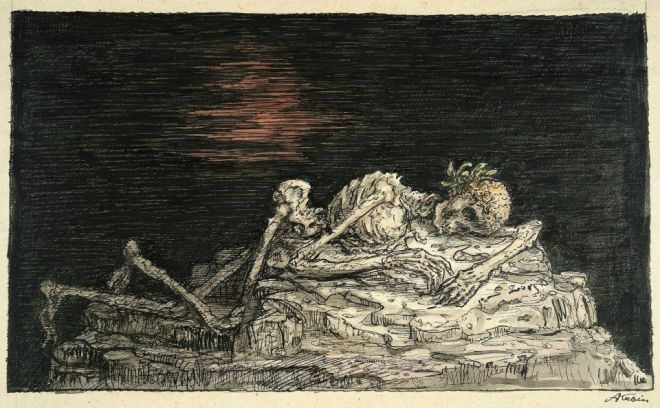
The same with Alfred Kubin, who seems to have only created this illustration, End of the War from 1918 – but, like Klimt, he was too old and had no direct experience of the fighting.

Source

Only Albin Egger-Lienz seems to have created some great war paintings. Here is his painting The Nameless.

source

Every time I see it, I am reminded of a commentary I read on the American Civil War, about an attack by Unionist troops on a Confederate-held fort. As they ran towards the fort, the soldiers leaned forward as if running against a strong hailstorm – which in a way they were, although it was a hail of lead rather than of ice.

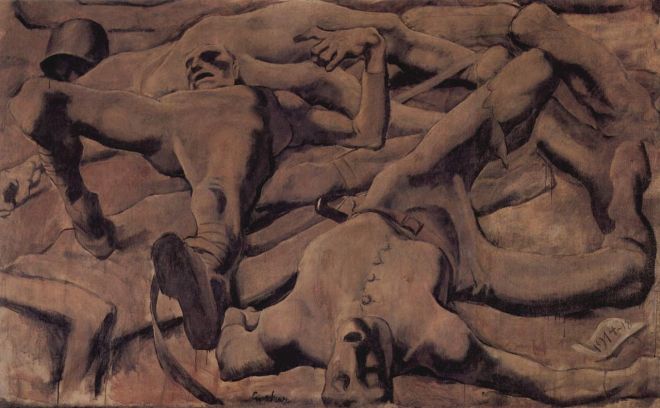
Here we have The Dead Soldier.

Source

This is Finale from 1918 (compare to Kubin’s lame attempt on the same theme).

Source

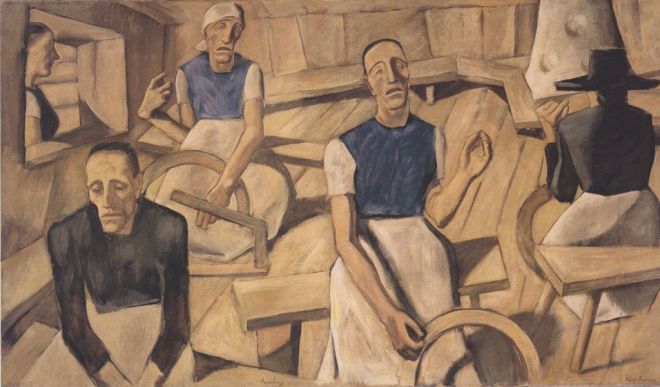
Egger-Lienz was also sensitive to the havoc the war wrought on home life. Here is his painting War Women, the women left behind when the men left for the war.

Source

And here is his painting The Blind, his commentary on the mutilations meted out by the war.

Source

Otherwise, we have to go down a level, to artists who are not all that well known outside Austria. A number of these were official war artists like Rudolf Weber, others fought in the war. Here, in no particular order, are some of the better paintings (and drawings) which I found on the net.

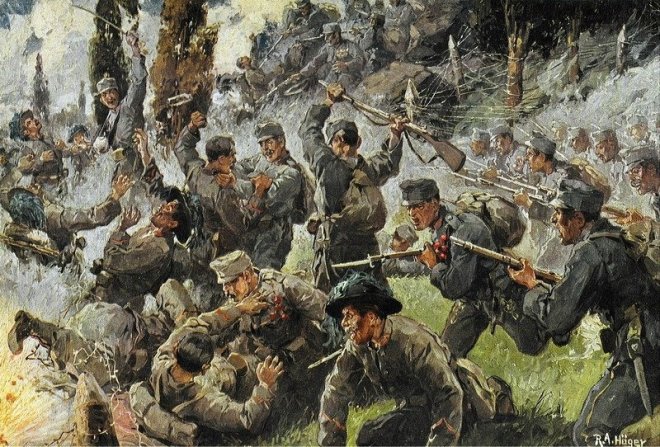
Rudolf Höger’s Fight at Doberdo

Source

Höger was an official war artist and no doubt was trying to show the soldiers in a good light, as brave “warriors”. But all I see is the sheer brutish thugishness of it all.

Alfred Basel’s Fighting in the Carpathians

Source

Basel was also an official war artist. In a way, his subject is no different from Höger’s, yet it seems more of a ballet in his hands.

This other work by Basel, After the Breakthrough at Tagliamento, reminds me of the work of another war artist, C.R.W. Nevinson, about whom I’ve written an earlier post.

Source

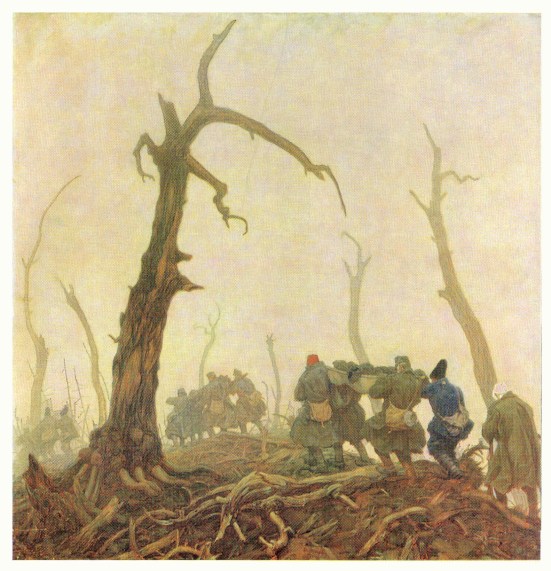
A painting by Wilhelm Dachauer

Source

Dachauer was assigned to a medical team as an orderly. No doubt this subject was drawn from his experience.

Stephanie Hollenstein’s Dying Soldier

Source

Pretending to be a man, Hollenstein joined a rifle brigade in 1915. After a few months, her officers discovered the deception and threw her out. But she returned to the Front, this time as an official war artist. No doubt she drew this on one of her visits to the Front.

Robert Angerhofer’s Dead Soldier in Barbed Wire

Source

As these paintings show, soldiers suffered and died in the same way on the Eastern Front as they did on the Western Front. But if there is one thing that has always struck me living here is how little the Austrians commemorate their war dead compared to the UK. Are the Austrians trying to forget their past? Or is it simply that they have decided that they cannot forever lament the dead? I sometimes think the British commemorate their war dead too much, in the process glorifying war. That is not good. But I don’t think we can just blank out the death and suffering of millions. We owe it to them not to forget.  So I’m glad that, once again – although a little late in this case – I have spent some time this year remembering the millions who died or were maimed, physically and mentally, in the war that was meant to end all wars.

AUTUMN

Vienna, 31 October 2020

Autumn is a wonderful time to go a-gathering. The last of the year’s fruits have ripened and are ready to be eaten – a cornucopia of Nature’s goodies waiting to be sampled!

Source

In the various hikes my wife and I have been making during this autumn season, we have been taking advantage of this bounty, gathering fruits that have (more or less) fallen into our laps.

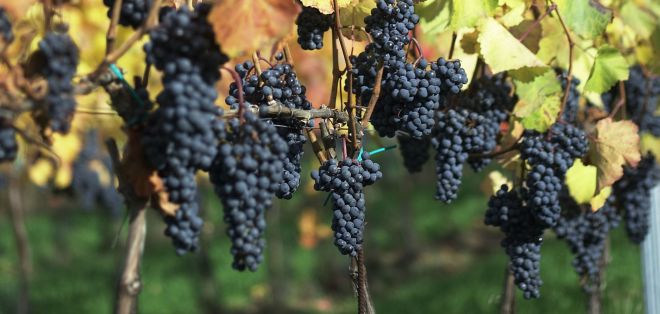
Our gathering started with grapes; not table grapes but wine grapes. I would admit, if my arm were twisted, that we took a few bunches from vines that were waiting to be harvested.

Source

But we soon discovered that quite often there were bunches at the very bottom of the vines which the harvesting machines they use nowadays didn’t catch.

Source

So we helped ourselves to those. I mean, they were obviously not going to get picked, and there was no point letting them rot on the vine, right? We ate white and red grapes indiscriminately, grapes that had been destined to become Zweigelt or Blaufränkisch in the red wines, Riesling or Grüner Veltliner in the whites. They were full of pips and had thick, rubbery skins but were wonderfully sweet.

Later on, we walked along hiking trails flanked by walnut trees

Source
Source

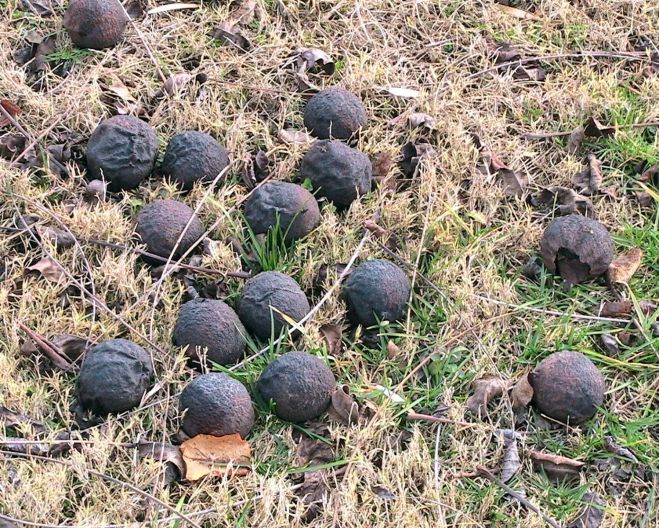
The ground below the trees was thick with walnuts still in their blackened husks.

Source

So many walnuts! It was terrible to see this bounty given to us free by Nature just being left to rot. So we got to work and collected several bags’ full, which we brought home to eat – waste not, want not, as my grandmother used to say!

my wife’s photo

That being said, I cannot in all honesty claim that they were a good find. Most of them were small, hard to crack, and the meat inside clung for all it was worth to the shell, a meat that after a while left a metallic taste in your mouth. Once we had dutifully finished our trove of nuts, my wife went out to buy some commercial walnuts, to remind ourselves how easy they were to open, how smoothly the meat fell out of the shell, and how delicious their taste was – sometimes, I have to admit, the products of the agro-industrial complex are tastier than the original …

Lately there have been apples and pears. In so many spots on our walks we came across apple or pear trees growing by the side of the path, groaning under their load of fruit and dropping them to the ground.

my photo

All these gifts from Nature, just going bad … It really broke our hearts to see this waste. I suppose the trees were planted in a time when more people lived on the land and when they grew more of what they ate. Now there is hardly anyone left in the countryside and those who are left can’t be bothered to pick the fruit from the trees their ancestors planted. Well, in memory of those ancestors, we gathered up a bag or so of both. The apples were really delicious: red-cheeked and slightly tart in their sweetness, just the way I like them.

Source

Not for me the vacuously mild Golden Deliciouses of this world!

The pears were not so good. A few are mixed in with the picture of our walnuts: small, green-skinned, with a flesh which was both granular and set the teeth on edge. But my wife whipped up a fruit salad, mixing them with some of the apples and adding a sprinkling of sugar and a dash of lemon juice. Mm-mm-goood! (pity we don’t have any gin in the house; a slug of that would have made the salad even more delicious).

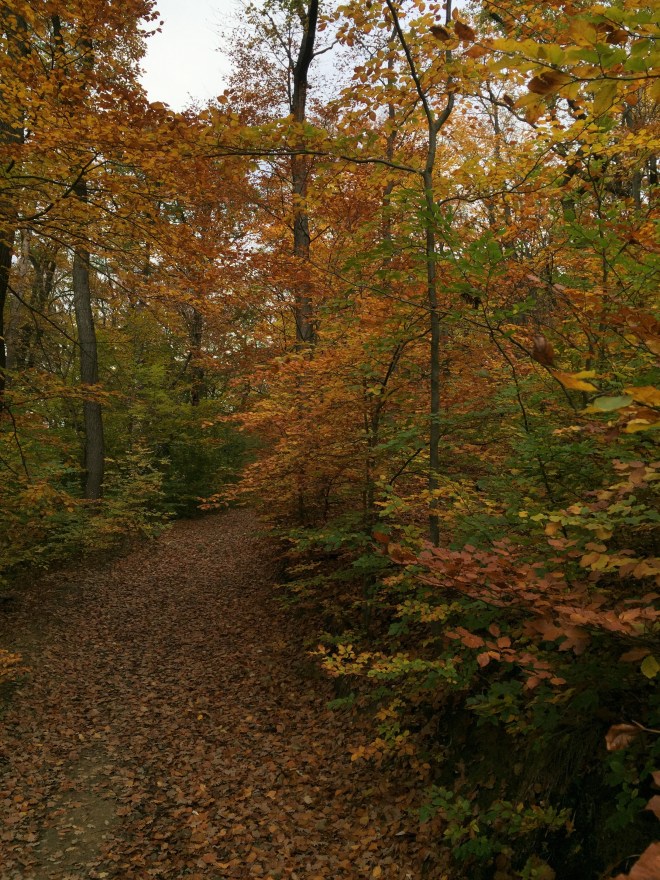
The fruit-picking time is nearly over. Now it’s leaf-watching time. This afternoon, we immersed ourselves in a world of yellow, gold, and russet (not too many reds in this part of the world).

my photo
my photo
My photo
My photo

We finished where our autumn adventures had started, in the vineyards, yellow now but with a dash of red.

My photo

The leaves are falling faster and faster, driven off the trees by wind and rain. Soon it will be time to search out mugs of glühwein, the hot wine toddy of this part of the world.

Source

Hopefully, if lockdowns and other Covid restrictions allow it, we’ll be able to drink the winter season away, waiting for Spring to roll around again and the cycle to start all over again.

Source

THE OBSCURE NAMES DEPARTMENT

Vienna, 14 October 2020

Question: What connects this tumbledown church, which my wife and I stumbled across during a multi-day hike we did this summer in the Wachau region of Austria

my photo

and this train station in London, well known to all those who take Eurail to go to London?

Source

Answer: Their names: they are both called Saint Pancras.

I must say, when we came across that half-ruined church and discovered its name my curiosity was piqued. I mean, Pancras is a funny name, no? I’ve never met anyone face-to-face called Pancras, I’ve never even heard of someone called Pancras. And those websites which will breathlessly list you famous persons having a certain name all came up blank for Pancras. I had only ever heard the name due to the station, and that only because it’s right next to King’s Cross Station, which I used a lot at a certain moment of my life. And I only remember the name because of its close similarity to the name of that organ we all have and whose precise purpose I have never really understood. Yet here were two places some 1,500 km apart with the same name. Yes, my curiosity was piqued, I had to investigate – “Google it!”, as my son always says. And I am now ready to report.

First of all, who was this Saint Pancras? Well, he was an obscure fellow about whom relatively little is known. Like Saint Blaise, another obscure fellow whom I have written about in an earlier post, he was born in what is now central Turkey some time in the 3rd Century. When still a boy and after his parents died, he moved to Rome to be with his guardian. There, again like Saint Blaise, he was caught up in one of the periodic persecutions against Christians, in this case by the Emperor Diocletian. It seems that he and his guardian were giving shelter to Christians and as a result he (and presumably his guardian, but he disappears from the story) were arrested. Pancras was 14. Here, the story gets fanciful. His hagiographer claims that Pancras was hauled in front of the Emperor himself, that the two had a long discussion during which Pancras impressed the Emperor with his youth and determination. Finally, annoyed (enraged, says the hagiographer) by the teenager’s refusal to refute his Christianity, he ordered Pancras’s execution. Pancras was promptly dragged off and beheaded. I find it hard to believe that the Emperor ever bothered to speak to this unknown youth; in fact, as one of the commentators diplomatically put it, it would have been very difficult for him to do so since he was not actually in Rome in the year that Pancras was beheaded. Whatever actually happened, it seems that Pancras was buried along the Via Aureliana.

For reasons that are just as obscure to me as the details of his life, his grave became a hub of pilgrimage and supposed miracles. Pope Symmachus built a basilica over the grave in 500 AD, a basilica that was expanded and much remodeled over the centuries. A church still stands on the spot (a church which, I must admit, I have never visited; perhaps the next time I’m in the Eternal City …).

Source

If things had remained there, Pancras might have ended up as simply a minor regional saint. But for reasons which are yet again obscure to me Saint Gregory of Tours in France wrote in a famous book on Christian martyrs which was published in about 590 AD, that anyone making a false oath at the saint’s tomb would be seized by a demon and would collapse and die. Well! In an age where oaths were taken incredibly seriously and where everyone believed in the existence of demons and Hell, this was equivalent to saying that Saint Pancras was a divine lie detector: who in their right minds would dare to lie if asked to take an oath on the saint’s tomb? An oath on Saint Pancras’s tomb was considered so potent that it could be held up in court as proof of a witness’s testimony.

There was one slight problem: Saint Pancras’s tomb was in Rome and Rome was far away. No matter! In an age in which trade in the relics of saints flourished, relics of Saint Pancras were considered just as potent. There was therefore a huge and urgent demand from all over Western Christendom for relics of Saint Pancras to be sent to them. The Romans were not slow to oblige, and soon relics purported to be of Saint Pancras were on their way to every corner of Western Europe. As one source I read commented: “The whole body of the Saint was apparently in at least twenty churches; the head, in at least ten cities. As for the individual bones, they were without number. Of course, only a small part of these relics could be authentic .”

Of course, such potent relics needed to be housed appropriately! As a result, many a church was built and dedicated to Saint Pancras, with his relics enclosed in the main altar. In great pomp and ceremony, swearers of oaths could be solemnly brought before the altar and required to take their oaths. In our more cynical age, we can smile at the credulity of our ancestors but I have to say if I had been around in the Middle Ages and had been required to take an oath before the relics of Saint Pancras I’m pretty sure I wouldn’t have lied. Who wants to spend eternity in Hell, even if you are being asked to swear that you didn’t kill someone?

It wasn’t just churches who owned relics. Rich aristocrats also had their collections of relics, housed in richly made reliquaries like this one.

Source

I have absolutely no basis for making the following claim, but I would like to believe that one of the most famous of all oaths taken during the Middle Ages, that taken by Harold Godwinson in Normandy in 1064 before Duke William, was taken on relics of Saint Pancras. For readers who are not familiar with this story, let me quickly summarize the salient points. In 1064, the-then king of England, Edward the Confessor, was clearly nearing the end of his life and didn’t have a son to succeed him. Various regional powers were jockeying to get into position to take the crown on Edward’s death. One of these was Duke William of Normandy, who was related to Edward, although in a rather indirect way. Another was Harold Godwinson, head of the most powerful family in England. For reasons which are not entirely clear, Harold went to Normandy (some say he was actually on his way to France but got shipwrecked on the Normandy coast). Duke William promptly laid hands on him and held him prisoner, although he went through the motions of treating him as a valued guest. Harold’s “stay” ended with him swearing an oath on a series of relics. The Bayeux tapestry captures this moment.

Source

Quite what he swore is not clear. William claimed that Harold swore fealty to him and agreed that he would support him to be king. Consequently, he cried foul when Edward died and Harold took the throne. Harold retorted that he had been made to take the oath under duress and therefore (whatever it was that he was made to promise) it was not valid. William took this “betrayal” as an excuse to legitimize his invasion of England. We all know how that finished. The two armies met at Hastings, Harold took an arrow in the eye and died, and his army collapsed. Again, this key moment in English history was caught in the Bayeux tapestry.

Source

We’ll never know what oath Harold really took. As they say, history is written by the victors. But coming back to the relics that Harold took his oath on, it certainly seemed to have been important enough to have warranted the use of Saint Pancras’s relics. The poet Lord Alfred Tennyson believed that they were of Saint Pancras. In his verse-drama “Harold,” when it comes to the moment of the oath he has William exclaim:
“Lay thou thy hand upon this golden pall!
Behold the jewel of St. Pancratius
Woven into the gold. Swear thou on this!”

Continuing in the obscurity department, when the Church hierarchy got around to assigning saints to all the days in the year, something which they seemed to have done quite early on, they assigned St. Pancras to 12th May. Why St. Pancras got 12th May is completely mysterious to me. In any event, 12th May was already St. Pancras day in 896 AD, when the Holy Roman Emperor Arnulf of Carinthia conquered Rome. Arnulf belonged to that delightful period of European history when everyone had fantastic names, something I have noted in an earlier post about Saint Radegund (itself a wonderful name). His father was called Carloman, his mother Liutswind, his son Zwentibold. He deposed Charles the Fat as Holy Roman Emperor and took his place, he was saving Pope Formosus from the clutches of Lambert and his mother Ageltrude when he conquered Rome. And on and on: there are literally dozens more such colourful names attached to Arnulf’s life and times.

But I digress. Arnulf attributed his success in conquering Rome to the intercession of that day’s saint, that is to say Saint Pancras. This made Saint Pancras even more popular than he already was in the German lands, and could well explain in a roundabout way why my wife and I came across this dilapidated church in the Wachau dedicated to him.

The fact that May 12th is Saint Pancras’s day meant that for centuries he also played an important role in the agricultural calendar of large swathes of Europe, from Lombardy and Liguria as well as Slovenia and Croatia in the south to Sweden and Poland in the north, from Belgium and France to the west to Hungary in the east. He, St. Mamertus (May 11th), St. Servatius (May 13th), and St. Boniface of Tarsus (May 14th) became collectively known as the Ice Saints, and Saint Sophia (May 15th) as Cold Sophy. They were so called because the middle days of May were believed to often bring a brief spell of colder weather, and there were warnings against sowing too early in case young crops were caught in a frost. These were translated into a series of colourful sayings, no doubt repeated around the hearth by the wise men (and perhaps wise women) of the village:

Pankraz, Servaz, Bonifaz
only make way for summer.

No summer before Boniface
No frost after Sophie.

You’re never safe from night frost
Until Sophie is over.

Servaz must be over
If you want to be safe from night frost.

Pankrazi, Servazi and Bonifazi are three frosty Bazi.
And finally, Cold Sophie is never missing.

Pankraz and Servaz are two bad brothers
What spring brought they destroy again.

Never plant before Cold Sophie.

Readers get the picture. Alas, science seems to disprove peasants’ belief that there was a tendency to a cold spell in that period. In fact, science has generally stopped us from giving any credence to saints. Which is generally a good thing. But it does mean that names like Pancras, Mamertus, Servatius, and Boniface have sunk into obscurity, so much so that when I came across a church dedicated to Pancras I scratched my head and muttered to myself “Who on earth was he?” Luckily there was Google to help me find the answer.

Oh, in case any readers are asking themselves why the railway station in London is called after St. Pancras, it seems that it was so called because the surrounding district was so called, and the district was so called because there was once in the vicinity a very ancient church dedicated to Saint Pancras. So there you are.


SINGING STICKS

Vienna, 5 October 2020

My wife and I have been doing a lot of hiking since I retired. It’s a great way to keep fit, and it’s a great way to see Nature – slowly, with the time to appreciate what you are seeing. Initially, we hiked without sticks but alas! Time has taken its toll, in my case especially in the knees. So we finally bit the bullet and bought ourselves a set of walking sticks each.

Shortly afterwards, when we were out on hikes I would often hear a low moaning, coming seemingly from close by. It sounded like the noise a kid would make on Halloween when dressed up as a ghost, a sort of ‘woo-hoo-oo’ noise.

Source


To make matters more confusing, the moaning came and went. After a bit, when I did hear it I would look around me to see what the source of the sound could be, but I could never identify anything. I began to think I was imagining the sound. Perhaps something was going wrong with my inner ear? Or was a tumour growing in my brain and pressing on some part of the brain that had to do with hearing sounds?

Luckily for my sanity, I finally figured out was going on. To explain, I need to throw in a picture of the upper part of our walking sticks.

my photo


Those holes allow me to modify the length of my sticks, by moving a button clip from hole to hole. It was the wind blowing over the holes that was causing the sound – my sticks were acting as flutes. This discovery led first to relief that I was neither mad nor sick, and then to a certain curiosity about flutes. As is my habit, I began to investigate (God, what a hopeless nerd I am …). I discovered a whole world out there that I had never known existed. I read that flutes belong to a bewilderingly complex family of musical instruments called aerophones. Someone even nerdier than me has come up with a scientific classification of musical instruments (the Hornbostel-Sachs system, so presumably the nerds in question are Messrs Hornbostel and Sachs). Aerophones are allocated the number 4, ‘non-free’ aerophones (“the vibrating air is contained within the instrument”) the number 42, and ‘edge-blown’ aerophones, which is the scientific name for flutes, the number 42.1. So as not to bore readers, I will at this point stop drilling down into the Hornbostel-Sachs classification system, but they should be aware of the fact that I could go down five – yes, five – more levels: the permutations on the design and operation of flutes seem almost endless.

Out of this welter of information, I have seized upon one comprehensible fact: that while all cultures on all continents have at some point in time come up with ‘end-blown’ flutes (“the player blows against the sharp rim at the upper open end of a tube”; number 421.11 ), only Asian cultures came up with ‘side-blown’ (or transverse) flutes (“the player blows against the sharp rim of a hole in the side of the tube”; number 421.12). Since my sticks were making a noise because the wind was blowing across the sharp rim of my sticks’ holes, and if therefore I were mad enough to classify them as a musical instrument it would be somewhere under number 421.12, I have decided to focus on this family of flutes (I also happen to very much like the music from one member of this family in particular, as we shall see in a minute).

Before I go off to explore transverse flutes, I want to pause a minute and muse on how come our very distant ancestors ever invented flutes in the first place. I mean, what possessed someone to take a hollow tube, drill some holes in it, and start blowing into it? And we are talking about very distant ancestors. The earliest known flutes are some 43,000 years old. They were unearthed in a cave in Germany. Two are made from mute swan bones, the third from a mammoth’s ivory tusk. This is one of those flutes.

Source


Since bone seems to have been a common initial material flutes were made from, I am now going to make a huge mental jump, unsubstantiated by any evidence that I know of, and suggest that actually the holes in bones were made by a predator with large, sharp incisors, that the bone dried out and the marrow disappeared thus hollowing out the bone, that the wind, blowing over the holes, made the same kind of noise I was hearing on our hikes, that an ever-curious early ancestor, attracted by the noise, picked up the bone and started playing around with it, blowing into it, trying to imitate the noise, … The rest is history, as we say. I also have to presume that the creation story of flutes happened independently many times over in different places and that Stone-age bone flutes will eventually be found in many places other than Germany. I should also say that I have not created this story completely out of nothing. There is a cave bear femur with holes in it that was uncovered in a cave in Slovenia, also about 43,000 years old.

Source


Initially, it was thought to be a primitive flute. This is now questioned, with the current argument being that the holes were made by some predator or other.

I can’t figure out if these German Paleolithic flutes were end-blown flutes or transverse flutes. There is a video online showing a pretend-Paleolithic woman playing one of these flutes (or presumably a copy) transversely.

Source

Which makes sense to me: if my story of how flutes first started is at all correct, our ancestors who picked up “singing bones” would have imitated the wind and blown across the holes. But then why did most cultures end up with end-blown flutes? Or perhaps more accurately, why did our ancestors, except those in Asia, abandon initial transverse flute playing for end-blown flute playing? I will let that question hang there, because I have absolutely no idea of the answer. Any readers who have an insight to this puzzle are welcome to weigh in.

Well, after those musings on the Ur-story of the flute, I can finally turn my attention to transverse flutes. My research (i.e., the reading of Wikipedia entries) have led me to identify some 20 types of transverse flutes. Here again, I do not propose to bore readers with breathless descriptions of each and every one of them. I will just mention two, for reasons which I hope will become clear.

I start with India. There, the bansuri reigns supreme. It’s been an integral part of Indian music for at least 3,500 years. It has an almost mystical standing among instruments, being closely associated with the God Krishna. We have here a modern take on this, from a temple in Singapore.

Source


And here we have an older take on the theme, a statue from the 15th Century.

Source


The bansuri does indeed produce divine music, although that of course is a very personal judgement and has as much to do with the instrument as it has with Indian music in general. I’m not sure when I became aware of Indian flute music. All I can say is that I have a very clear recollection of seeing an Indian black-and-white film in my early twenties, no doubt in some rundown arty cinema somewhere, where the soundtrack was this achingly lovely, haunting flute music. I tried to rediscover the film and its music while writing this post but failed. I throw in instead this video of the bansuri being played.

Close your eyes and let the music flow over you, let it envelop you, let it transport you to some secret place in your soul where the music of heaven resides. Without being too morbid about it, I would be more than happy if such a piece of Indian flute music were to be played at my funeral.

My old Chinese connection brings me to the second transverse flute which I want to write about, the dizi. It’s been in use in China for at least 7,000 years, although I throw in here a photo of it being played considerably more recently. This is a late 15th-early 16th Century painting of the Daoist Immortal Han Xiangzi nonchalantly walking on water as he plays his dizi.

Source


It’s not only because of my connection with China that I mention the dizi, it’s also because of a very distinctive design feature this flute has. The dizi uses a mokong, which is a paper-thin membrane traditionally made from the inner skin of bamboo cells that is pasted over a hole located between the hole across which the player blows (the “embouchure” – such an elegant way of saying it, try saying it a few times, you sound really erudite) and the finger holes.

Source


Don’t ask me to explain what exactly this does to the sound, I simply quote here what someone else has said: ”The mokong has a distinctive resonating effect on the sound produced by the dizi, making it brighter and louder, and adding harmonics to give the final tone a buzzing, nasal quality”. Readers may judge for themselves from this recording.

Like many things Chinese, the dizi (and flutes in general) migrated to the surrounding countries: Japan, Korea, and Viet Nam all have dizi-like flutes with the membrane and/or transverse flutes which had a membrane but where it has been abandoned. I throw in a couple of photos to record the use of transverse flutes in these countries. Here we have a transverse flute being played at a convivial meeting (a meal, I suspect) of Japanese men in the pre-modern era.

Source


Here we have a group of Koreans playing various instruments together, one of which is a transverse flute.

Source


Of course, there is a question as to where the Chinese in turn got the transverse flute from. I’m sure the Chinese would argue that they invented it locally. They certainly invented the use of the mokong – the earliest dizis didn’t have it. But as for the flute itself some music historians think that actually the Chinese got it from Central Asia. I will carefully refrain from taking any position on this issue. Let’s simply say that it is an open question.

Which leads me – sort of – to my last point. The transverse flute, I’m happy to say, allows me to bring up one of my favourite topics, covered many times in these posts, namely the transfer across Eurasia of various products and ideas. The transfer mainly took place along the Silk Road, that network of trading routes which stretched out across Central Asia from China to Europe, with most of the transfer going from east to west, but sometimes in the other direction. Readers will no doubt remember what I wrote above, that the transverse flute only existed in Asia. However, any reader who has been to a concert hall knows that the transverse flute is often used in Western classical music. So am I mistaken? Was the transverse flute also invented in Europe? It seems not, according to historians of music. They believe that the bansuri somehow made its way to Byzantium (they think it was the bansuri rather than the dizi, say, or some other transverse flute from Asia, because of how the flute is depicted in Byzantine sources) and from there spread slowly to the rest of Europe. I find this intriguing. There were contacts, although indirect as far as I know (i.e., through some intermediary country), between Rome and India, contacts which no doubt would have continued with Byzantium. I have to assume that as part of these contacts Indian flautists came to Byzantium and showed the Byzantines how to make and play the transverse flute. In any event, here we have someone – probably Orpheus – playing a transverse flute in an 11th Century Byzantine manuscript.

Source


From Byzantium, the transverse flute made its way to Germany and France first, and from there – a good deal later – to the rest of Western Europe. The mention of Germany allows me to slip in a mention of the Pied Piper of Hamelin. Most representations have him playing an end-blown flute, but some have him playing a transverse flute.

Source


The use of transverse flutes got a big leg up from the military use of fifes. Armies in southern Germany and Switzerland began using fifes in the 15th Century, as a way of signaling maneuvers (fifes can be extremely piercing in the higher registers and so can be heard over the noise of battle). From then on, every serious European army began to have a fifing unit. It was only in the early 19th Century that fifes were displaced as a military signaling device. Nevertheless, many regiments continued to have a band of fifers (which is where the musical use of the word “band” comes from – a useless factoid which readers can cite at their next party). If I report all this, it’s only because it gives me an excuse to insert a photo of that wonderful painting by Manet of a young military fifer.

Source


The Baroque period saw a makeover of the transverse flute, with it being completely redesigned. Various types of transverse flute were created. Music was written especially for the flute. And – once again – the rest is history. Just to round out the story, I throw in here a picture from an opera which has as one of its main protagonists a flute, Mozart’s Magic Flute. Without going into the details of its highly convoluted plot, the prince Tamino is given a magic flute which he plays at various moments. The opera is a delightful piece of nonsense, allowing Opera companies to go over the top with decors and costumes, as is the case here with a production by the Metropolitan Opera in New York.

Source


As readers can see, in at least some productions the flute in question is a transverse flute (although I seem to remember that in the production I saw it was an end-blown flute).

Well, I leave my readers with a link to a lovely piece of Western, modern flute music: Claude Debussy’s “Syrinx”.

In the meantime, my wife and I will be plotting our next hike, where perhaps our sticks will sing in the wind.