POSTS

NOTES ON AUSTRALIA – THE EUCALYPTUS

Beijing, 2 October 2013

In my previous post my wife and I were driving down the coast just south of Sydney. I should point out that during the drive, while we were keeping one eye on the sea to our left we had the other eye fixed on the forests of eucalyptus on our right. They clothe the upper reaches of the Great Dividing Range which runs parallel to the coast. Both of us found these forests of eucalyptus fascinating.

What is more Australian than the eucalyptus? My favourite source of information, Wikipedia, informs me that of the 700-plus species of eucalyptus, only 15 occur outside of Australia and only 9 of these do not also occur in Australia. So Australia is Eucalyptus-land. But we humans have carried it out of Australia.  The tree which destroyed my bed of nasturtiums when I was a child was a eucalyptus. This was in Eritrea, and the eucalyptus was brought there by the Italians when it was an Italian colony. One of my memories of that period was taking a walk with my English grandmother through a plantation of eucalyptuses. The crackling of the dry leaves on the ground as we walked over them, that typical scent of eucalyptus, my pulling off the bark hanging from the trees – all this I still, more than 50 years later, remember vividly. Since then, I’ve always had a fondness for the eucalyptus, even though its being taken out of its natural Australian ecosystems has been criticized: an “invasive water-sucker”, it’s been rudely called. All my life, I have seen it dotted around parks and along streets, the last time in Sausalito when we went to visit our son in San Francisco.

SF 097

So it was with pleasurable interest that I was finally meeting the eucalyptus on its home turf.

I mentioned in my last post our drive through Heathcote National Park. That was our first taste of a forest of eucalyptuses. But we wanted more. So when we decided to leave the coast for Canberra, I thought we could first swing through Brooman State Forest down to the Clyde River and then follow the river until we got to the King’s Highway, which would take us up to Canberra. Based on the maps I had, I thought we would be taking small but asphalted roads the whole way. Wrong! Almost immediately we found ourselves on a dirt road which given our little Micra made me somewhat nervous. My levels of nervousness increased geometrically as the road got progressively rougher. And then we arrived at an intersection not marked on my map. Which way to go? After a moment of hesitation, I indicated a direction to my wife. As we drove deeper into the forest, and as signs of human presence quickly disappeared, my wife became more cheerful while my forebodings grew. While she exclaimed at the beautiful things we were passing I began to mentally review various nightmare scenarios we could be facing: we would run out of petrol, we would run off the road, something under the car would break, a tree would fall on us … Then the road started running downwards and suddenly we found ourselves at a ford. We had to drive through the Clyde River! The ford was 50 metres long, at least!! I stared aghast; this was not among the nightmare scenarios I had envisioned. Could we get across? My wife got out, took off her shoes, and waded in. Yes, yes, she said, you can make it. I looked at the height of the water on her calves and hoped that she was right. After a short prayer I started driving across, leaving my wife to wade over behind me.

fording the river and creeks 006

fording the river and creeks 009

We made it, for me a huge relief, for my wife a huge enjoyment, with her merrily taking photos left and right as she waded across the river.

fording the river and creeks 010

fording the river and creeks 011

I thought that was it. But we had to ford three more streams feeding into the river! At the last, I really thought we had had it, the water was considerably deeper than even at the river.  But an angel was with us and we made it across. Thereafter, the road got better and I could relax and get into the mood of things. The road was a delight

fording the river and creeks 018

the river was lovely

fording the river and creeks 030

Gazing down on it I could almost imagine what this country must have looked like to the first European immigrants who arrived here, before they started changing the landscape to make it look more like what they knew back home.

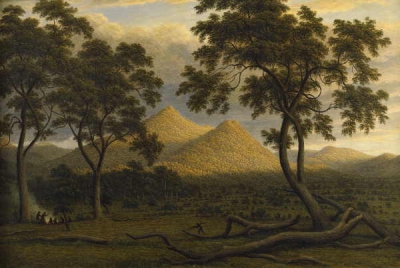
We came across more eucalyptus forests as we crossed the Snowy Mountains after Canberra, and slowly a thought formed in both our minds. My wife put it very well when she said one day that eucalyptus trees look dusty. So true! The green of eucalyptuses is indeed a very dull green, the sort of green you see on trees lining a dirt road where passing cars throw up clouds of dust. I was pleased to see a comment in the museum we visited in Canberra, to the effect that the first European painters had been perplexed by the green of the local trees, which to their eyes was dull and quite unlike the bright greens of the trees they were used to in the UK (They were also perplexed by trees that didn’t shed their leaves but shed their bark. That doesn’t bother me so much; effects of globalization, I suppose).

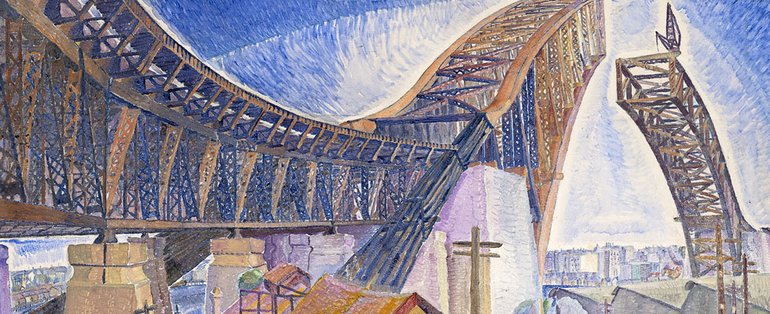
Early painting

It’s nice to know that we had the same reaction in 2013 as a bunch of Brits 200 years ago did when also on their first visit to Australia.

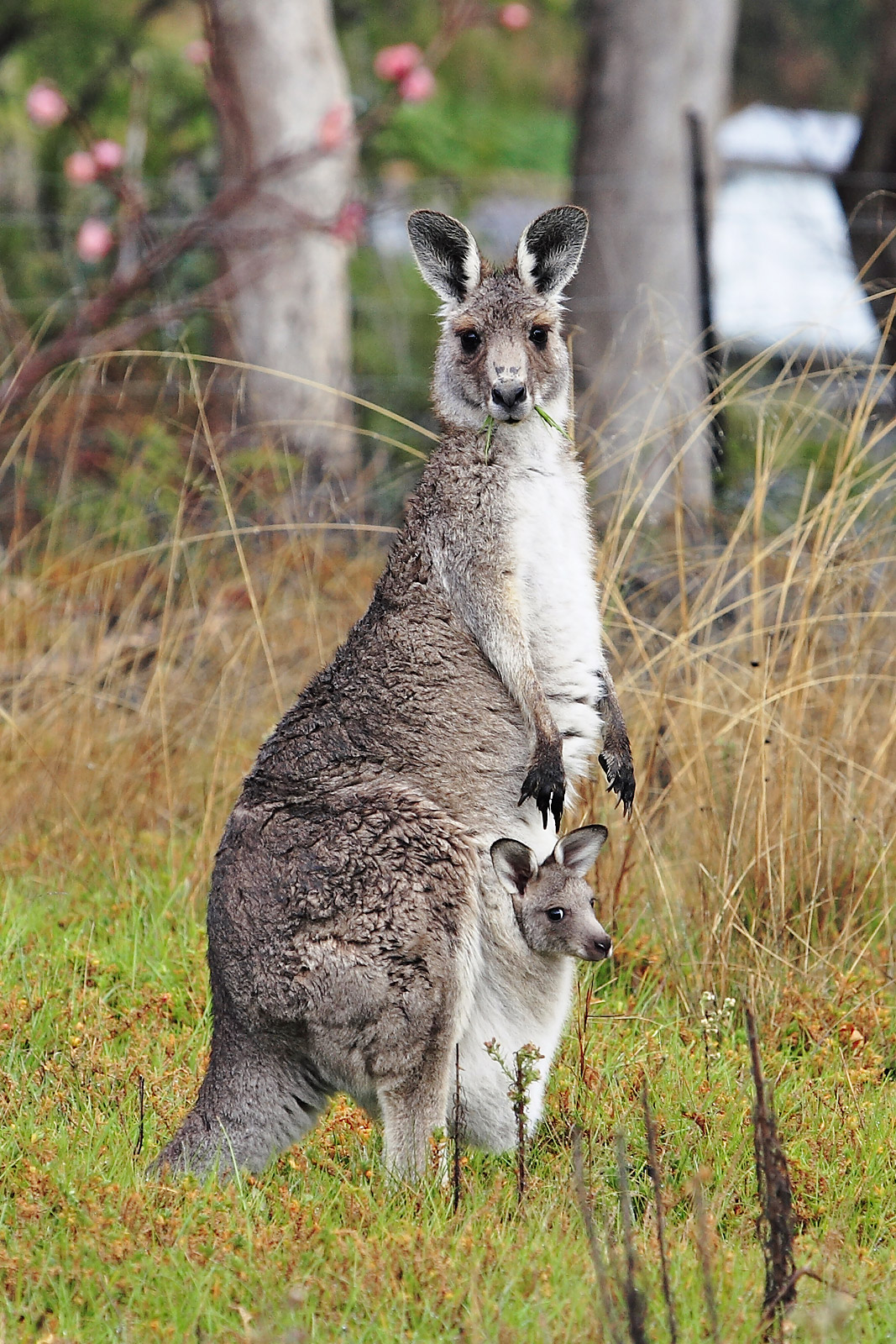
Next post I’ll deal with another very Australian thing, the kangaroo.

____________

Early Australian art: http://www.myplace.edu.au/verve/_resources/Early_Colonial_Art_1830_page.jpg

Other pictures: mine and my wife’s

___________________

NOTES ON AUSTRALIA – GRAND PACIFIC DRIVE

Beijing, 2 October 2013

Welcome back to these notes on the trip my wife and I made to Australia. Our stay in Sydney is covered in the previous post.

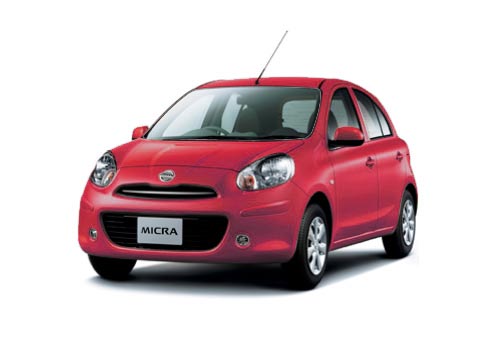
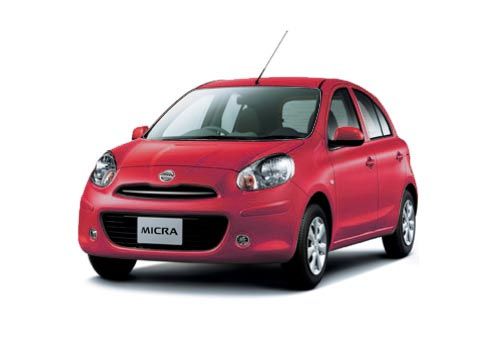
After Sydney we moved south. This meant hiring a car, and we got ourselves a bright red Micra

micraIt’s a snug little car which was just the right size for me, my wife, and three pieces of luggage (which ended up being five after we had bought things in the local supermarkets which we can’t get in Beijing). Initially, we faced the challenge of driving on the left-hand side of the road. This is one of the less useful things which Australia has inherited from the UK. I passed my driving test in Scotland and so started my driving life driving on the left, but the vast majority of my driving since then has been on the right. As for my wife, she’s never really driven on the left. So there was a bit of tension at the beginning, especially as we had to drive out of Sydney during a busy period. But we quickly got the hang of it and thereafter we had no problems – except for two things: we systematically put the windscreen wipers on when we wanted to signal a right or left turn (because the positions of the two levers were the reverse of their positions in “normal” cars); and when we turned right at an intersection we had a tendency of ending up on the right hand side of the road. But no worries! As you can see, we have survived to tell the tale.

Our initial plan was to drive down the coast towards Melbourne, along the Prince’s Highway, and then turn inland whenever it was time to start heading back to Sydney and its airport. I should explain why we chose to do this. Some five years ago, in a lodge located on a tributary to the Amazon River not too far from Manaus

juma lodge

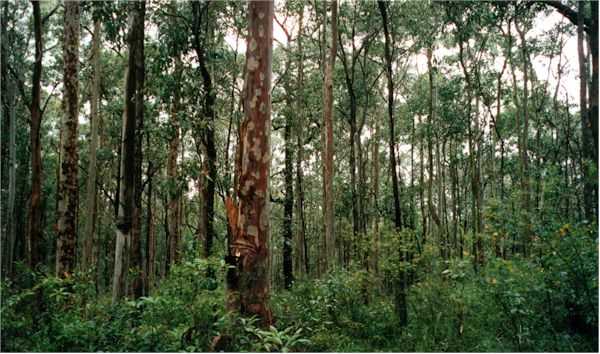
we met an Australian and had one of those conversations you always have when meeting fellow-travellers: swapping notes on places travelled and things to see. The conversation inevitably turned to Australia, and he told us to go to Sydney and then drive along the coast. He wrote it all down on a paper napkin, which we carefully kept – but alas, that paper napkin is in storage in Vienna! When we were planning this trip we were trying to remember if he had told us to drive south or north from Sydney. For reasons which I cannot now remember, we plumped for going south. But this turned out to be not such a good idea. Contrary to what we had expected, we found the coast ho-hum. It was terribly built up, the sea-shores offered the usual sea-related touristy stuff, and most of the towns we passed through were suffering from ugly strip development. There were three bright spots in the gloom. The first was a highly enjoyable drive through Heathcote National Park just south of Sydney, where we saw massed Eucalyptus trees close up for the first time in our lives

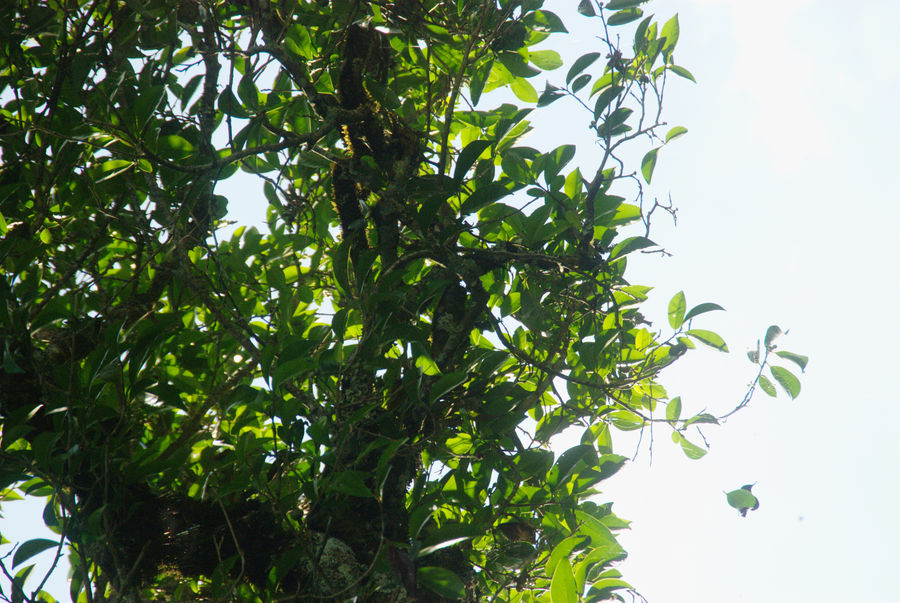
eucalyptus-forest

After which we landed up on the Grand Pacific Drive. This road hugs the coast for some 20 kilometers, so we got wonderful views of the coast in the dying hours of the day.

pacific coast 006

The second bright spot was the few hours we spent on Jervis Bay, which has the most amazingly white sand (and very clear water – but bloody cold, at least when we were there).

Jervis bay

The third bright spot was our dinner at Batehaven, next to Bateman’s Bay. We had an excellent fish and chips (at a place called Berny’s – pass the word). In contrast to driving on the left, fish-’n-chips is one of the more useful things which Australia has inherited from the UK.

bernys

We ate it sitting at a table in the city park with the sea in front of us, lingeringly licked our fingers when it was all wolfed down, and then walked along the beach under a waning moon. Wonderful.

But all this was not enough to keep us from abandoning the coast. We decided on a rapid change of plan: make a brief trip to Canberra to visit a museum and then head for the Snowy Mountains. But before we did that, we went for a little ride through the Benandarah State Forest. This ride, and what we found there, will be the subject of my next post.

_______________

Red Micra: http://images.cardekho.com/images/car-images/large/Nissan/nissan-micra/05-nissan-micra-brick-red.jpg
Lodge in the Amazon: http://www.jumalodge.com/gallery/2012/2.jpg
Eucalyptus forest: http://www.elrst.com/wp-content/uploads/2009/09/eucalyptus-forest.jpeg
The coast along the Grand Pacific Drive: my picture
Jervis bay: http://media-cdn.tripadvisor.com/media/photo-s/01/70/a6/66/jervis-bay.jpg
Bernys: https://lh5.googleusercontent.com/-dRGLeO8Kuw8/UhBa4uMijTI/AAAAAAABGmQ/afHL9AEl4Qs/s0/DSC03108.JPG

NOTES ON AUSTRALIA – SYDNEY

Beijing, 1 October 2013

G’day cobbers!  My wife and I are just back from a short holiday in Australia – the first time either of us have visited the country.

OK, let me say right up front that I am indulging in some revolting ethnic typing here. No-one during our trip said either “g’day” or “cobber” to us. Maybe in the small part of Australia we visited – Sydney, the coast immediately to the south of it, Canberra, and the Snowy Mountains – people don’t use these expressions, but the fact is no-one said them. Sorry about that!

But they did use a number of expressions which sounded odd to my English ear. “No worries”, used the same way I would use “you’re welcome”, as in “thank you”, “no worries”. “See you later” at the end of a conversation, even if there was no chance in hell of ever seeing the other person again. “How’s it going today?” at the beginning of a conversation, where I would merely say “hello” – the Americans have the same habit; I’ve never known how to respond to this. They obviously don’t want to hear a catalogue of my ills, so should I just say “fine”, even if I’m feeling like death warmed up? And should I in turn ask them how it’s going for them? That seems the logical – and civil – thing to do, but the few times I’ve done it my American or Australian interlocutors have seemed rather startled.

Then there were words used in normal conversation which I’ve only heard as Australian exotica. Take “billabong”, for instance, which I’d only ever heard in the song “Waltzing Mathilda” (“Once a jolly swagman camped by a billabong, Under the shade of a coolibah tree” etc.). But after hearing several people talk about billabongs, I plucked up the courage to ask what they were exactly. (FYI, they are isolated ponds left behind after a river changes course; we saw many of them on the upper reaches of the Murray River – more on that later. Now I have to find out what a coolibah tree is ..)

And of course there was the accent. Though distinctive,  it wasn’t that hard for us to decipher. But for several nights in a row I did try to figure out, through endless repetition with my mouth in various shapes, how the Australians were forming their O’s, as in “no” or “go”. My wife eventually ordered me to halt my dreadful drones, or else.  The New Zealand accent is much harder to follow, as my wife and I discovered a few years ago when we visited that country. I quickly got into the habit of standing next to her whenever she asked a New Zealander a question, because there was a 99% chance she wouldn’t understand the answer whereas in my case it was only 60%, so I could step in to continue the conversation and not have us standing there smiling uncertainly at the responder.

If I start with these linguistic considerations, it’s because the language we heard during our trip typifies my feelings about Australia: so much was deeply familiar, yet so much was quite strange. This continuing counterpoint between the familiar and the strange accompanied us throughout our trip.

We started our trip in Sydney, emerging bleary-eyed from our overnight flight to a sunny, beautifully clear, fresh day, conditions which we had pretty much for the whole trip. Ah, those clear, intensely blue skies! After all the misty, foggy, smoggy days we had endured in Beijing, we couldn’t stop remarking with wonder on the blueness of the sky, and on the clarity, the sharpness of the air.

Our first port of call was – had to be – the Sydney Opera House down at the harbour. The path we chose to get there took us through the city’s botanic gardens: shades of Kew Gardens in London, so familiar to me after multiple visits there as a child with my grandmother. A familiarity made that much stronger by the Worthy Civic Buildings like Government House and the Art Gallery of New South Wales which lie along the gardens’ edges and which obviously belong to that class of British official buildings which clutter up Imperial London and dot the cities of the ex-British colonies. But the gardens also had a more exotic flavour, planted as they are with Australian species I had never seen before; look at this tree, for instance, with its shaggy bark. My wife and I gawked at it, never having seen anything quite like it. It’s a Prickly Leaved Tea Tree, by the way.
sydney general 007
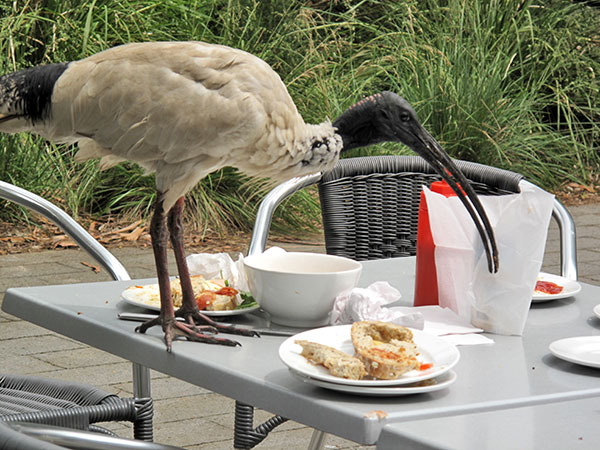
And look at these really odd birds, with their curiously curved long thin beaks, which populated the gardens.
sydney general 015
They played the familiar role of pigeons in a park, padding cautiously around people sitting or lying on the grass and looking out for any crumbs or left-overs to pick up, as this photo by someone else amply demonstrates.

ibis eating food

They went about their business in a much more dignified manner than pigeons, though; aristocrats fallen on hard times compared to pigeons’ scabby lumpen-proletarianism. I later learned that this is the Austalian white ibis.

To enter the gardens we first had to walk down Victoria Street, which was lined with magnificent plane trees – the familiar – but also rows of two-floor houses with verandahs running the length of the second floor – very foreign to our eyes.

sydney general 002

My wife saw a resemblance to houses we had seen ages ago in Savannah, Georgia. To me, they had something of the Caribbean or the Latin American, or maybe the South-East Asian. Certainly not English.  We saw similar houses in other parts of old Sydney. I wonder where their design came from?

This road threw up another delight, this flowering plant which we later saw in a number of other places.

sydney general 001

My wife and I had never seen this plant before, but it reminded us powerfully of the flowering agave plant which we often see when we go down to the sea in Italy.

flowering agave plant

And so eventually, after these various detours, we came to the Sydney Opera House.

sydney opera house 001

What a magnificent, magnificent building! All the more stunning because of its position in the harbour, its white sails, or wings, or shells, picked out against blue: blue skies above, blue waters below.

sydney opera house 014

We came back to it again and again, with a ride on one of the harbour’s many ferries …

sydney opera house 025

… with a concert one evening (where we were served up a strange medley of Wagnerian themes), which allowed us to see the building at night …

sydney opera house 019

… and finally with a tour of the whole complex, where I discovered to my surprise that the shells are not plain whitened concrete as I had imagined but are covered with ceramic tiles of different shades of white, and with different degrees of shine, very beautiful to look at close up.

sydney opera house 023

sydney opera house 006

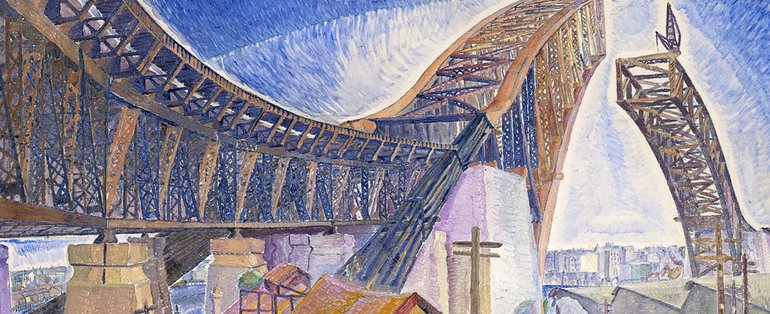
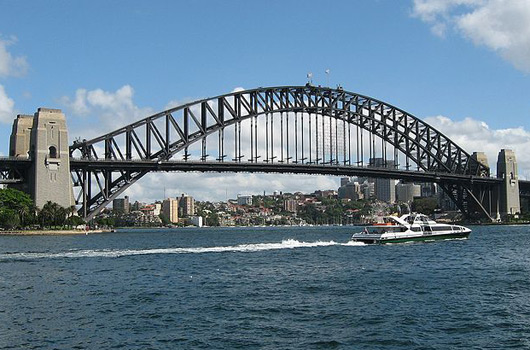
The Opera House is undoubtedly a marvel, alone worth the trip. It is truly unique, I cannot think of any building anywhere quite like it (incidentally, the story of its construction is also dramatic, full of clashes between huge egoes, of back-stabbings, of bad-mouthings, and of a final dramatic denouement; worthy of an opera). I cannot say the same of that other architectural icon in Sydney, the Harbour Bridge. Perhaps its construction was an engineering feat in its time (the 1930s), but I find all that criss-cross of thick, black iron bars horribly clunky.

sydney harbour bridge

It reminds me of Scotland’s Firth of Forth railway bridge

firth of forth railway bridge

the ugly duckling to the later Firth of Forth road bridge, with its beautiful soaring lines of a classical suspension bridge.

firth of forth road bridge

Perhaps Sydney’s city fathers could consider a rebuild along the latter lines, or at least a make-over. I’m sure that with modern computing to help them refine the load calculations, engineers could get rid of half of that ironware and still have the bridge stay up. Just a suggestion.

I will pass over the rest of our time in Sydney, pleasant as it was. In a later post or two, I’ll come back to our visits to two of its museums when I mention our lightning visit to the Federal capital city, Canberra, and I’ll cover the rest of our trip.

See ya later!

_____________

Ibis eating food: http://www.rudyrucker.com/blog/images2/au_ibistable.jpg
flowering agave plant: http://upload.wikimedia.org/wikipedia/en/7/75/Agave_at_Cape_Sounion.jpg
harbour bridge: http://www.ausmotive.com/images/MB-Sydney-Harbour-Bridge-crossing.jpg
firth of forth railway bridge: http://infohost.nmt.edu/~armiller/jpeg/firth3w.jpg
firth of forth road bridge: http://imgc.allpostersimages.com/images/P-473-488-90/38/3839/K3YYF00Z/posters/forth-road-bridge-built-in-1964-firth-of-forth-scotland-united-kingdom-europe.jpg
all other pictures are mine

FUJIAN TEA

Beijing, 16 September 2013

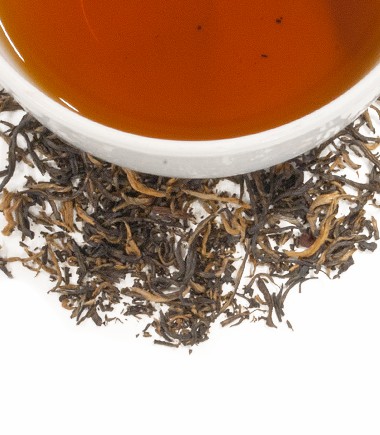
Last week, I was down in Fujian province. Tea connoisseurs will know the province, it being the home of black tea in China (as well as of white tea and oolong) and, as a result, of some of the most famous black tea brands, including the three Fujian Reds: Tanyang Gongfu, Zhenghe Gongfu, and Bailin Gongfu.

fujian red

I’ve written a previous post about a fourth black tea from Fujian, smoked this one, which was my grandmother’s, and now is my wife’s, favourite tea: Lapsang Souchong.

But I was not in Fujian to explore its tea. I was there to visit two factories. One produces spirulina, a family of blue-green algae, which in the last several decades has received a lot of press as a sort of miracle food for the undernourished, and which was already being eaten by the Aztecs back in the 16th Century when the Spaniards conquered them. I’ve mentioned this wonder product in an earlier post.

Spirulina-Powder

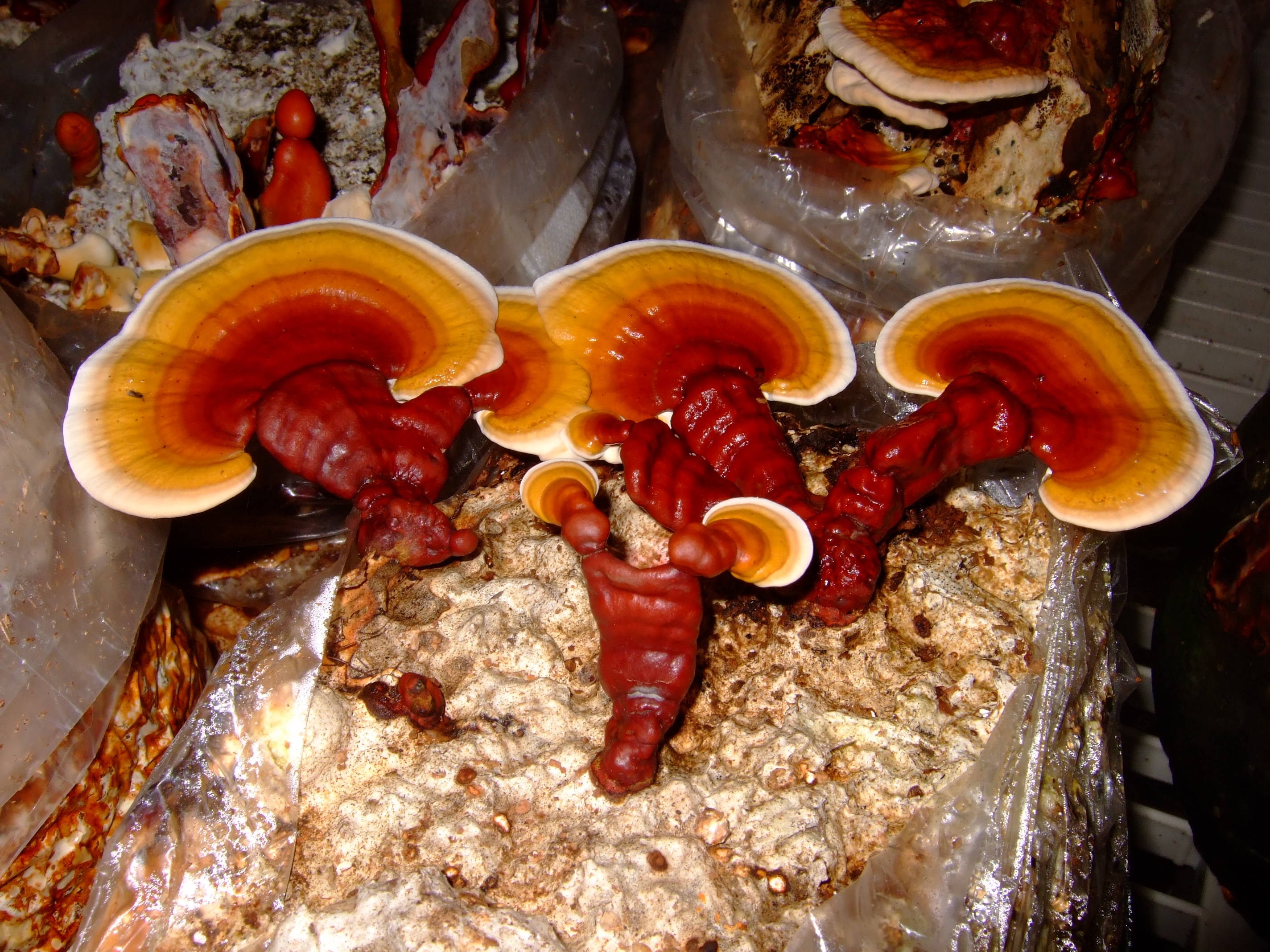
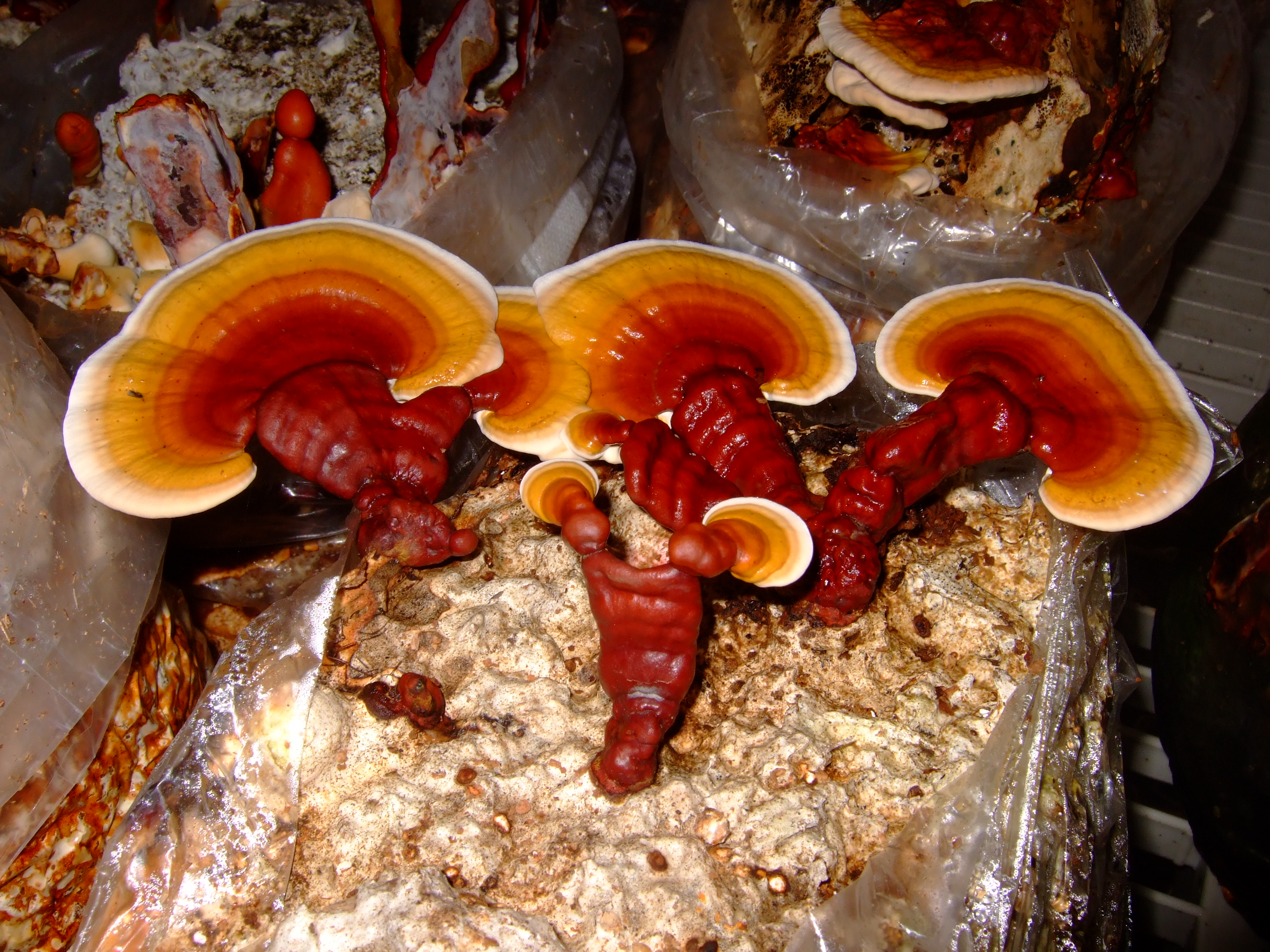
The second factory produces glossy ganoderma, a fungus which the Chinese have been consuming for the last two thousand years for its medicinal properties and which has a renewed lease of life as a possible anti-cancer drug.

glossy ganoderma

The two factories were quite distant from each other as well as from the nearest airport at Wuyishan, so our days were long as we drove to each factory, visited them, and of course had long and copious dinners with our hosts and various local worthies such as the mayor or party provincial secretary.  It was with some relief that I saw we had finally arrived back in Wuyishan that last evening of the trip. Alas! I had rejoiced too soon. Wuyishan is an important centre for the tea trade, with scores of tea shops lining the main roads. Our driver, who also happened to be the son of the owner of the spirulina factory, had the great idea of taking us to one of these tea shops. Its owner was a good friend of his, he informed us brightly. He had been so good to us that I didn’t have the heart to say no. So we drew up in front of one of these tea shops, and were greeted effusively by its owner as we got out of the car. He was an Artist, he later informed us, which presumably explained his heartily embracing me; no normal Chinese would ever have done such a thing. It also no doubt explained his pony-tail, something which is now rare in China since the heady days of the birth of the Chinese Republic, when Chinese men everywhere cut off their queues to mark their liberation from Manchu rule.

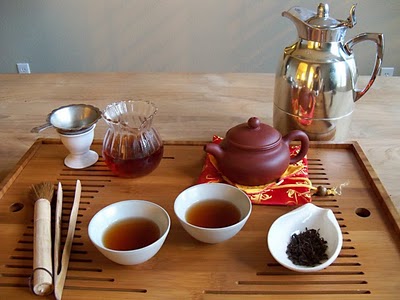
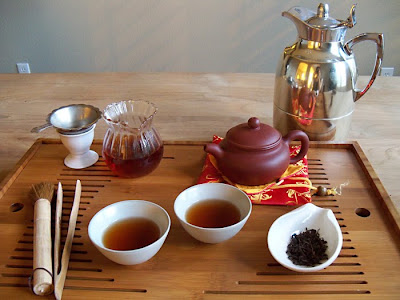
In any event, he ushered us into his tea house, introduced us to his mother and sister, bid us sit, and quickly made us a cup of tea.

chinese tea ceremony

After a few minutes, and perhaps after a quiet word from his friend the factory owner’s son, he invited us to follow him up some back stairs, to a more private den on the second floor. Here, he had us sit around a table whose top was a square slab of rough stone into which he had carved a Chinese character; this in turn acted as a channel for a little fountain which emerged from the middle of the table’s top. The fountain added a quiet sound of running water to the proceedings. Our host announced that he would be serving us a rare black tea made from just a few kilos of leaves picked every year.

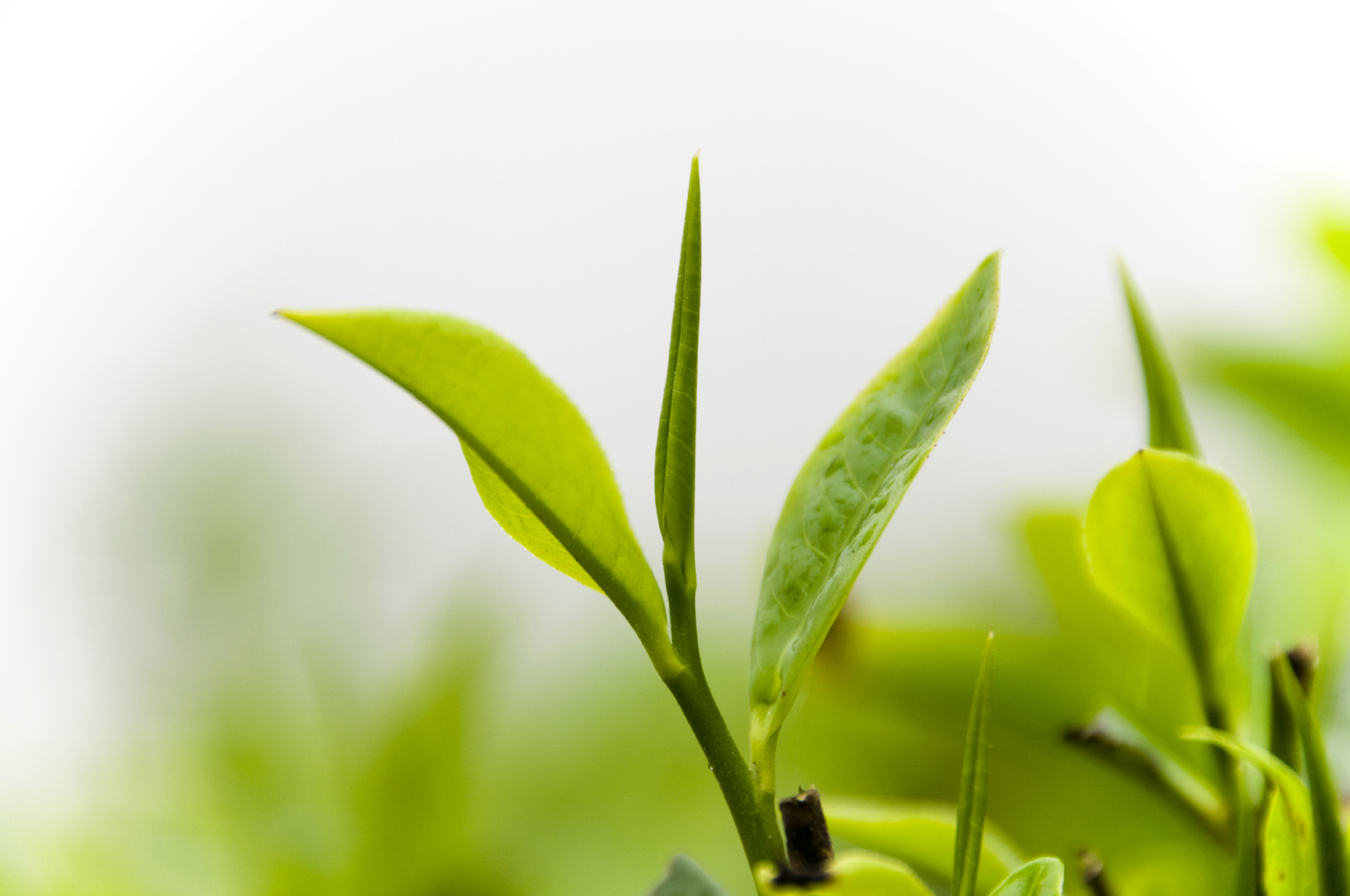
Tea in the mist

He gave us each a little cup which could contain a thimbleful of tea; he had made them himself, he informed us. He then ordered an acolyte who was hovering in the background to pull out his 18th Century Qing cup, which turned out to be even smaller than the ones we had been given and sat on its own tiny wooden table. We all inspected it with great respect. By this time, our host had boiled the water and transferred it to a small cast-iron Chinese teapot. With this, he poured a thin jet of hot water over the cups to warm them, and then added water to the tea. He let it stand for a while, then filled our little cups.

We all sipped our tea – I, out of the Qing cup – and murmurs of appreciation rose up. Now, I don’t pretend to be a tea connoisseur. In fact, I keep it a secret in China that I drink my black tea with milk and sugar. This would put me quite beyond the pale for most Chinese if it ever became common knowledge. And I have never appreciated the green tea which I am routinely offered here. But I actually liked the tea our host had offered us! It did indeed leave a mildly sweet aftertaste, as he had predicted. We drank a few more thimblefuls, after which he declared he would have us try another black tea. This one, he said, was even rarer. Just a kilo or so was collected every year, from one wild tea tree whose location he kept deeply, deeply secret.

old tea treee

It had to be sort of slurped to appreciate its taste, he instructed us. I duly sort-of slurped the tea and was astonished to discover a mild chocolaty aftertaste. Yes, my host smiled, that’s what many say.

As we continued to drink the tea, our eyes started to wander around the room, taking in the various ceramic pieces placed on the shelves around us. Our host began to take them down to let us inspect them. This small cup was Song, he said – Song! Oh  –– My –– God! I love Song ceramics!

song cup

– while this one was early Ming, he continued, and that shallow bowl was Qing. My head whirled. And as we sat there, sipping our tea and holding the ceramic pieces gingerly, oh! so gingerly, I felt for a moment – an instant – like a Chinese scholar of yore, sitting in my study, sipping my favourite tea, gently turning my ceramic pieces in the light, murmuring that Tang love poem I loved so much – and wondering if I would ever pass the next level of those damned imperial examinations …

chinese scholar-2

__________________________

Fujian red: http://3.bp.blogspot.com/-kvSw6A0btv8/UIlzv5xNqLI/AAAAAAAAAkw/T0MCEP9zCSE/s1600/goldenmonkey_base.jpg
Spirulina powder: http://spirulinapowder-review.com/wp-content/uploads/2013/07/Spirulina-Powder.jpg
Glossy ganoderma: http://upload.wikimedia.org/wikipedia/commons/d/d7/Jreishi2.jpg
Chinese tea ceremony: http://2.bp.blogspot.com/_UERtENI3oaU/TKzqT_cEx2I/AAAAAAAABvM/ENJO27ZhxiI/s400/chinesetea2.jpg
Fresh tea leaf: http://www.pingminghealth.com/wp-content/uploads/2009/12/green-tea-leaf.jpg
Old tea tree: http://www.puerh.fr/dynamic//files/system/articles/80/17.jpg
Song cup: http://p2.storage.canalblog.com/21/37/577050/46025483_p.jpg
Chinese scholar: http://images.visitbeijing.com.cn/20121011/Img214758300.jpg

THE TRACTOR

Beijing, 14 September 2013

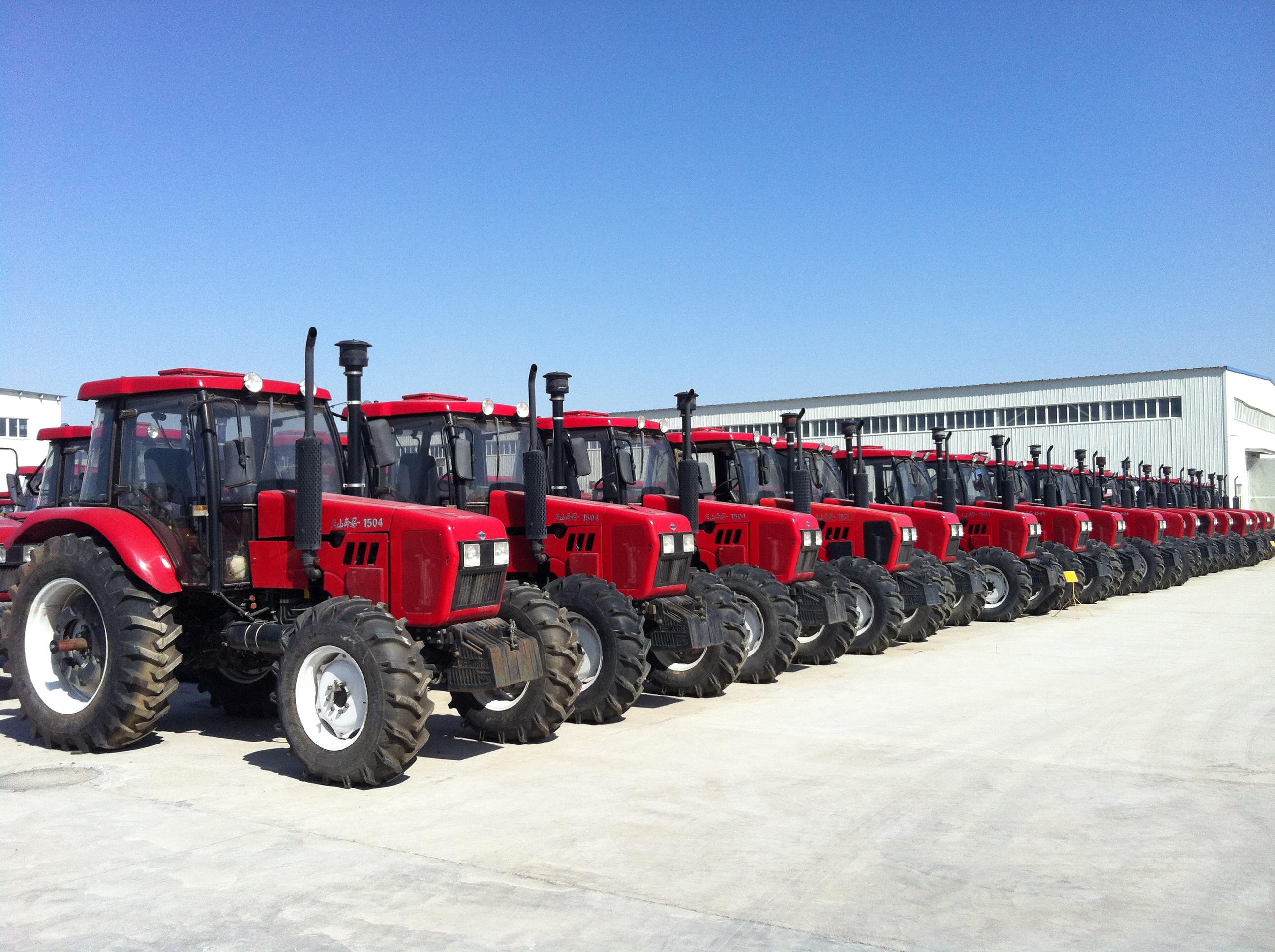
In the trip to Xinjiang which I mentioned in my previous post, we were also taken to see a tractor manufacturer. Row upon row of bright new tractors greeted us as we walked into the factory’s yard
tractors outside
but we ignored these, headed as we were for the shed where they assembled the tractors.

It was with some relief that we exchanged the heat and light of the yard for the cool darkness of the shed interior. There, we were introduced to the plant manager, and after a hearty shaking of hands all round he launched into his exposé of all the wonderful things his factory was doing. I let his voice wash over me as I took in a yellow tractor, newly assembled, standing proud and tall before me.

tractors inside

And suddenly I was 14 or 15 again, standing, on a beautiful summer’s day, by the side of a tractor. I was out on the plains of Manitoba, an hour or so’s drive from Winnipeg, on a farm owned by the parents of a friend of my sister’s.  The farmer was asking me if I wanted to try ploughing a field and I was saying yes. Why not? Everything is possible when you are 14 or 15.

So he gave me a quick lesson in tractor driving and ploughing, and sent me off to a distant field. And off I went, my hat cocked at a jaunty angle as I surveyed the surroundings, Lord of everything I beheld.  After 10 minutes, I arrived at the field – the North American plains are very big and tractors are very slow – and there I found myself faced with an unexpected choice: there were actually two fields, one to the left and one to the right, and no fences. Which one? I hesitated, trying to remember my instructions – no mobile phones in those days, no way to check back – and eventually plumped for the field to the right.

So I started ploughing, starting as instructed at the field’s edge and going round in ever-decreasing circles until the middle was reached. By the end of the first circle, I noticed a man standing on the edge of the field. By the end of the second circle, he had walked over and signaled me to stop. He asked me politely what I was doing. Well, I was ploughing the field, I replied lamely. Yes, he responded patiently, but on whose instructions. Well, I said, and here I named my farmer host. Ah, he said, but the fact was that I was ploughing HIS field. Not that he minded, he added quickly, the field was fallow (thank God! I screamed inside of me) and no doubt it would benefit from an extra plough, but still … He pleasantly instructed me to stay still while he phoned his neighbour.

I sat there, on the tractor, with my hat at not quite such a cocky angle now, with a sense of impending doom. And indeed my farmer host came scorching over like a bat out of hell. He covered in 10 seconds in his battered old car what had taken me 10 minutes with the tractor. He bounced out, glared at me, and excused himself profusely with his neighbour, but the offended party was very gracious about it all and the situation resolved itself pleasantly.

My farmer host next turned to me and in that very deliberate and slow tone one reserves for the village idiot told me that I was meant to be ploughing the LEFT field. And to make sure that the village idiot had understood he pointed very insistently at the field in question. Suitably chastened, with my hat drooping about my ears, I headed for said field, and started again.

So there I was, circling the field, spiraling slowly – EVER so slowly; the field was very big – towards its middle.  I have to tell you,  ploughing is pretty boring. After about the fourth circle the novelty of it all had worn off and I was wondering how to pass the time. I tried singing, but the noise of the engine drowned out even the lustiest of my songs. I tried driving with one hand, but that palled after 2 minutes. I tried driving with one leg up on the dashboard, but that was uncomfortable. In a moment of desperation, I even thought of trying to drive sitting backwards but luckily good sense prevailed. So I was reduced to just driving, driving, driving in ever decreasing circles as the sun slowly dropped to the horizon of the endless Manitoban plains.
OLYMPUS DIGITAL CAMERA
Ploughing the plains may be boring but the plains themselves have a strange beauty. As a boy brought up in undulating landscapes, used to cresting land-waves and finding hills rising up before me, I initially found the plains disorienting. Whenever my parents took us out for drives I never knew which way to look. But after a while I began to appreciate the way the sky was so close to the land, seeming to press down on it and you, and how you could really enjoy cloud formations in the vast, uncluttered sky of the plains. I could never get over those fields of wheat stretching off as far as the eye could see, registering on their waving surface every meander of the passing breeze …
the plains-7
I was nudged, the plant manager had finished his peroration. I came out of my reverie with a smile playing on my lips, which no doubt delighted the man, reinforcing his conviction that what he did was incredibly interesting. With another round of hearty handshakes, we emerged blinking into the strong sunlight and headed for the car and the next factory.

______________________________

tractors inside and outside: GUO Li
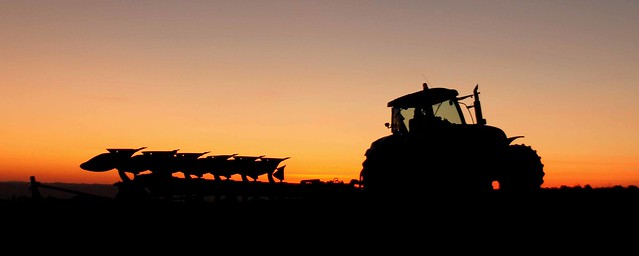
tractor and the sunset: http://farm5.staticflickr.com/4045/4482416778_f1fc6db355_z.jpg
wheat fields: https://farm5[dot]staticflickr.com/4127/4975335245_a2e33916c3_z.jpg

TOMATO WASTE

Beijing, 13 September 2013

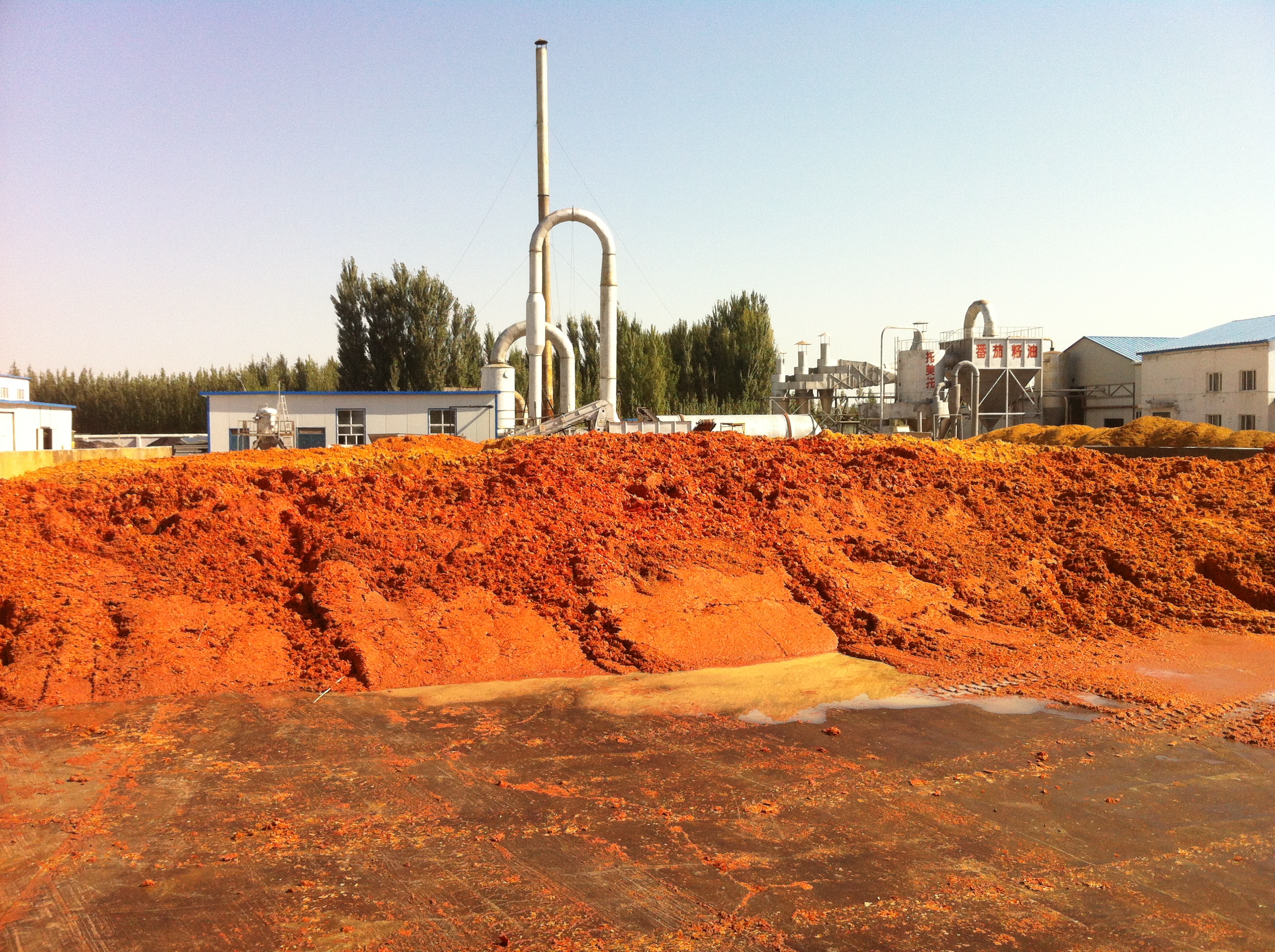
Last week, I was up in Xinjiang (or the Xinjiang Uighur Autonomous Region, to give it its full title), where I and some colleagues were discussing possible projects and visiting some industrial plants. The most intriguing of these visits was to a plant where this welcomed you when you arrived.
tomato waste-4
Readers would be excused if, like me when I got out of the car and like my wife when I showed her this picture, they scratch their heads and ask themselves what on earth this stuff is.

Tomato waste, that’s what it is.

Yes, these are the left-overs from the process to make tomato paste, a significant industry in Xinjiang, which grows some 4 million tons of tomatoes a year. As you might imagine, with a process that basically squeezes the juice out of tomatoes for further concentration the waste consists primarily of tomato seeds and skins.

Mr. Liu, a spry septuagenarian and founder of the company, met us as we got out of the cars and led us to the exhibition room. He started by explaining that he was on the rebound with this company; he set it up after going bankrupt in a previous foray into capitalism. The business model Mr. Liu adopted in this new venture is simple but ingenious. He takes the tomato wastes off the hands of the tomato paste makers, who are glad to offload them at no cost since they don’t know what to do with them. So far so good. But he doesn’t just dump them in a convenient hole somewhere as most waste dealers still do in this part of the world. No, he works his magic on the wastes to make a whole series of new products with them.

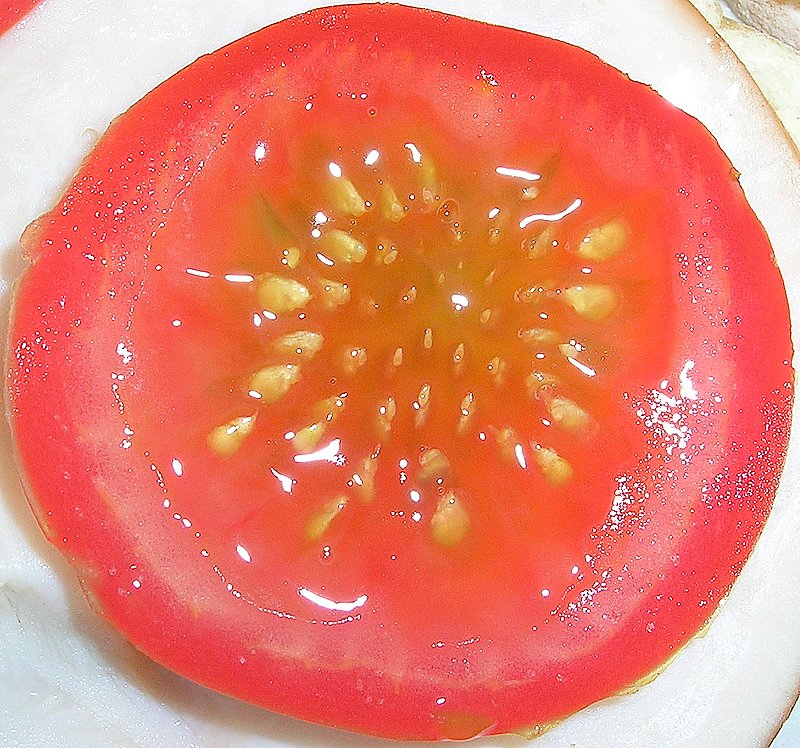
The most important of these is tomato seed oil. Yes, you can press all those little seeds in a tomato

tomato seeds

and make this lovely orange-colored oil
tomato seed oil
No doubt the colour comes from a combination of the gold of oil with the red of lycopene, the chemical which gives tomatoes their red colour. The oil commands premium prices from restaurateurs and others who have refined culinary tastes.

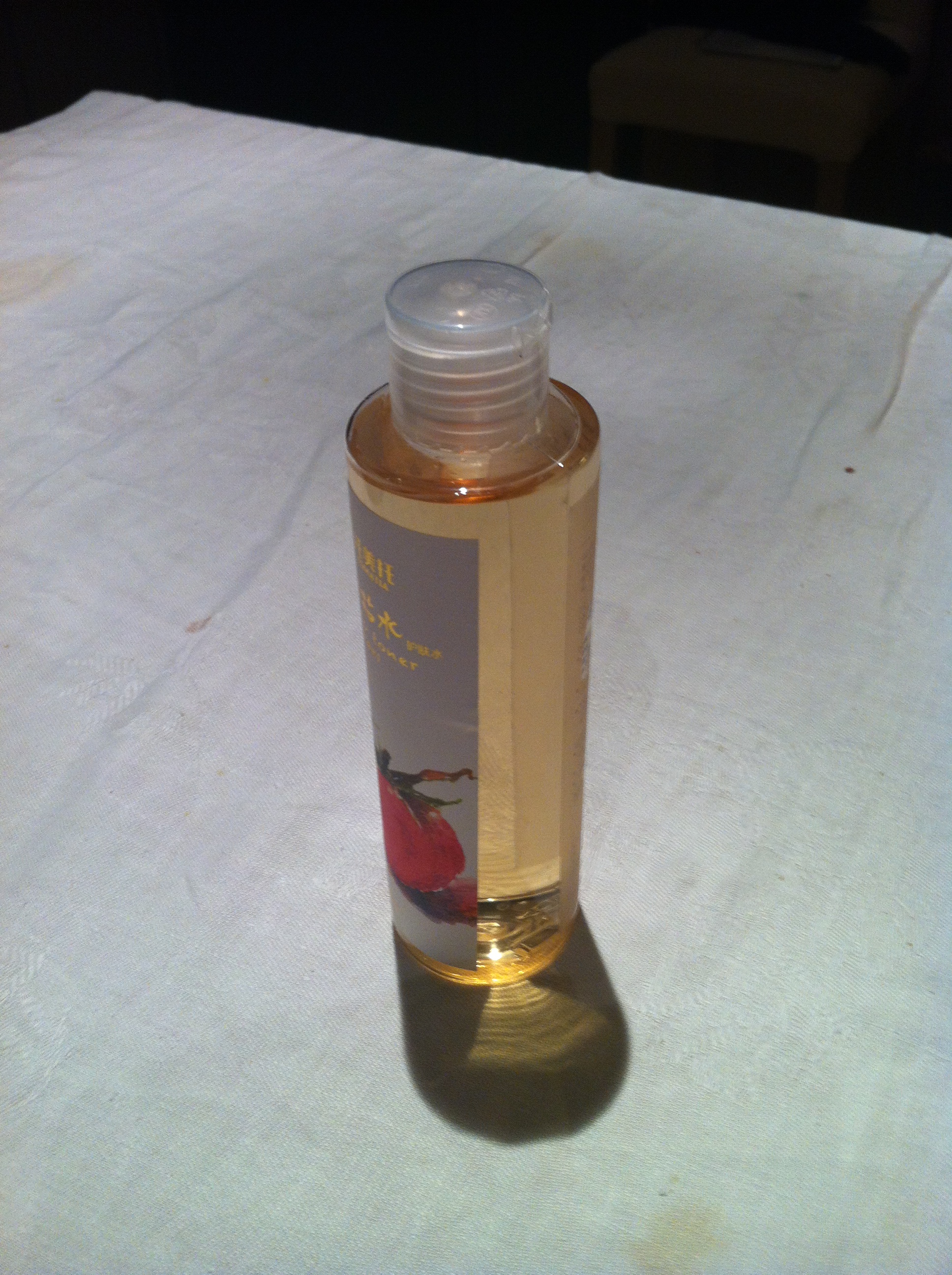
But Mr. Liu is not satisfied with just this one product. He also makes a skin tonifier from the juice squeezed out of the waste.
tomato tonifier
He told us it contains high levels of anti-oxidants, so is excellent for slowing down the aging process.  As proof of this assertion, he said he was made aware of the juice’s beneficial effects by his workers who, it seems, were padding around in the juice with only sandals on and discovered that the skin of their feet was rejuvenated. I pass on this nugget of information without in any way suggesting that I believe it.

Mr. Liu also makes pills from this same juice, no doubt to encourage digestion or some such (I can’t believe the skin of our stomachs and intestines need rejuvenation).

And with everything that is left over Mr. Liu makes cattle feed. Apparently, cattle quite like tomato waste once the seeds have been removed. They clearly have refined palates.

Despite his 70 years, Mr. Liu is bubbling over with new ideas. He showed us a new silo where he will start storing the tomato left-overs so that he can process the stuff more regularly throughout the year – right now, he is forced to do a lot of processing at harvest time and to stand idle the rest of the year. I didn’t quite understand how he planned to avoid the waste from rotting; something about adopting a system used for centuries by farmers in Xinjiang to preserve their cattle feed (the translation got a bit tangled at this point). He is also planning to start processing the small, green tomatoes which are left behind in the fields at harvest time and which actually represent some 20% of the tomatoes grown. And no doubt he has other ideas up his capacious sleeves.

I really admire people like Mr. Liu. He is the embodiment of that phrase much loved in certain environmental circles, “from waste to profits”. I don’t pretend that Mr. Liu invented the process of extracting oil from tomato seeds – a rapid surf of the web after the visit showed me this (although the lotion may be his idea).  But he had the courage, after a ruinous bankruptcy which left him more or less only with the clothes on his back, to set up a new business, seeing an opportunity where others would only turn up their noses. And he keeps on coming up with new products to squeeze out of his tomato wastes.

I feel duty bound, however, to report a slight hiccup in all this. A few mornings ago, my wife tersely informed me by text that the skin tonifier which I gave her to try made her smell like a tomato.  For a tomato lover like myself this may actually be a plus, but for others with a more measured relationship to the tomato this news may give them pause.

____________________________________

Tomato waste: my picture
Tomato seeds: http://www.fixityourself.com/wp-content/uploads/2011/03/SavingSeeds1.jpg
Tomato seed oil: http://www.onecoup.com/uploadfile/2011822325.jpg
Tomato tonifier: my picture

DIGGING

Beijing, 31 August 2013

Between my finger and my thumb
The squat pen rests; snug as a gun.

Under my window, a clean rasping sound
When the spade sinks into gravelly ground:
My father, digging. I look down

Till his straining rump among the flowerbeds
Bends low, comes up twenty years away
Stooping in rhythm through potato drills
Where he was digging.

The coarse boot nestled on the lug, the shaft
Against the inside knee was levered firmly.
He rooted out tall tops, buried the bright edge deep
To scatter new potatoes that we picked,
Loving their cool hardness in our hands.

By God, the old man could handle a spade.
Just like his old man.

My grandfather cut more turf in a day
Than any other man on Toner’s bog.
Once I carried him milk in a bottle
Corked sloppily with paper. He straightened up
To drink it, then fell to right away
Nicking and slicing neatly, heaving sods
Over his shoulder, going down and down
For the good turf. Digging.

The cold smell of potato mould, the squelch and slap
Of soggy peat, the curt cuts of an edge
Through living roots awaken in my head.
But I’ve no spade to follow men like them.

Between my finger and my thumb
The squat pen rests.
I’ll dig with it.

Seamus Heaney, Irish poet, Nobel Laureate for Literature, died 30 August 2013.

SILENT AND DEADLY

Beijing, 30 August 2013

I’ve mourned in a past posting the passing of the bicycle culture which so dominated China until a few decades ago. In that same posting I wrote about a sub-family of bicycles which seems to be surviving the onslaught of the automobile. In this posting, I want to write about another sub-family of bicycles which is surviving; indeed, seems to be thriving: the electric bicycle.

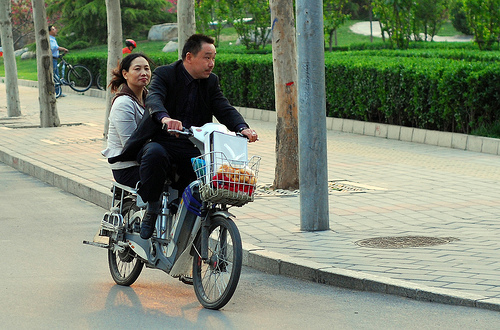
When we first arrived in Beijing, my wife and I were intrigued to see these machines cruising up and down the roads in large numbers. Here are a couple of examples of what greeted us:

electric bicycle-1

(this one being ridden by a lady avoiding the sun, about which I’ve also written in another posting)

electric bicycle-2

I have to say, they immediately reminded me of another motorized bicycle which had played an important role in my teens: the French VéloSolex. For those of my readers who are less than 40, I probably have to quickly explain what this is. Originally (i.e., just after World War II), it was a bike (vélo in French) on whose front wheel had been placed a motor (made by the company Solex).

solex-old-1

This motor powered a small ceramic roller which in turn turned the front wheel through simple friction. And when you wanted to use it as a bike, there was a lever which allowed you to pull the motor and roller off the front wheel. Very simple. Pretty cool. And cheap.

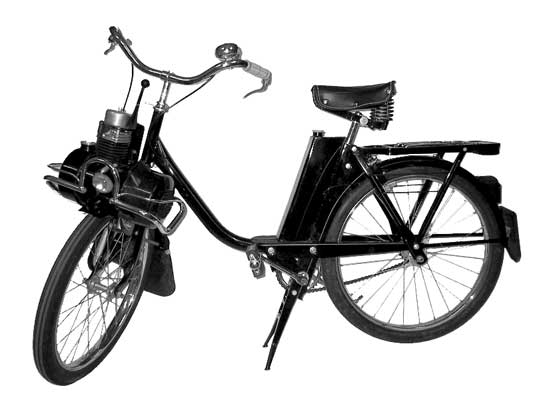
By the time I came along, the VéloSolex had become a bulky bicycle. Or maybe a thin motorbike.

solex-new-1

My parents had bought two of them, for my elder brother and sister. They stayed at my grandmother’s house, ready for use during the summer holidays. As my siblings grew up and moved on, the VéloSolexes passed on to the next sibling. I reckon that by the time I inherited my VéloSolex it was third-or fourth-hand, as it were. No matter, I loved that bike. It was my set of wheels which gave me my freedom, which allowed me to escape from the house when things were really too boring, which they often were in my teenage years.

For me, the VéloSolex was France,

Velosolex_postcard

along with De Gaulle

De Gaullle

the Deux Chevaux

deux chevaux

The baguette

baguette

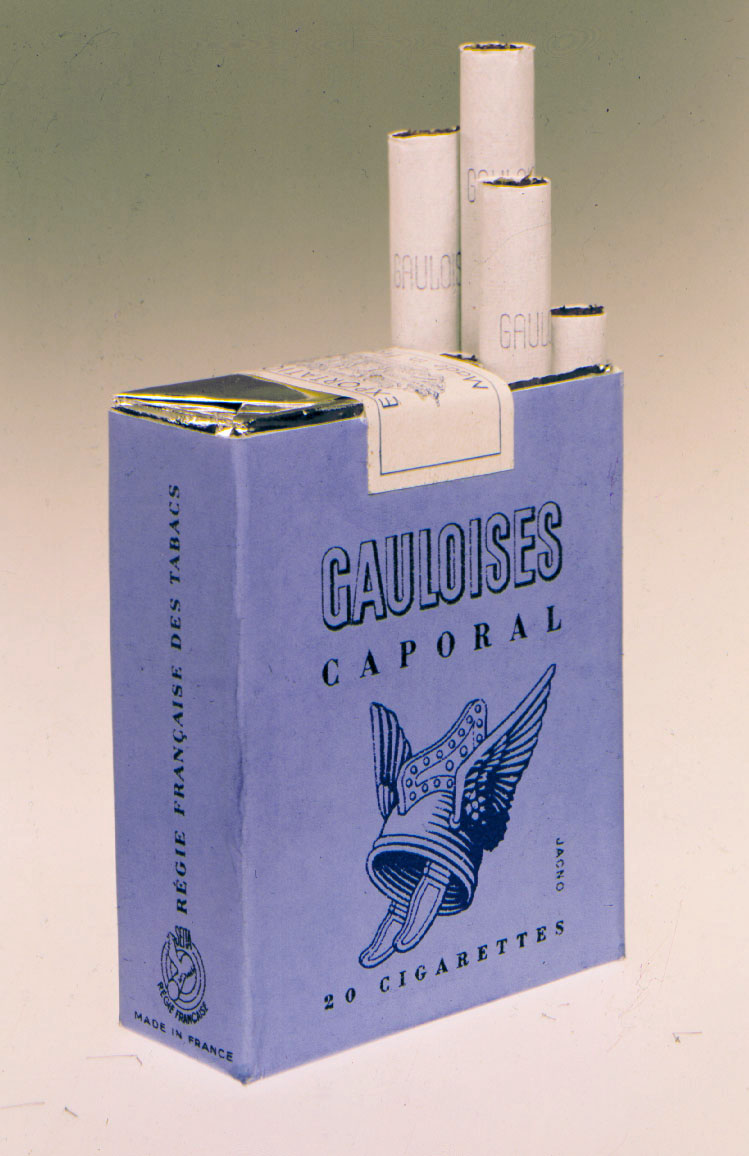
And Gauloises unfiltered cigarettes, which – I will confess – I smoked for a certain period of my life.

Gauloises Caporal

Who knows where my VéloSolex is now? In some knacker’s yard no doubt.

To come back to our electric bicycles in Beijing, they have one big difference with the VéloSolex: they are silent. Silent and deadly. One of the things which newcomers to Beijing learn quickly – or die – is to look VERY carefully, in ALL directions, when they are crossing a road, even if the little man is green. Right-turn at red lights is allowed, so cars turning right do so, regardless of whether you, the pedestrian, are crossing. Cars which have the green light and are turning left are anxious to do so before the cars coming in the other direction reach the middle of the intersection, so they whizz across it scattering to the winds any pedestrians that might be in the way. All two-wheelers, motorized or not, ignore lights and keep going, weaving around any pedestrians who may be in the way; to make their case worse, they drive on both sides of the road. In this last category of menace, electric bikes are the worst. They move fast, and they are completely silent. At night, they are even deadlier. None of their riders ever bother to put on their lights – so as not to run down the battery, no doubt – and the street lights are not particularly bright. So fast, silent, and invisible. They make me think of torpedoes.

But electric is the future! Even the VeloSolex, whose production ceased in 1988, has now been resurrected in an electric form

Velosolex-electric

And product designers have got into the act, designing excessively cool electric bicycles. And once they are there, you know the product is IN!

cool electric bicycle-5

cool electric bicycle-4

cool electric bicycle-1

So I guess my wife and I had better buy electric bicycles. Not only will we be riding the wave of coolness, but we’ll be running people down rather than being run down. When you can’t beat them, join them.

_________________________________________

Electric bicycle-1: http://thecityfix.com/files/2009/06/cycling.jpg
Electric bicycle-2: http://www.chinasignpost.com/wp-content/uploads/2011/11/electricbike_China-Digital-Times.jpg
VeloSolex-old: http://homepage.hispeed.ch/Spridget/solex/prototyp1.gif
VeloSolex-new: http://img175.imageshack.us/img175/8817/solex1.jpg
VeloSolex poster: http://cybermotorcycle.com/gallery/velosolex/images/Velosolex_postcard.jpg
De Gaulle: http://05.wir.skyrock.net/wir/v1/profilcrop/?c=isi&im=%2F5508%2F87355508%2Fpics%2F3147952278_1_2_Nvepv9eQ.jpg&w=758&h=1024
Deux chevaux: http://upload.wikimedia.org/wikipedia/commons/thumb/6/6f/Deux_chevaux_mg_1748.jpg/640px-Deux_chevaux_mg_1748.jpg
Citroen DS: http://www.blogcdn.com/www.autoblog.com/media/2009/02/citroen-ds.jpg
Baguettes: http://www.tranquilla.it/wp-content/uploads/2013/01/baguette-640×442.jpg
Gauloises : http://3.bp.blogspot.com/_siskXeTIdkY/S-6ACEDO1MI/AAAAAAAAADs/-Ny-fMbye2A/s1600/Gauloises+Caporal+-+ann%C3%A9es+40.jpg
Velosolex-electric: http://www.veloecologique.com/produits/128.jpg
Cool electric bicycle-1: http://evworld.com/press/smart_e-bike_profilecityscape.jpg
Cool electric bicycle-2: http://www.evrdr.com/wp-content/uploads/2009/09/leopard-electric-bike.jpg
Cool electric bicycle-3: http://www.designbuzz.com/wp-content/uploads/2012/07/vw-folding-electric-bike_xfBve_58.jpg

EXERCISE, CHINESE-STYLE

Beijing, 24 August 2013

For several weeks now, as I walk to work in the morning along my piece of canal, I have crossed paths with an old gentleman, a Senior Citizen, who is dressed in casual sporting gear and walking backwards. And clapping as he walks – backwards.

He is exercising.

I’ve been in China nearly four years now, but I don’t think I’ll ever get used to some of the odder exercise habits which I’ve seen here. Don’t get me wrong, I’m sure it does the exercisers good, or at least no wrong. For instance, several web-sites I have visited earnestly explain that walking backwards is actually a very good exercise because it uses muscles that would not otherwise get a good workout. I suppose I can buy that, but in addition, to give it a Chinese philosophical twist, they say that walking backwards sort-of rewinds you and rebalances your karma. Don’t ask me how that works, I’m just reporting what I’ve read. As for clapping, yet other web-sites have informed me that this liberates the clapper of his or her stresses. OK, I buy that too. Certainly better to take the stresses out bit by bit through clapping than all at once by punching someone in the nose. These web-sites add yelling to the list of stress-removing exercises. I’m not so sure about this one. There was a moment when some man on the other side of the canal was always declaiming something in a loud – and I mean loud! – voice when I walked by in the morning. It may have been releasing his stresses, but it was surely building up mine. Mercifully, he disappeared after a while. Perhaps the fishermen told him to bugger off.

The Chinese also have a habit of beating and slapping themselves, on the arms, on the legs, on the face. I still remember very clearly the first time I saw this. I had been in China no more than a week, and was on a plane to somewhere. As we were coming in to land, a woman on the other side of the aisle, who up to that moment had looked perfectly normal, started vigorously – and I mean vigorously! – punching herself, first on the face and then on the legs. No-one else seemed phased by this behaviour but I stared at her in a manner that, if it had been my kids doing it, I would have told them that it was rude to stare at people so. I think this muscular self-pummeling has something to do with encouraging the blood’s circulation, rather like the Finns who flagellate themselves with birch twigs after cooking in saunas.

This last point brings us towards TCM – traditional Chinese medicine – where I have also seen some weird and wonderful things, but I won’t go there today. I’ll stay on exercise.

There are also some fairly normal types of exercises which the Chinese indulge in. One set which I rather fancy is the use of these open-air gyms, which public authorities have thoughtfully placed in many city squares and even on the side of many pavements:

exercise machines-1

We’ve tried a number of these machines, especially the following one:

exercise machines-2

I’ve no idea what you call it; a maxi-strider? Because, as the lady to the left is amply demonstrating, that’s what you do, you swing your legs through these huge strides. I felt like I had been at sea for six months when I got off. Very odd effect.

And then, because this is a country where there are people everywhere, everywhere, all the time, and because of lingering attachments to their communist past, where the individual drowned himself in the mass, the Chinese are fond of communal exercise. My favourites in this category are fan dancing:
fan dance-1
ballroom dancing:
ballroom dancing-1
and of course, best of all, Tai Chi:
tai-chi-1
Tai Chi as the symbol of China is somewhat cheesy now, but I have a magic Tai Chi memory from my very first trip to Beijing. It was 2001 or 2002, we were driving in from the airport early in the morning, and it seemed that every park, every open space was filled with people slowly, silently, smoothly moving through the balletic steps of Tai Chi. And if any of my readers have the chance to see Michelangelo Antonioni’s film Chung Kuo, grab it.

chung kuo

Apart from showing a fascinating picture of China when it was still closed to foreigners – it was filmed in 1972 – there is a breathtaking sequence when the cameraman filmed for what seems an eternity a man doing Tai Chi as he bicycled along without holding the handlebars.

I keep telling my wife we should learn Tai Chi, and she keeps pretending not to hear. But one day, I will prevail! So that when we finally retire, you will find us early in the morning, in some Italian piazza, slowly going through our Tai Chi moves before having our cappuccino and brioche for breakfast.

old couple tai chi

_______________________________

Exercise machines-1: http://2.bp.blogspot.com/-ZeBmA8vPHeU/TbHjkv9UmWI/AAAAAAAABkc/BDYunnXTi9A/s400/park%2Bin%2Bhutong.jpg
Exercise machines-2: http://static.guim.co.uk/sys-images/Guardian/Pix/pictures/2011/9/20/1316525669182/People-exercising-in-a-Ch-005.jpg
Fan dancing: http://justincalderon.files.wordpress.com/2011/05/xujiahui-park-011.jpg
Ballroom dancing: http://www.usa-rom.com/photography/albums/userpics/10004/Shanghai_China_0529.JPG
Tai chi: http://www.pyroenergen.com/articles08/images/tai-chi2.jpg
Old couple doing Tai Chi: http://images.colourbox.com/thumb_COLOURBOX6239057.jpg

ROLLED-UP T-SHIRTS

Beijing, 20 August 2013

As we go around gasping for air in the currently hot and humid weather, like fish flopping around on a river bank, my wife and I cannot but notice the common Chinese fashion statement at this time of year of men (never women) rolling up their T-shirts

rolled-up-tshirt-1

and – if they are wearing them – their trousers.

rolled-up-tshirts-6

In the past, when I’ve seen Chinese men stroll past me so attired, I’ve always wondered if I couldn’t make a T-shirt which is specifically designed to be rolled up – in a somewhat more elegant way than the way Chinese men currently do it. Alas, some searching on the internet has shown me that a Japanese designer, Kaoru Inoue, has already come up with a Venetian blind design for a T-shirt!

tshirt-venetian blind-2

Story of my life, someone always beats me to the good ideas … But I do think that I could perhaps improve on this design – a circle of some stiff material around the bottom perhaps, to ensure that the whole T-shirt gets pulled up?

But actually, rather than think about how to roll up T-shirts in a more elegant way, we should think about why we are wearing T-shirts, or shirts, or even worse shirts, ties and jackets, in this kind of weather in the first damned place. The modern way of dealing with hot weather is to turn every building into a refrigerator – already standard fare in North America for at least 50 years (one of my enduring memories of my first visit to Canada, 40+ years ago, was my going into a supermarket on my second day there and being astonished at the frigid temperature); and fast becoming standard fare in China.

So we scurry from refrigerated building to refrigerated building, and then we sit in our offices and freeze

EXIF_JPEG_T422

while outside the world is turning to toast.

burning world

What stupidity. What folly.

Why don’t we do it the way of the few remaining Amazonian Indians do, just wear few clothes?

amazon indians-2

although I think we could avoid the rather small loin cloths these gentlemen are sporting …

A great advantage of this approach is that it would allow those of us who like painting (not tattooing) the skin to do so, with the certainty that our neighbours would see our designs and admire them.

amazon indians-5

amazon indians-1

amazon indians-4

______________________________________

Rolled-up T-shirt-1: http://www.royalmood.com/img/funny/bell/bell01.jpg
Rolled-up T-shirt-2: http://liuzhou.co.uk/wordpress/wp-content/uploads/2013/06/P1050163.jpg
venetian-blind T-shirt: http://tab-files.s3.amazonaws.com/images/crop_LL/f6877b6b752d79d4bbdb3e56533f95e433343c73.jpg?1339079993
Air conditioning: http://media.nowpublic.net/images//d6/5/d659eca89a214dd28daac0bc0ca6d4ba.jpg
Burning world: http://ninja.typepad.com/.a/6a00e554fa70848834014e5fbb3ea4970c-800wi
Amazonian Indians-1: http://www.vikingsword.com/vb/attachment.php?attachmentid=65733&stc=1
Amazonian Indians-2: http://www.wehaitians.com/amazon_2_b.jpg
Amazonian Indians-3: http://madamepickwickartblog.com/wp-content/uploads/2010/11/amazon34.jpg
Amazonian Indians-4: http://birdonthemoon.com/Indian_game1104-thumb.jpg