POSTS

KEDGEREE

Beijing, 14 November 2013

I was doing my favourite thing two Sundays ago, which is to be with my wife, sipping a cappuccino, and reading the weekend section of the Financial Times. My eyes fell on the cookery section, where Rowley Leigh was explaining how to prepare kedgeree.

Kedgeree …

My mind whirled back 50 years, and suddenly I am a boy again, staying with my English grandmother in London. She is having some guests over to dinner and has prepared kedgeree, one of her signature dishes. She is allowing me to take part in the dinner, and amid the chatter of grown-up conversation around me, I dig into this new dish for me. Ah, the softness of the rice with its buttery taste, overlain by the flavour of strong tasting smoked haddock merging with mild tasting hard-boiled egg. Mmmm …
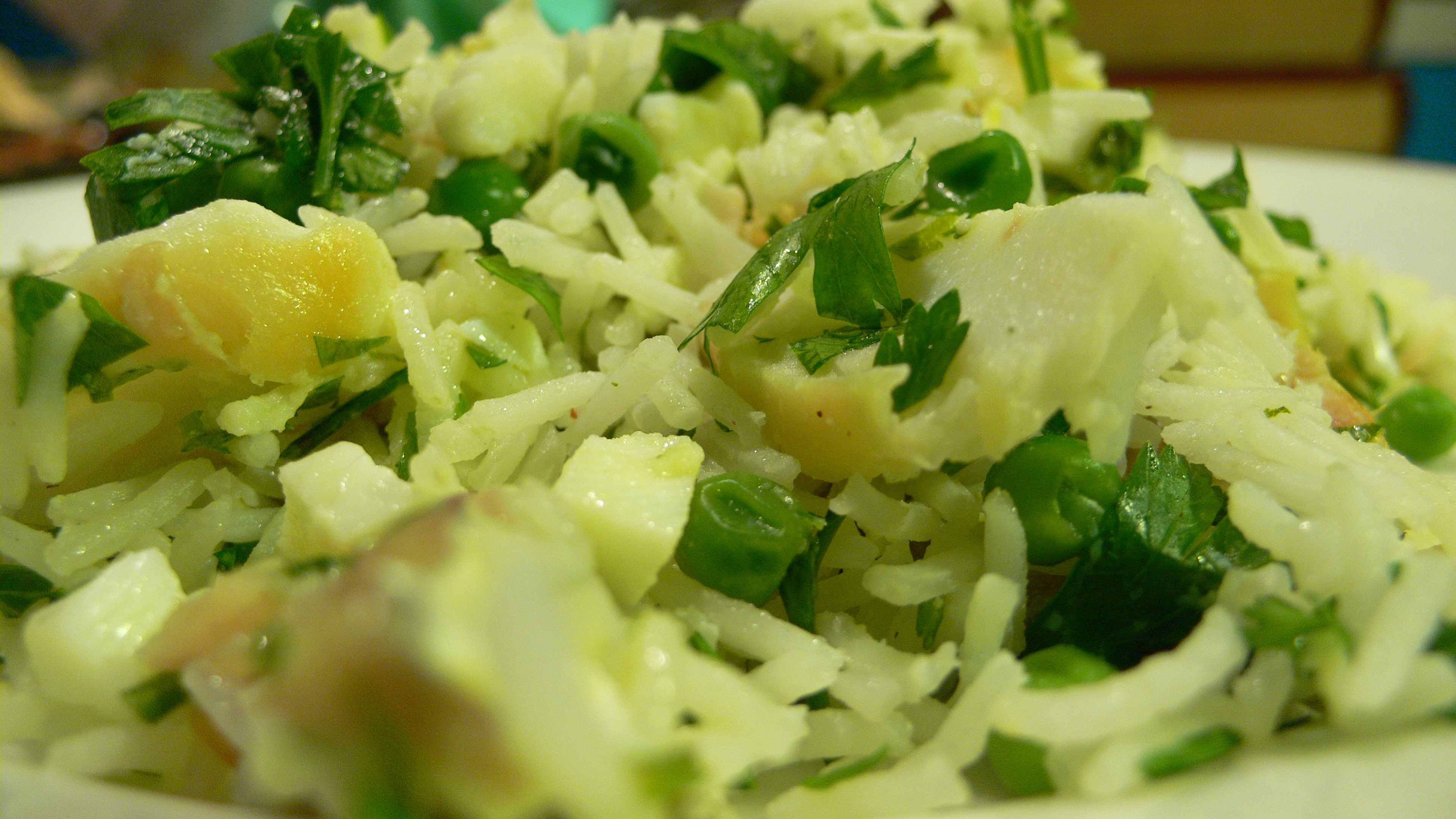
Kedgeree-2
I once asked my sister if she had ever persuaded my grandmother to hand over her kedgeree recipe (my sister is the cook of the family). She had, and she sent it to me by return of electronic post. I printed it off and slipped the sheet into one of my wife’s cookery books, with the intention of trying it one day. Alas, the road to hell is paved with good intentions, as they say.  That piece of paper has never been used and is now lying, along with the cookery book, in a storage space in Vienna, awaiting our return to Europe.

After receiving the recipe from my sister, my curiosity was piqued and I started to do some research on kedgeree. The first thing I discovered was that its culinary roots are in India!  For some reason, I think because my grandmother was always going on about her Norwegian roots (she was half Norwegian) and because the dish had fish in it (the Norwegians are a sea-faring nation, aren’t they? They must all eat fish), it had to be originally Norwegian, with a name like kåjorø or something.
viking_longship

Of course, the rice should have warned me that Norwegian roots were doubtful, but I wasn’t that sagacious when I was young.  Apart from the rice, my grandmother had eliminated all other references to India. For instance, all recipes mention a sauce in which to cook the rice. There is a good deal of disagreement about what should go into this sauce, but they all agree on at least two ingredients. There should be onions, and there should be curry. Well there you go! My grandmother disliked onions – she didn’t like the smell and I think they disagreed with her digestion (as they do with mine and as they did with my father’s – the mystery of genes; I wonder which part of our DNA helix has problems with onions). In addition, my grandmother really, really disliked curry and all spicy spices. It looks like there too I inherited her bit of anti-spice DNA. So it’s not surprising that she ruthlessly eliminated the onions and the curry from her version of kedgeree, along with the medley of other spices which various sources suggest: cardamom, turmeric, cumin, fennel, cloves, cinnamon, nutmeg, mace, … the Spice Islands unfurl before the eyes. So maybe I wasn’t that wrong all those years ago. My grandmother’s kedgeree may not have come from Norway, but it sure ended up looking and tasting Norwegian.

The fascinating thing is to look at the Indian ancestor of kedgeree. The sources all seem to agree on khichdi as the ultimate source, or khichuri to give it what I think is its Bengali pronunciation. A typical recipe goes like this. First, throw out the fish and egg. This seems to have been a British addition (Wikipedia suggests that Bengalis eat their khichuri with fish and/or eggs, but I was able to find no reference to this in other recipes). Second, add lentils to the mix. Because basically, as far as I can make out what we have here is a dal mixed with rice. Third, add vegetables like cauliflower and peas. Cook the lentils, the rice, and the vegetable in the sauce, et voilà! (more or less; I’m cutting details).
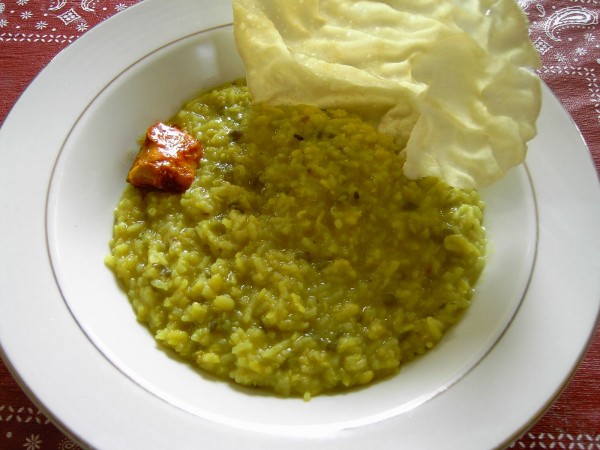
moong-mogar-dal-khichdi

How did this Indian dish mutate into its pale British imitation? I construct the following hypothetical journey – a complete fabrication, I’m sure, but it satisfies my sense of the romantic. I take as true the Wikipedian claim that Bengalis added fish and eggs to their khichuri. So I imagine that khichuri started its journey to kedgeree in Calcutta, among the men of the East India Company.
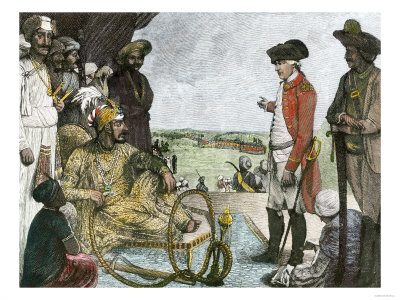
East-India-Company

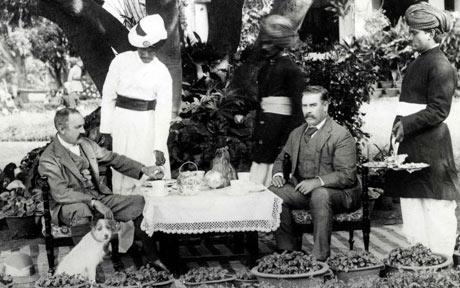
At the beginning, there were few British women in India to feed the men their British meat and potatoes, and since the men did not cook (of course) their diet went native. So far so good. But here I have recourse to another aspect of khichuri, that it is fed to those who are recovering from sickness or are otherwise generally feeble. And so I imagine that the Indian servants fed khichuri to their East India Company masters who had been felled by one of the many diseases of the Indian subcontinent to which their British constitution was not used and against which they had no defence, natural or pharmaceutical.  Since the British were very often sick (the death rate among the British at the beginning of their rule in India was alarmingly high), they were very often fed khichuri by their Indian servants (although in this case the servant seems to be bringing his sick master a cup of tea).
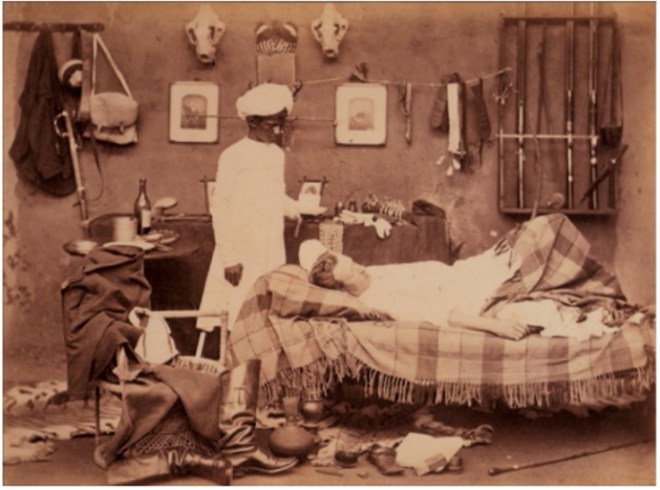
Thus was born a love of khichuri among the British men of India.

Now we have to move on some decades, to when sanitary conditions got better and medicines more effective, travel to India quicker, and racist theories about the superiority of the British over the Indians grew stronger. This last factor led from an earlier disapproval of having British women around to a disapproval of having British men – naturally, given the circumstances – consorting with Indian women. British men, it was decreed, should be with British women. The better and quicker travel meant that single (normally dowryless) British women could be brought over by the boatload and married off to the single British men running India. The better sanitary conditions and more effective medicines meant that they didn’t die in droves and had time to set up stable families.

So were born the memsahibs, that army of British women who ran the men who ran India.

memsahibs

They were the keepers of the flame of Britishness.  Everything became more British and the divide between British and Indians widened and deepened.
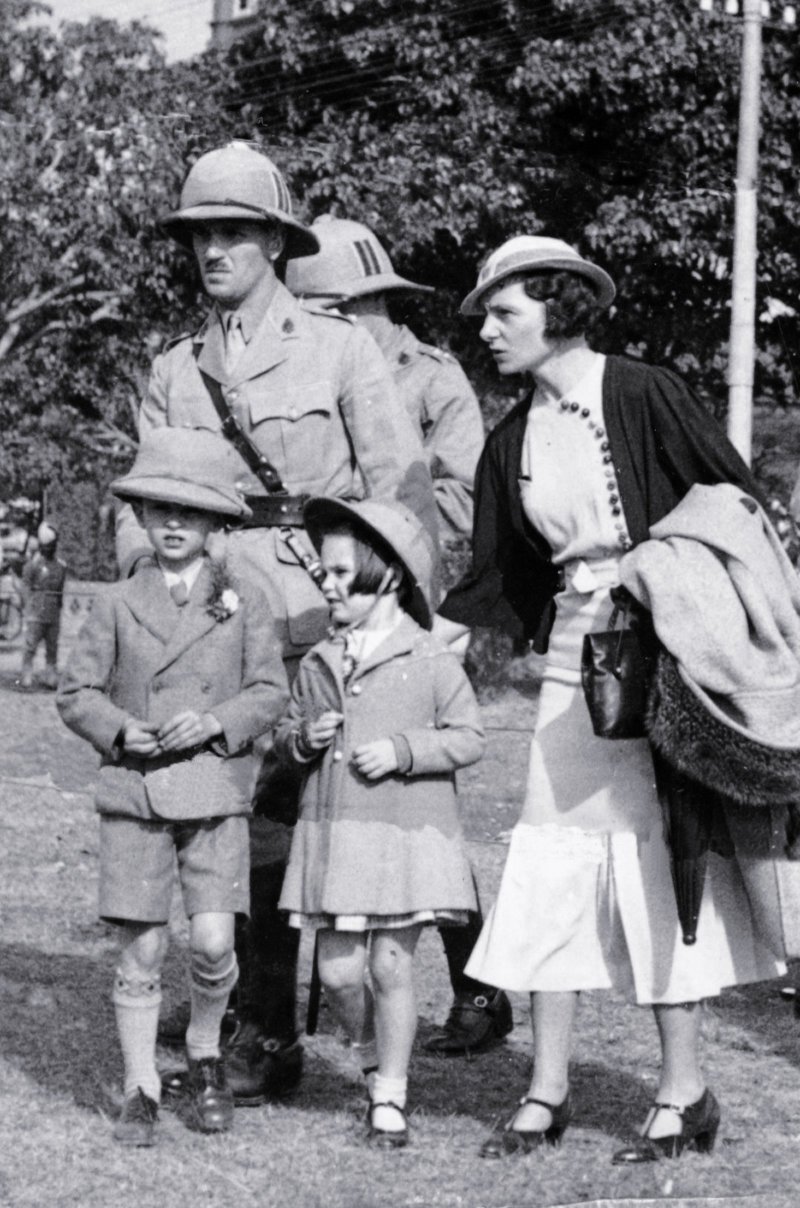
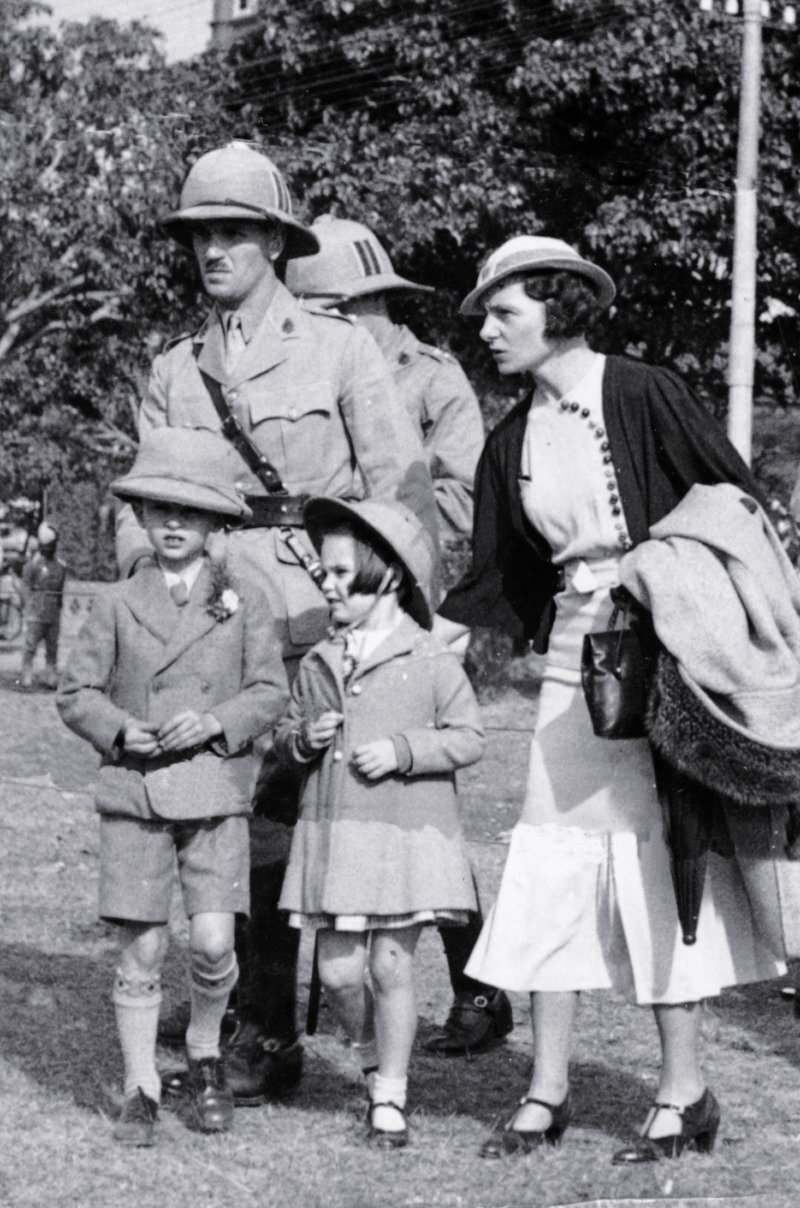
British family in india

Britification included the cuisine, of course. Meat, two veg, and potatoes, along with soggy deserts, became de rigeur, and all things Indian in the kitchen were determinedly stamped out (except the cook, of course; memsahibs did not cook).

But some Indian dishes survived the onslaught and slipped into the mainstream of British food. Chutney was one, although much of the original Indian spiciness and sourness was stripped out in the transition. When I was young chutney seemed as British as cricket.
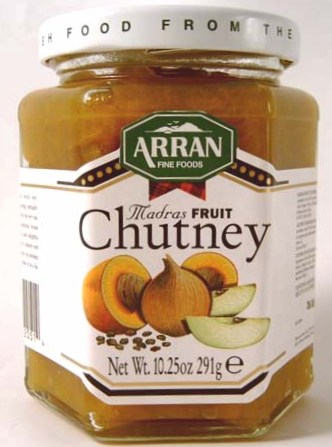
Chutney

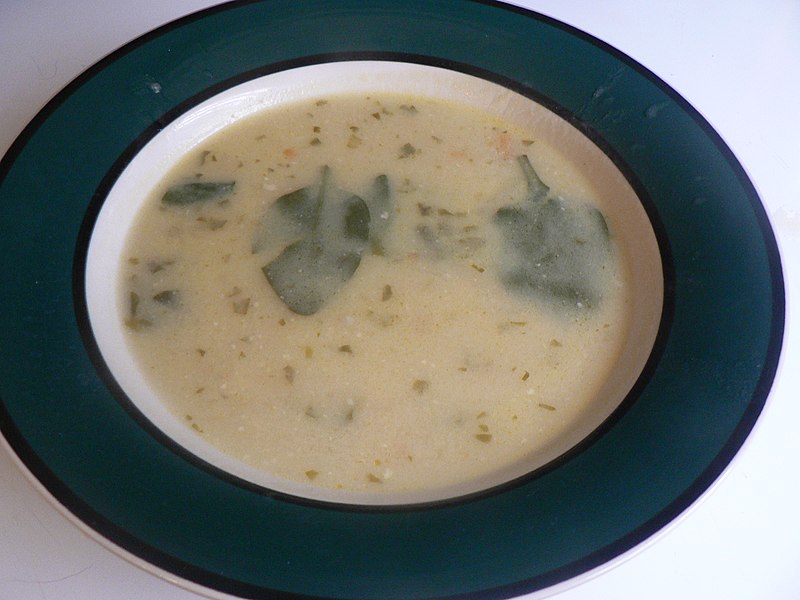
Mulligatawny soup (Milagu thanni in Tamil) was another, although my Wikipedian sources tell me that the British got confused and gave the name of one soup to the recipe of another; what the Brits eat really should be called Russum soup.

Mulligatawny

And of course there was khichdi /khichuri/kedgeree.

For some reason, in Anglo-India kedgeree became a breakfast dish, perhaps because fish (in the form of kippers) and eggs were typical ingredients of the British breakfast while the idea of eating rice at breakfast made sense in India.

breakfast-british raj

But I have to think that once kedgeree filtered back to the UK proper, the rice content meant that it migrated to the lunch and dinner menus; that’s certainly where my grandmother had it.

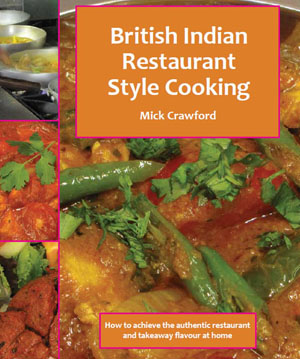
Of course, Indian cuisine has had the last laugh. When I was a young, impoverished University student, going to an Indian restaurant was a good option for a night out. The restaurants were slightly dodgy, the sort of places where you weren’t quite sure of the source of the meat on your plate (a story which made the rounds of the student dorms was of an inspection of an Indian restaurant turning up a dead dog in the kitchen’s refrigerator).  But now, as far as I can make out the English themselves are cooking Indian food. My guess is that in another thirty years British cooking won’t exist anymore in Britain. Everyone will eat Indian.

Indian cookery book

_________________

Kedgeree: http://upload.wikimedia.org/wikipedia/commons/b/b8/Kedgeree.jpg [in http://en.wikipedia.org/wiki/Anglo-Indian_cuisine%5D
Viking longship: http://www.celticattic.com/scandinavian/images/viking_longship.jpg [in http://www.celticattic.com/contact_us/norwegian_connection/ships.htm%5D
Kichdi: http://jainrasoi.com/mg/wp-content/uploads/2012/09/moong-mogar-dal-khichdi-600×450.jpg [in http://jainrasoi.com/khichdi/moong-mogar-dal-khichdi%5D
East India company: http://thediplomat.com/sport-culture/files/2012/01/East-India-Company.jpg [in http://thediplomat.com/sport-culture/2012/01/12/revisiting-the-east-india-co/%5D
Sick man: https://naughtgin.com.au/a-tonic-for-our-time/ HhdTZia6Bzk/ULac2VucJAI/AAAAAAAAAN0/rCoD3QxO_us/s1600/sick_man_24338_md.gif [in http://storytimehats.blogspot.com/2012/11/sick-to-move.html%5D
Memsahibs: http://s157.photobucket.com/user/dismasdolben/media/memsahibs.jpg.html?t=1176095517 [in http://sanatana-dharma.livejournal.com/106044.html%5D
British family in India: http://3.bp.blogspot.com/-JXoJcY6cvfg/T33zjAqxGjI/AAAAAAAAAc4/Ln-30Elvh-8/s1600/British+india.jpg [in http://hkm128.blogspot.com/2012/04/being-dark-skinned-in-india.html%5D
Chutney: http://www.taste-of-arran.co.uk/data/shop/Madras%20Fruit%20Chutney.jpg [in http://www.taste-of-arran.co.uk/item.asp?itemid=121%5D
Mulligatawny soup: http://upload.wikimedia.org/wikipedia/commons/thumb/b/bd/Mulligatawny.jpg/800px-Mulligatawny.jpg [in http://en.wikipedia.org/wiki/Mulligatawny%5D
Breakfast-British Raj: http://4.bp.blogspot.com/-pEIQ5D-CSEU/UCo2tDj8nNI/AAAAAAAAJs8/35DYCGC5zk4/s1600/raj.jpg [in http://marykunzgoldman.com/2012/08/breakfast-of-champions.html%5D
British Indian cookery book: http://www.greatcurryrecipes.net/wp-content/uploads/2012/05/FRONT-COVER-NEW-BOOK1.jpg [in http://www.greatcurryrecipes.net/2012/05/12/a-review-of-british-indian-restaurant-style-cooking-by-mick-crawford/%5D


LEST WE FORGET

Beijing, 10 November 2013

I don’t think I’ll be able to wear my poppy this year.

Hoppe

Every year I pick it out of the corner of the drawer where I keep it, from under the paper clips and rubber bands. After four years in China, the paper petals are now sadly scuffed and creased, but I still like to give it pride of place in the lapel of my jacket. I am somewhat diffident to wear it here, because everyone stares at it wondering what it is. Several of my Chinese staff have asked me politely what it means. After I’ve gone through the explanation, they thank me nicely but I rather think they put my behaviour down to a form of British eccentricity.

It was the same in Vienna. You would have thought that Europeans would be more familiar with the British paper poppy and its symbolism but it seems not. Every year, I would be asked by two or three people what it was all about, and every time I would go through the explanation.

In Vienna, the enquirers would often start by commenting that they had seen the same poppy being worn by British politicians

Britain's Prime Minister David Cameron (

and indeed it is the sight of these politicians on my TV screen looking pious behind their poppies that reminds me that it is once again that time of the year … the eleventh hour, of the eleventh day, of the eleventh month. It was on 11 November 1918 that the Armistice between Germany and the Allied Forces was signed. The guns finally fell silent on the Western Front and the First World War came to an end.

The habit in the Commonwealth countries of wearing a poppy to remember the end of that war, and to raise funds for the wounded who came home and the widows and orphans of those who did not, grew out of a popular war poem written by a Canadian officer, John McCrae, who fought on the Western Front. I cite its first two verses here.

In Flanders fields the poppies blow
Between the crosses, row on row,
That mark our place; and in the sky
The larks, still bravely singing, fly
Scarce heard amid the guns below.

We are the Dead. Short days ago
We lived, felt dawn, saw sunset glow,
Loved and were loved, and now we lie
In Flanders fields.

Anyone who has ever seen a field sprinkled with poppies will immediately understand their strong symbolic resonance. They look like so much blood sprayed across the land.

poppies in field-3

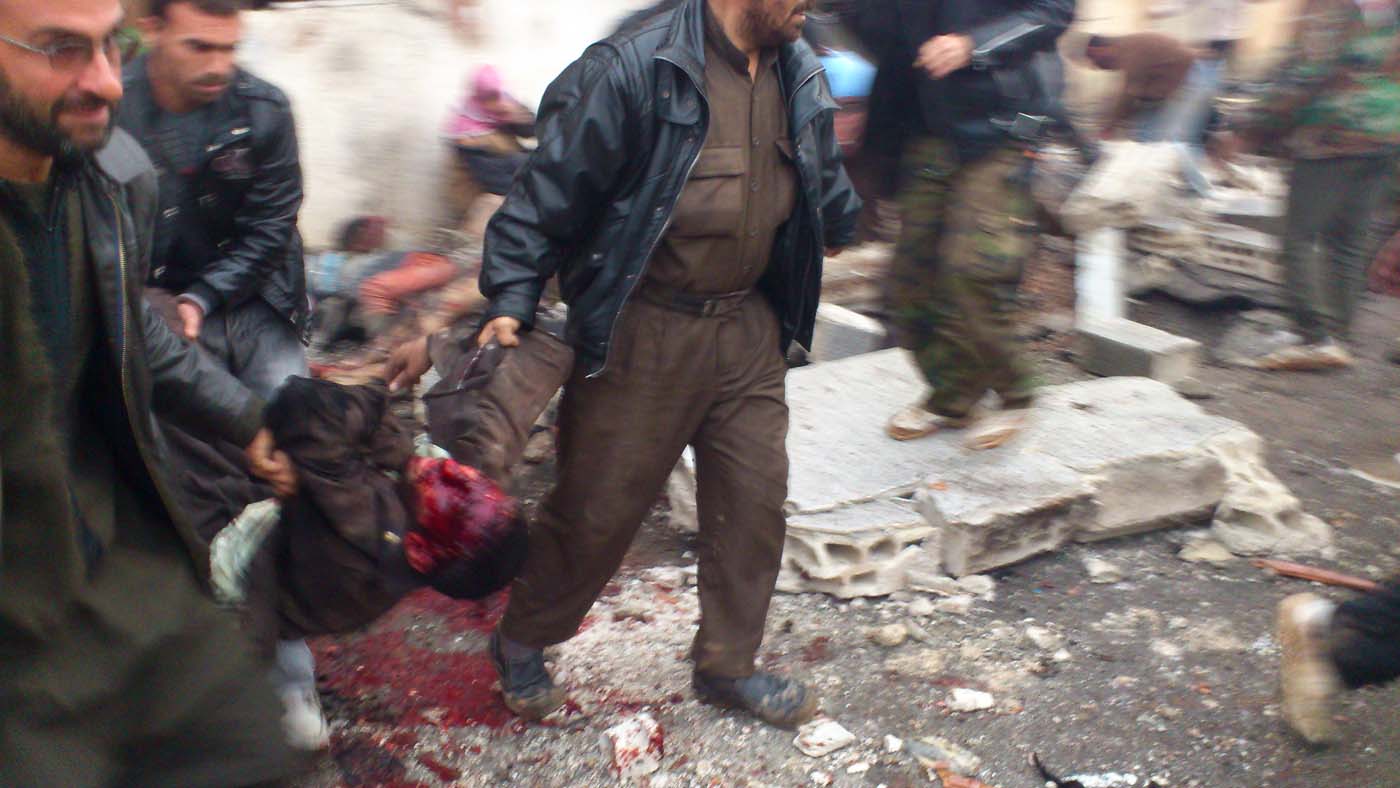
Earlier pious-looking politicians proclaimed that the First World War was the war to end all wars. Well, as we are all too aware, it wasn’t. As wars have continued to be fought, the poppy has become the way for the British and ex-British colonies of remembering their war dead. But I wear my poppy to remember all those who have died – civilians as well as soldiers – and continue to die in wars and other conflicts big and small the world over. Just this year we have the human tragedy of Syria, which is spilling over into Lebanon, there is the continuing conflict in Afghanistan which is spilling over into Pakistan, the continuing violence in Iraq and Libya, the growing violence in Egypt, the fighting in South Sudan, in Somalia, in the Congo, in Mali, in Myanmar, and on and on and on …

SYRIA-CONFLICT

When you see the sheer scale of the human misery which all this fighting engenders you understand why I did not cite the last verse of John McCrae’s poem.

Take up our quarrel with the foe:
To you from failing hands we throw
The torch; be yours to hold it high.
If ye break faith with us who die
We shall not sleep, though poppies grow
In Flanders fields.

I hate this glorifying of war, this coating in a veneer of sacred language what is simply a nasty, brutish fight. I prefer the following poem from that same war

Bent double, like old beggars under sacks,
Knock-kneed, coughing like hags, we cursed through sludge,
Till on the haunting flares we turned our backs
And towards our distant rest began to trudge.
Men marched asleep. Many had lost their boots
But limped on, blood-shod. All went lame; all blind;
Drunk with fatigue; deaf even to the hoots
Of disappointed shells that dropped behind.

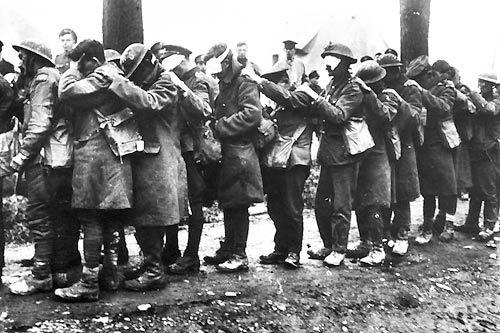
GAS! Gas! Quick, boys!– An ecstasy of fumbling,
Fitting the clumsy helmets just in time;
But someone still was yelling out and stumbling
And floundering like a man in fire or lime.–
Dim, through the misty panes and thick green light
As under a green sea, I saw him drowning.

In all my dreams, before my helpless sight,
He plunges at me, guttering, choking, drowning.

If in some smothering dreams you too could pace
Behind the wagon that we flung him in,
And watch the white eyes writhing in his face,
His hanging face, like a devil’s sick of sin;
If you could hear, at every jolt, the blood
Come gargling from the froth-corrupted lungs,
Obscene as cancer, bitter as the cud
Of vile, incurable sores on innocent tongues,–
My friend, you would not tell with such high zest
To children ardent for some desperate glory,
The old Lie: Dulce et decorum est
Pro patria mori..
[It is sweet and right to die for your country, a line from the Latin poet Horace]

dead soldiers

blinded soldiers

war-cripples

The poem was written by Wilfred Owen, who was killed exactly one week (almost to the hour) before the Armistice was signed. His mother received the telegram informing her of his death on Armistice Day, as the church bells were ringing out in celebration …

I must find a few minutes tomorrow to wear my poppy. I must make my annual statement against war, even if I am the only one to understand what I’m saying.

_____________

poppy in jacket: http://wpmedia.o.canada.com/2013/10/remembrance_frustrated_vets_20121108_24958803.jpg?w=660&h=330&crop=1 [in http://o.canada.com/technology/internet/legion-asks-redditors-to-remove-poppy-symbol-citing-trademark-protection/%5D
Politicians with poppies: http://4.bp.blogspot.com/-9GUo5YLH4iQ/Tr_Fb1rb4AI/AAAAAAAAInQ/qOXaLXKgfjg/s1600/a-9.jpg [in http://nobelprofile.blogspot.com/2011_10_16_archive.html%5D
Poppies in field: http://gallery.photo.net/photo/7644092-md.jpg [http://photo.net/blog/tag?tag=nature]
Wounded person: http://www.lapatilla.com/site/wp-content/uploads/2012/12/000_Nic6168584.jpg [http://www.lapatilla.com/site/2012/12/28/las-mejores-fotos-de-la-semana-5/]
Dead soldiers: http://upload.wikimedia.org/wikipedia/commons/8/89/Q_004256GermanDeadGuillemont.jpg [http://en.wikipedia.org/wiki/World_War_I_casualties]
Blinded soldiers: http://www.icrc.org/eng/who-we-are/history/first-world-war/v-p-hist-03088-25.jpg [in http://www.icrc.org/eng/who-we-are/history/first-world-war/overview-first-world-war.htm%5D
Crippled soldiers: http://www.ralphmag.org/CG/war-cripples640x432.gif [in http://www.ralphmag.org/CG/world-war-one2.html%5D
KAKI

Beijing, 3 November 2013

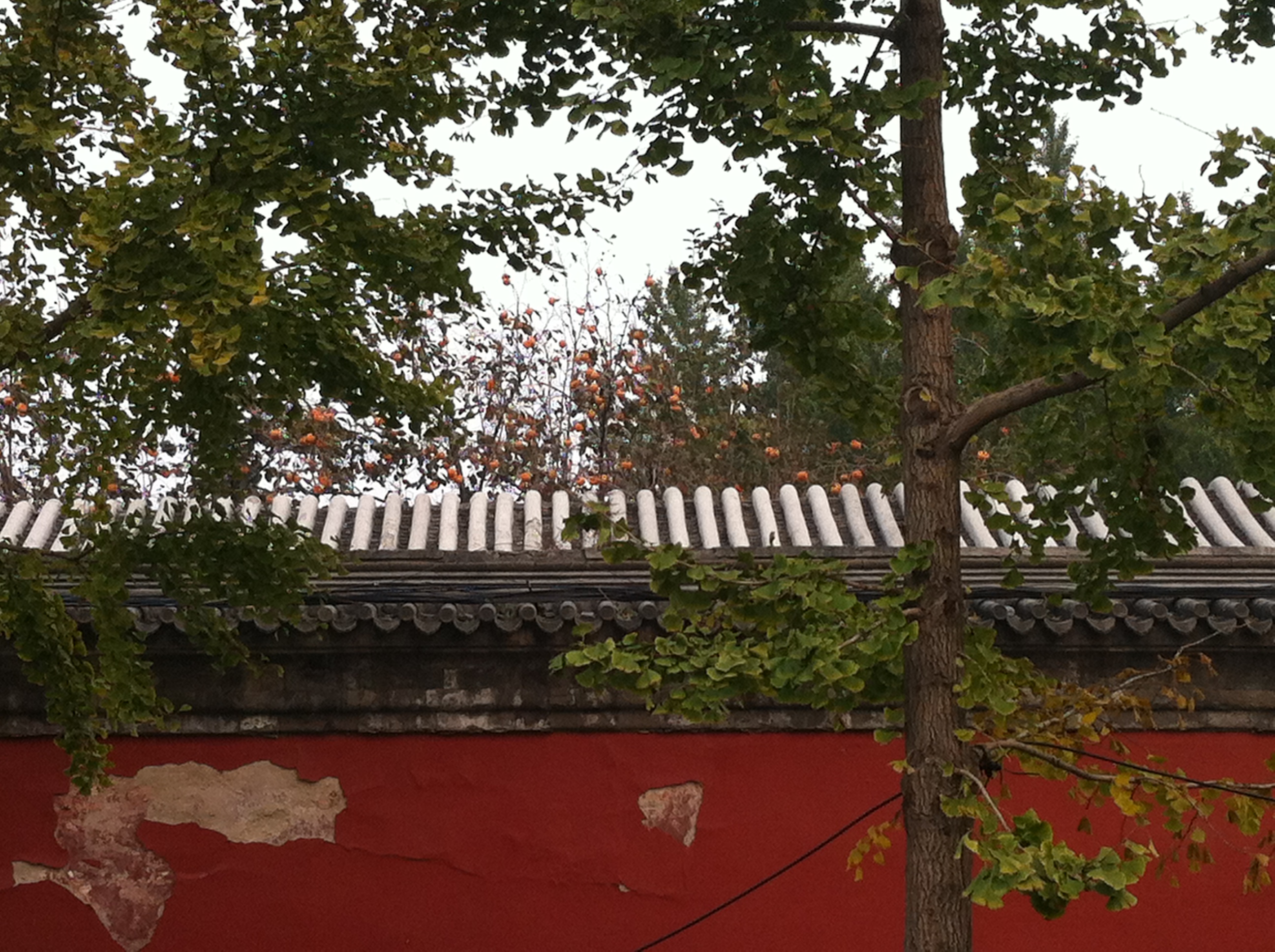
My wife and I went to an art show last weekend in an old temple located somewhere in the hutongs behind Beijing’s old drum tower (as a friend whom we met there said, “great space, great mulled wine, average art”). We went for a walk around the area afterwards, and I spied this kaki tree in full fruit peeping over a high wall.

kaki over temple wall 002

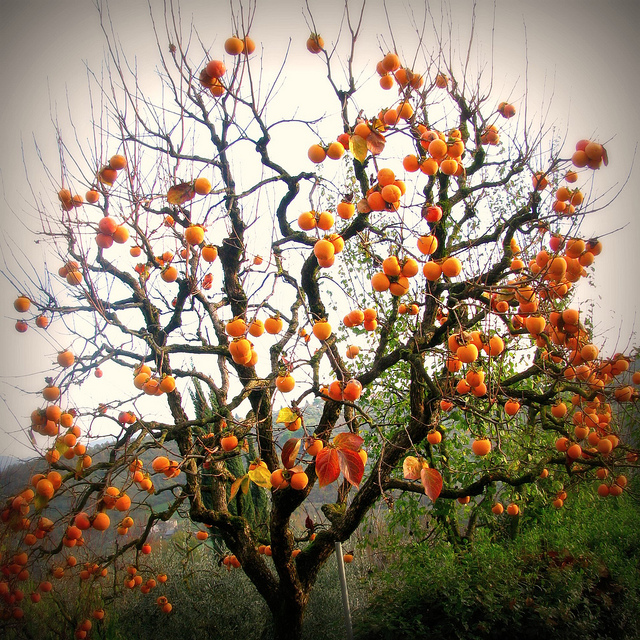
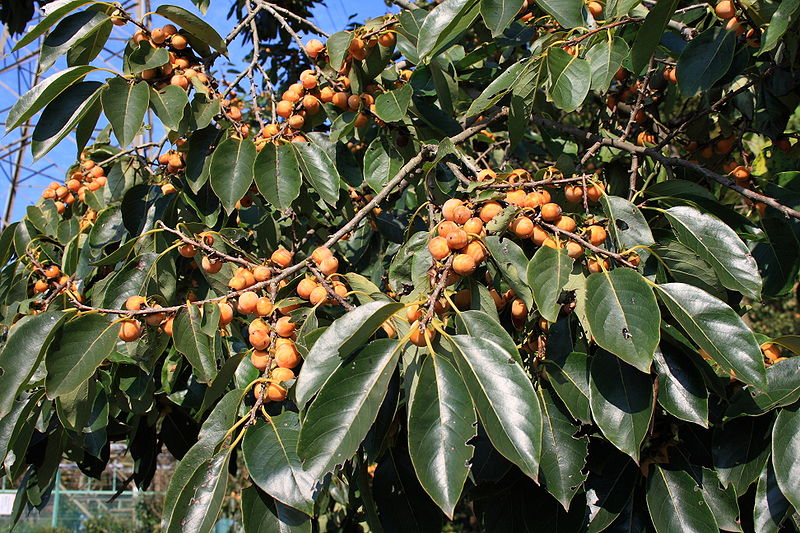
For those of my readers who can’t quite make out the tree in my picture, here is a much better take of the same species.

kaki

I realized that it was that time of the year again, when the kaki are fully ripened and ready to eat. And I suddenly noticed that all the Chinese grocers were filled with kaki.

I’ve noted in a much earlier posting that my wife brought much more food and culinary novelty to our marriage than I did. One of these was the kaki, which I first saw in Liguria during one of our trips out to the sea in the late months of the year.

cachi in liguria

My mother-in-law was very fond of this fruit, but I must say I have never been convinced by it. I appreciate neither its mushiness nor its sweetness. I’ve eaten it but rarely during the years since I first discovered it, and every time I have been reinforced in my lack of enthusiasm for the fruit.

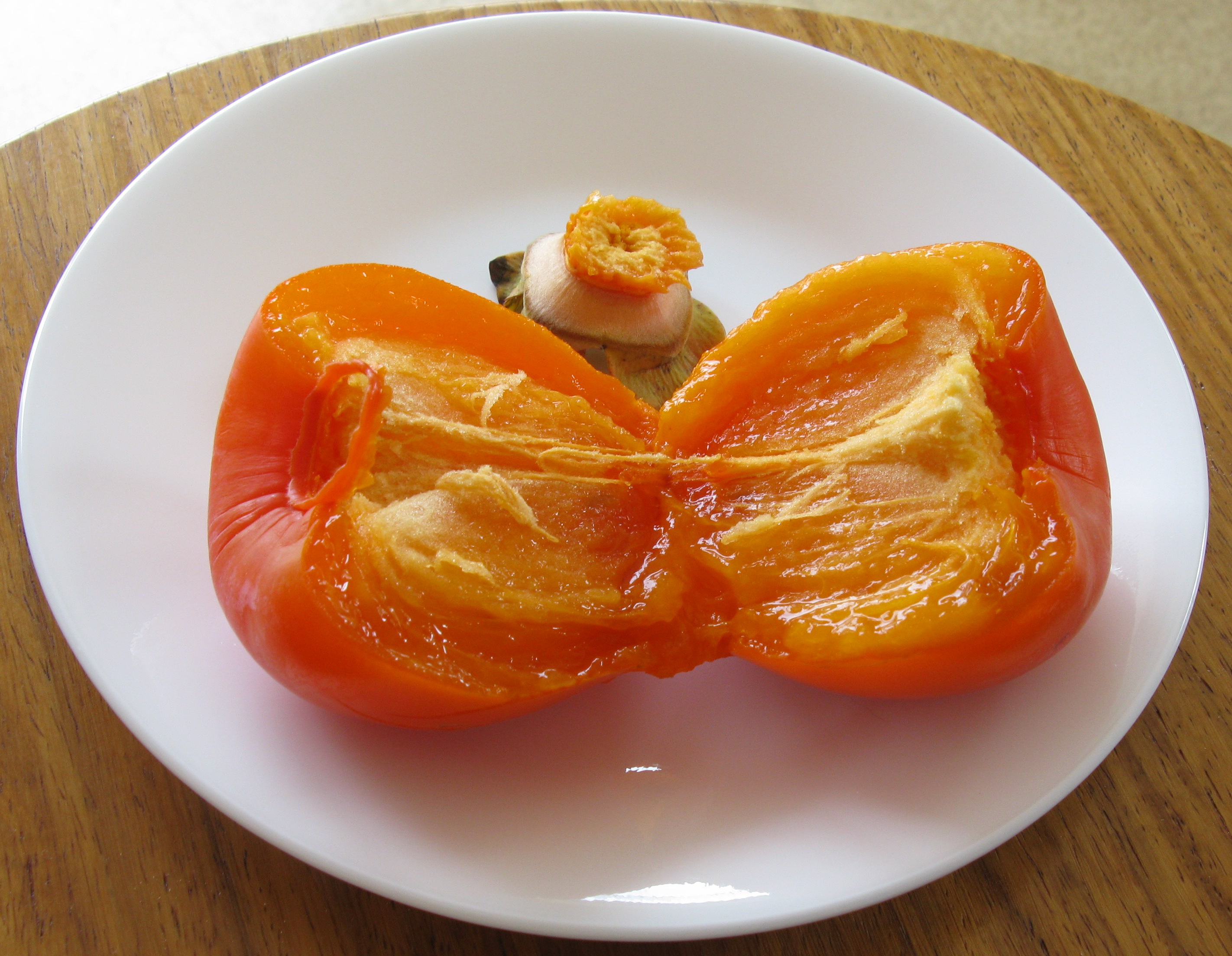
kaki fruit

Without really thinking about it much, I assumed that this tree and its fruit were native to the Mediterranean. I adopted the Italian spelling cachi as the original spelling. Imagine my surprise, then, when several years after my initial discovery of the fruit, we came across the tree laden with fruit during the trip which my wife and I made to Japan, and our Japanese companion informed us that it was called kaki. Kaki! The scales fell from my eyes. This must have originally been a Japanese tree, which was brought to Italy at some point – back in the 1800’s, I have since discovered. Another botanical species, like the ginkgo which I’ve written about earlier, which was trekked back to Europe during the first era of globalization.

Actually, I was wrong again! Because, like the ginkgo, the kaki is actually native to China and at some point got transported over to Japan – along with Buddhism perhaps? So if I were a linguistic purist I should switch to calling it shizi, which is its Chinese name. But I’m getting old and set in my habits. Kaki it will remain.

Talking of names, English-speaking readers may be asking themselves what the English name of the tree and fruit is. It was years before I asked myself that question and looked up cachi in an Italian-English dictionary. Persimmon, that’s what it is! Persimmon … that was a word which had hovered on the far horizons of my linguistic knowledge. I’d heard it spoken or maybe seen it written, I knew vaguely it was a fruit, but that was it. It sounds such an upper-class English name, don’t you think? Like Fitzwilliam or the Duke of Buccleuch. So it was another surprise to me to discover that persimmon is actually an English transliteration of the word pasiminan or pessamin, an Algonquian word from the eastern United States. Another result of the first era of globalization, in this case the colonization of North America. Because there is also a species of kaki that is native to Eastern North America, the American Persimmon.

American persimmon-tree

American persimmon-fruit

I prefer the formal Latin name Diospyros virginiana, which suggests to me that it was in the British colony of Virginia that the Brits first came across the tree.

By the way, there is actually a species of Diospyros which is native to the Mediterranean; actually, its range is somewhat broader, stretching from Southeast Europe to Southwest Asia. In English, it’s called the date-plum tree. Apparently, the fruit’s taste reminds one of both plums and dates.

date plum diospyros lotos-tree

Maybe I’m pushing this globalization thing too far, but I see another strand of globalization in that name. It is a literal translation of the Persian name for the tree and its fruit: khormaloo. In the earlier period of globalization, American colonists were content to simply anglicize the Native American name. But in a later, more learned period of globalization, when some more academic Brits actually learned the foreign languages which the expanding British Empire was coming into contact with, rather than call the tree, say, cormalew, they preferred to translate the original name.

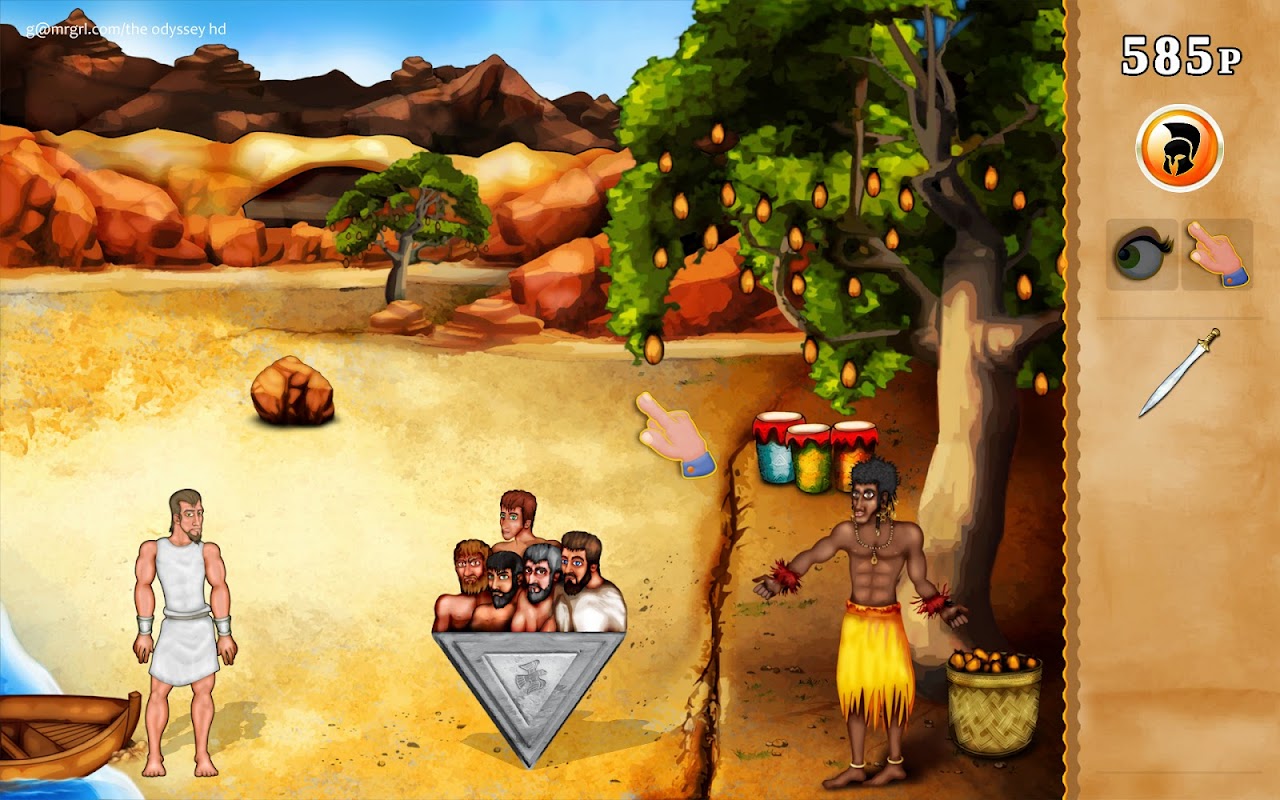
Actually, the Latin name of this species of kaki, Diospyros lotos, is even more interesting. It refers to a belief in Greece that this fruit could have been the lotus fruit mentioned in Homer’s Odyssey. According to that story, the lotus fruit was so delicious that those of Odysseus’s men who ate it forgot about returning home and wanted to stay and eat lotus with the native lotus-eaters. I throw in here a screenshot from an electronic game based on Odysseus’s story; the fruit looks vaguely kaki-like (amazing what they will make electronic games about …)

lotus eaters-2

Personally, I can’t think that kaki is the lotus-fruit. All that squishiness and mushiness would definitely not make me stick around.

______________

Kaki over the wall: my picture
Kaki: http://www.flickr.com/photos/giagir/5185254421/sizes/z/in/photostream/ [in http://www.flickriver.com/photos/giagir/5185254421/%5D
Cachi in liguria: http://www.flickr.com/photos/ciric/3032113542/sizes/z/in/photostream/ in [http://www.flickr.com/photos/ciric/3031273027/]
Kaki fruit: http://upload.wikimedia.org/wikipedia/commons/0/01/Diospiros_kaki_Fruit_IMG_5472s.JPG [in http://en.wikipedia.org/wiki/Persimmon%5D
American persimmon tree: http://3.bp.blogspot.com/-hroimehTRQk/TlPhN7euB8I/AAAAAAAAAds/lBlwEER714k/s1600/persimmon4.jpg [in http://tcpermaculture.blogspot.com/2011/08/permaculture-plants-persimmons.html%5D
American persimmon fruit: http://4.bp.blogspot.com/-b3lVcZ8FOnw/TlPgCINg7VI/AAAAAAAAAdk/LQCyiQYUw2c/s1600/Persimmon3.png [in http://tcpermaculture.blogspot.com/2011/08/permaculture-plants-persimmons.html%5D
Date plum-tree: http://upload.wikimedia.org/wikipedia/commons/thumb/6/63/Diospyros_lotus_01.jpg/800px-Diospyros_lotus_01.jpg [in http://en.wikipedia.org/wiki/Date-plum%5D
Odysseus and the lotus eaters: https://lh5.googleusercontent.com/-2uTp30FUU4E/UaHOcmkRBwI/AAAAAAAACsY/UU21szj7LBk/s1280/013_Lotus_Eaters.jpg  [in http://www.gamrgrl.com/2013/05/walkthrough-odyssey-hd.html%5D

LITTLE MARIA

Beijing, 2 November 2013

revised 14 December 2014

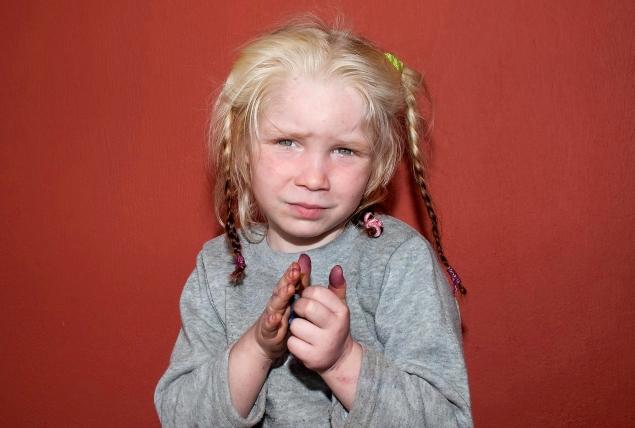
So Europe has been abuzz with the story of a little girl – Maria is her name – with the blondest of blonde hair and the bluest of blue eyes, who was found living with a Roma family in Greece. Her sweet little face flashed across all our television screens.

Little-girl-found-in-a-Roma camp

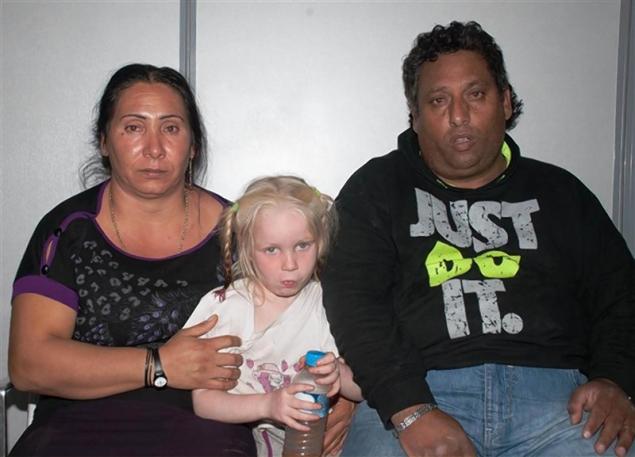
Greek police suspected, based on the lack of physical similarities between her and her supposed parents, that she was not their child.

marias greek so-called parents

Of course, there was a racist element in the whole discussion: how on earth could Romani have blonde children? Everybody knows that Romani are dark and swarthy (and shifty and unreliable and of thievish disposition and, and, and …). The obvious corollary was that the Romani had stolen Maria from a “normal” family. There was a certain level of triumphalism when science came along with DNA tests which proved without a shadow of doubt that the Romani who claimed to be her parents were in fact not her parents. So I had to laugh when DNA tests went on to show that actually Maria is a Roma – but from another Roma family in Bulgaria. And her Bulgarian parents look just as dark and swarthy as the Greek “parents”!

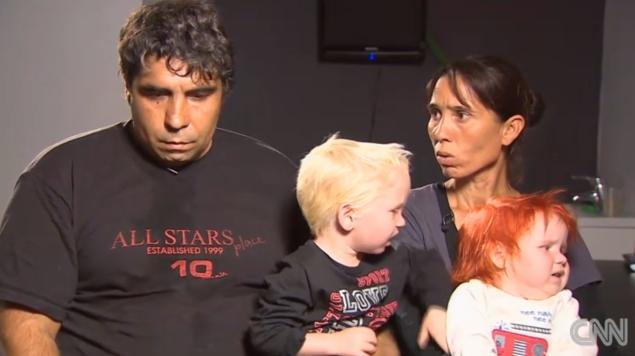
marias bulgarian real parents-2

And to top it all, as the picture shows, they have other equally blonde children!

It seems that the solution of the mystery is simple enough. All this testing has shown that Maria’s father carries the gene for albinism. So Maria and her other white-skinned, blonde-haired children are albinos.

Actually, when we get away from all the fuss and bother of these last few days along with the borderline racism of it all, there is the deeper, fascinating tale of the Roma people themselves. For some 200 years already, scholars have inferred from the Romani’s language that their original home must have been the Indian subcontinent and more specifically somewhere in its northwestern part (I won’t bore you – or myself – with the details, but it has to do with the fact that the Romani language is clearly a New Indo-Aryan language rather than a Middle Indo-Aryan language, with the closest affinities to the Saraiki linguistic group, which is native to southern Punjab, northern Sindh, Southern Khyber Pakhtunkha and northeastern Balochistan provinces of Pakistan). So how come little Maria ended up in Bulgaria?

To answer that question, it would be nice if the Romani had written histories and other documents which would tell us what happened to them after they had left their original home and, after much wandering, ended up in Europe. But like most marginalized peoples, the Romani have little if any written documents. And so we are left with mentions of their passage – mostly disapproving if not downright hostile – in the documents of the countries they crossed, along with the Romani’s own myths and folklore about their past.

And now we also have genetics.

Modern genetics is amazing. Truly, we carry our history in our cells. Scientists can carefully tease out from those millions of chemicals spiraling in our DNAs our story as peoples. As the biotechnology tools and equipment have grown more powerful – and cheaper – more and more historical information about us is being squeezed from our cells. The Romani are no exception. I have just finished reading a scientific article about a large genetic study recently undertaken on the Romani – the latest of a series. It was pretty hard going, I have to tell you. Here is a sample: “we applied the ADMIXTURE clustering method to estimate the membership of each individual to a range of k hypothetical ancestral populations (k = 2 to k = 15, see Figures 2C, S1D, and S1E). At k = 2, a longitudinal gradient on the amount of ancestry of each component is observed from India to Europe (Spearman’s rho = 0.935, p < 10216, after exclusion of European Romani; Figure S1F)”. Aie-aie-aie! But I ploughed through the article, and this is what I got from it (with some help from a review of the article in Scientific American, I will admit).

We can start with this prettily coloured map.

india map

It shows the strength of affinity between the Romani’s genetic makeup and that of the modern populations of the Indian subcontinent (red, the strongest affinity; blue, the weakest). It tells us that most probably the Romani’s homeland was somewhere in the valley of the Indus River. This fits nicely with the linguistic evidence I mentioned earlier.

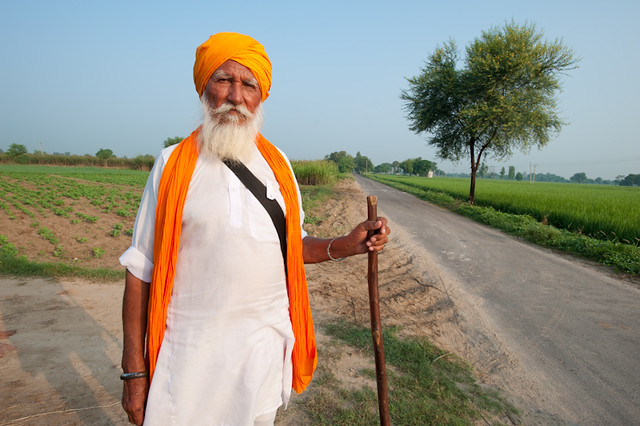
I throw in a picture here of one of the modern inhabitants of this part of India, a Punjabi farmer

punjabi farmer

Many of them are now Sikhs, but take away the turban and other Sikh attributes I don’t suppose the first Romani looked very different from this distinguished gentleman.

Genetics also tell us that it was very probably one group of people who left (rather than a number of groups leaving at different times and mingling over the centuries of their wanderings), and that they left in about 500 AD. Genetics can’t tell us why they left, alas, but a look at India’s history books shows that this was the time when the White Huns conquered the northwestern part of India from the Gupta Empire. Perhaps the Romani’s ancestors wanted to get out of the way of the fighting, or they were on the losing side of the fight and had had their lands taken from them.

Quite soon after leaving, genetics goes on to tell us, this so-called “founder group” went through what geneticists euphemistically call a bottleneck, which is another way of saying that the group’s numbers dropped sharply, in this case by half. Perhaps the White Huns caught up with them, perhaps a local population objected to their presence on their territories, perhaps they were decimated by some infectious disease. We’ll probably never know. In any case, genetics tells us that thereafter they moved quite fast through the Caucasus and the Middle East, mixing only moderately with the local populations along the way.

In about 800 AD, they ended up in Bulgaria; genetics tells us that this was their trampoline into Europe. And there they stayed for some three hundred years, according to the genetics, until about 1100 AD, when they started dispersing throughout the rest of Europe. The genetics can tease out two main dispersal streams, one to Western Europe and the other to Eastern Europe. Something bad happened to the Western European group in about 1200-1300 AD; their genes went through another strong “bottleneck”, equivalent to their losing some 30% of their population. Could it have been the Black Death? But why didn’t the Eastern European Group suffer similarly? The plague struck there too (except in the area of what is now mostly Poland). Again, we’ll probably never know.

Be that as it may, the genes also give us an indication of how much the Romani people have mixed their genes with other people’s as they spread through Europe. Overall, the Romani haven’t mixed much; their genes show more evidence of marriage among blood relatives than is the case with the other European populations (an interesting exception are the Welsh Romani, who seem to have mixed quite a bit). But they haven’t kept completely to themselves. And here there is an interesting difference between various groups of Romani. For instance, Romani from Spain and Portugal, but also from Lithuania, seem to have mixed more readily with the local populations in the past than they have recently. The opposite pattern is seen in the genes of the Romani populations from Slovakia and Hungary in Central Europe, and Croatia, Romania, and Bulgaria, in the Balkans. Here, the Romani kept to themselves for a long time but then more recently have mixed with other populations.

Given our generalized suspicion of Romani and our desire to keep away from them (I remember as a child being told that gypsies would carry you off if you weren’t careful, that you had to keep away from gypsy encampments, etc. etc.), how did any mixing between Roma and non-Roma take place at all? Well, it could have been kidnapping, as was the initial suspicion in the case of Maria. But it could just as well have been a case of Romani women being raped. But more likely it was people who, out of desperation, running away from dire poverty or abuse or some other misery, or out of a love for the open road, joined groups of Romani. And so mixed their genes with those of the Romani.

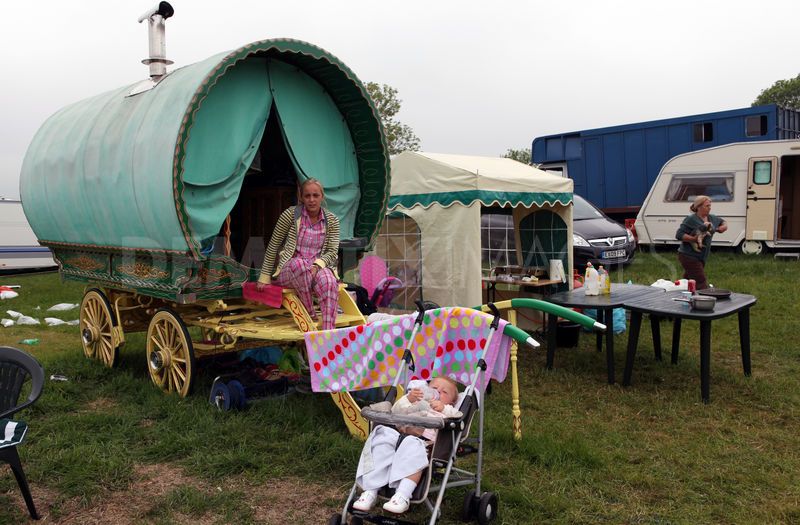
The urge, or need, to take to the open road is not a monopoly of the Romani. Many local European populations have done so over the ages. In my country, we have the English Travellers, the Highland Travellers, the Welsh Travellers. The Irish have their Travellers.

irish-travellers

The Norwegians have theirs. The Dutch have their Woonwagenbewoners (“caravan residents”). The Germans have their Landfahrer (“country drivers”). Germany and Switzerland (but also parts of France and Austria) have had the Jenische.

Jenische

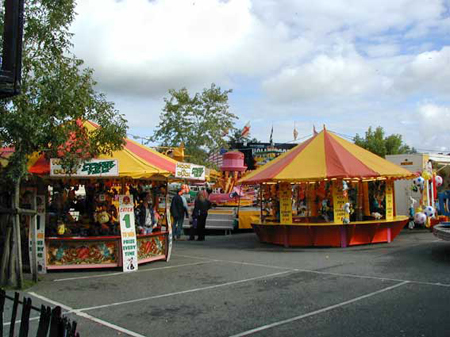
The Spaniards have their mercheros. And of course there are Show Travellers, all those people who travel around working in circuses, fairgrounds and the like.

fairground

And then we have those who don’t belong to any particular community, who are out on the roads alone, the tramps, who were turned into philosophers by Samuel Beckett in his immortal play Waiting for Godot

waiting-for-godot

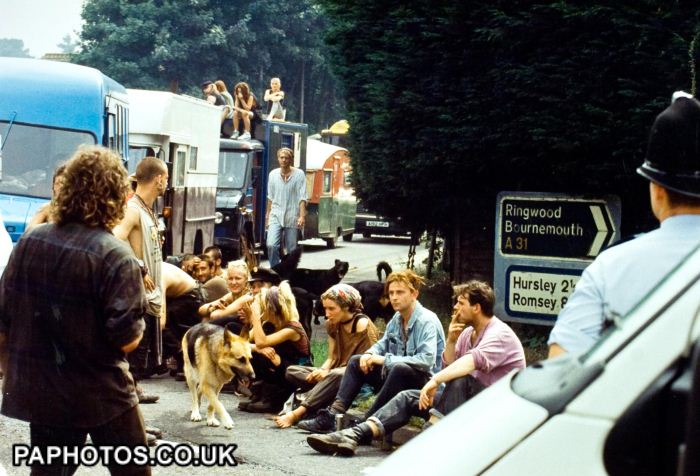
Many of these groups formed through poverty and desperation. But fascinatingly enough, the urge to make for the highway hasn’t died down, even in our rich, modern societies. We now have New Age Travellers, who travel between musical festivals and similar happenings.

new-age-travellers

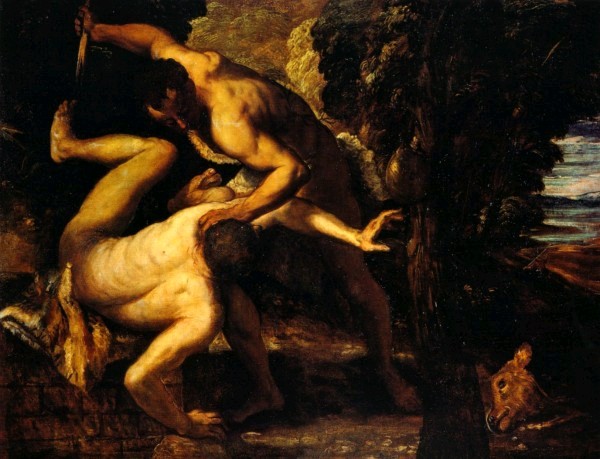
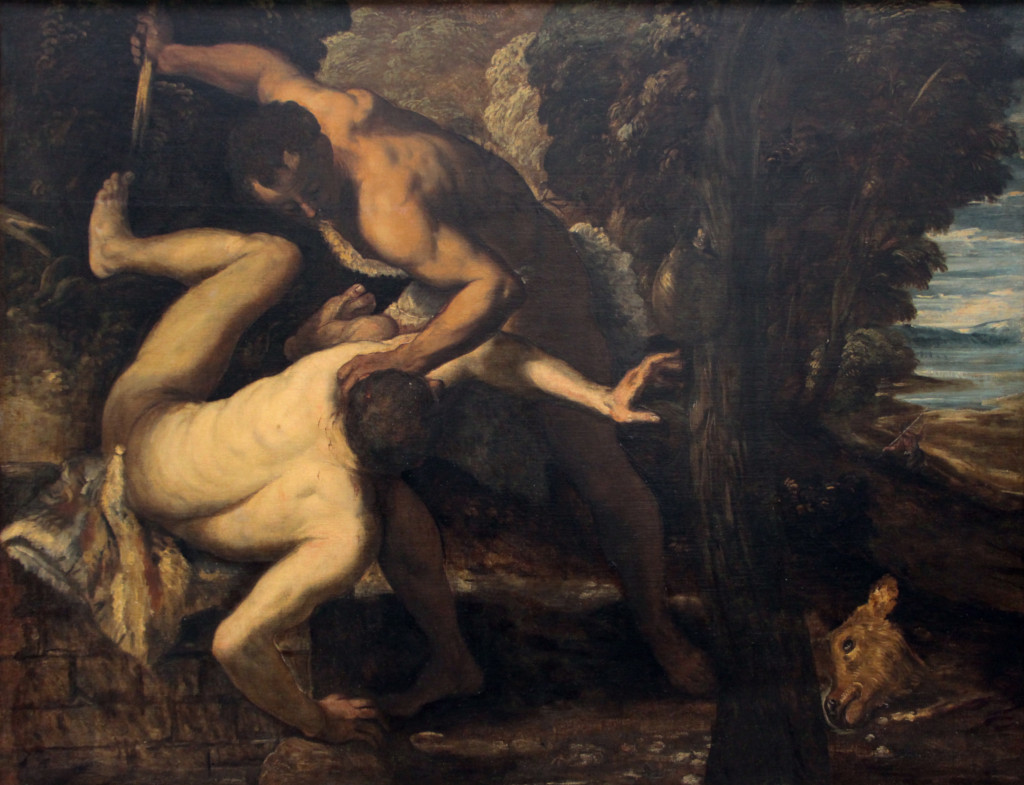
This last photo, with the policeman standing guard, says everything about the relationship us settled people have with the travellers. We view them with suspicion, bordering on fear. These people are shifting, rootless, not only physically but morally. They are dangerous. It was ever so, the relationship between the settled farming communities and the travelling herders of the plains, the grasslands, of the wide-open spaces. Why, even the Bible has its story of this difficult, often violent, relationship between the two peoples, in the story of Cain and Abel. Cain was the settled farmer, Abel was the wandering shepherd. Cain was jealous of Abel, who seemed to enjoy God’s favour more, and he killed him.

cain and abel

Yes, we fear them and have pushed them further and further to the fringes of our societies. But they despise us. I rather like the term Show Travellers use to describe us settled folk: Flatties. Yes, I suppose our lives are flatter for not being out on the road.

NOTE: I thank Andrew for correcting a fundamental mistake I made in the original post. I had not picked up on the fact that our little Maria is in all probability an albino.

________

Little blonde girl found in Roma camp: http://assets.nydailynews.com/polopoly_fs/1.1499215.1382989726!/img/httpImage/image.jpg_gen/derivatives/landscape_635/185472147.jpg [in http://www.nydailynews.com/news/world/roma-mom-maria-back-article-1.1499222%5D
Maria’s Greek “parents”: http://assets.nydailynews.com/polopoly_fs/1.1499217.1382989729!/img/httpImage/image.jpg_gen/derivatives/landscape_635/greece-girl.jpg [in http://www.nydailynews.com/news/world/roma-mom-maria-back-article-1.1499222%5D
Maria’s Bulgarian parents: http://assets.nydailynews.com/polopoly_fs/1.1499220.1382989732!/img/httpImage/image.jpg_gen/derivatives/landscape_635/roma29n-2-web.jpg [in http://www.nydailynews.com/news/world/roma-mom-maria-back-article-1.1499222%5D
Map of India: from the quoted article  (hyperlinked)
Punjabi farmer: http://farm5.staticflickr.com/4005/4432639845_00be7b0578_z.jpg?zz=1 [in http://www.flickr.com/photos/gurbirsinghbrar/4432639845/%5D
Irish travelers: http://static1.demotix.com/sites/default/files/imagecache/a_scale_large/700-6/photos/1306505237-irish-travellers-in-the-uk_705916.jpg [in http://www.demotix.com/news/705942/irish-travellers-uk#media-705926%5D
Jenische: http://upload.wikimedia.org/wikipedia/commons/1/10/Jenische_um1890_Muotathal_CHe.jpg [in http://en.wikipedia.org/wiki/Yeniche_people%5D
Fairground: http://www.callington-tc.gov.uk/images/Honey_Fair_stalls.jpg [in http://www.callington-tc.gov.uk/civic_community/honey_fair.html%5D
Waiting for Godot: http://rosariomariocapalbo.files.wordpress.com/2011/03/waiting-for-godot11.jpg [in http://rosariomariocapalbo.wordpress.com/2011/03/31/samuel-beckettwaiting-for-godot/%5D
New Age travelers: http://www.assetstorage.co.uk/AssetStorageService.svc/GetImageFriendly/721206537/700/700/0/0/1/80/ResizeBestFit/0/PressAssociation/F2E18D5B4CC53FE75B4C42D68612D0FF/new-age-travellers-in-winchester.jpg [in http://www.friendsreunited.co.uk/new-age-travellers-in-winchester/Memory/b7746d77-162d-4041-8b82-a00a012a3288%5D
Cain and Abel: http://www.artbible.info/images/kain_abel_grt.jpg [in http://www.artbible.info/art/large/81.html%5D

CHENGLISH

Beijing, 26 October 2013

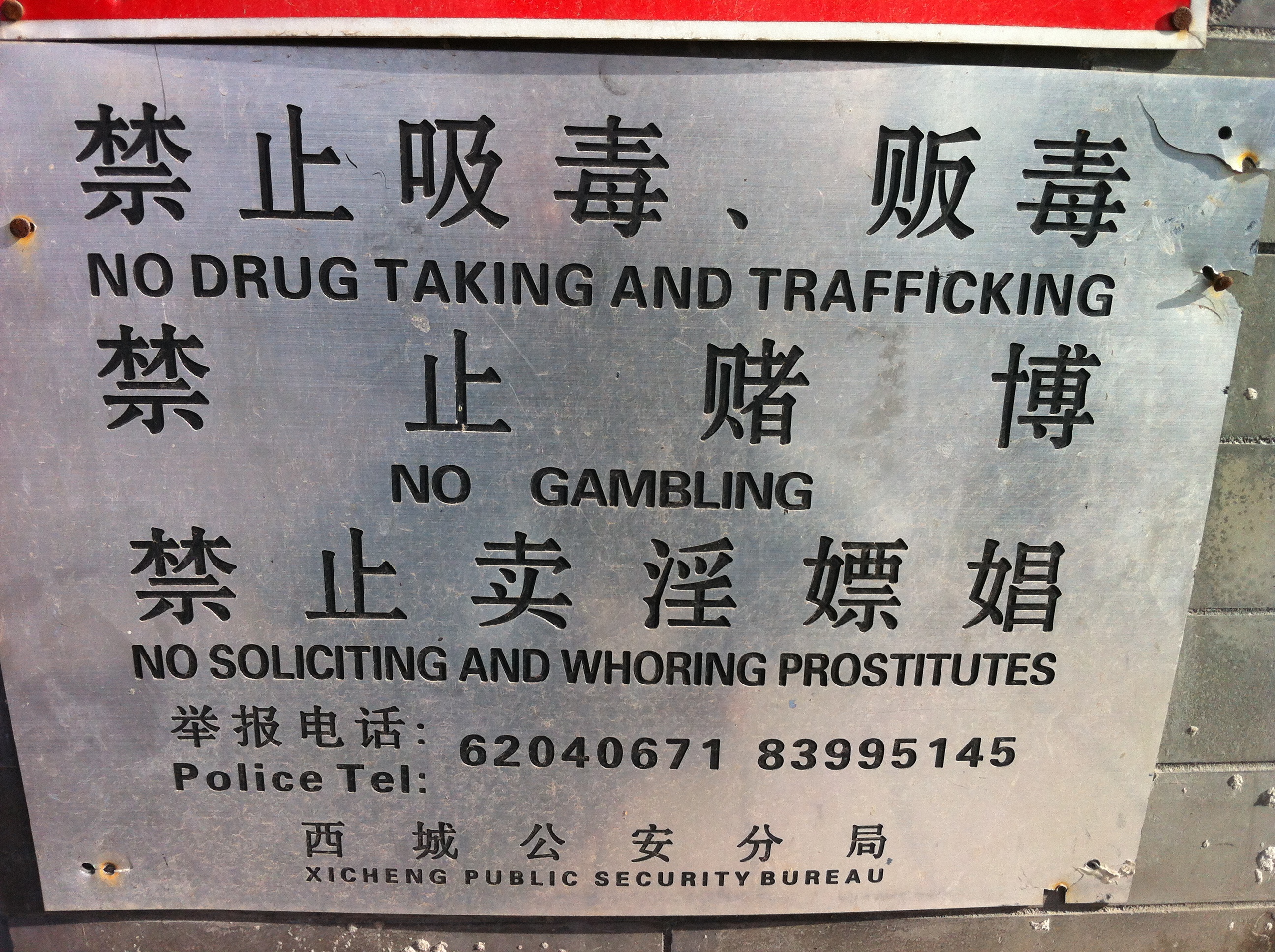
It is a sport in which all expats in China eventually indulge, that of hunting out prime examples of Chenglish and waving around their finds with glee. The internet is full of examples, and the electronic mirth which they engender echoes up and down the world’s broadbands.

For those of my readers who are not familiar with this sport, I should clarify that Chenglish stands for “Chinese English” and refers to the tangled, fractured, often incomprehensible English translations of Chinese notices that pepper the land. Of course, it’s mean to laugh at these very laudable attempts to reach out to foreigners, and I, who can speak but two words of Chinese and write none, who am I to smirk and titter and these honest efforts to communicate with me?

But really, sometimes I just cannot stop myself from bursting out into hearty peals of laughter at the English notices I am confronted with here. I share with you some of the pearls of my collection – because I must admit that, somewhat guiltily, I photograph the better ones I come across, with the locals generally looking on bemusedly.

This one is still comprehensible, although I rather liked its 18th Century take on the English language
Beijing-lake

This one, too, is comprehensible, although the sign makers are obviously not familiar with modern idiomatic English.

no tossing

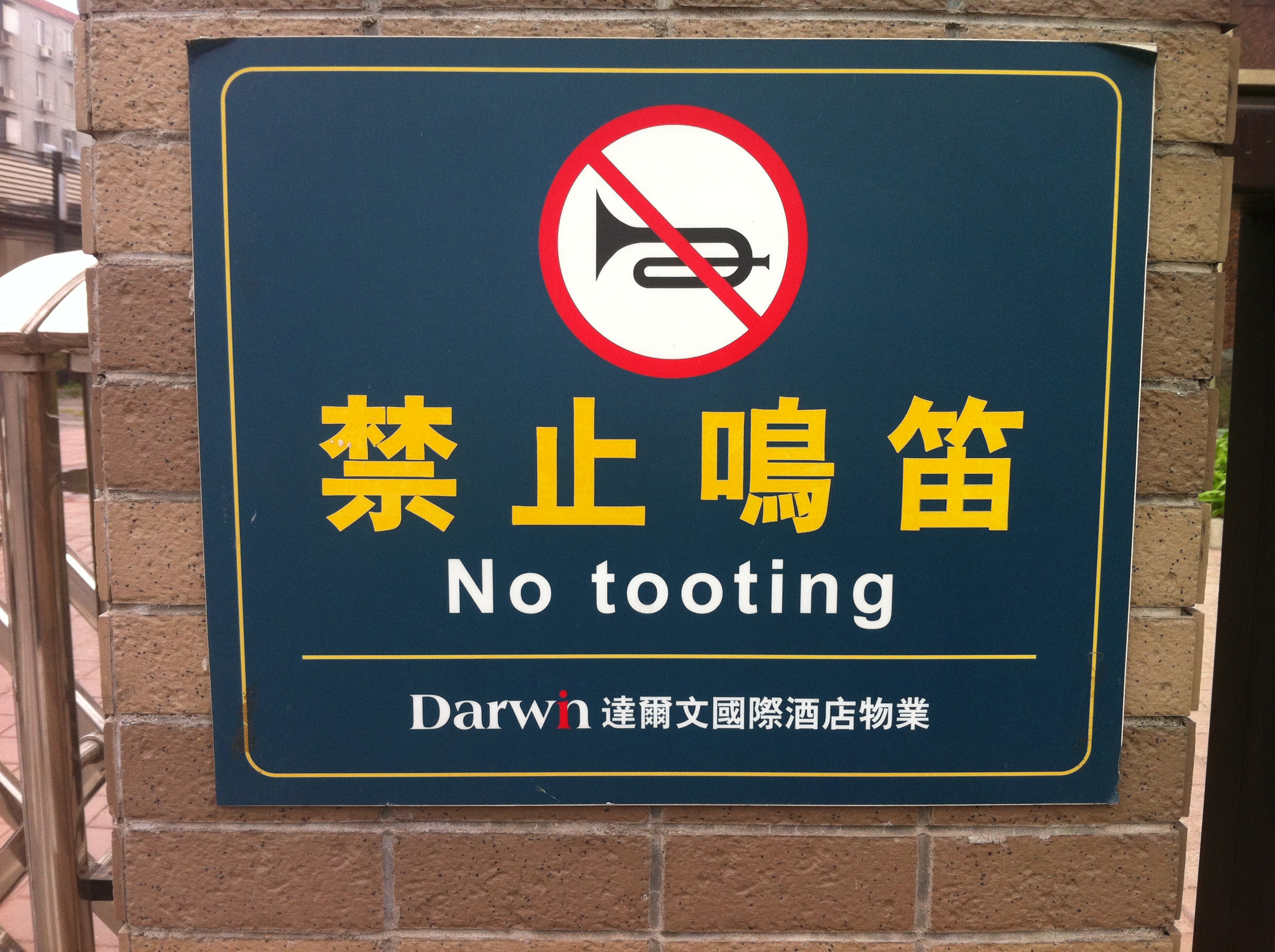
This one has a charming Berty Woosteresque feel to it

no tooting

This one was on the door of a restaurant loo – the context explains, I think, the rather medical feel to the sign-maker’s declaration

forbids the bowel movement

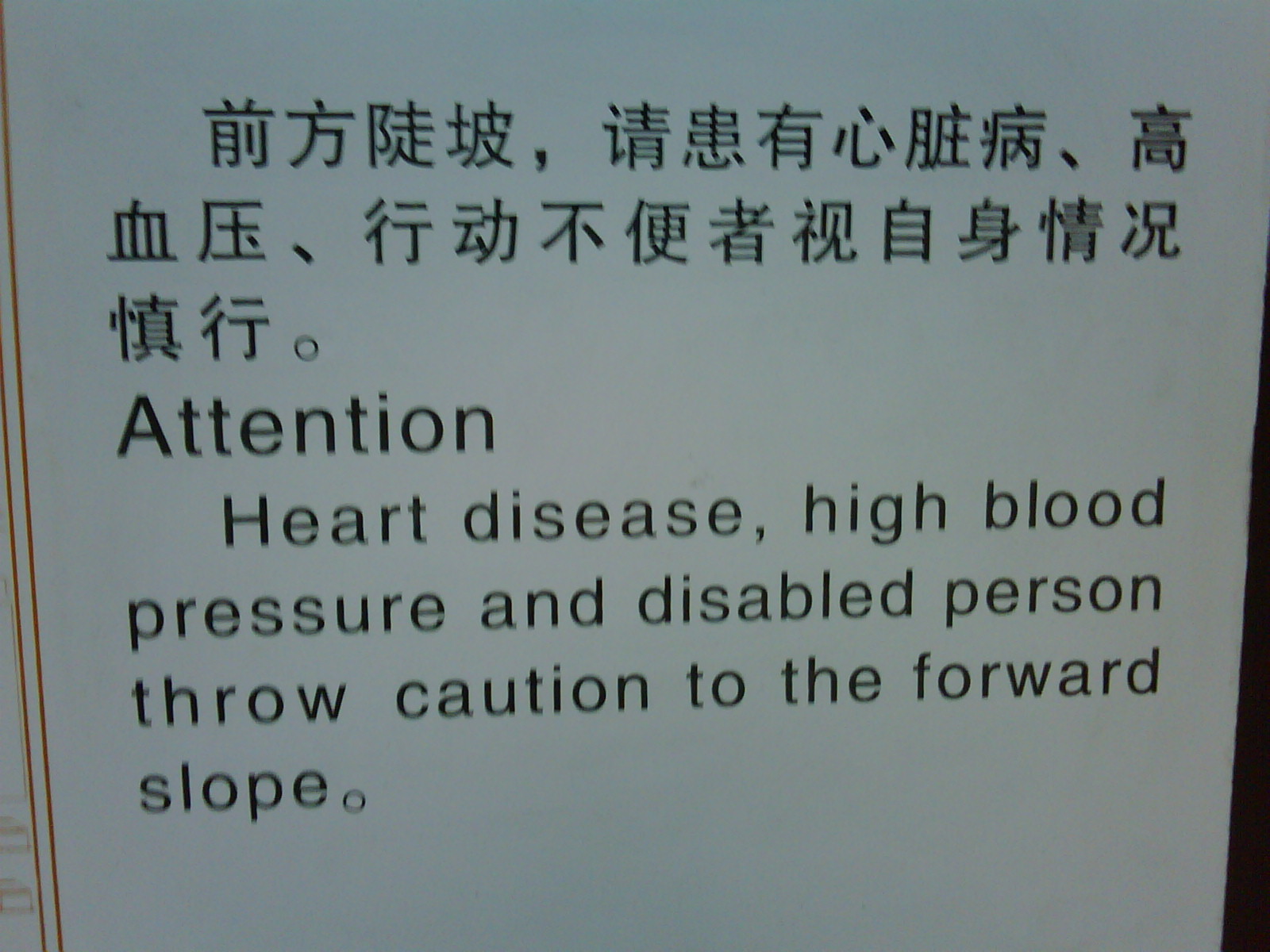
Here we begin to descend into the more incomprehensible

no treacherous acts

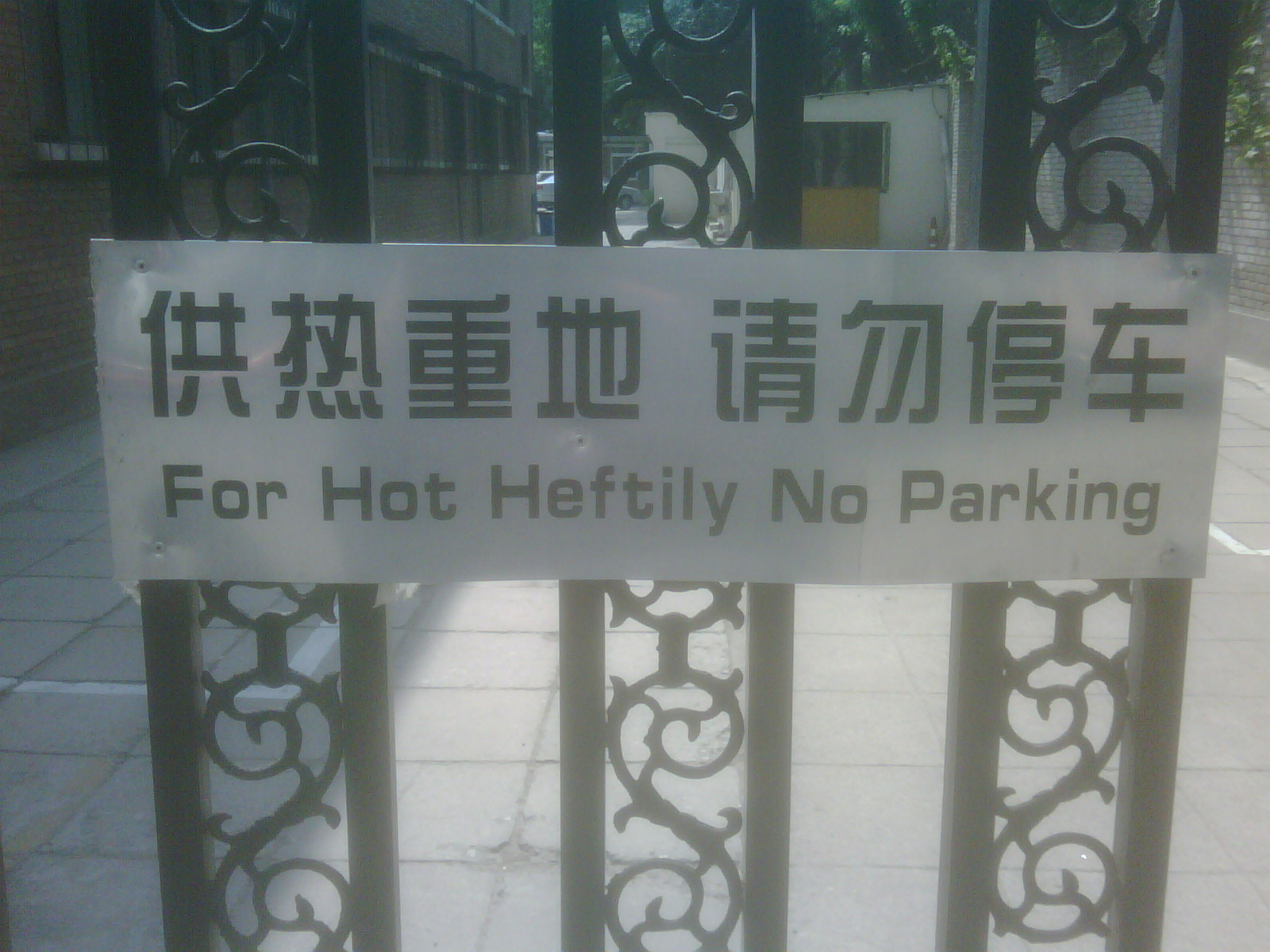
And now we reach the frankly incomprehensible

ming tombs

for hot heftily no parking

ending with this final poetic note

interior using dont be though

Chenglish has migrated onto T-shirts, sweat-shirts and the like, although in these cases it usually takes the form of a series of English words strung along one after another in lines of gibberish. I have only one photo of this genre of Chenglish.  Normally, I’m embarrassed to be seen by the wearers to be too obviously taking a photo of what they are wearing. But in this case, I sneaked up behind the lady in question as we waited to board a plane.

Kunming

This traveller to China, though, captured a brilliant example of the genre

T-shirt lingo

The language on clothes always remind me of a phase which my son went through when he was learning to talk, in which he just emitted words and half-words in a meaningless jumble but with much nodding of his head as if to stress the important point he was making. My wife and I have concluded that these are attempts by the manufacturers to make their clothes more desirable by making them look more exotic, although I always wonder how the designers choose the words. Do they just open a dictionary at random and pick out words? But who has a dictionary these days? Is there an app which will generate a random string of words at the touch of a key? Is this a side-business for badly paid English teachers?

Sometimes the words on clothes are really quite bizarre, and you have to wonder if the wearers have any idea of what they are declaring to the world from their T-shirts. It is an example of this which I saw yesterday that has got me to write this post. A young girl, up on a stage with a musical group and playing her heart out in front of an audience, was sporting a sweat-shirt on which was emblazoned in beautiful, bright green italics “Failure”. Who on earth would willingly write that on their chest?! Surely, I thought, it must continue on the back with something like “is not a word I know”, or “is not an option” or “is for weaklings”. But no, there was just that one word: Failure.

This really mystifies me. But not as much as a T-shirt I once spotted on a young Chinese girl walking arm-in-arm with her boyfriend which said “Romeo Fuck Juliette”.  Truly weird.

_____________________

all pictures mine, except:

yellow T-shirt: http://wanderlustandafoilheart.files.wordpress.com/2013/05/img_3961.jpg [in http://wanderlustandafoilheart.wordpress.com/%5D

AUTUMN LEAVES

Beijing, 23 October 2013

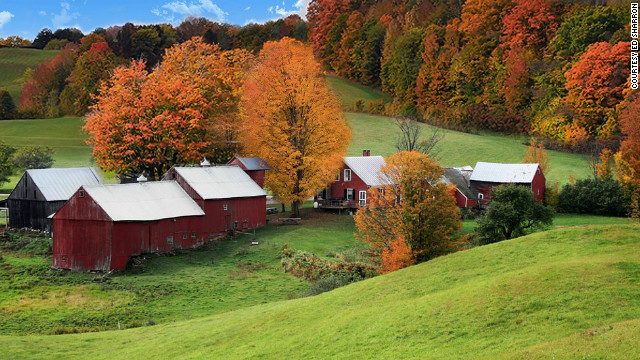
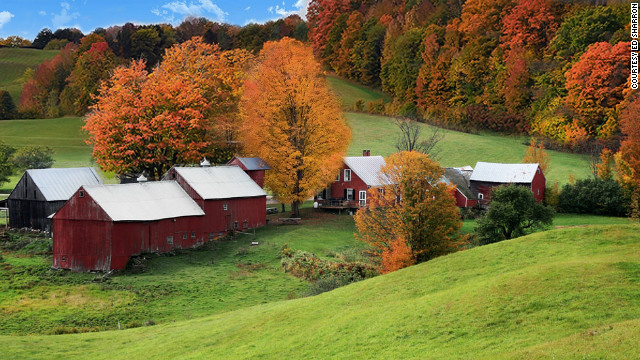
It’s that time of the year in the northern hemisphere when the trees begin to lose their leaves. If we’re lucky, depending on where we’re perched on that hemisphere, we can witness the glorious spectacle of leaves turning intensely red, orange or yellow before they expire and finally float to the ground. My wife and I had such luck some thirty years ago, when we went “leaf peeping” in Vermont.

vermont fall foliage

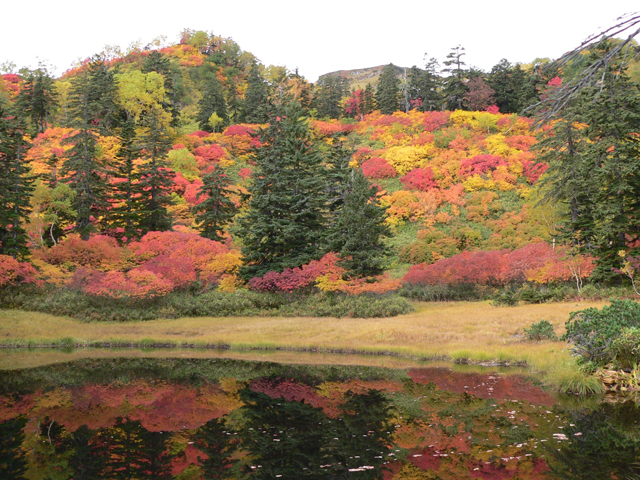
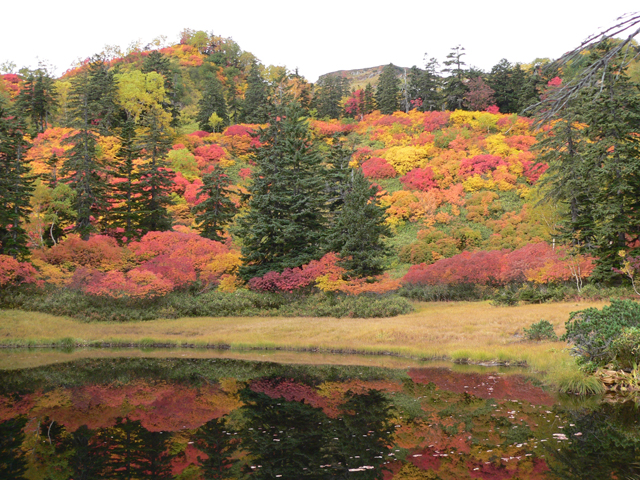
We had such luck an equally long time ago in Hokkaido, the northern island of Japan

hokkaido fall foliage

And I had such luck, alone this time, on my recent trip to Qinghai province, where the poplars were turning bright, golden yellow.

trees in fall

Alas, we have no such luck in dirty, dusty, smoggy Beijing. The leaves here go a little bit yellow, or just plain brown, before dropping miserably to the ground.

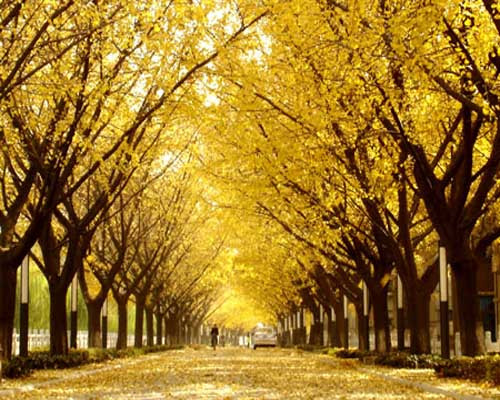
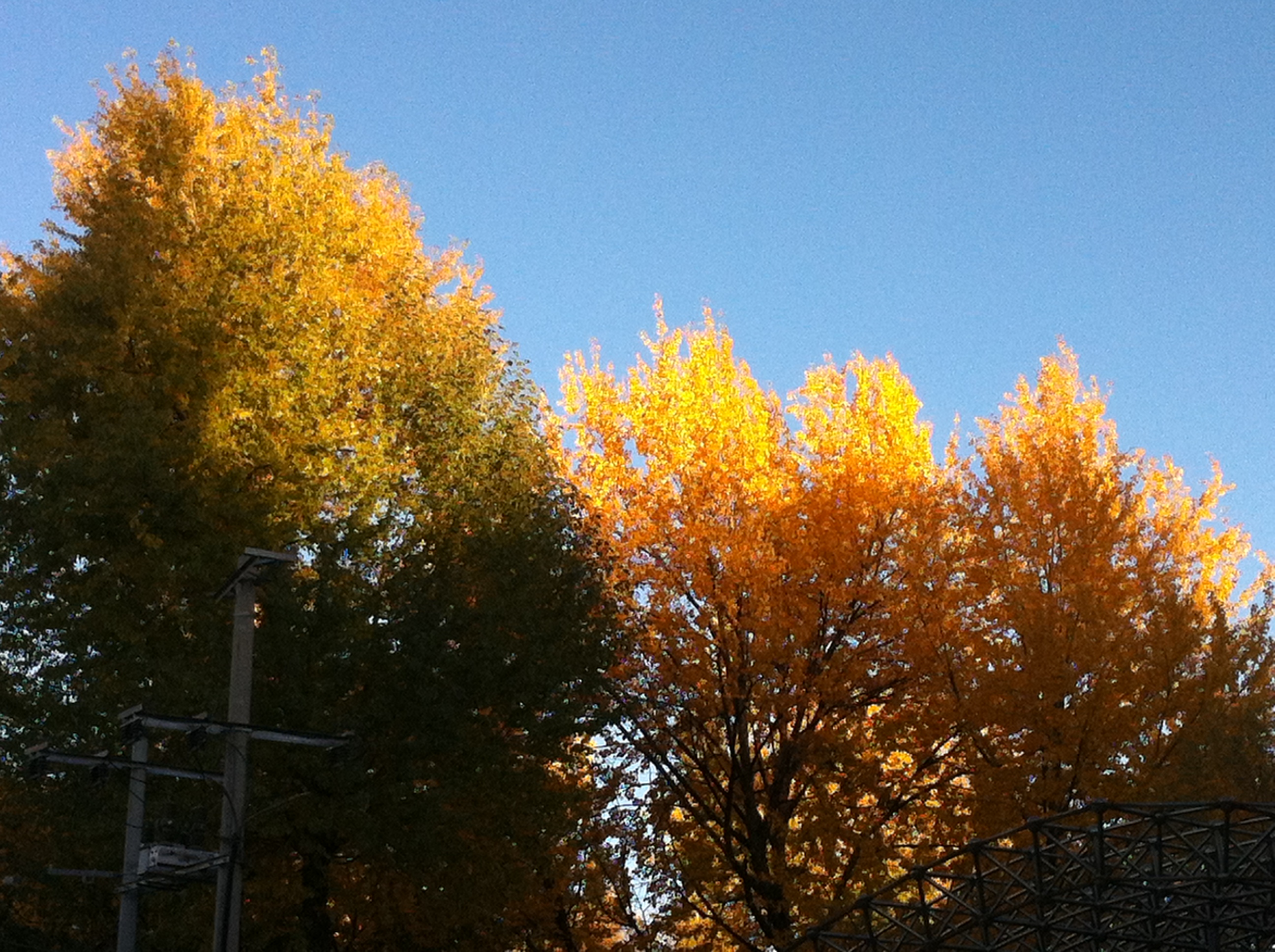
The partial exception is the ginkgo.  Ginkgos are popular trees to plant along streets. They tolerate well pollution and confined soil space, admirable traits for a tree growing in Beijing. And they look handsome, in the summer

ginkos 001

but even more so in the autumn

gingkgo trees autumn

Strange trees, ginkgos. The name already is odd. It was years before I realised that the “k” actually comes before the “g”. Who on earth came up with that spelling? A Dutchman called Engelbert Kaempfer, that’s who, back in the late 17th Century. He was the first European to see a gingko – sorry, ginkgo – in Japan. When he reported it to the European world, he seems to have stumbled over his transcription of the Japanese name ginkyō: what should have been written “ginkio” or “ginkjo” somehow got written as ginkgo.

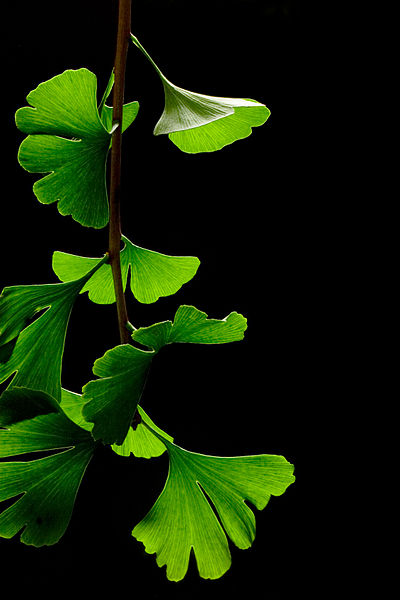
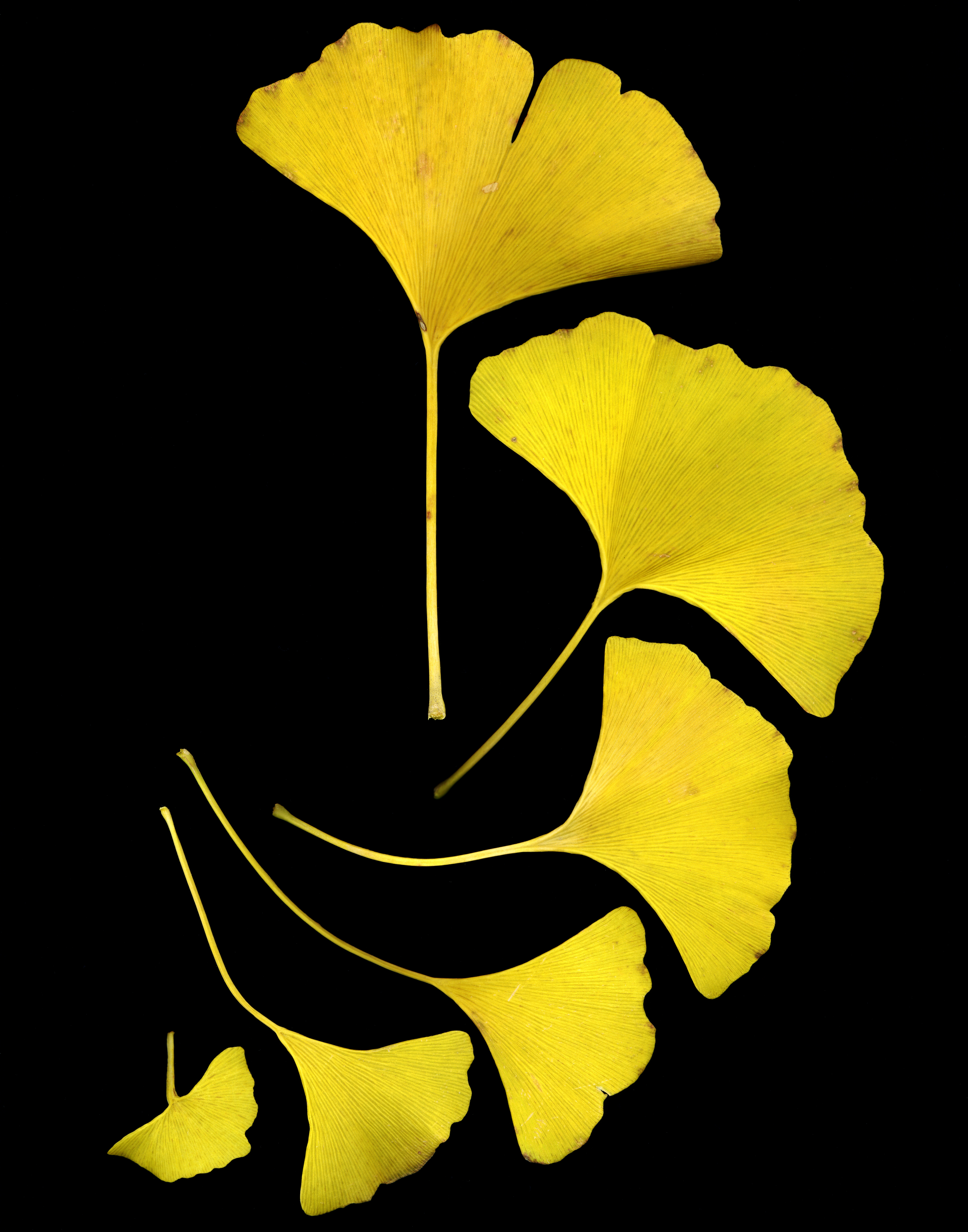
That double-lobed leaf is odd, too.

Ginkgo Leaves summer

In fact, it’s unique among seed plants. Unique, because the ginkgo is a living fossil. This fossilized ginkgo leaf

fossil ginkgo leaf

is 40 million year old, although the ginkgo is far older. It first appears in the fossil record some 200 million years ago. It did nicely for the first 100 million years or so but then it went into terminal decline. Its range shrank and shrank, the various ginkgo species disappeared, until only ginkgo biloba survived, and survived only in China.

In fact, even the ginkgo biloba probably wouldn’t have survived if it hadn’t been for Buddhism coming to China. There’s a lot of debate about whether or not the ginkgo trees currently found in the wild in China are truly wild or simply feral, that is, grown from seeds that wafted away from domesticated trees. What is sure is that Buddhist monks took to planting ginkgos in their temples as their local version of the bo-tree, the sacred fig tree under which it is said that the Buddha attained enlightenment.

sacred fig

and of course the ginkgo then got included in the Chinese Buddhist iconography – look at those ginkgo leaves peeping behind the buddha:

maitreya buddha under ginkgo

The ginkgo, having thus gained enormously in stature as a sacred tree, was carefully nurtured by all and sundry and survived – and got carried by Buddhism to Korea and Japan, where our friend Engelbert saw it.

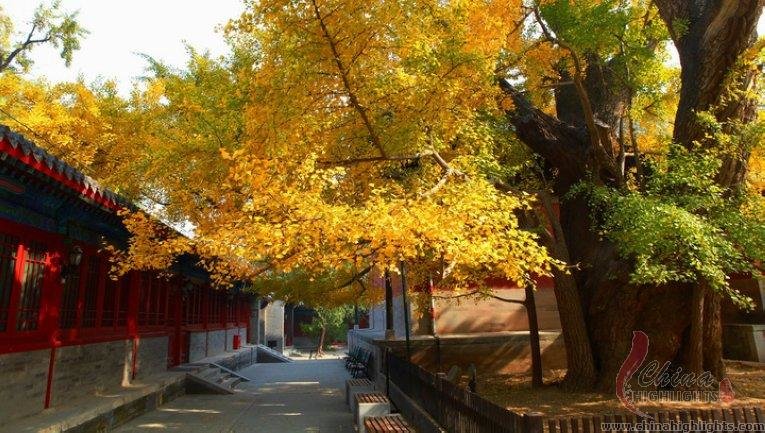
So I suppose it’s really best to admire the ginkgo in the environment which saved it from probable extinction, a Buddhist temple like this one, Dajue temple in the western hills near Beijing.

ginkgo fall dajue temple

___________________

Vermont fall foliage: http://i2.cdn.turner.com/cnn/dam/assets/120911072551-leaf-peeping-vt-jenne-farm-ed-sharron-story-top.jpg [in http://www.cnn.com/2012/09/21/travel/fall-leaf-peeping-autumn/%5D
Hokkaido fall foliage: http://4.bp.blogspot.com/-HK-XCKr055I/UGvr1pwda3I/AAAAAAAAGc8/oe2ckytpNRk/s1600/%E7%A7%8B%E3%81%AE%E9%AB%98%E5%8E%9F%E6%B8%A9%E6%B3%892.jpg [in http://talk-hokkaido.blogspot.com/2012/10/autumnal-foliage-around-daisetsu.html%5D
Qinghai fall foliage: my picture
Ginkgo trees along the street: my picture
Ginkgo trees autumn: http://chinatour.net/member/wp-content/uploads/2012/09/gingkgo.jpg [in http://chinatour.net/beijing/tour/autumn/%5D
Ginkgo leaves summer: http://upload.wikimedia.org/wikipedia/commons/thumb/f/f5/Ginkgo_Biloba_Leaves_-_Black_Background.jpg/400px-Ginkgo_Biloba_Leaves_-_Black_Background.jpg [in http://en.wikipedia.org/wiki/Ginkgo_biloba%5D
Ginkgo leaves autumn: http://upload.wikimedia.org/wikipedia/commons/7/78/GinkgoLeaves.jpg [in http://en.wikipedia.org/wiki/Ginkgo_biloba%5D
Fossil gingko leaf: http://upload.wikimedia.org/wikipedia/commons/c/c5/Ginkgo_biloba_MacAbee_BC.jpg [in http://en.wikipedia.org/wiki/Ginkgo%5D
Sacred fig: http://img.xcitefun.net/users/2009/09/117740,xcitefun-sri-maha-bodhi-tree-2.jpg [in http://forum.xcitefun.net/sri-maha-bodhi-sacred-fig-tree-sri-lanka-t38289.html%5D
Maitreya Buddha sitting under ginkgo: http://www.asia.si.edu/collections/zoom/F1911.411.jpg
Ginkgo Dajue temple: http://images.chinahighlights.com/2012/11/4c1ed9eaebda4d74a20d96f4.jpg [in http://www.chinahighlights.com/beijing/article-see-golden-ginkgoes.htm%5D

RATATOUILLE

Beijing, 20 October 2013

For several months now, I have been going around with an article from the Financial Times carefully folded and tucked away in the back of my wallet. The article describes a recipe for the French dish ratatouille, and is there ready to be whipped out at a moment’s notice in a supermarket so that I can purchase the necessary ingredients.

Truth to tell, I should have whipped it out in the days immediately after the article’s appearance back in mid-August, when the vegetables which form the core of this dish were still in season. But sloth and general laziness got in the way, so now I have to wait until next summer to try out the recipe, by which time the article will, I fear, be frayed and tattered.

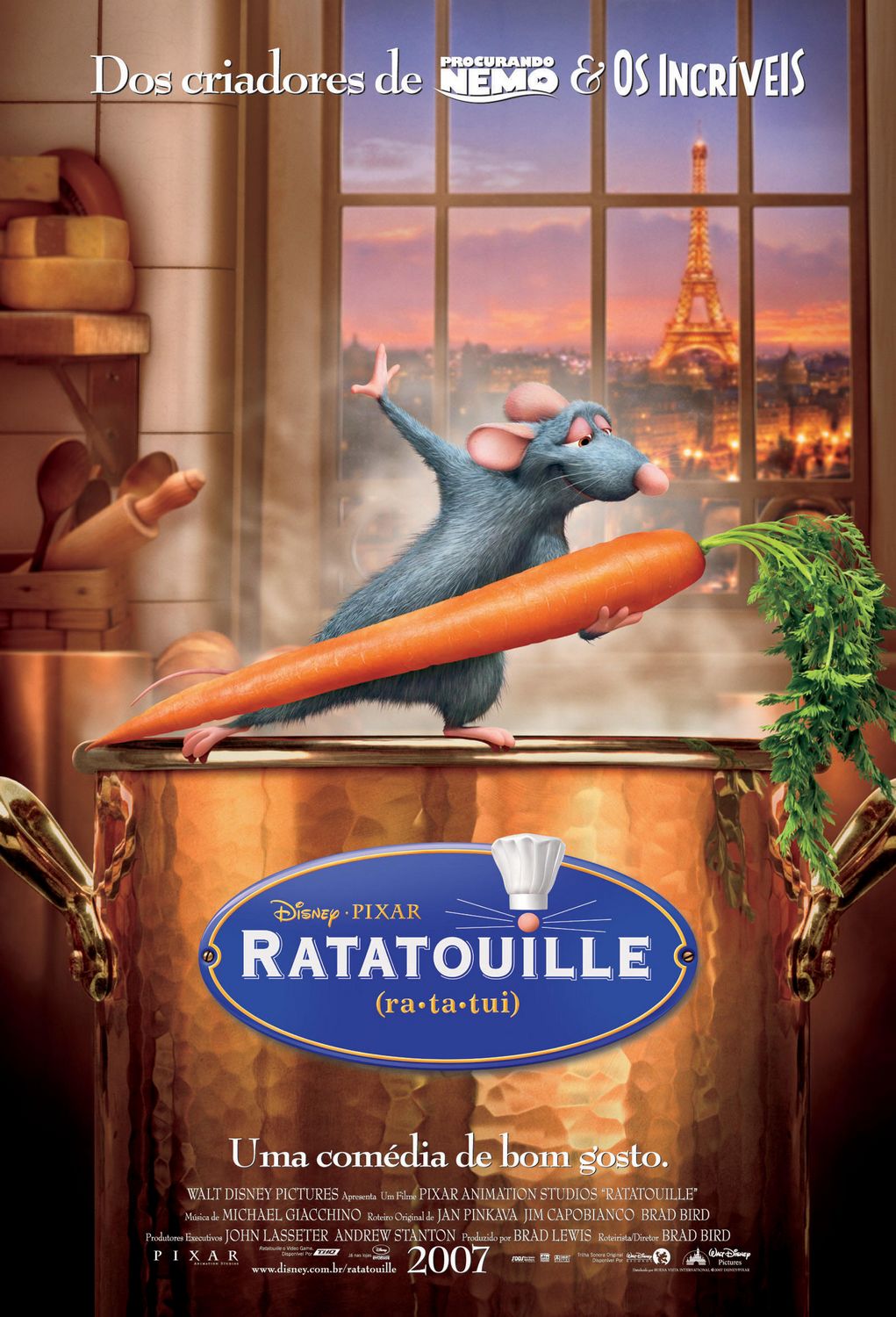
After the release back in 2006 of the animated film of the same name

ratatouille

it seems hard to believe that there should be anyone on this planet who doesn’t know the dish, but just in case there are a few dinosaurs out there who, like me, have never seen the film and, unlike me, have never had the pleasure of eating ratatouille, let me quickly explain what this dish consists of.  It is a stew of five vegetables:

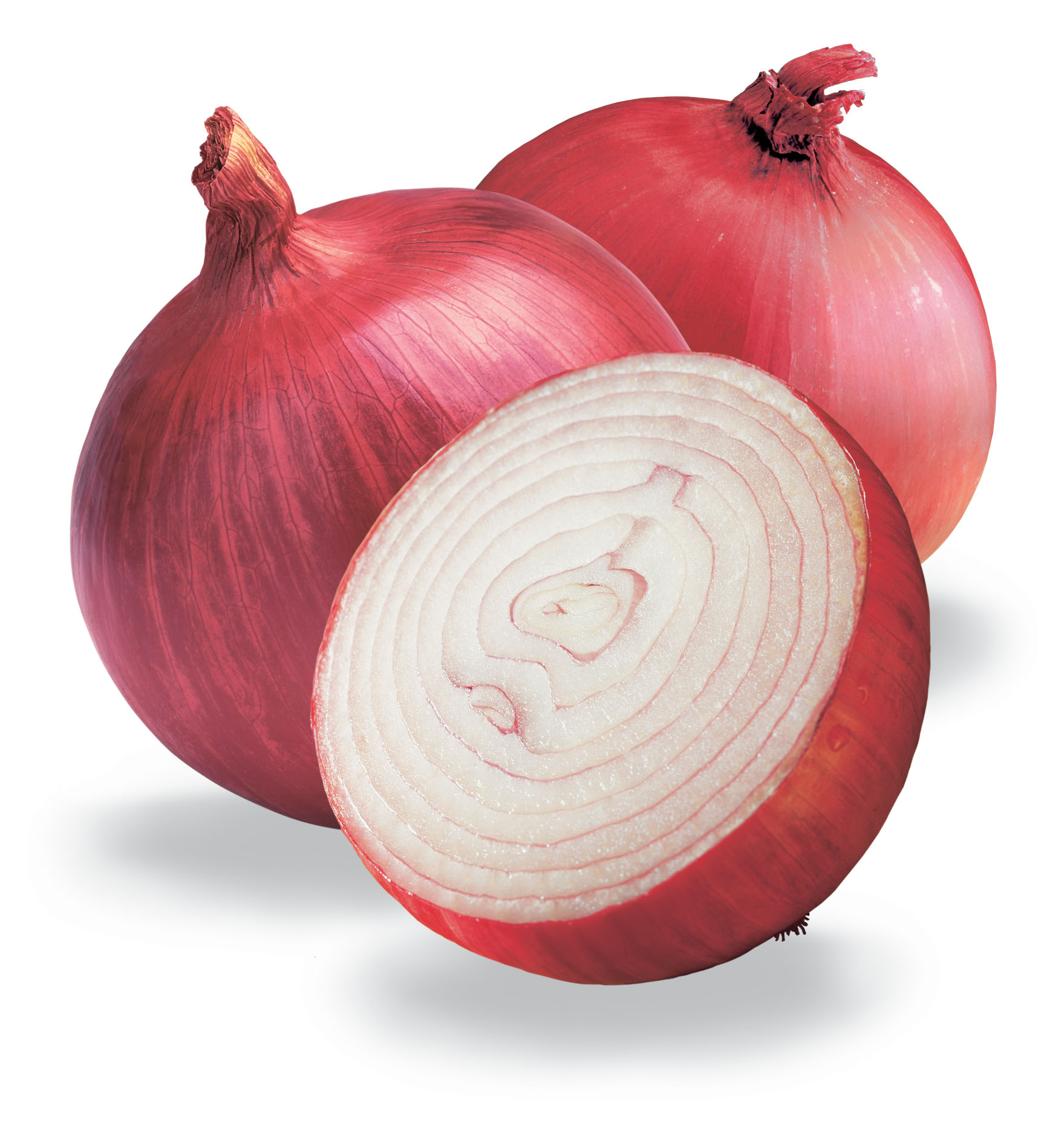
onion

red_onions

sweet pepper

sweet pepper

aubergines (eggplants to some)

aubergines

courgettes (zucchine to my wife and 60 million other Italians)

FD ZUCCHINI 080806

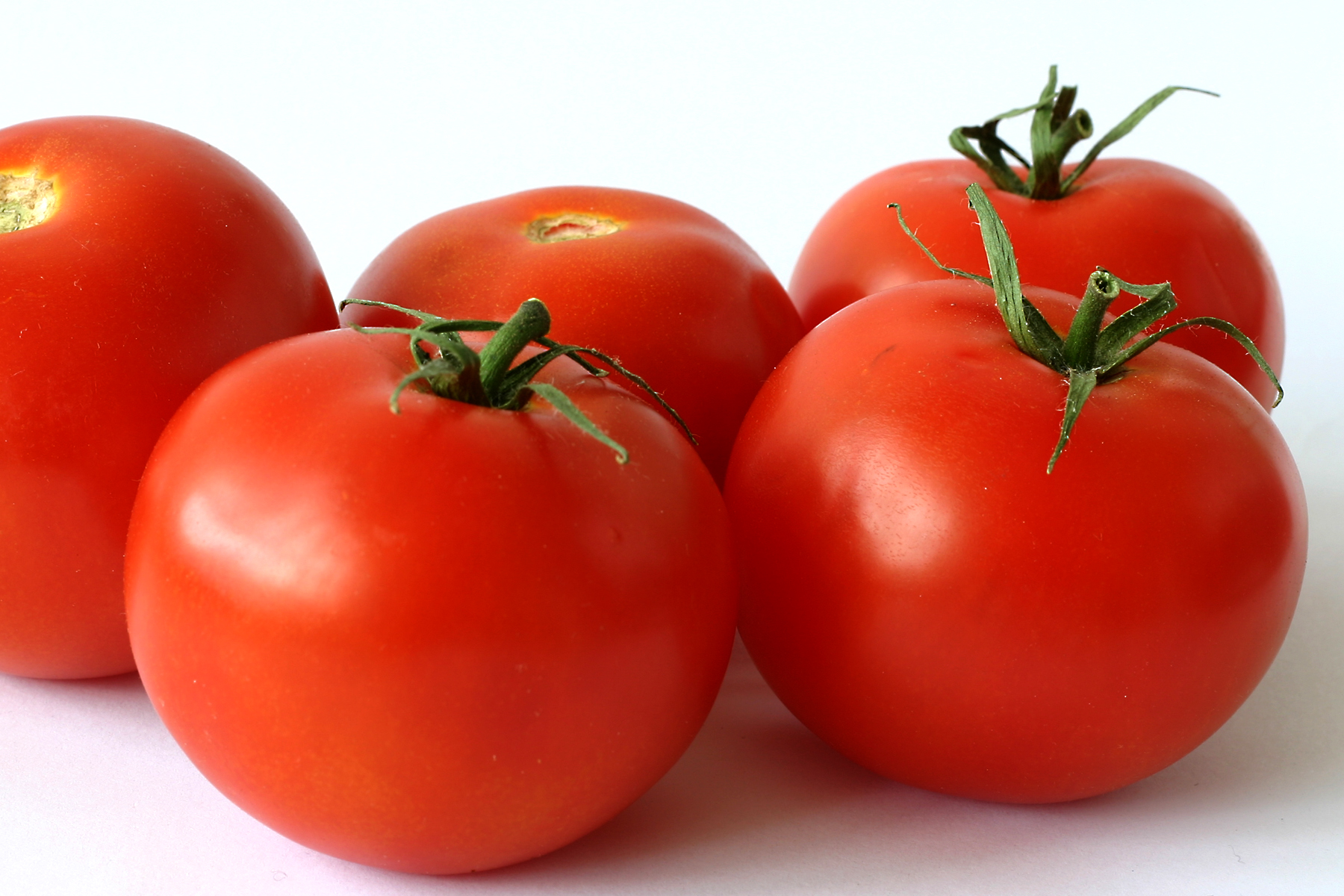
and tomatoes.

tomato

Voilà!

Ratatouille connoisseurs will immediately roll their eyes and cry out oh, la, la, it is not voilà, there is much more to it than that! They are right of course. For instance, you cannot just mix all the vegetables together and stew them, non, non! Each vegetable must be cooked separately, and then put together – in a certain order, messieurs-dames! – to stew gently. And not just any oil can be used to cook them, it must be olive oil. And the stewing must be gentle and long, to impart a creamy texture to the vegetables and an intensity to the sauce. And we have not even started talking about the minor ingredients: the garlic, the basil, the thyme, the saffron …. Yes, yes, all of this is true. But still, when all is said and done, it is a vegetable stew – or a ragout, if you prefer to remain French.

ratatouille-1

My wife asks me what I see in ratatouille. It’s OK, she says, but after all it’s just – well, a vegetable stew (or ragout).   It’s the tomatoes, I reply, and some of my readers may immediately understand this. In previous posts, I have unveiled an unfeigned passion for this vegetable (and even for its wastes). OK, she responds, but in Italy we have a very similar dish, capponata, and I’ve never heard you going on about that. She’s absolutely right, of course (as she always is), and indeed to complete the catalogue several Mediterranean countries have similar dishes: the Spaniards have the Catalan samfaina, the Majorcan tombet, the Castilian-Manchego pisto; the Maltese have kapunata; the Greeks have briám and tourloú; the Turks also have türlü as well as şakşuka (just the names make me lust to try them). Then the South-Eastern European countries have similar dishes. Even the Philippines has a similar dish!

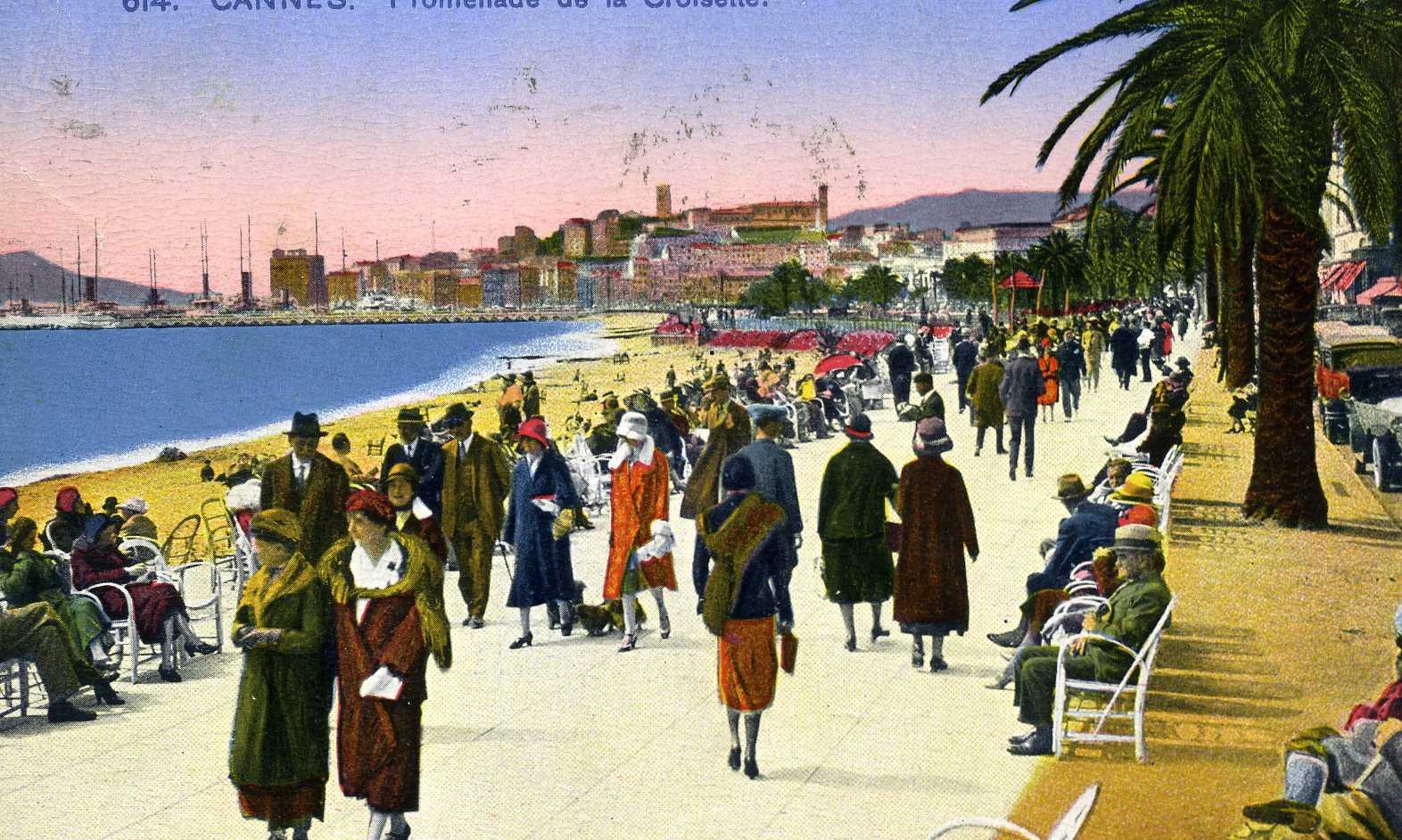
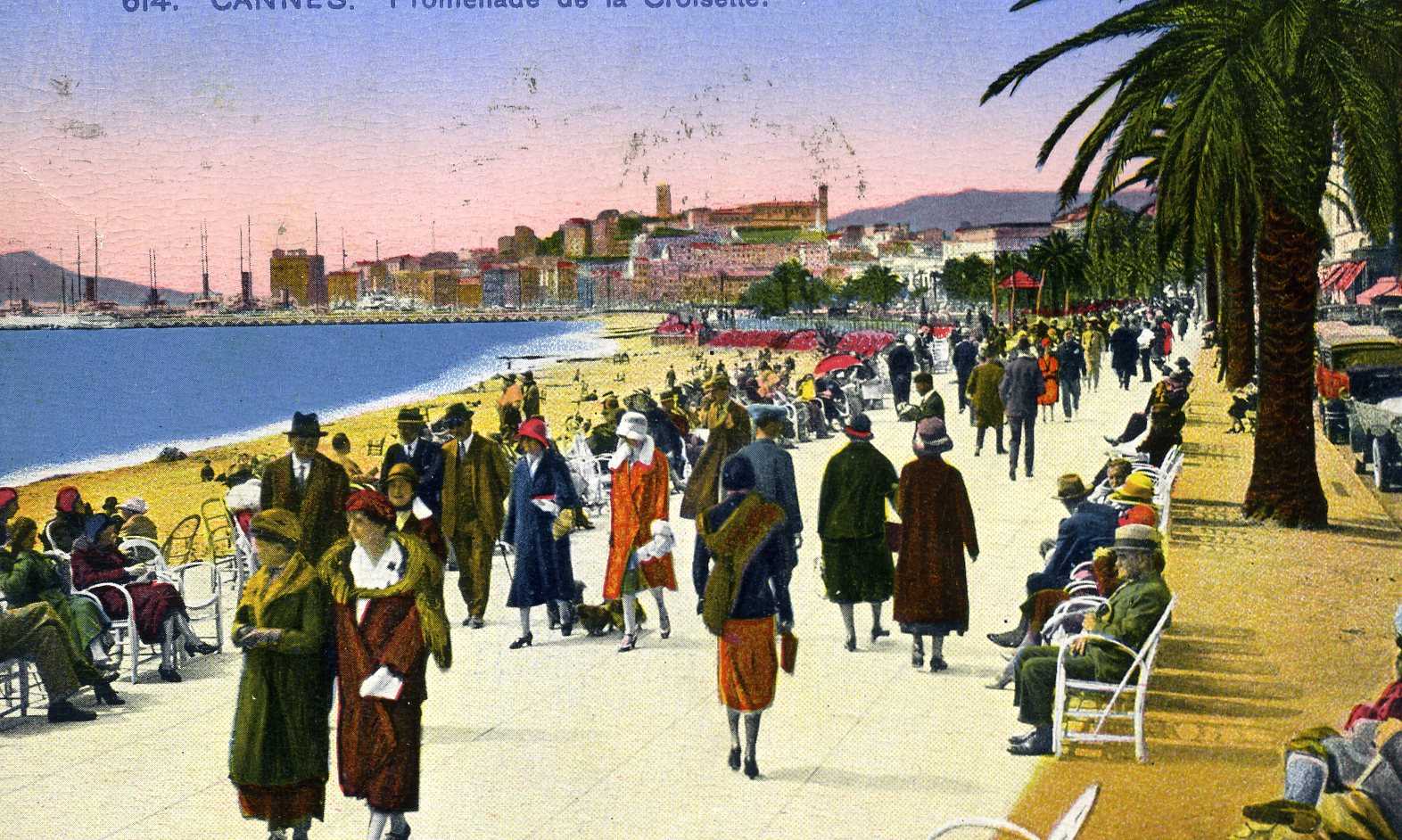
So I have to confess to a deeper reason for my being fond of ratatouille. I was introduced to the dish when I was a young boy spending my summer holidays with my French grandmother. I still remember with great clarity one lunch where a steaming bowl of ratatouille was put before us with great fanfare and to much ooh, la, la around the table. For this was not a dish from my part of Burgundian France. It hails from Provence, and more specifically from Nice. Its presence on the table reflected my mother’s childhood history. In the mid 1920’s, and in short order, my grandfather’s business went bust and he contracted tuberculosis. The family was destitute and without a bread-winner. In this moment of desperation, my grandmother managed to get a job as secretary to a rich English friend of hers, who with her husband spent the winters in Menton (a stone’s throw away from Nice). The whole coast of Provence pullulated with rich English during this period. It’s not for nothing that Cannes’s main boulevard along the sea – the one the film stars walk along during the festival – is called “Promenade des Anglais”

promenade-de anglais-2

Coming back to the English lady, I suspect it was an act of kindness on her part to hire my grandmother; she had no real need of a secretary. In any event, it meant that until the Second World War the whole family would move south to Provence for the winter and return to Burgundy for the summer when the English lady and her husband went home to England (the family got smaller during the early 1930’s when my grandfather finally died of his tuberculosis). At some moment during these stays in the south my grandmother picked up the recipe for ratatouille. So for me, every forkful of ratatouille reconnects me with my mother’s family history.

I have to thank the kind, rich English lady for more than just ratatouille; I have to thank her for being of this world! When my mother was 18, my grandmother packed her off to stay with the English lady for a couple of months to polish up her English (she was studying English Literature). It was in the lady’s house that she met my father, aged 19, who was studying at the University down the road. The rest, as they say, is (my) history.

_______________

Movie poster: http://www.look.yeah1.com/albums/userpics/234993/poster1.jpg [in http://photo.yeah1.com/showthread.php/39632-My-RatatouilleChuot-Can-Cook-2007.html%5D
Red onions: http://p21chong.files.wordpress.com/2010/05/red_onions.jpg [in http://paulchong.net/2010/05/16/the-magic-healing-power-of-onions/%5D
Sweet pepper: http://www.greeneryuk.com/images/products-feature/920pepper.jpg [in http://www.greeneryuk.com/productsdetails.php?key=p%5D
Aubergines: http://nuestrasfrutasyverduras.com/media/catalog/product/cache/1/image/9df78eab33525d08d6e5fb8d27136e95/b/e/berenjena_3_2.jpg [in http://nuestrasfrutasyverduras.com/berenjena%5D
Zucchini: http://www.amyroose.com/wp-content/uploads/zucchini.jpg [in http://www.amyroose.com/tag/zucchini/%5D
Tomato: http://atlantablackstar.com/wp-content/uploads/2013/10/tomato.jpg [in http://atlantablackstar.com/2013/10/10/tomatoes-may-help-lower-stroke-risk/%5D
Ratatouille: http://www.bonappetit.com/wp-content/uploads/2013/08/grilled-ratatouille-salad-646.jpeg [in http://www.bonappetit.com/drinks/wine/article/the-5-best-wine-pairings-for-tomato-dishes-from-caprese-to-ratatouille-to-blt%5D
Promenade des anglais: http://tonton84.t.o.pic.centerblog.net/do3uxg9p.jpg [in http://tonton84.centerblog.net/rub-CARTES-POSTALES-anciennes-region-PACA–8.html%5D

VARY THE THEME!

Beijing, 19 October 2013

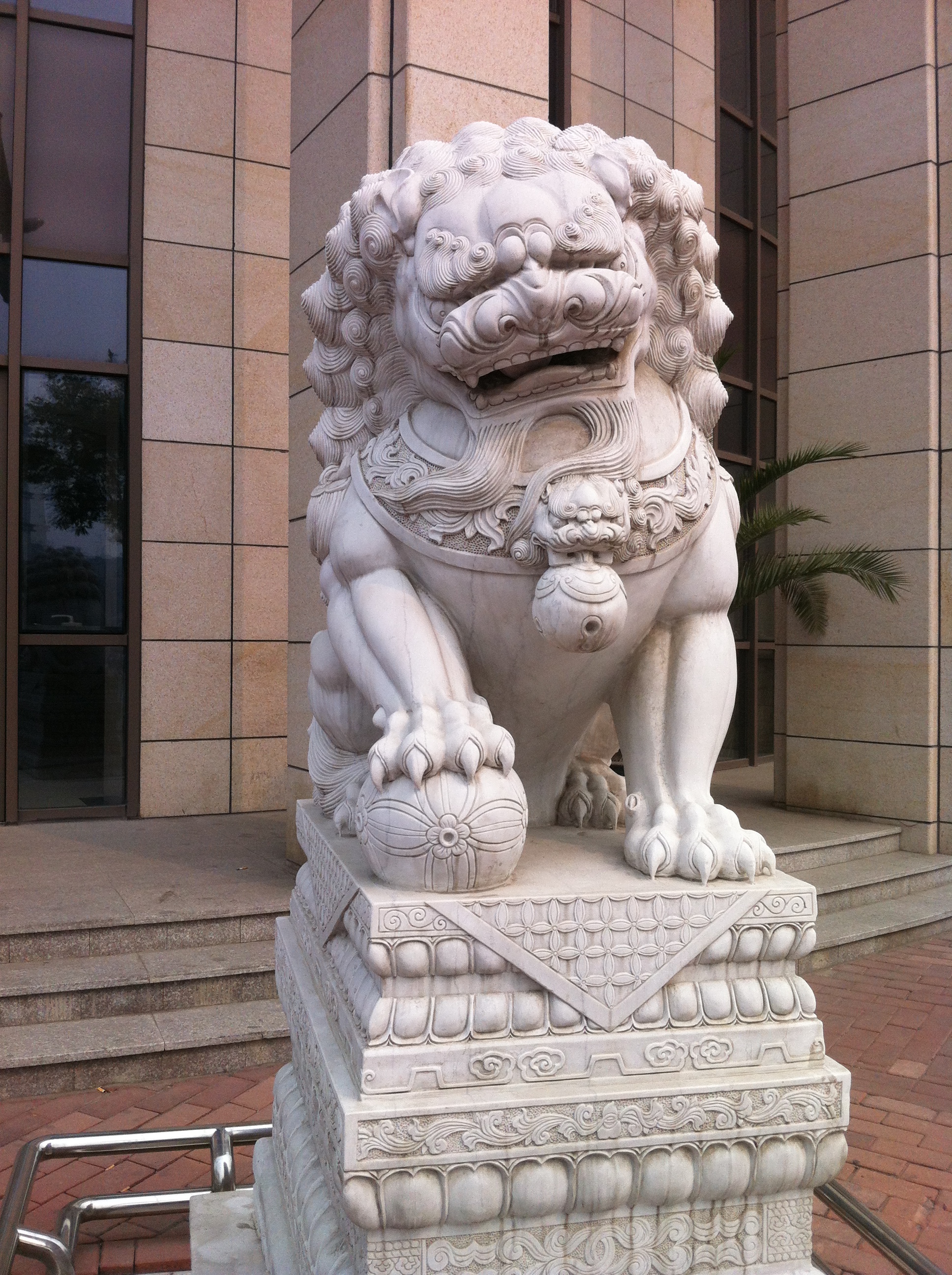
Anyone who visits China for more than a few days cannot fail to notice the many, many pairs of stone animals standing guard in front of any building which has pretensions to be something (although “something” can be no more than a second-rate noodle restaurant). Here is a typical pair of these animals, which my wife and I recently came across in front of the China National Philatelic Corporation.

chinese lion 003

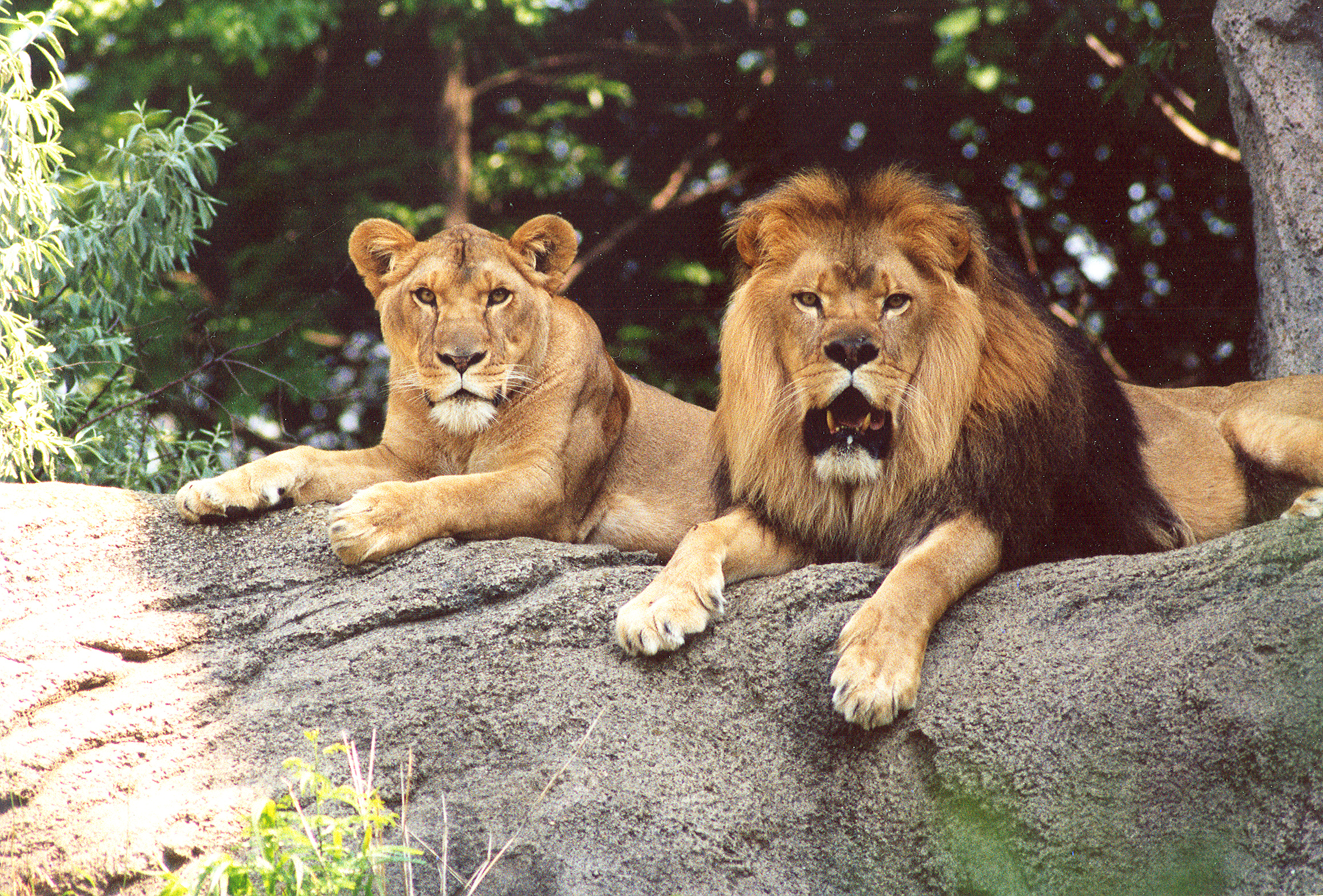
The Chinese call these animals “lions”, which is really a bit of a joke. In today’s globalized world, where images of this iconic animal must surely have been beamed into every corner of every house on the planet, we all know that lions actually look like this:

real male and female lions

One theory has it that the original model for these “lions” was the Asiatic lion, of which a few miserable specimens still linger on in the Indian state of Gujarat. According to this theory, some live samples were brought to China along the Silk Road from Central Asia or the Middle East some 2,000 years ago, as gifts, tribute or whatever. Artists copied them, and then the originals stopped coming. So the artists copied the copies, and then copied the copies of the copies, and … Anyone who has seen the film Multiplicity, where Michael Keaton makes copies of himself and then the copies make copies of themselves

Multiplicity movie

knows what happens: there is a high loss of quality in the picture the further you get from the original.

A second theory is that actually the original model wasn’t a lion at all. It was a chow chow, which is a dog from this part of the world. It seems to have originated somewhere in northern China or Mongolia, or possibly in Siberia. I don’t know what readers think, but I’m not convinced that this

chow chow dog sitting

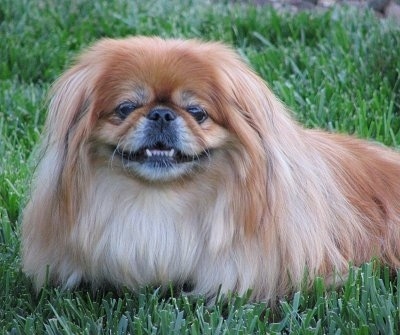
is the model of the above. Nor am I convinced that another ancient Chinese dog breed, the noble Pekingese (only members of the imperial family were allowed to have them), is the model

Pekingese dog

Such an irritating little dog, I’ve always felt, as it raspily yaps around your feet at some apartment door – a good, swift kick is what it deserves, but one has to be polite to the apartment owners. In any event, while it’s true that the Pekingese’s face has certain resemblances to my stone “lions” (and in fact it’s often called a lion-dog because of this resemblance), I rather think this is an example of convergent evolution: the sculptors went their way with their designs, the dog breeders with theirs, and one day someone said, “Ooh look, the Peke looks just like the stone lions!”.

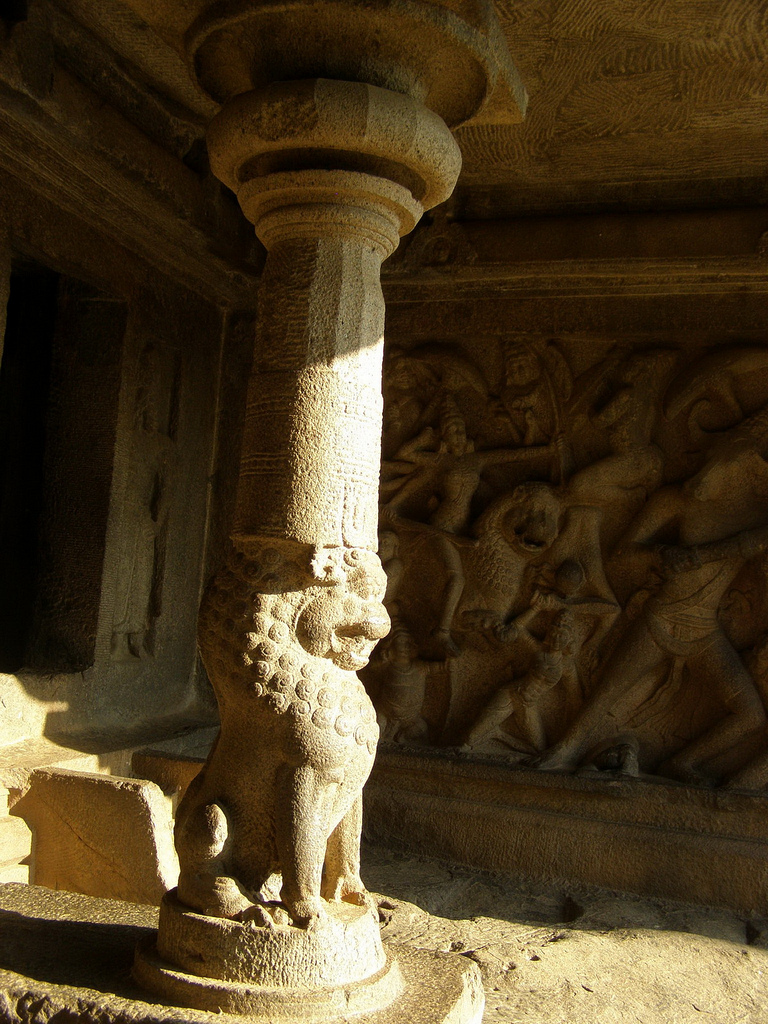
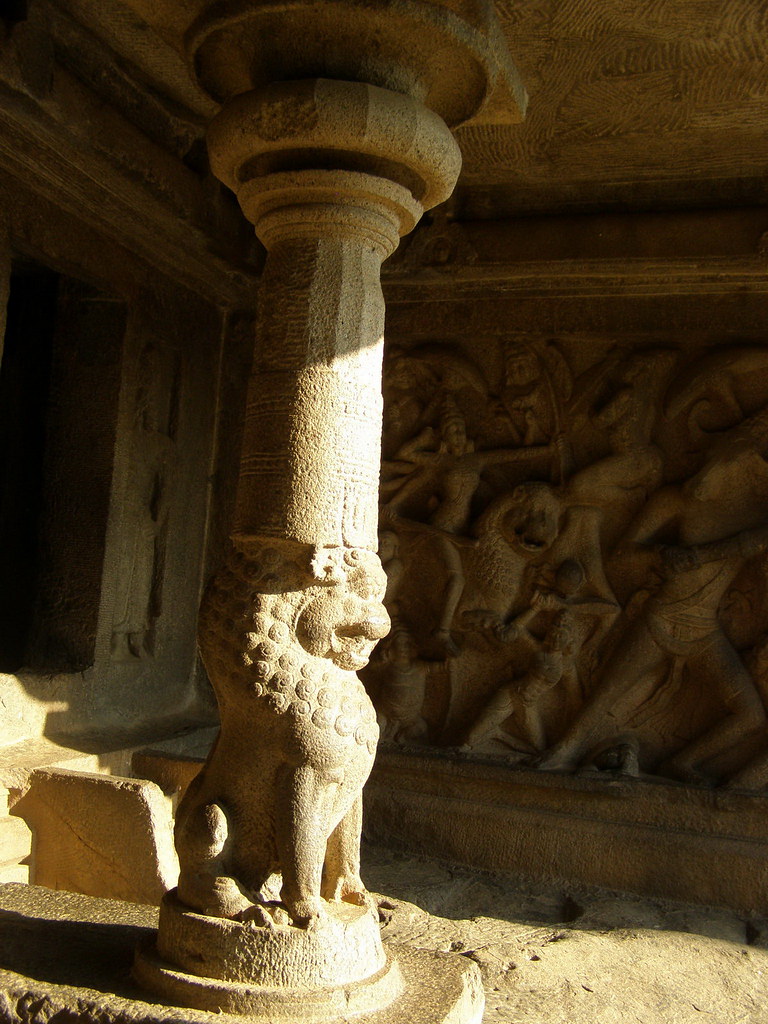
A third theory, which I find quite convincing, is that actually the models for the Chinese stone “lions” are the stone lions which are often found outside Indian temples. See the following link for a further development of this theory, while here is a picture of one such Indian lion from Mahabalipuram:

indian carved lion

It really does look quite similar, doesn’t it?  I presume that proponents of this theory would argue that it is Buddhism which brought to China the idea of placing stylized “lions” at the entrances of temples and then with time they migrated to the entrances of any important building.

However the design came about, the fact is that this being China, where everything eventually became (and still becomes) formalized, codified and rigidified, these pairs of stone “lions” have been made in exactly the same way ever since the Ming dynasty. The key is that they look nearly exactly the same. Both have the same ritualized snarl on their faces. Both have the same mane of tight curls. Both have the same strong legs. Both are sitting on their haunches. There is only one important difference, fruit of a typical male chauvinism: the male is always – always – made with his paw resting on a ball (representing the male’s mastery over the world)

chinese lion 001

while the female is always – always – made with her paw resting on a cub which is playfully lying on its back (representing the female’s nurturing nature).

chinese lion 002

And sited as they are on either side of the entrance, their heads are always slightly inclined towards the enterer.

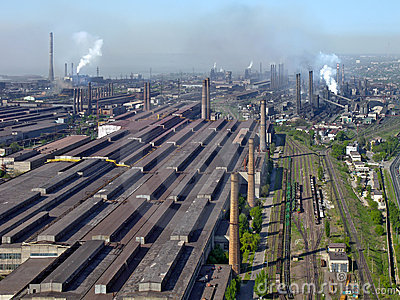
There must be literally millions of these stone “lions” scattered across the length and breadth of China, large, small, and every imaginable size in between. I swear, somewhere in China there must be a factory like this

huge-industrial-factory

that churns these damned things out by the thousands every day.

So tedious! So boring! Change, for God’s sake!

So you can imagine that it is with some small relief that I occasionally run across variations on this monotonous theme. Take this pair of “lions” which I recently came across in Beiing, in front of a restaurant.

lions looking at one another

How exciting! They are looking at each other and not the enterer.

Or take this “lion”, which I came across during my recent trip to Fujian.

river gorge 008

Why, rather than glaring at you he really looks glad to see you! And he seems to be offering you the ball to play with. It could almost be a playful Pekingese (assuming those damned dogs play). What a refreshing site for sore eyes.

Or how about this pair of “lions”, which we bumped into in Hong Kong? They were outside some bank as I recall, and not even guarding an entrance. A wonderful postmodern take on the old, very tired stone lion design.

lions in HK

And now, I even see real lions! This picture was taken five minutes after the picture with which I started the post

realistic lion

It was sitting in front of a furniture shop as I recall.

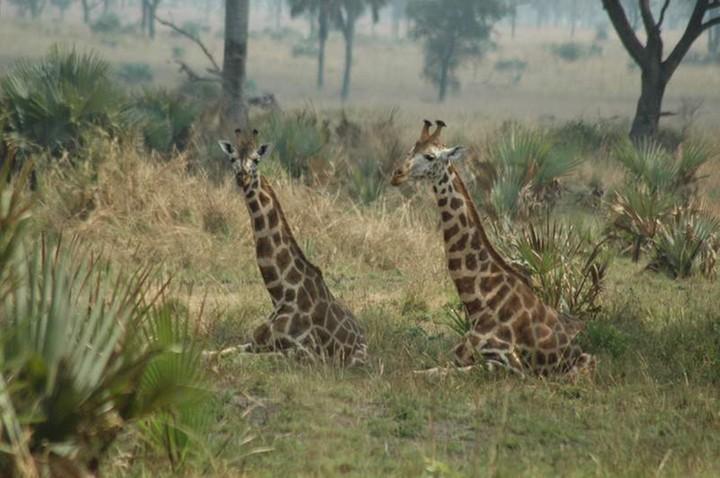
So when will I see two giraffes guarding the entrance to some place?

sitting giraffes

Change, for God’s sake!

____________________________

pair of Chinese lions: my picture
Real male and female lions: http://farm4.staticflickr.com/3400/3189788124_26e25201fd_o.jpg [in http://www.flickr.com/photos/kenkeener1621/3189788124/%5D
Multiplicity movie: http://www.thefancarpet.com/uploaded_assets/images/gallery/4480/Multiplicity_41523_Medium.jpg [in http://www.thefancarpet.com/ActorGalleryPicture.aspx?mga_id=46948&a_id=714%5D
Chow chow dog: http://comps.canstockphoto.com/can-stock-photo_csp7744774.jpg [in http://www.canstockphoto.com/search.php?term=chow%20dog%20sitting&type=1%5D
Pekingese dog: http://www.dogbreedinfo.com/images19/PekingeseSissiePrincess11YearsOld1.JPG [in http://www.dogbreedinfo.com/pekingese.htm%5D
Indian carved lion: http://farm3.staticflickr.com/2036/2312684736_1f31c1a673_b.jpg [in http://bighugelabs.com/onblack.php?id=2312684736&size=large%5D
male Chinese stone lion: my picture
female Chinese stone lion: my picture
Huge industrial factory: http://thumbs.dreamstime.com/x/huge-industrial-factory-9265211.jpg [in http://www.dreamstime.com/royalty-free-stock-photos-huge-factory-image6897978%5D
Chinese stone lions looking at each other: my picture
Chinese stone lion in Fujian: my picture
Chinese stone lions in Hong Kong: my picture
Realistic stone lion: my picture
sitting giraffes: http://media.offexploring.co.uk/photos/pamandralph/photos/070212-11-DSC_0112.JPG [in http://blogs.statravel.co.uk/pamandralph/albums/uganda/10149717%5D

BACK OF BEYOND

Beijing, 15 October 2013

I’m just back from a business trip to Haixi prefecture, which is the remotest prefecture of that remote Chinese province, Qinghai. Squeezed between its better-known neighbours Xinjian, Gansu, Sichuan, and Tibet, Qinghai doesn’t get much press, which is a pity. To my mind, it’s one of China’s most beautiful provinces. Here’s a picture we took out on the grasslands when my wife and I, together with our son, went there a couple of years ago.

IMG00095-20110712-1113

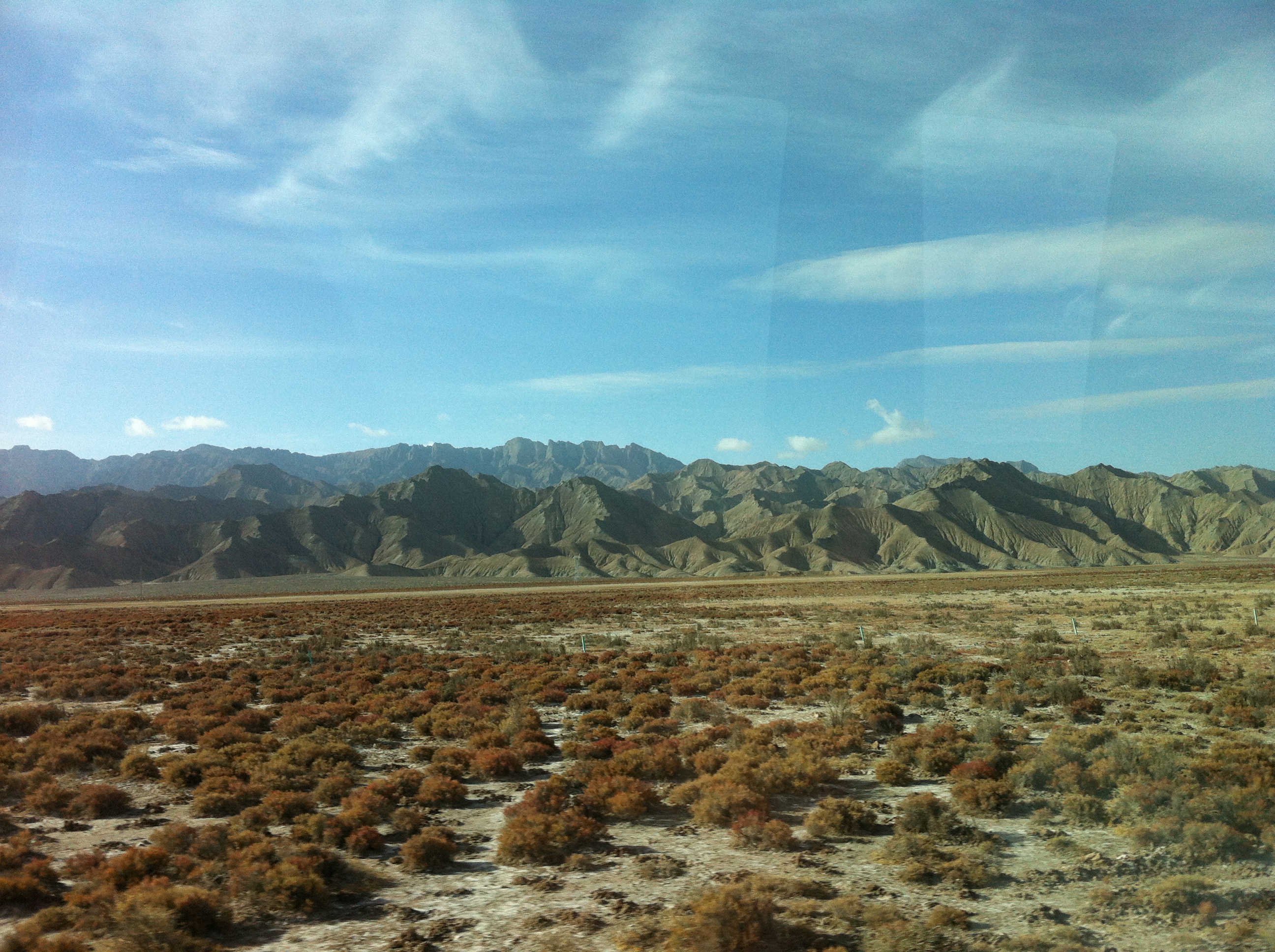
As for Haixi prefecture, it hardly gets a mention at all in the world’s press. This is a great pity, because it’s a seriously beautiful part of the world; on the desertic side, but I like that kind of landscape.

landscapes 002

landscapes 007

My colleague and I were there to study what we could do to help the prefectural authorities build up a local brand in the organic production of wolfberries (we seem to be getting a reputation for agro-processing). I can perfectly understand it if my readers have never heard of wolfberries. Neither had I until I came to China and found them floating in various soups during banquets. But our ignorance is our loss. Wolfberries have had an honourable place in Chinese cuisine – and traditional medicine – for the last 2,000 years.

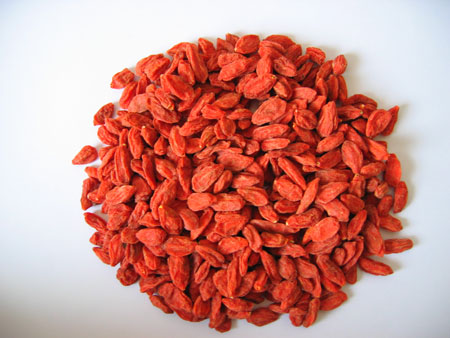
If one has seen them at all, it’s probably as dry berries

wolfberry-dry

although this is how we saw them during our trip, fresh

Wolfberry-fresh

on bushes in plantations

wolfberry-bush and fresh berry

OK, I probably shouldn’t say this, since one of the things the Haixi authorities would like us to help them with is to get fresh wolfberries into supermarkets, but I can’t say that I’m particularly impressed by the wolfberry. If I were standing in the fruit aisle of my local supermarket and had to choose between wolfberries and, say, blueberries, I would choose the latter every time. But hey, I’m not Chinese; they would probably make the opposite decision.

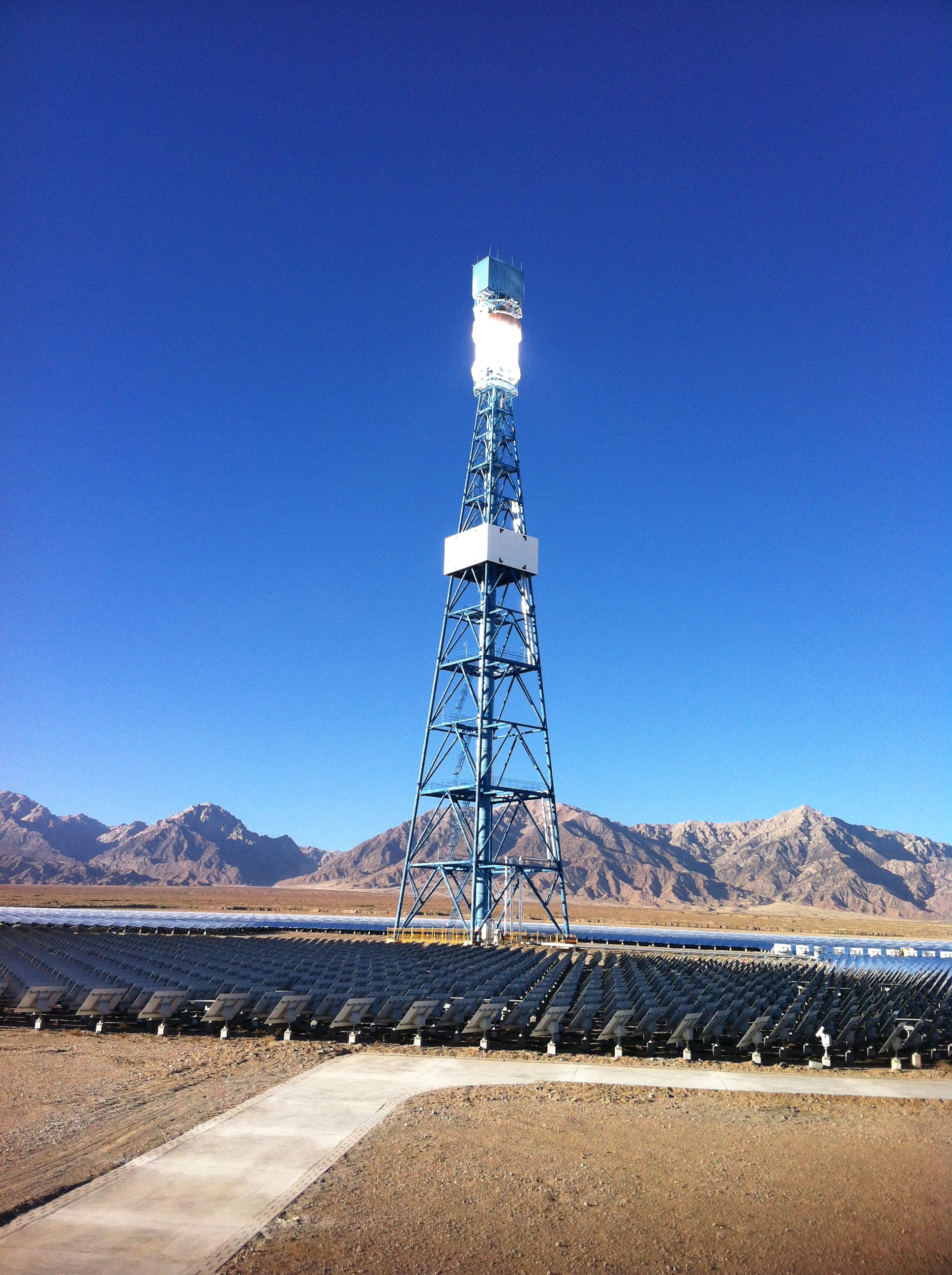
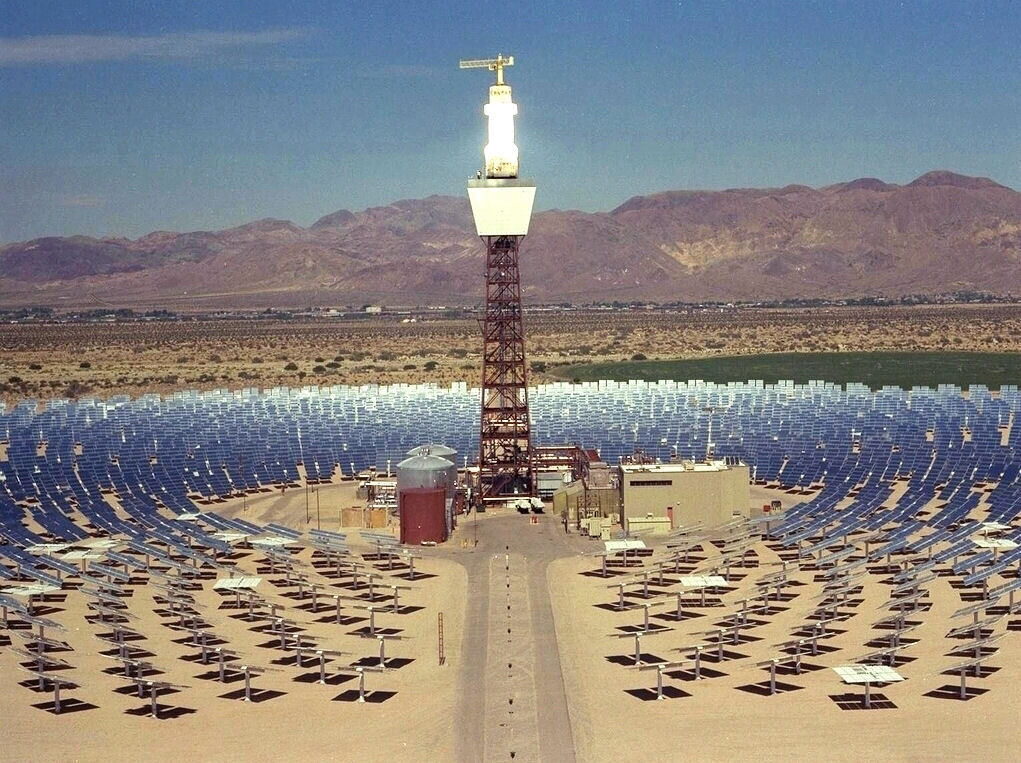
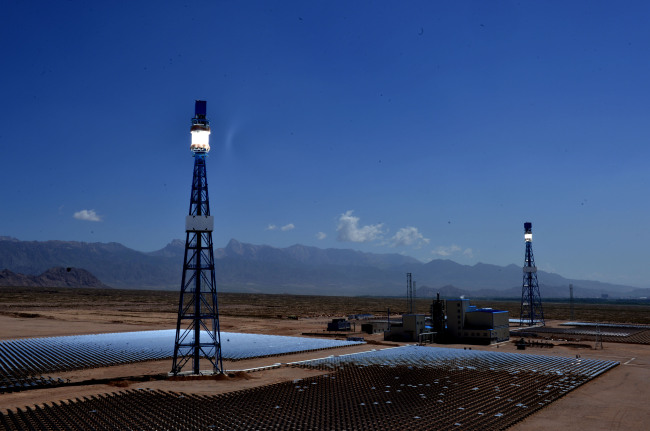
In any case, I will not dwell on the wolfberry, because my attention was captured by something else altogether. Haixi has a lot of sun – 300 days of sun a year, we were told. So quite sensibly, the government has bet on a solar power future for Qinghai. As we drove from wolfberry plantation to wolfberry plantation, and after passing several large photovoltaic arrays, we drew up here:

CSP 006

This, my friends, is a concentrated solar power plant (or at least one version of such). The hundreds of mirrors on the ground focus the sun’s rays on the luminous white spot at the top of the column. That spot is a boiler where the heat of the sun turns water into steam, which is then used to generate electricity. I tried to capture the beauty of that ethereally, whitely glowing spot of concentrated solar rays, but my iPhone camera simply wasn’t up to it. So I’ve added the  only other photo I’ve found on the web of this plant.

CHINA-QINGHAI-SOLAR THERMAL POWER PLANT (CN)

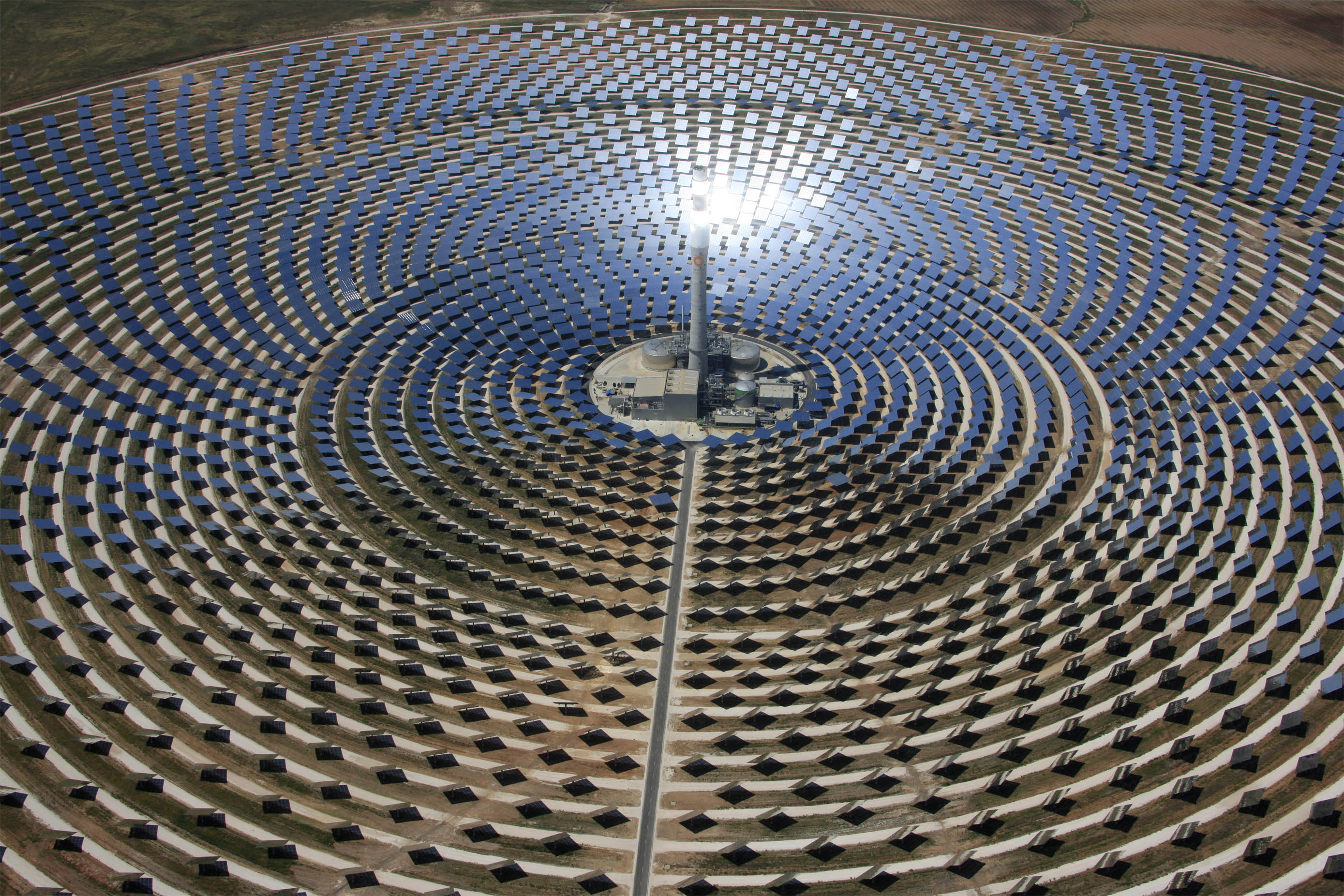
And I add photos of similar plants in other parts of the world. This one is near Seville in Spain

CSP spain

While this is one was in California’s Mojave desert (it was demolished a few years ago).

CSP US

Not clear if this approach will ever generate electricity cheaply enough. But who cares, like Concord, another technological has-been

concorde

it’s beautiful.

Soon after this brush with the ultra-modern, we came across a picture as ancient as China itself, a line of camels padding slowly into the setting sun. I didn’t get a photo, not with my iPhone, but I show a picture of camels taken elsewhere in Qinghai.

camels

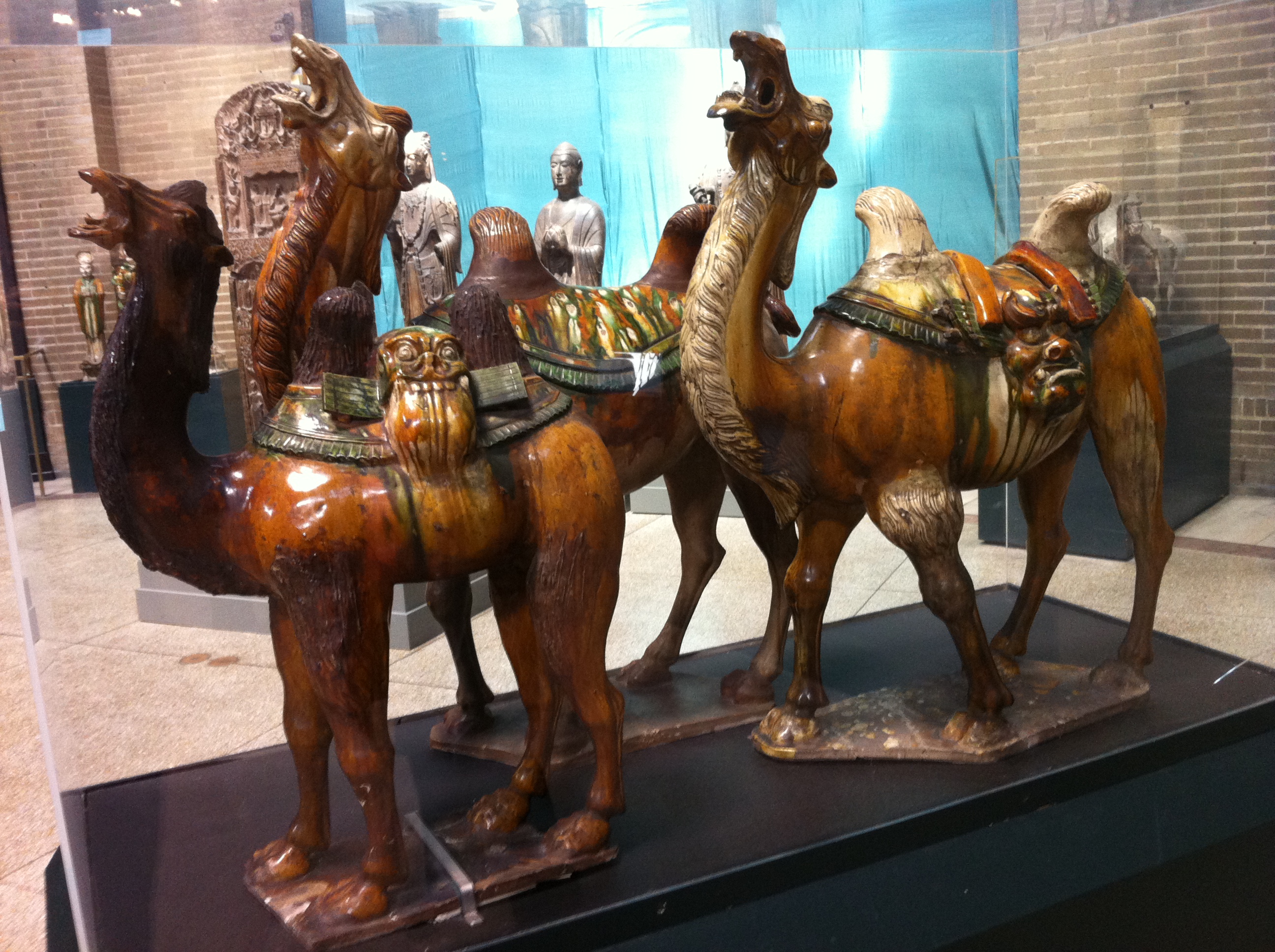
I could have been in Tang China. I am moved to throw in a photo I took back in May in the Museum of the University of Philadelphia of Tang era sculptures of camels.

philly museum 004

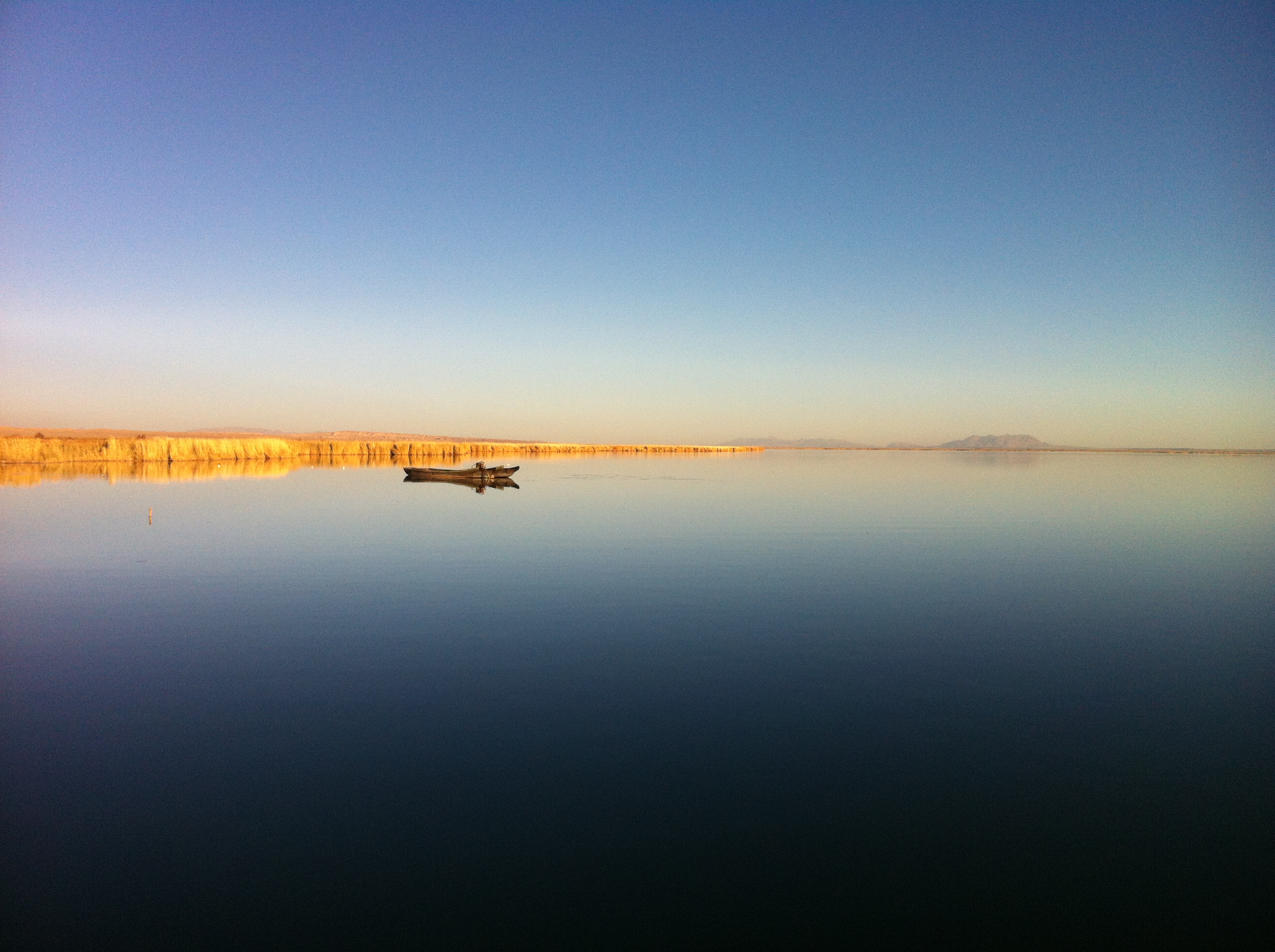
Minutes after this close encounter with the age-old, we drew up at a freshwater lake for a dinner of locally caught crabs. To whet our appetite, we were taken on a short cruise across a magically still mirror of water

lake-fresh 002

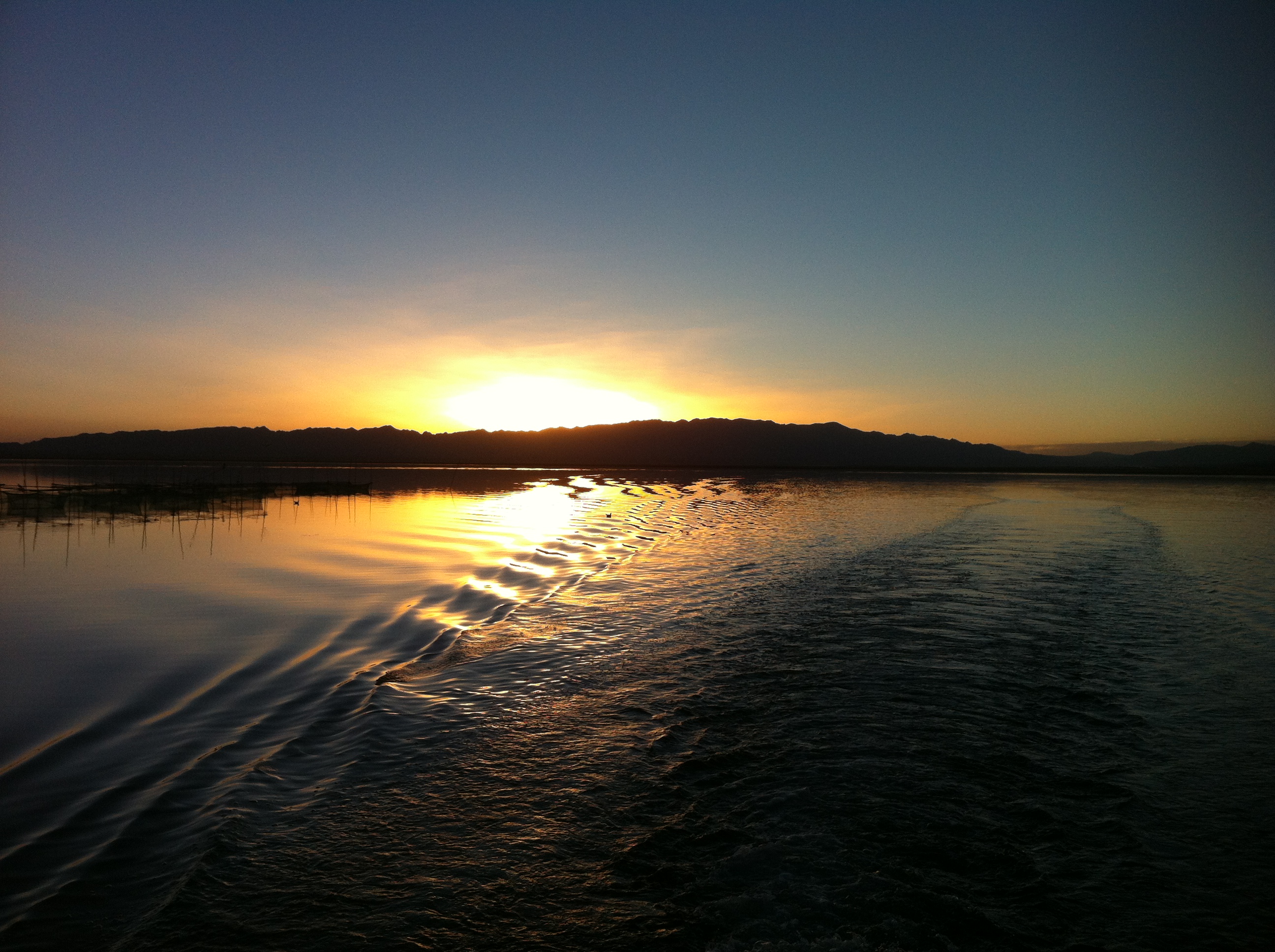
as the sun dipped below the hills behind us.
lake-fresh 010

___________________________

Qinghai grasslands: my son’s picture
Wolfberry-dry: http://soni.monovee.com/wp-content/uploads/2012/05/wolfberry.jpg
Wolfberry-fresh: http://mingmingtea.com/wp-content/uploads/2012/01/Wolfberry_extract.jpg
Wolfberry-bush and fresh berry: http://images04.olx.com/ui/2/98/54/13309454_2.jpg
CSP-1: my photo
CSP-2 : http://res.heraldm.com/content/image/2013/08/01/20130801000653_0.jpg
CSP Spain: http://www.finetubes.co.uk/uploads/images/gemasolar-2011-2_low_res.jpg
CSP California: http://www.trec-uk.org.uk/images/solar_two_barstow.jpg
Concord: http://s1.cdn.autoevolution.com/images/news/concorde-will-take-to-the-skies-again-21839_1.jpg
Camels: http://m1.i.pbase.com/g1/62/942562/2/146679881.nWrkycH7.jpg
Tang camels: my photo
Lake views: my photo

NOTES ON AUSTRALIA – UPPER MURRAY RIVER

Beijing, 8 October 2013

After a quick visit to Canberra and its museums, which I covered in my last post, we were on our way to the Snowy Mountains and beyond. Since I want to focus on the beyond, I’ll quickly slip through the mountains part. It wasn’t quite that easy in practice. Our plan was to drive along the Alpine Way, but when we got to Jindabyne, we discovered that the Way was closed after Thredbo because of a massive landslide.  What to do? After poring over the map, we decided to loop through the mountains to the north and rejoin the Alpine Way just before Corryong.

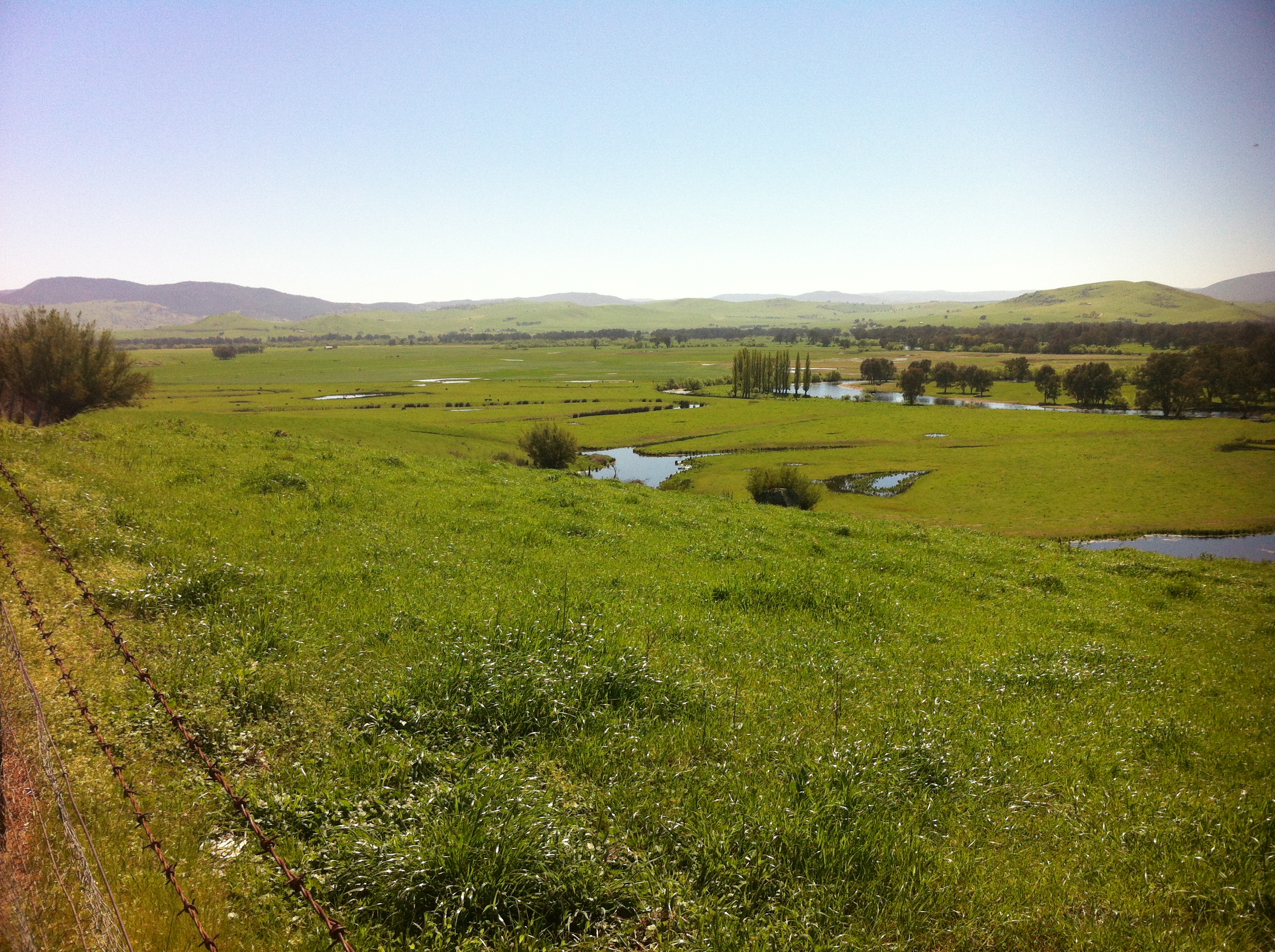
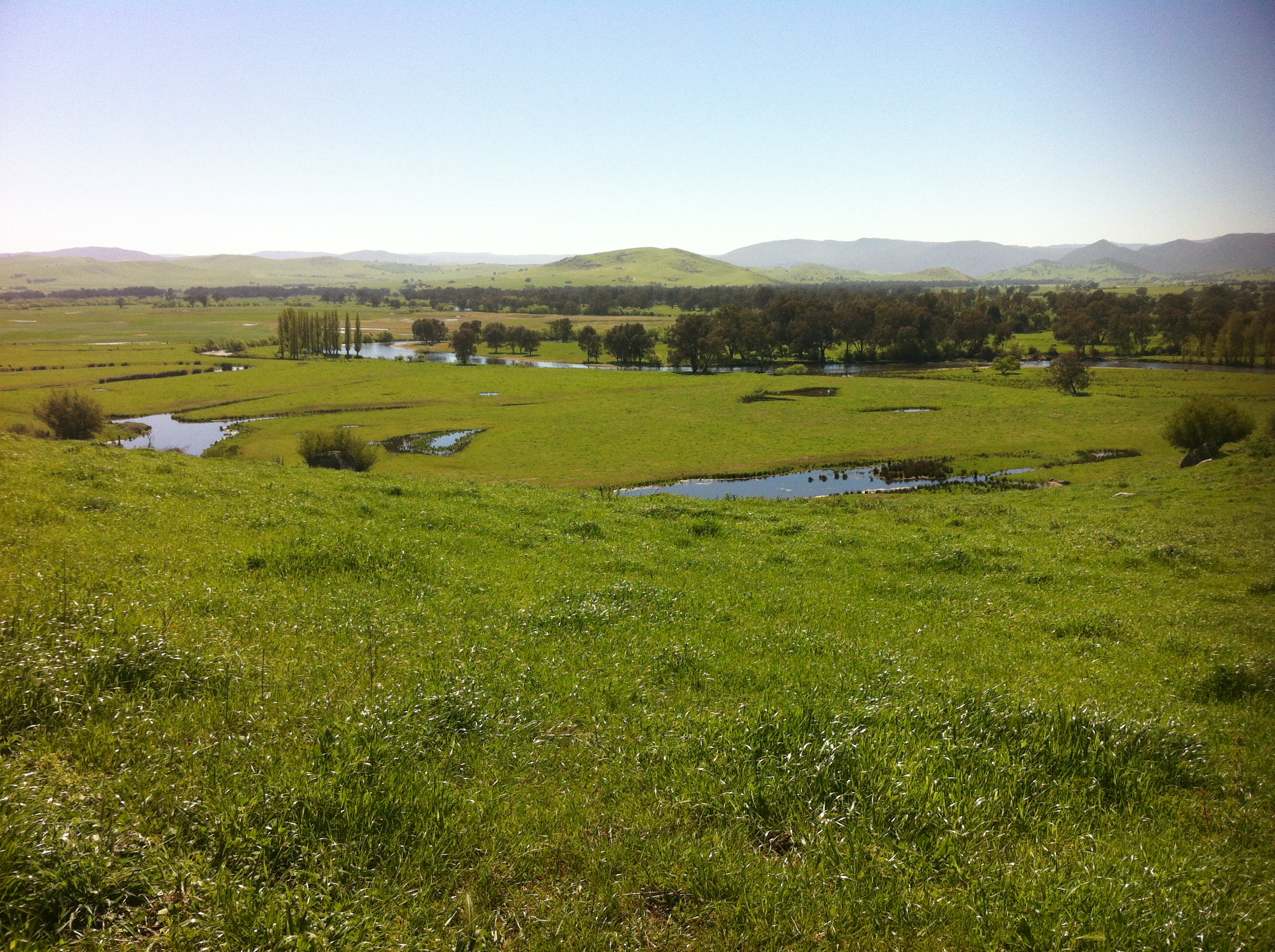
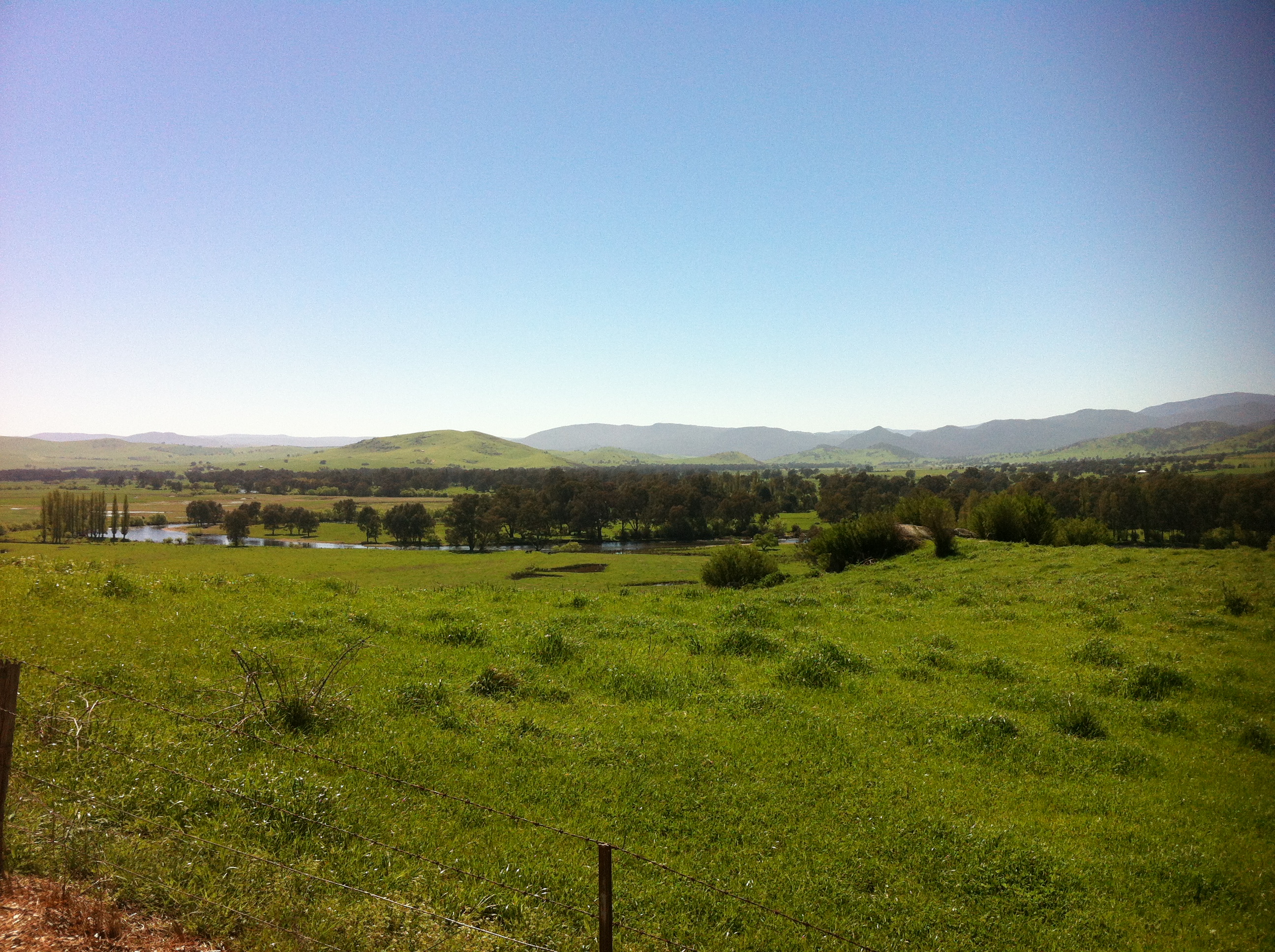
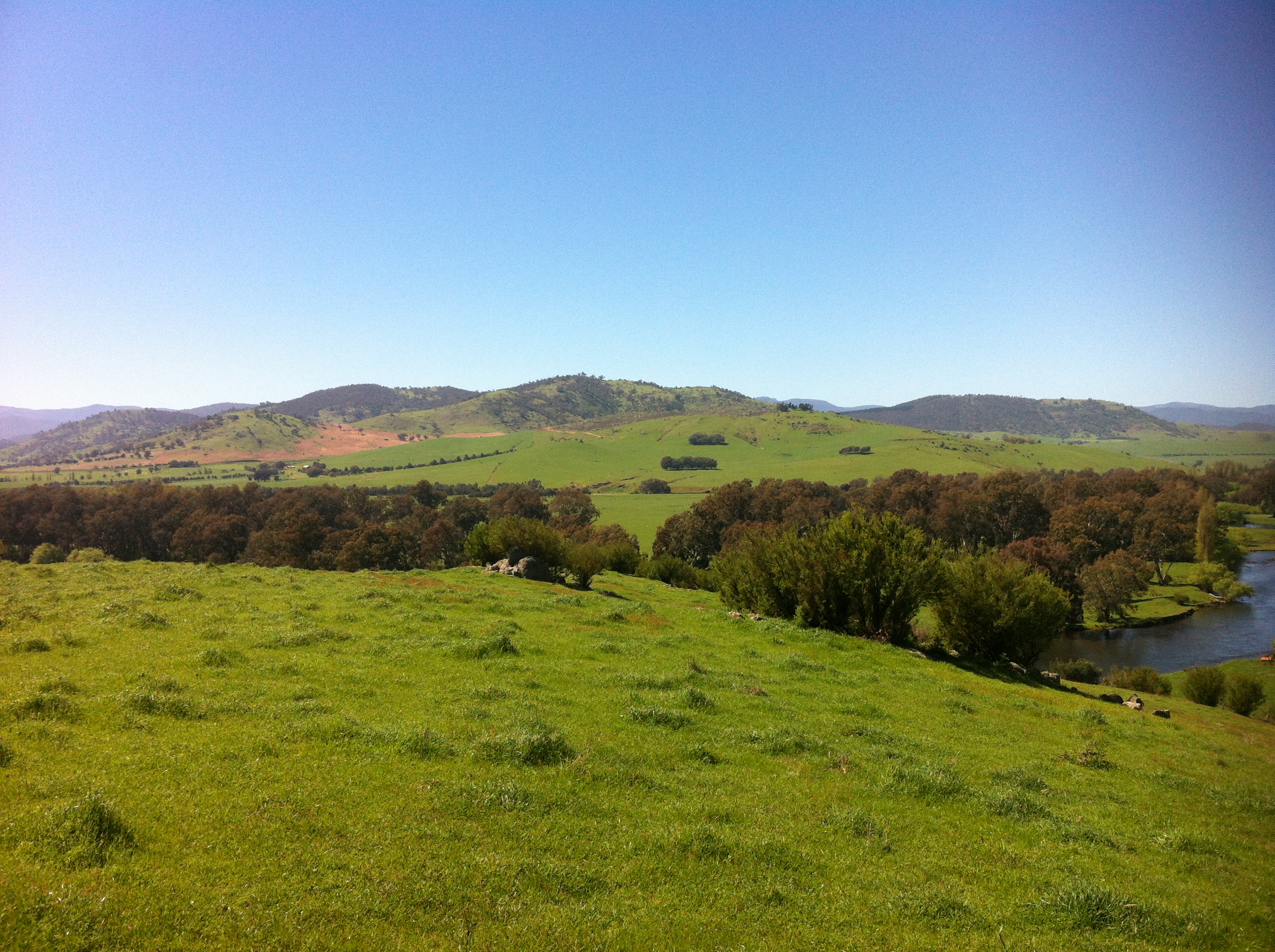
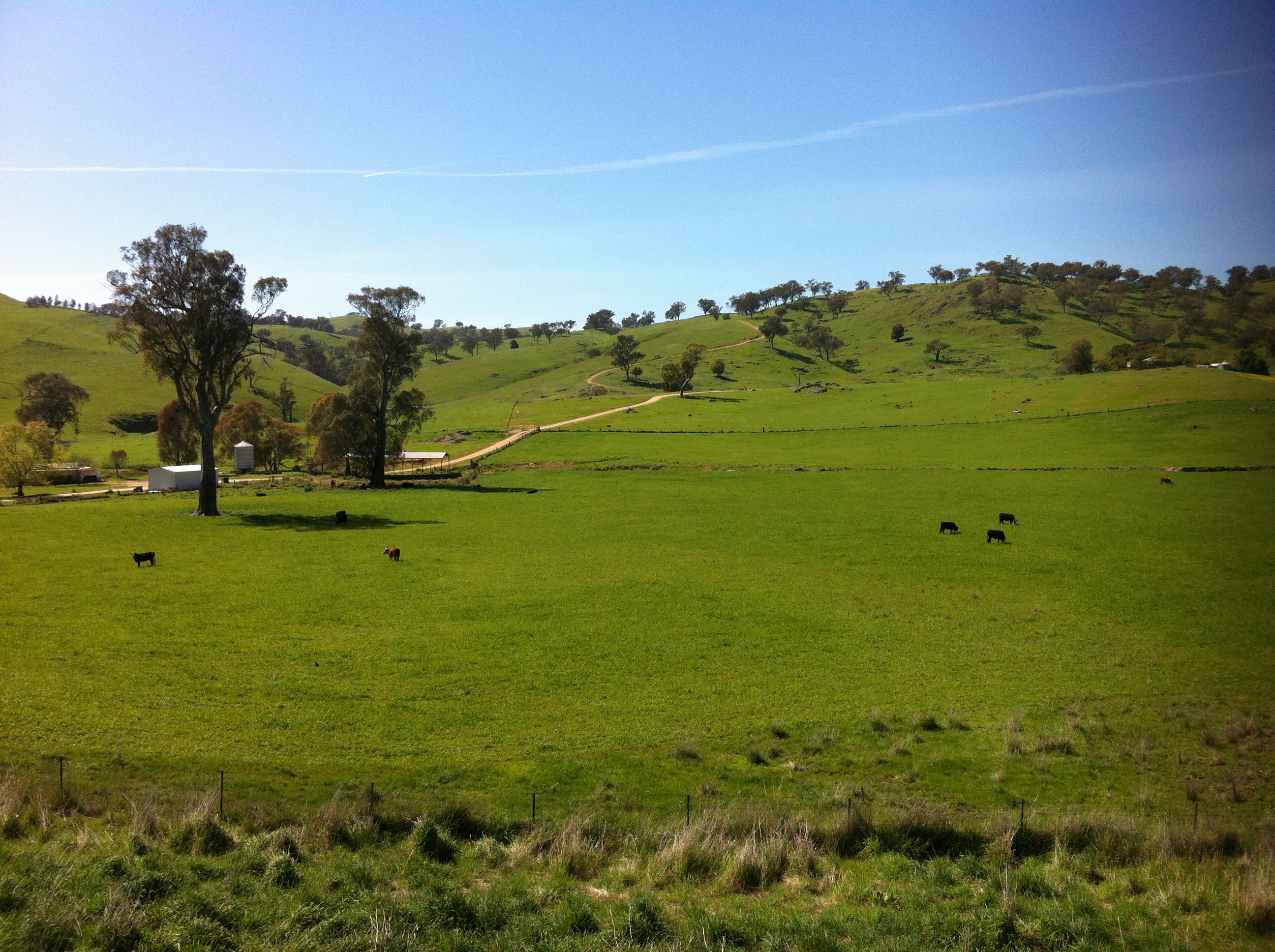
And so we found ourselves, without really planning it, in the upper reaches of the Murray River. I have to tell you, it was absolutely, absolutely lovely.  Maybe we were lucky with the season, with spring being in full swing. It certainly helped that we had clear, sunny days. Here’s a series of photos I took with my iPhone. Hopefully, they can give readers a sense of the sheer beauty of the landscape that we had wandered into.

upper murray river valley-corryong 020

upper murray river valley-corryong 019

upper murray river valley-corryong 017

upper murray river valley-corryong 016

upper murray river valley-corryong 015

You can see the Snowy Mountains in the distance, while the river in the foreground is the Murray River and the ponds are the famous billabongs which I mentioned in my first Australian post.

When I saw this landscape after our drive through the relatively dry eastern side of the Snowy Mountains and the forests of Kosciuszko National Park, I could not stop myself from thinking biblically. Up popped the Old Testament story of the Israelites who come back to Moses after exploring Canaan and exclaim, “We went into the land to which you sent us, and it does flow with milk and honey!” Milk and honey … that certainly describes the land we saw before us. William Blake’s Jerusalem also came to mind:
And did those feet in ancient time,
Walk upon England’s mountains green:
And was the holy Lamb of God,
On England’s pleasant pastures seen!

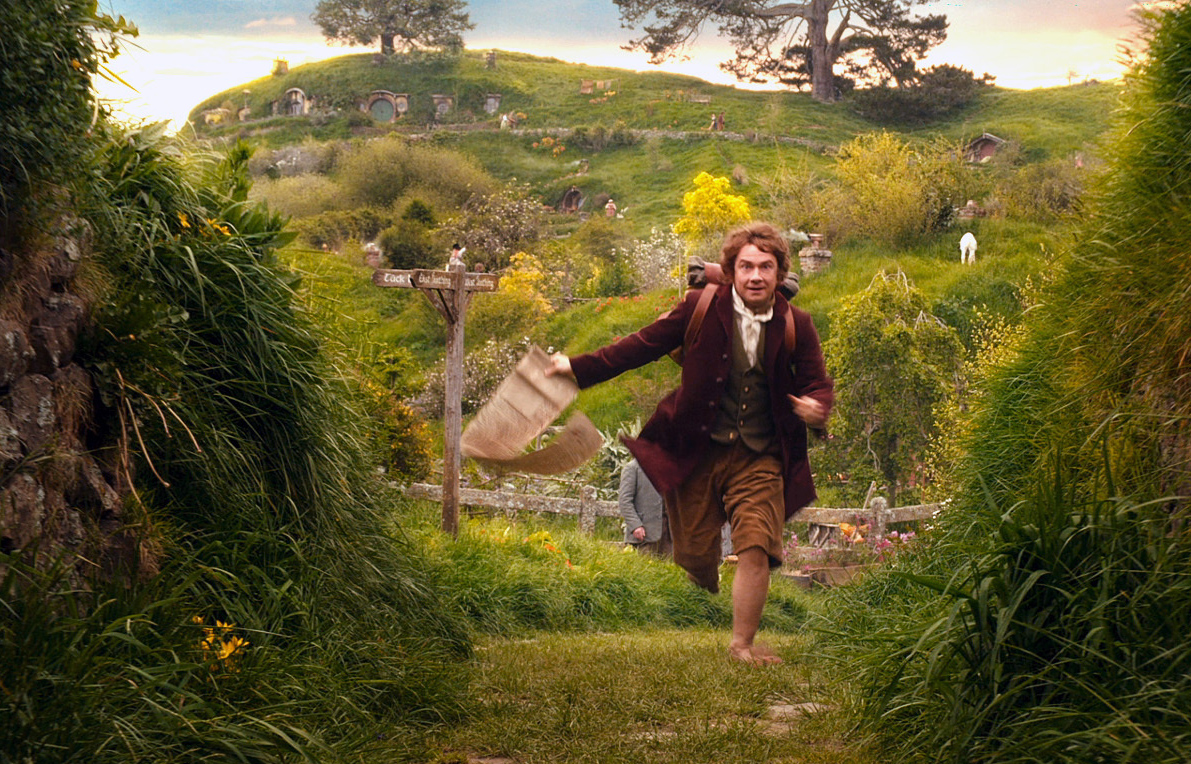
My wife’s first thought had instead a whiff of the pagan. It reminded her, she said, of Lord of the Rings or the Hobbit.

the-hobbit-movie

Whatever the reference, it was certainly very beautiful.

After spending a night in Corryong, and getting some good advice on which road to take from a very nice lady at the local information centre (I have to say, these information centres gave us excellent service everywhere we went), we set off along a small road which hugged the Murray River. It was all very peaceful.

upper murray river valley-corryong 050

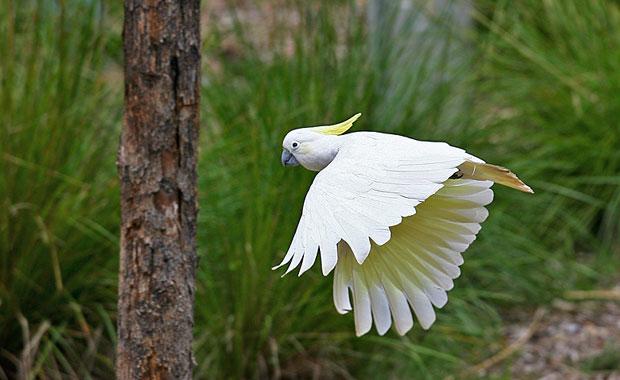
We watched a local farmer and his family herd in cows and their calves for marking, as they bellowed mightily against this corralling, and had a long chat with them about the future of farming. We watched Australian white ibises, which we had last seen in Sydney as scavengers, fly regally over our heads, while sulphur-crested cockatoos crossed our path with a slow and sensuous flap of their wings.

sulphur-crest-cockatoo

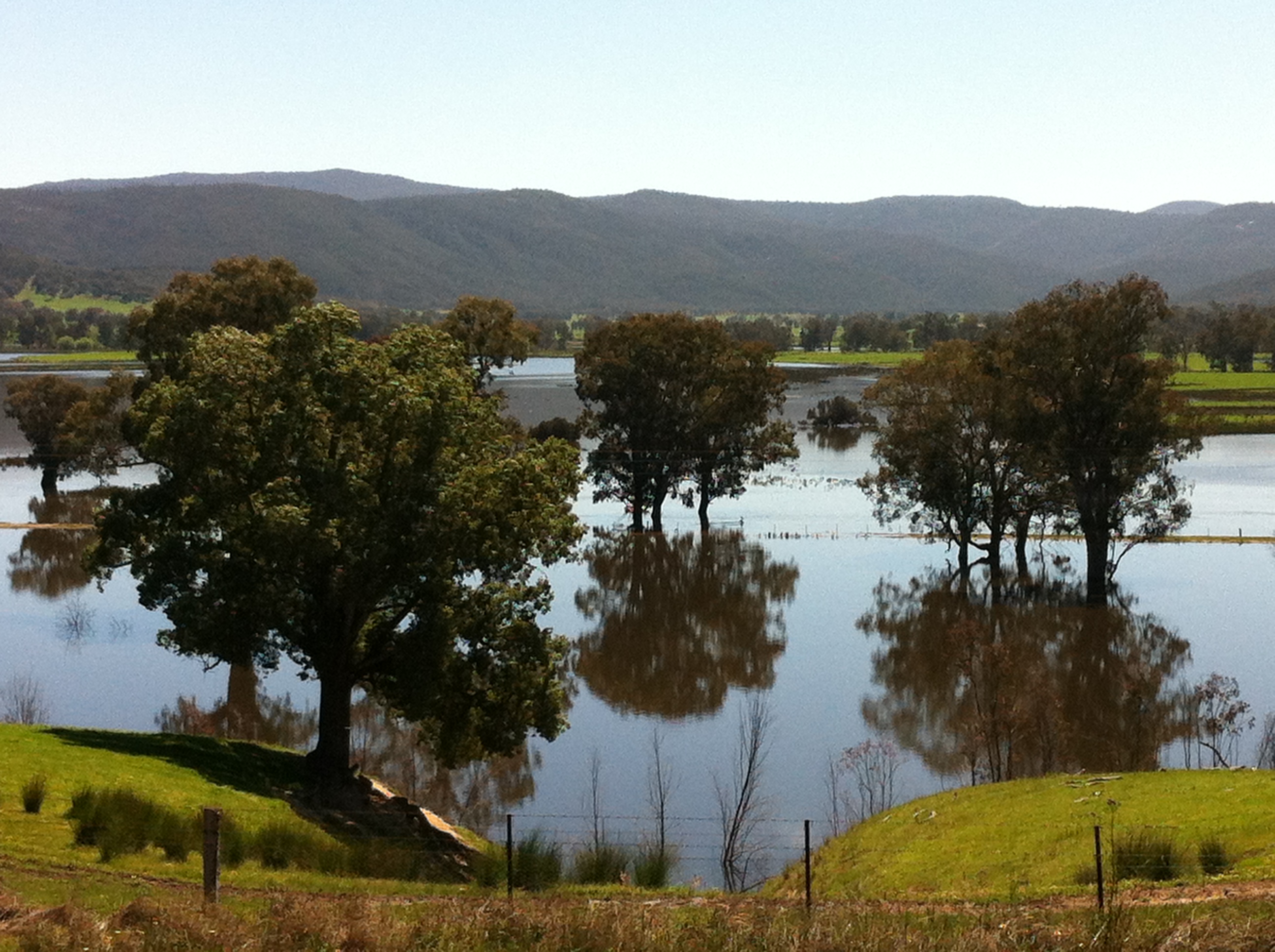
We finally reached Lake Hume. At first, it was the drowned trees which struck us

upper murray river valley-corryong 021

then it was the pelicans, which were swimming among the trees

upper murray river valley-corryong 024

The last time I had seen pelicans was as a child in St. James’s park

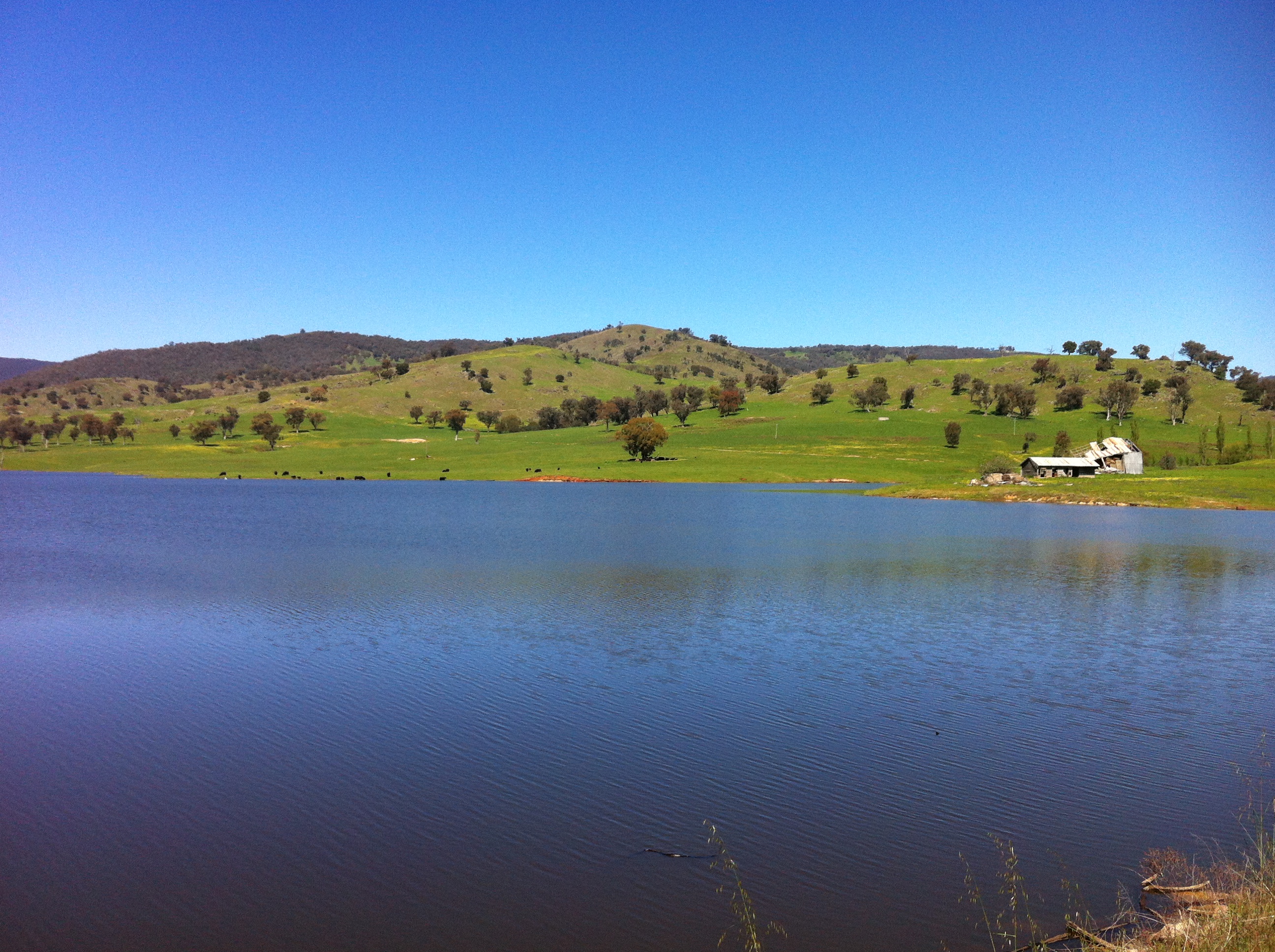
Then the lake broadened out.

upper murray river valley-corryong 036

We followed the lakeshore until Albury. Thereafter, the landscape got drier, flatter and less interesting so I’ll skip the final day.

Finally, it was time to drive back to Sydney. We decided to pass through Corryong again; we had liked it so much. We had one last vision of wondrous drifts of wildflowers in the fields

upper murray river valley-corryong 038

upper murray river valley-corryong 051

before we headed up through Tumbarumba and Tumut to the Hume Highway. Next stop, Sydney Airport and then Beijing. Sigh!

_____________________________

Hobbit: http://www.digitaltrends.com/wp-content/uploads/2013/02/the-hobbit-movie-48-fps.jpg
Sulphur-crested cockatoo: http://www.zoo.org.au/sites/default/files/styles/zv_carousel_large/public/sulphur-crest-cockatoo-animal-profile-web620.jpg?itok=dXPfOmk5
all other photos: mine