THUNDER

Bangkok, 4 July 2016

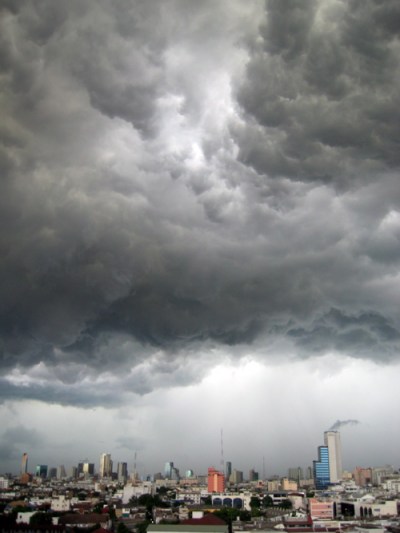
It’s the rainy season in Bangkok. The normal schedule sees the day start dry with perhaps some cloud cover, which then builds up into impressively nasty-looking, black, whorly cloud piles by late afternoon.

image
image
At that point, lightning rips the sky from cloud to ground
image
followed moments later by thunder. And what thunder it is! The air itself seems to crack and splinter, the clouds angrily boom and hammer, over and over again as lightning keeps bursting out of the clouds. Instinctively, my wife and I step back, retreating into the safety of the apartment, and murmur comments to each other about the elemental son et lumière playing outside our windows. And then the rain starts, so dense that the other side of Chaophraya River, normally perfectly visible from our terrace, is blotted out.

At moments like these, I feel pity for our early ancestors cowering in their rock caves or flimsy huts watching the same grand spectacle. With the benefit of science, I can rationalize what I am seeing: why, thunder is just the noise of the sonic shock wave created by the very sudden expansion of air caused by the almost instant increase in pressure and temperature brought about by the passage of a lightning bolt! That’s all … But they did not have this intellectual crutch to lean on. They must have found such dramatic displays by nature very frightening. So I suppose it’s not very surprising that all the early religions had a god of thunder, who no doubt had to be ritually appeased.

What I do find surprising, though, after a quick zip around the Internet, is how decorously many of these gods of thunder have been portrayed in art. If I were cowering in my cave 50,000 years ago, or even in my flimsy hut 5,000 years ago, listening to all that tearing, splintering, and booming mayhem going on outside, I think it would come naturally to me to depict the god of thunder as a mean, nasty, angry son of a bitch. Some portrayals do seem to go in this direction. For instance, those of Tawhirimatea, the Maori’s god of thunder

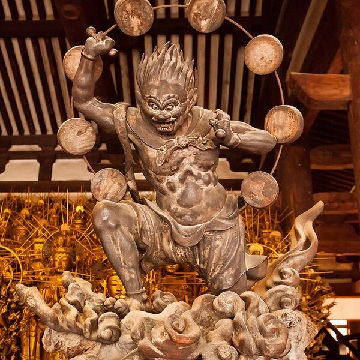
make him look satisfyingly nasty. So do portrayals of Raijin, Japan’s god of thunder
image
who to my eyes looks apoplectic. Chaac, the Mayan god of thunder also looks suitably nasty
image
although as in so much Mesoamerican art he looks gruesomely nasty – they really seemed to have a need for downright disgusting-looking gods, the Mesoamericans did. I think Thailand’s own god of thunder, Ramasura, could perhaps be added to the list. I suspect he has a nasty monster’s face, but the nastiness of it is offset by the graceful balletic poses he is depicted in, a pose common to any flying spirit in Thai art.
image
After that, it gets difficult to find angry-looking gods of thunder. Take Zeus, for instance, the Greek god of thunder and lightning. The angriest depiction I could find was this one, on a vase, where frankly he just looks a little snippy rather than rip-roaring mad.
image
His usual mode of representation seems to be that typically Greek one of Olympian calm and good muscle tone, like this magnificent statue of him in the National Archaeological Museum in Athens (the lightning bolt which he is, calmly, throwing has gone missing).
image
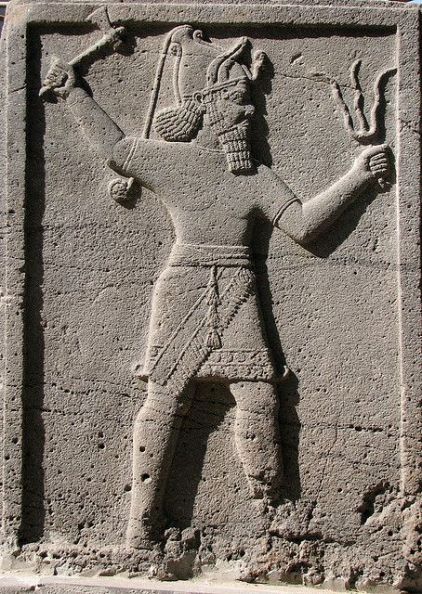
A rapid whizz through the pantheon of thunder gods in the Middle East gave me nothing better than this representation of Teshub, the Assyrian and Babylonian god of thunder
image
who, let’s face it, is looking petulant rather than angry as he wields his axe and lightning bolt.

I was hoping that the Norsemen, who after all seemed to spend most of their time stoving in their enemies’ skulls and drinking mead from those they hadn’t stoved in, would come up with a suitably horrible portrayal of Thor, their god of thunder. Not a bit of it! The best I could find was this
image
which, let’s face it, is a really pathetic representation of this god, who, if I’m to believe the Icelandic sagas, was testosterone-fueled and badly in need of anger management classes. Marvel Comics have done a much better job at depicting him
image
(and, by the way, have done a much better job of depicting Zeus too)
image
What to make of all this? Perhaps that the trick of our ancestors was to personalize these frightening phenomena. By personalizing them, they could clothe them with known and understandable personality traits, thus rendering the unfamiliar familiar. And/or maybe the ruling classes who arose out of the early agrarian societies and needed the acquiescence of the masses to their rule, if necessary through force, rather liked the idea of the masses equating their power to that of natural forces like thunder and lightning – but also wanted that power to look regal rather than just plain nasty; the fist of iron in the velvet glove, as it were.

Well, that’s my two-cent’s worth of pop-anthropological musings. My wife and I can now go back to watching the spectacle through our apartment windows – but from two steps back; you never know.

____________________
Thunder clouds over Bangkok: https://paulandsarahinthailand.wordpress.com/author/artyfooty/page/5/
Thunder clouds over Bangkok-2: http://2bangkok.com/2bangkok-weather-index.html
Lightning over Bangkok: http://www.digitalphotographytipsonline.com/my-image-gallery.html
Tawhirimatea, NZ: http://auckland-west.co.nz/2011/08/09/twhirimatea/
Raijin, Japan: http://www.esamskriti.com/print.aspx?topicid=969&chapter=1
Chaac, Mayan God of rain: http://archaeology.about.com/od/mayaarchaeology/a/Mayan-Rain-God-Chaac.htm
Ramasura: http://www.thaifolk.com/doc/mekkala_e.htm
Zeus on pottery: http://www.theoi.com/Gallery/K1.1.html
Artemisium Zeus statue: http://www.crystalinks.com/zeus.html
Teshub, Assyrian-Babylonian: https://www.pinterest.com/pin/12525705192076524/
Thor: https://en.m.wikipedia.org/wiki/Eyrarland_Statue
Thor comic book: https://en.m.wikipedia.org/wiki/Thor_(Marvel_Comics)
Thor and Zeus comic book: https://en.m.wikipedia.org/wiki/Zeus_(Marvel_Comics)

THE AUSTRALIAN BOAB TREE

Bangkok, 11 June 2016

One of the first things which struck me as my wife and I started our tour of the Kimberley in Australia was the presence of this tree, which we frequently saw, both in leaf
image
and bare
image
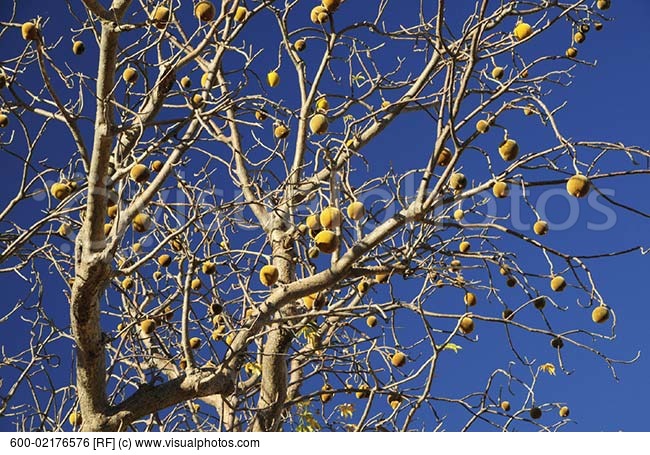
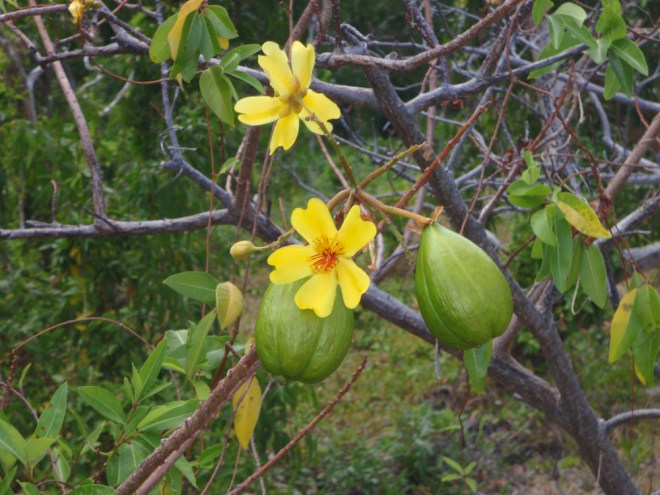
and many of them with fruit.

image
I kept saying, “Aren’t those baobab trees?” For they looked amazingly like African baobabs.
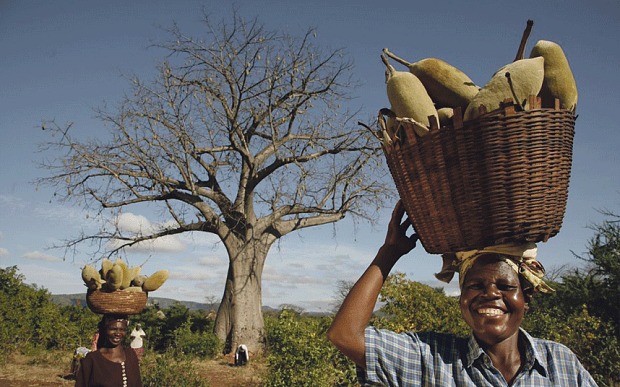
image
Well, the fact is, they are baobabs (although Australians insist on calling them boabs). These trees are to be found in sub-Saharan Africa (two species) as well as in Madagascar (six species, of which these, subjects of a previous post of mine, are magnificent specimens)
image
and there is this one species in Australia – actually, the tree is found only in the Kimberley and nowhere else in Australia.

How did the baobab tree end up in the Kimberley? I mean, it’s quite some distance, some 8,000 km to be precise, between the east coast of Africa and the west coast of Australia.

A first hypothesis was that this was a left-over from the break-up hundreds of millions of years ago of the supercontinent Gondwana into its constituent pieces of South America, Africa and Madagascar, Antarctica, India, and Australia
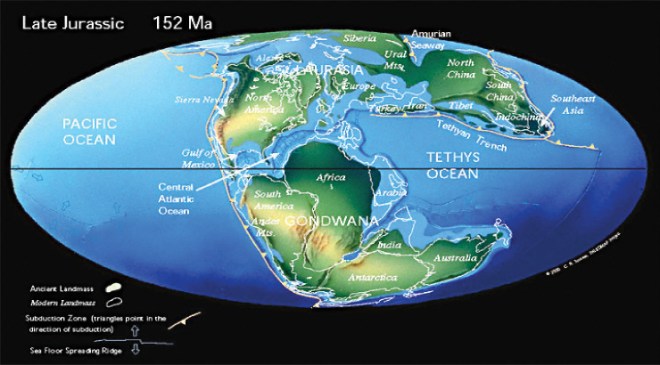
image
which then proceeded, through continental drift, to arrive where they are now. The ancestors of the baobab had existed on Gondwana, so the thinking went, and were carried along for the ride on the drifting continents.

Apart from the fact that this hypothesis doesn’t explain why there aren’t baobabs in India or South America, modern DNA analysis has nixed it. Comparison of DNAs has shown that the African and Australian varieties of the baobab separated a “mere” 100,000 years or so ago, when (by my calculation) Africa and Australia were 7 km closer (continental plates drift slowly).

So how did the baobab make it to Australia?

Well, the next most obvious hypothesis is that an African baobab nut or two (of which the smiling ladies in the photo above are holding a basketful) was carried out to sea and then carried along by surface currents to its new home in Northwestern Australia. But the experts are hesitant, and I understand why. A study of this map of surface currents
image
shows that to make it to the Kimberley region, a nut would have had to fall into the Somali current and been carried northward, then it would have had to get taken eastward by the northern branch of the Indian Ocean’s Equatorial current, all the way to the island of Sumatra. At that point, our bobbing baobab nut would have had to hug the southern coastlines of Sumatra and Java, to then, somewhere around Bali or Timor, change course, coming southward and westward, finally making a landing in the Kimberley. As the sad fate of the Malaysian flight MH370 has shown, anything floating further south in the Indian Ocean would tend to be carried westward rather than eastward. The map below is a computer-generated estimate of where debris of the plane could have drifted from the original hypothesized crash point (the square point on the border of the blue area); the red area is where debris might have been 18 to 24 months after the crash.
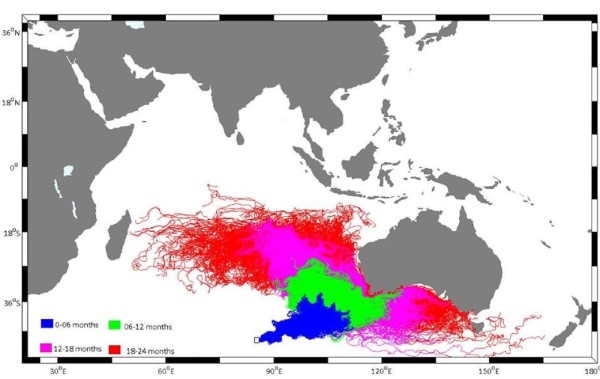
image
If this ocean voyage of the baobab nut occurred at all, it would have taken place during the last ice age. This started 110,000 years ago, which is pretty much when the two baobab lines separated, and finished 12,000 years ago. Among other things, the ice age caused sea levels to drop, which modified coastlines in certain parts of the world. In turn, these modifications could have affected the direction of surface currents. So to be really correct, one should look at a map of someone’s best guess of surface ocean currents during the ice age. Unfortunately, I didn’t come across any such map. This map, however, shows where the coastlines were at the time.

image
It seems there were no big changes in the area we’re interested in except around the islands of Indonesia and New Guinea, where the lower sea levels connected up a lot of the islands (and, en passant, made that last hop of human beings into Australia 50,000 or so years ago a good deal easier). I’m no ocean currentologist, but I rather think that the blocking up of the straits between these islands might actually have made the last leg of the baobab nut’s journey, that right turn from Bali to Australia, somewhat easier.

How long would such a trip have taken? Well, it took debris from MH370 about two years to wash up on the coast of Mozambique, so I would imagine that it would take just as long, if not longer, for a baobab nut to travel in the opposite direction. Could a baobab nut soak that long in the ocean and still be able to germinate upon arrival? We can look to the coconut for an answer; a coconut, at least the original version before human beings started messing around with it, was designed to be dispersed by sea.
image
There happens to be a lot of argument on this point, but no-one has ever claimed that a coconut can last two years in seawater. A maximum seems about three months, and even that has been challenged. So I seriously doubt that a baobab nut, even if it had managed to make it to the Kimberley by sea, would have been in a fit state to germinate.

So, how else could the baobab have arrived in the Kimberley?

The next most obvious hypothesis is that human beings brought the baobab with them, because they too originated in Africa. Could the ancestors of the Aboriginal people, who are currently thought to have arrived in Australia 50,000 years ago (plus or minus 10,000 years), have carried the baobab nut with them? Well, since they left Africa about 120,000 years ago and took 70,000 years to reach Australia, that would have meant planting the baobab as they went along. This is not actually as crazy as it sounds. Both in Africa and in the Kimberley there is strong evidence that the local hunter-gathering groups deliberately carried the baobab with them and planted it in new areas – the tree is a great source of many things other than the nut. But if this really did happen, then shouldn’t we find baobabs along their most probable migration route?
image
Yet, apart from southern Arabia, none of the places between Africa and Australia have baobabs, or even baobab remains. Of course, it could be that climate changes in these places after the end of the ice age killed off the baobabs, or it could be that they were killed off by the after-effects of the absolutely gigantic volcanic eruption of Mount Toba in the island of Sumatra about 70,000 years ago
image
the ash from which fell over a huge area, much of it on the migration route to Australia, which could have choked plant life.
image
It has also been argued that many years of permanent darkness set in after this event, a sort of “nuclear winter”, which of course would have affected the ability of plants to photosynthesize.

But still, all in all, the chances of the baobab having gotten to Australia via this long, long migration route seem very slim.

So how, then, could the baobab have gotten to the Kimberley?

And here, gentle readers, we step into a wasps’ nest. One Australian scientist has made the radical suggestion that tribes sailed from the east coast of Africa to the Kimberley, carrying baobab nuts as food. He claims that the rock art of the Kimberley (which I will cover in a future post) is (a) far older than is generally thought, maybe 50,000 years old, and (b) shows that 50,000 years ago the painters knew the use of boats.

OLYMPUS DIGITAL CAMERA
He suggests that the nuclear winter caused by Mount Toba led them to sail east, to the source of the sun, to find it again, which coincidentally would have brought them to the Kimberley (and he argues that there are strong connections between Kimberley’s rock art and the rock art of East Africa).

Well, as readers can imagine, such views have the Australian archaeological community in a tizzy. It certainly is a pretty far fetched theory. But somehow we have to explain how the baobabs got to the Kimberley, right? Anyone of my readers have any ideas?

_____________________
Boab tree in leaf: https://en.m.wikipedia.org/wiki/Adansonia_gregorii
Boab tree bare: http://www.alamy.com/stock-photo/boab-tree-kimberly.html
Boab tree in fruit: http://www.visualphotos.com/image/1×10636003/australia-western-australia-broome-roebuck-bay-a-faint-banded-sea-snake-caught-on-the-mud-flats-at-low-tide
African baobab tree: http://www.telegraph.co.uk/foodanddrink/11328252/Baobab-the-superfood-of-2015.html
Grove of baobab trees, Madagascar: https://www.pinterest.com/pin/1618549836269760/
Gondwana: http://www.earthsciences.hku.hk/shmuseum/earth_evo_07_01.php
Ocean surface currents: http://www.cruiserswiki.org/wiki/Indian_Ocean
Debris path of MH 370: http://www.deepseanews.com/2015/07/how-currents-pushed-debris-from-the-missing-malaysian-air-flight-across-the-indian-ocean-to-reunion/
Coastlines last ice age: http://maxworldhistory.weebly.com/map-exercise.html
Coconut in the sea: http://www.allposters.com/-sp/Coconut-Floating-on-Water-Indo-Pacific-Split-Level-Dispersal-of-Seed-Posters_i2634256_.htm
Migration out of Africa: http://cogweb.ucla.edu/ep/Paleoanthropology.html
Mount Toba eruption: http://www.thedailysheeple.com/yellowstone-super-volcano-is-far-bigger-than-previously-thought_122013
Mount Toba ash coverage: http://news.berkeley.edu/2015/03/31/200th-anniversary-of-tambora-eruption-a-reminder-of-volcanic-perils/
Bradshaw art boat: http://forum.woodenboat.com/showthread.php?169983-Primitive-Depictions-of-Medieval-Ships-Seen-from-Above
I’VE EATEN THE GREEN BUMS OF ANTS

Bangkok, 7 June 2016

Yes, I did that. On our recent tour of the Kimberley in Australia. The ant in question was the Green Tree ant or Weaver ant.
image
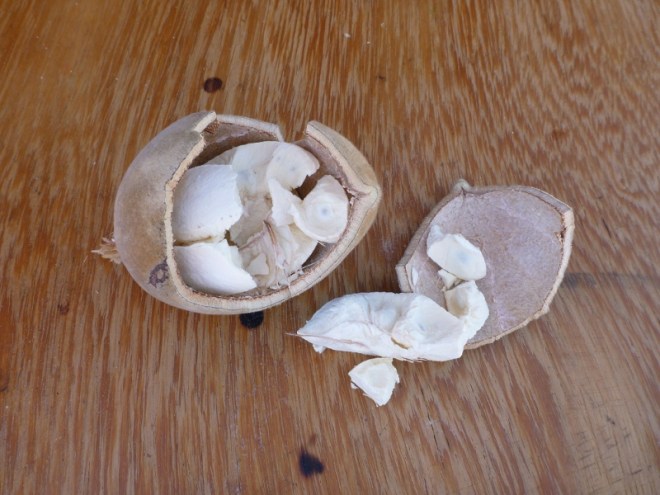
As readers can see, the ant has a bright green bum. The driver-cum-guide of our tour was a passionate advocate of the country’s Aboriginal population, of which there are still many in this little corner of Australia (it was the last part of the continent to be penetrated by white settlers, back in the 1870s). Among other things, on our walks through the bush he would point out various bush tucker (for non-Australians, that’s wild food which can be harvested in the bush), which he always claimed were bursting with proteins, Vitamin C, and other goodies, and which he would then invite us to try. So apart from Green Tree ants, I dutifully ate the petals of Australia’s kapok tree

the “petals” of the rosella “flower”
image
and the inside of the “nut” of the Australian boab tree (on which hangs a fascinating tale, which I will write up in a later post).
image
His partner, who was our cook, also fed us camel burghers (camels can now be found in the wild in Australia by their millions)

image

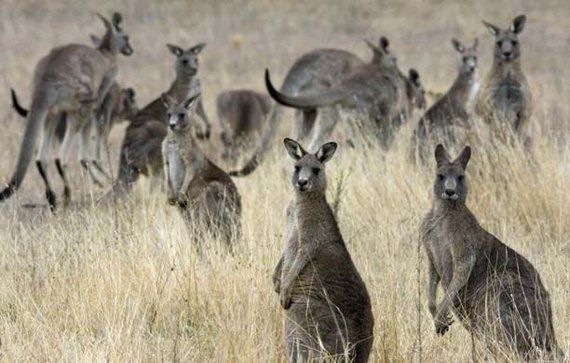
and kangaroo stew (also to be found in their millions throughout Australia, but of which we saw surprisingly few on this trip).
image
My conclusion: I really hope I don’t need to be a vegetarian in the Australian bush.

But actually, further research on my part since we returned from Australia suggests that the range of bush tucker we tried on our tour was rather limited. One article in Wikipedia has quite a long list of bush tucker to be found in the top end of Australia where we found ourselves, only one of which – the boab nut – we tried. So I really shouldn’t give up on bush tucker just yet.

_____________________
Green tree ant: http://www.alexanderwild.com/Ants/Making-a-Living/Arboreal-Ants/i-wpGjWZ8
Kapok tree flower: http://www.crystalchannelers.com/blog/plantology—aboriginal-healing-recipes—reduce-a-fever
Rosella: https://cnesgreen.wordpress.com/2010/04/19/roselle-flower-tea-hibiscus/
Open boab nut: https://outbackjoe.com/macho-divertissement/bush-tucker-plants-and-animals/boab-tree/
Wild camels in Australia: https://www.dpaw.wa.gov.au/management/pests-diseases/202-camels-in-western-australia?showall=1
Kangaroos: http://notallowedto.com/the-feral-child-a-boy-raised-by-kangaroos-discovered-in-australia/

AUSTRALIA – KIMBERLEY TOUR HIGHLIGHTS

Bangkok, 5 June 2016

My wife and I both agree that without a doubt the Bungle Bungle National Park was the highlight of our recent tour of the Kimberley (I suppose I should use its proper name, Purnululu National Park, but Bungle Bungle is such a delightfully silly name that I shall stick to that). It has been chosen as a World Heritage Site and for once I agree with this. What we have here is a deeply eroded range, and I think the best way to appreciate the unique geology of the Bungle Bungle is through an aerial photo
image
or two
image
or three.
image
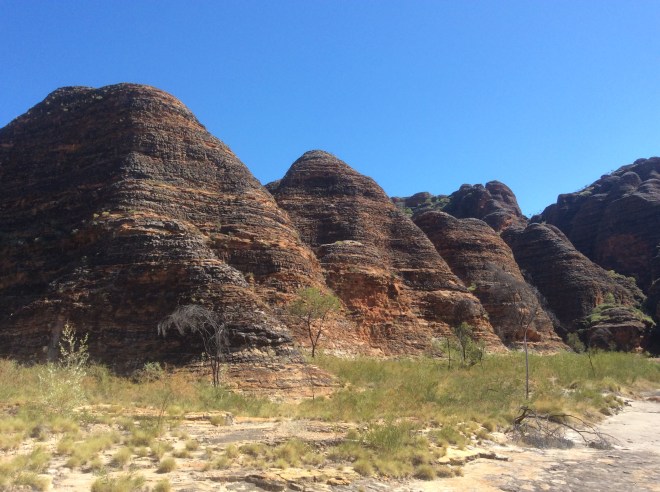
Readers will immediately notice the smooth rounded shapes into which the rocks have weathered – beehives is a commonly used descriptor and seems very apt. The guidebook with which we were thoughtfully supplied on our coach stated that this type of formation is very rare – only a few other places on Earth have it, and not nearly as extensively as in the Bungle Bungle Range. UNESCO, in its World Heritage Site write-up, notes approvingly that “the Bungle Bungles are, by far, the most outstanding example of cone karst in sandstones anywhere in the world.” Without going too much into the geological whys and wherefores, the fact that the rock has eroded into these smooth rounded shapes seems to have to do with the bands in the rock, seen quite well in the third photo above and even better in this photo taken by my wife from ground level.
image
The key to the bands’ existence is the clay content of the rock. The darker bands have more clay, which means they hold moisture better, which in turn allows a very thin film of cyanobacteria to grow on the rock. It is this film which gives the rock its darker colour. The red bands, on the other hand, having less or no clay, dry out quicker and so cannot support a colony of bacteria. Instead, they have been stained orange-red by iron and manganese deposits. The bacterial film protects the rock from too rapid an erosion, which allows the rounded shapes to form.

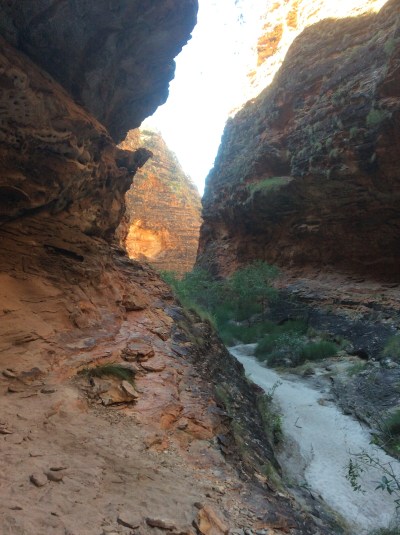
Geological considerations aside, it’s a delight to walk through these humped and rounded rocks, which are split by numerous gorges and chasms, a number of them having trails laid along them. We walked just two, the Cathedral Gorge and the Echidna Chasm. The Cathedral Gorge narrows slowly
image
image
image

image

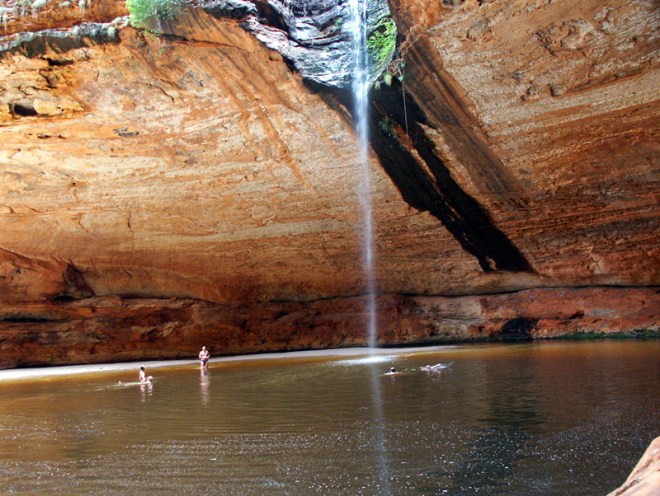
to finally finish in a pool partially covered by deep overhangs.

DCF 1.0

image
The Echidna Chasm, on the other hand, is a deep, narrow gash in the rock, at times so narrow that it is hard to get through. After the surprise of coming across Livistona fan palm trees at its mouth (palms are not the first trees that come to mind in this hot and arid landscape)
image
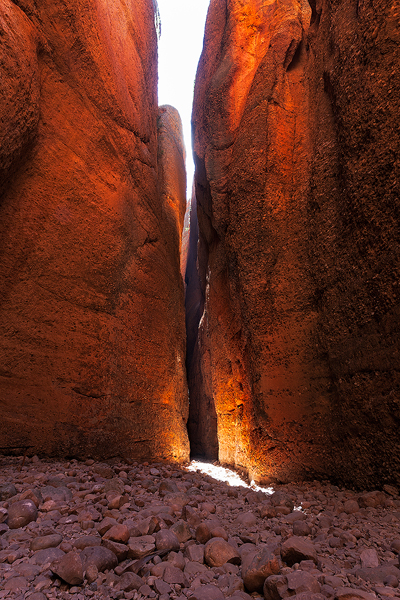
one edges into the chasm itself. There is a certain fun in threading one’s way through, at some points having to climb and clamber over huge boulders, sections of the walls which have come crashing down; one keeps looking nervously up to see if others might not be about to give way and squash one like a beetle. But there is also an ethereal beauty in this chasm. At certain times of the day, the sun catches the rocks and makes them literally glow. Our iPad cameras were too feeble to catch this wonderful light, but this photographer has managed beautifully.
image
We would gladly have stayed longer in this Park and done more of the trails. But that is the downside of organized tours: the tyranny of The Schedule.

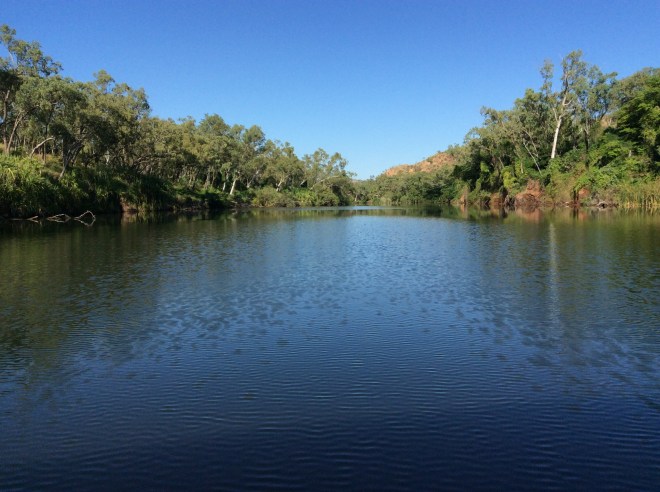
After detailed discussions, my wife and I have agreed on two more modest scheduled highlights, both, interestingly enough, having to do with water. One was the boat ride on a section of the Ord River near Kununurra, which has been dammed for irrigation purposes. From such utilitarian objectives has come a very pleasant body of water, in the form of several kilometers of the river which are filled year-round with water (a rarity in Australia).

image

image
“Water is life” our driver-cum-guide would constantly intone, and this stretch of river was the living proof of this. Apart from several well-fed freshwater crocodiles which we spied along the banks with a twittering of excitement, we saw a large number of birds, the most majestic of which was undoubtedly the white-breasted sea eagle
image
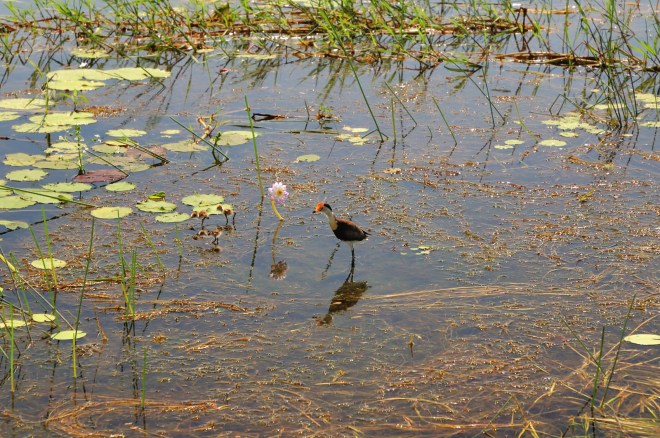
and the sweetest of which was the Jesus bird (aptly named since it seems to walk on water).
image
The mother hatches the chicks, the father is then solely responsible for their upbringing (many of the ladies on board noted this division of labour with approval; the men said nothing). But perhaps the most interesting wildlife we came across was a colony of fruit bats hanging out (literally) in a couple of trees along the bank, making quite a noise as they yelped and barked – when do they sleep, I wonder?

SONY DSC

From the mutterings of disapproval among our Australian companions and the spirited defense of the bats put up by our guide, we surmise that they are considered a nuisance in more urban settings, no doubt because they sink their fangs into the fruit of your garden which you had been looking forward to eating.

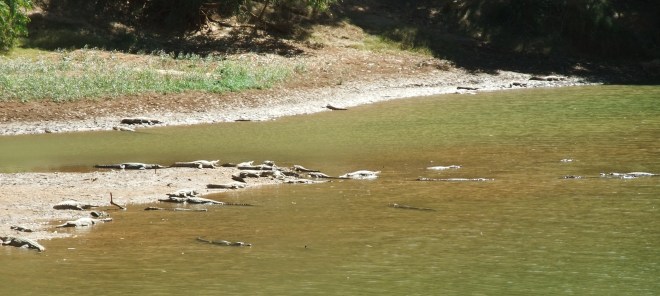
The second modest scheduled highlight was Windjana gorge, in the King Leopold Ranges (why the British explorer who first came across these ranges named them after the King of the Belgians is a bit of a mystery to me; my guess is he was hoping the guy would fork out for his next expedition). Apart from the frisson we got from seeing twenty or more freshwater crocodiles all in one place waiting in complete stillness on the banks or in the water for their next meal to go by
image
the gorge itself was very pretty
image
and once again the rocks glowed orange-red in the setting sun.
image

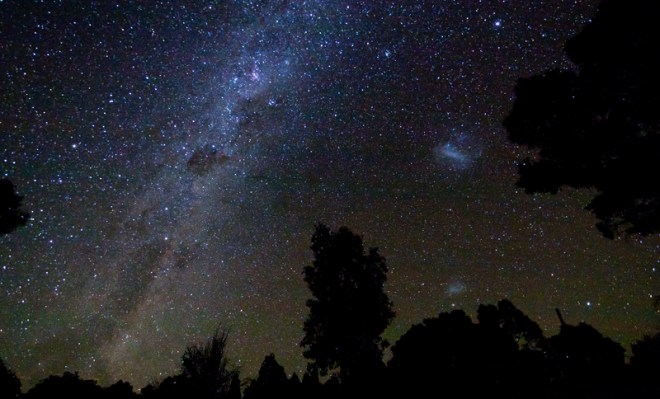
There was one other highlight, which wasn’t marked in The Schedule, and that was the night sky. In many places, we camped far, far away from any polluting light sources. This, combined with the normally clear skies, meant that when the moon didn’t get in the way we had glorious views of the night sky. It was a sky without the constellations of the Northern Hemisphere with which my wife and I are familiar, but nevertheless a magnificent site to behold, especially on the nightly walks to the toilet to which I alluded in the previous post.
image
Our last night out, we dragged our camp beds out of our tent, and as we dozed we watched the Milky Way wheel across the sky. Wonderful. But as they say, there is no gain without pain. I am still spreading anti-histamine cream on the dozen or so bites I got from the accursed Australian mosquitoes that night, may they rot in Hell.

____________

Bungle Bungle aerial view-1: http://www.kimberleywilderness.com.ccd. dau/the-apt-experience/photos-and-videos/photo-gallery
Bungle Bungle aerial view-2: http://www.ryanphotographic.com/Essay.htm
Bungle Bungle aerial view-3: http://kimberleymedia.photoshelter.com/gallery/Bungle-Bungles-Purnululu/G0000GcT6t3sRLPw/C0000uv7H8rn8We0
Cathedral Gorge trail: my wife’s photos
Cathedral Gorge pool-1: http://studyperth.com.au/about/news-feeds/2015/10/top-10-walking-tracks-and-bike-trails
Cathedral Gorge-2: my wife’s photo
Livistona palm trees: my wife’s photo
Echidna chasm: http://www.wildroad.com.au/galleries/australia-photos/echidna-chasm-purnululu-national-park-australia/
Ord River: my wife’s photos
White breasted sea eagle: http://thelife-animal.blogspot.com/2012/07/white-bellied-sea-eagle.html
Jesus bird: https://well.smugmug.com/keyword/WadingBirds;birds
Fruit bats: https://drivedownunder.wordpress.com/2013/06/14/its-a-bungle-out-there/sony-dsc-138/
Crocodiles, Windjana Gorge: https://flamingoing.wordpress.com/2013/08/19/the-devonian-reef-national-parks/
Windjana Gorge: http://www.broomeandthekimberley.com.au/gibb-river-road-and-gorges/
Night sky: http://www.3rf.com.au/gallery.asp

OUR TOUR OF THE KIMBERLEY, AUSTRALIA

Bangkok, 5 June 2016

I must excuse myself to my readers for the long gap in my posts, but my wife and I have just come back from a two-week holiday. We were visiting the Kimberley region in Australia, which for those not familiar with Australian geography is the region tucked away into the continent’s northwest corner.

It’s Australian outback country par excellence: a poor, red, stony earth with rocky outcrops, lightly covered by a varying mix of grasses and eucalypts

image

and dotted, sometimes thickly, with termite mounds
image
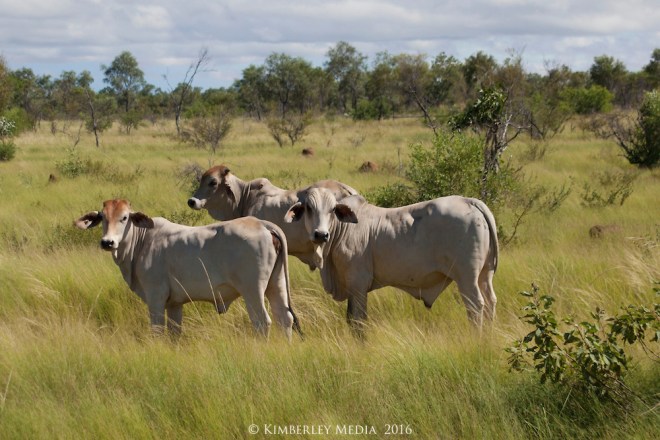
sparsely populated, with huge cattle stations whose cattle is almost wild
Young Brahman cattle enjoy the lush grasslands in the Kimberley wet season.
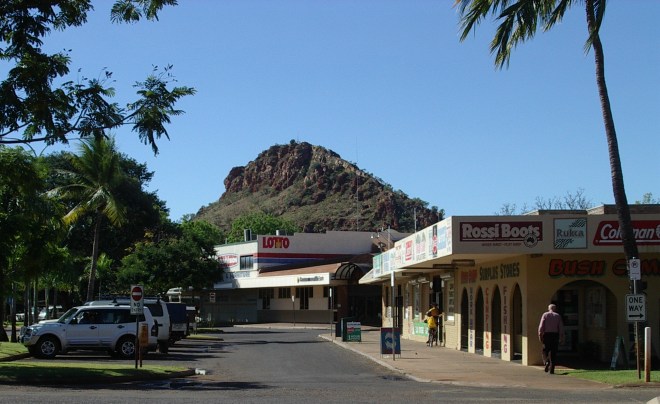
and small, nondescript towns
image
with significant Aboriginal populations.

image
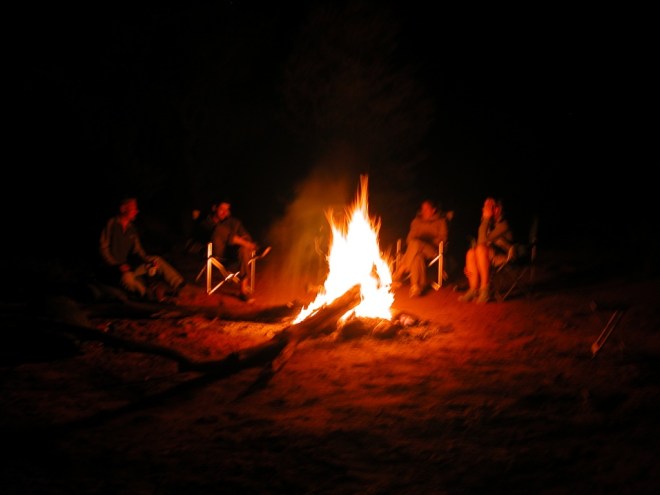
We chose to go with an organized tour, and so we found ourselves, the rather exotic foreigners, traveling with 22 Australians and a New Zealander (I don’t think New Zealanders really count as foreigners in Australia). It was a fascinating mix of people. Nearly all of them were from Australia’s east coast, escaping their “cold” winter. Most of them were retirees; at 62, we were among the youngest (there were two outliers, girls in their early twenties – we all stared at them in surprise when they first got on the coach; what on earth were they doing with us old fogies?). Two couples had been dairy farmers, a number had been teachers, a number had been social workers of one form or another, one had worked in the prison system, one had been an architect and another a house builder, one had been a bureaucrat in the Ministry of Finance, one of the young girls drove coal trucks out of a coal mine while studying part-time to be a nurse, the other was a receptionist. As behoves an immigrant country, several of our group were first-generation immigrants: there was a woman who hailed originally from Malaysia, another from France, a couple from the Netherlands, and another couple from what had once been Rhodesia and is now Zimbabwe. All this diversity made for interesting discussions as we opened up to each other at meals and around camp fires in the evening.
image
And of course, we touched upon the more intimate things of life: children, deaths of or separations from spouses, and, as we settled into the trip and admitted several trips a night to the toilet, the state of our prostates. It was somewhat akin to that film of long ago “If It’s Tuesday, This Must Be Belgium”
image
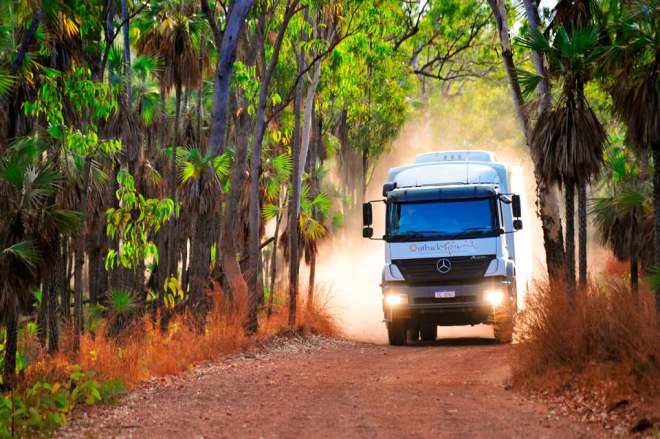
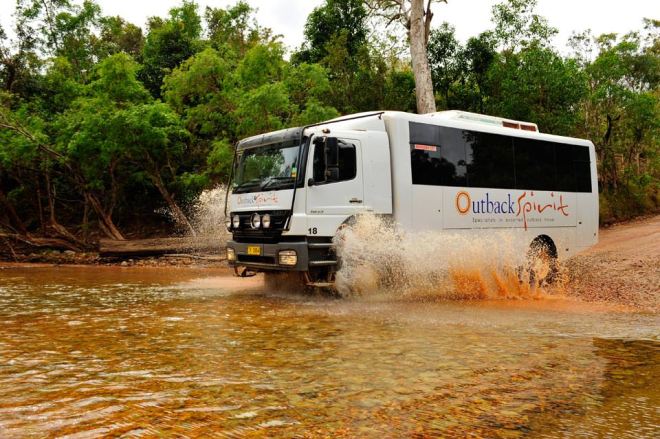
although in our case we only toured one small part of one country (but still managed to clock up 2,600 km; just to put things in perspective, the Kimberley is twice as big as the UK), the coach we rode in was technologically very sophisticated, custom-built on a Mercedes chassis to take anything the rugged unpaved roads of the outback could throw at it
image

image

and we slept in tents – I was strongly reminded of my Boy Scout days.
image
The tour started in Broome, a small town on the Indian Ocean and once a pearling station, went east along the paved Great Northern Highway for a thousand kilometers or so, to the even smaller town of Kununurra, and then looped back to Broome along the unpaved Gibb River Road, with a detour north at some point along the Kalumburu Road to visit the Mitchell Falls situated very nearly on the northern coast. I do not intend to bore my readers with a detailed travel diary. I will just touch upon some highlights in the next posts. So cheerio, mates!

_________________

map: https://en.m.wikipedia.org/wiki/Kimberley_(Western_Australia)
Kimberley vista: my wife’s photo
Termite mounds: https://www.birdwatch.co.uk/categories/articleitem.asp?item=643
Cattle: http://kimberleymedia.photoshelter.com/gallery/Cattle-Kimberley-Images/G0000RM6HcfEh3fE/
Kununurra: http://www.avalook.com/newsite/?page_id=13
Old Aborigine: my wife’s photo
Around the campfire: http://sacreddestinations.org/sacred-destinations-spiritual-tours-meditation-retreats.html
“If It’s Tuesday, This Must Be Belgium” film poster: https://en.m.wikipedia.org/wiki/If_It%27s_Tuesday,_This_Must_Be_Belgium
Coach: http://www.outbackspirittours.com.au/tours/cape-york-wilderness-adventure
Tents: my wife’s photo

WATER

Bangkok, 7 May 2016

It’s hot here in Bangkok at the moment, very hot.

And it’s humid, very humid.

We drag ourselves through the day, stumbling from one air-conditioned space to another.

We scout the horizon for clouds. Will the cooling rains ever come?

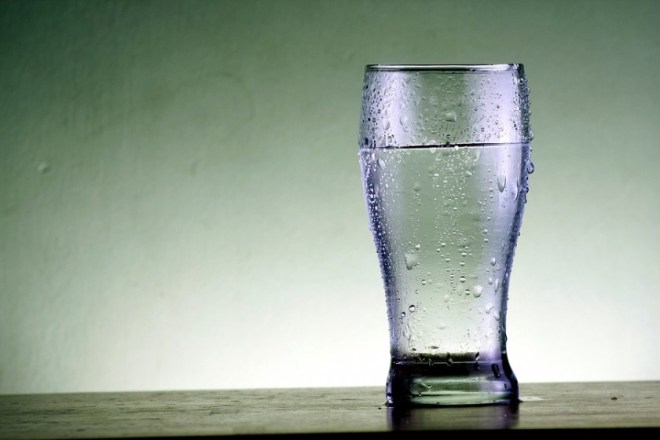
We sweat, we’re thirsty. We go to the fridge to get that bottle of cold, cold water. We pour ourselves a glass. A film of water immediately forms on it.

We drink. Aaaah, sooooo good …

In her garden, my French grandmother had a water pump which looked like this.
image
When we were children, half a century ago, my cousins and I would amuse ourselves by pumping the handle vigorously till the water poured out. Watching us one day, my mother told us that when she had been a child our age, so some time in the late 1920s, early 1930s, before refrigerators were common, on hot summer days she was sent out by various uncles and aunts who were visiting to get a glass of water from that pump. But she was not to take the first water to gush out, no, she was to pump and pump until the water was “bien frappé”, well chilled, enough to form a film on the glass …

That pump stopped pumping 30 years ago. As ever more water was sucked from the aquifer the level dropped, until one day it dropped so far that the pump ran dry. It never pumped a drop of water again.

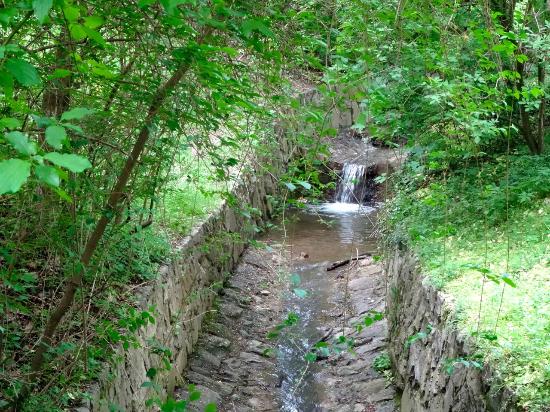
At my old primary school in Somerset, whose halls I graced half a century ago, there was a bubbling little stream that ran along the edge of the playing fields. We played for hours on it, floating sticks and leaves, building dams, and generally mucking about. It looked like this, minus the horses.
image
30 years ago, when I visited one summer, it was gone, dried up. The aquifer had dropped too far.

A larger stream ran along the valley floor not too far from my French grandmother’s house. It was a quick bike ride away, and my cousins and I would often go there to catch freshwater crayfish in its clean, clear waters and bathe in a deep, blue pool that had formed in the middle reaches. 20 years later, when I visited, it was turgid and scummy, with froth floating on it.

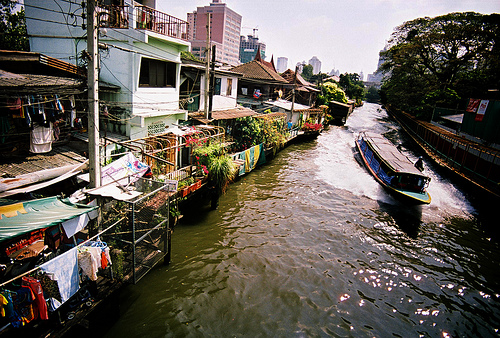
Bangkok is a water city. It sits on a river and is laced with canals. It should be lovely to travel on its waterways. Instead, it’s like cruising along stinking, fetid sewers. We take a water bus from time to time, when the traffic is really bad, from the Golden Mount Temple to the modern downtown.
image
Instead of enjoying the passing scenery, I live in dread of spray from the canal landing on my face; God knows what viruses and bacteria populate the water. I always scrub my face vigorously when I get off. As for the river, from our apartment terrace we look down on the rubbish of the city which floats by every day.
image
Recently, we visited Halong Bay, in Viet Nam, a World Heritage Site. We gazed on the unutterable beauty of the surroundings. But we also gazed at the rubbish floating around us and at the locals’ pathetic attempts to get rid of it.
image
Are we mad? We guzzle water like there was no tomorrow and treat it like a rubbish dump. Yet we need water, it’s vital to our lives. How can we treat so badly something we absolutely cannot do without?

________________
Glass of water: http://www.healthydietbase.com/does-drinking-ice-cold-water-help-you-lose-weight/
Old water pump: http://fr.123rf.com/photo_20440985_fonte-ancienne-pompe-a-eau-de-fer-humide-dans-le-jardin.html
Small stream: http://www.gettyimages.com/image/photo-2-tarpan-horses-crossing-a-small-brook/508354517
Bangkok canal: http://aspiringwriter.ca/tag=bangkok
Rubbish in Chao Praya River: https://bangkok2birmingham.org/2013/05/30/deteriorated-water-so-what/
collecting rubbish in Halong bay: https://www.pinterest.com/pin/27725353931017487/

CORAL REEFS AROUND SURIN ISLAND

Kuraburi, 18 April 2016

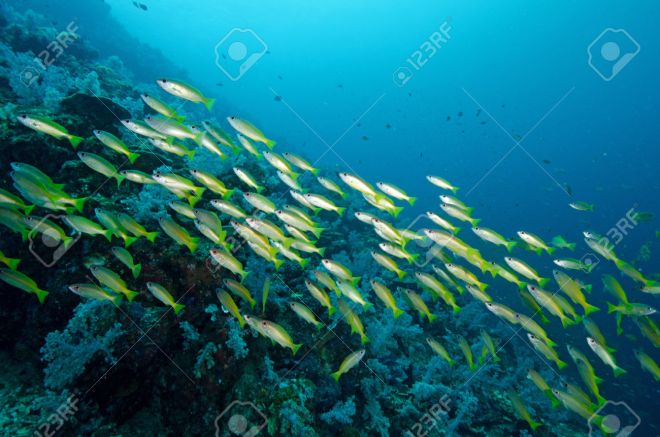
It was a few minutes before we turned back to the boat that my wife and I spotted them, a school of pale lemon yellow fish, browsing on the bottom of the reef. Much internet surfing suggests that we saw yellow runner fish.

Yellow runner school fish in Similan, Thailand

As we watched, another school of fish, light blue this time, floated by, pulled by some unseen current. They were fusilier fish, I think
image
During our two-day snorkeling trip to the Surin Islands National Park, just north of Phuket, we saw much more besides on the four or five reefs we visited.

The last time I’d snorkeled was half a century ago, in the shallow waters of a bay near Buea, Cameroon. My father had some work to do there, and he had brought me along. An English family living in Buea had taken me with them on an afternoon outing, and so it was that after a merry hour spent sinking up to my thighs in the micro-quicksands which dotted the bay, I spent another hour floating on my stomach, watching with fascination the tiny, brilliantly coloured fish darting back and forth across the black sand, fruit of the nearby volcano, Mt. Cameroon. A badly burned back was the result of this excessive curiosity. Still remembering the pain of that red and peeling back, I snorkeled this time with a shirt on. Alas! In the intervening five decades, my hair has thinned so I found afterwards that my scalp was burned from floating face down in the water (my wife instead got burned just below her swimsuit, on what our personal trainer calls the glutes).

All of which has not taken away one jot from the pleasure we derived from the wonderful sights we took in as we paddled slowly hand-in-hand along the reefs, with no sound but our breathing, witnessing a riot of colour as fish swam into our line of sight and then disappeared, intent on their business. Below is an incomplete catalogue of our sightings:

Powder blue surgeonfish
imageRainbow parrotfish
image
The wonderfully named Moorish idol

image

Lined surgeonfish
image
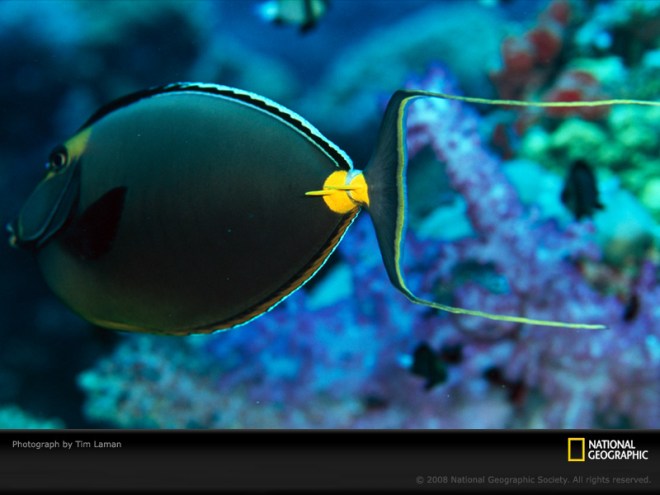
Black surgeonfish
image
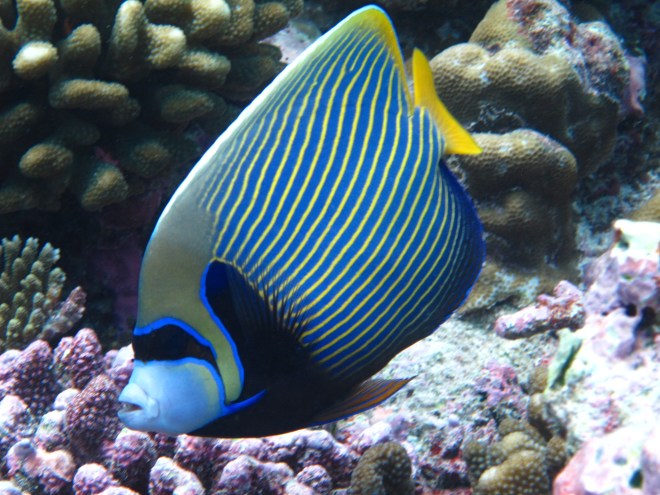
Emperor angelfish
image
Triggerfish
image
Melon butterfly fish

image

Blue lined grouper

image
We saw other denizens of the reefs too:

A powder-blue starfish

image
The aptly named crown-of-thorns starfish

image

Squamose giant clams, which would snap shut as we floated over them
image
Magnificent sea anemone, whose green tentacles would wave this way and that, revealing a wonderful blue-mauve body beneath

image

And of course there were the corals, around which all these other species revolved:
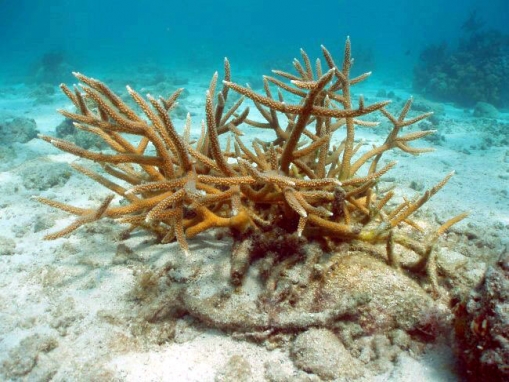
Staghorn coral, whose tips seemed to glow phosphorescently
image
Table coral

image

Mushroom coral
image

But really, although it was fun to point out to each other new species that we spotted, it was the reef communities as a whole that were most fascinating

image

those tens of species all working in and around a coral mount which surged up from the bottom towards the light.

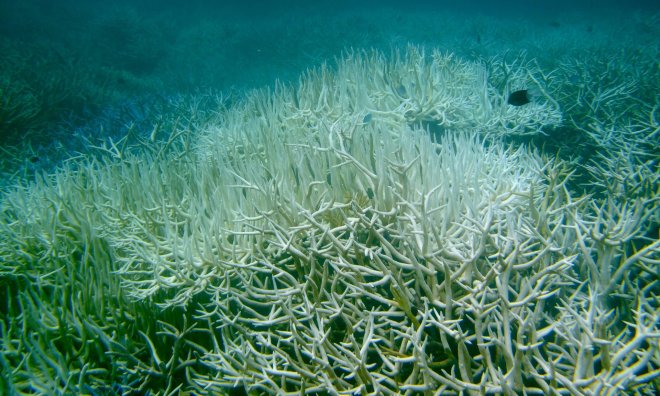
I suppose we’re lucky to have seen this. As we were floating over the reefs around Surin Island, an article appeared in the Guardian about massive coral bleaching going on at the Australian Great Barrier Reef. The immediate cause is El Niño, which is leading to much warmer waters than usual; coral dies if the water is too warm, and all you are left with are the bleached bones of coral, devoid of that blizzard of life with which it would normally be surrounded.

image

But behind this latest episode is climate change, which is making El Niño events ever longer and more intense. Two days before this article appeared, the Guardian had another announcing that the month of March had been the hottest on record.
image
But so had February. And so had January. And so had 2015 as a whole.

One of the many, many – many – impacts of climate change will be the die-off of coral reefs the world over. Coral reefs everywhere are showing signs of increasing strain. And with that die-off will come a steep decline in fish species: coral reefs are home to an astonishing 25 percent of the world’s fish species. That favourite cartoon character, Nemo, will lose his real-life counterpart.
image
Can we really let this happen? Surely we humans can collectively take on our responsibilities for controlling climate change. Let’s not destroy this beautiful planet we inhabit.

_________________
Yellow runner fish: http://www.123rf.com/photo_24661711_yellow-runner-school-fish-in-similan-thailand.html
Fusilier fish: http://www.123rf.com/photo_16881582_blue-and-gold-fusilier-fish-at-surin-national-park.html
Powder blue surgeonfish: http://www.alamy.com/stock-photo/acanthurus.html
Rainbow parrotfish: https://www.pinterest.com/pin/303922674822811295/
Moorish idol: http://diveadvisor.com/sub2o/the-moorish-idol
Lined surgeonfish: https://en.m.wikipedia.org/wiki/Acanthurus_lineatus
Black surgeonfish: http://photography.nationalgeographic.com/photography/wallpaper/surgeonfish-laman_pod_image.html
Emperor angelfish: https://cococares.wordpress.com/2012/11/14/maldives-emperor-angelfish-at-3-different-stages-of-life/
Triggerfish: http://www.seafocus.com/species_triggerfish.html
Melon butterfly fish: https://www.flickr.com/photos/thailandbeach/3568555120
Blue lined grouper: http://www.aquariumdomain.com/viewSpeciesMarine.php?id=49
Blue starfish: http://www.shutterstock.com/pic-3387803/stock-photo-blue-starfish-close-up-similan-islands.html
Crown of thorns starfish: http://www.bubblevision.com/underwater-pictures/racha-noi/pages/crown-of-thorns.htm
Squamose giant clam: http://forum.scubatoys.com/showthread.php?t=9755
Magnificent sea anemone: http://www.shutterstock.com/video/search/heteractis
Magnificent sea anemone: http://forum.scubatoys.com/showthread.php?t=9755
Staghorn coral: https://www.fau.edu/facilities/ehs/info/elkhorn_staghorn_corals.php
Table coral: http://adamjadhav.com/2010/
Mushroom coral: http://www.messersmith.name/wordpress/tag/mushroom-coral/
Reef life: https://www.govoyagin.com/activities/thailand-phuket-snorkel-and-see-sea-turtles-and-sharks-in-phi-phi/2039
Bleached coral reef: http://www.theguardian.com/environment/2016/apr/17/great-barrier-reef-worst-destruction
March global temperatures: http://www.theguardian.com/environment/2016/apr/15/march-temperature-smashes-100-year-global-record
Clownfish: https://prezi.com/m/m7zrpx-gkdqs/life-cycle-of-a-clown-fish/

TENNYSON IN HALONG BAY

Hanoi, 5 April 2016

It was our second day in Halong Bay, Vietnam.

image

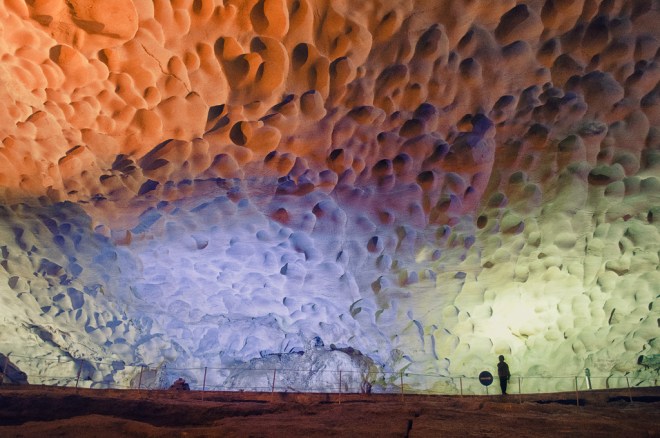
We’d climbed up the 173 steps to the Surprise Grotto, we had politely looked at the stalactites and stalagmites (“stalagTites from the Top, stalagMites like a Mountain” had helpfully intoned our guide) and been quite taken by the cave’s ceiling, a tracery of dimples formed by wind and water, a natural flamboyant gothic.

Shot taken at Surprised Grotto of Halong Bay. A Massive Cave system with thousands of gigantic stalactite and stalacmite decorating of almost all parts of cave's wall, based and ceiling.

We had climbed back down the 215 steps to the dock, we had puttered back to the boat, and now we were lying on the sunless sun deck waiting to be ferried to our next activity, a bicycle trip to a small village on the island of Cat Ba followed by lunch. All around me, rising sheer out of the water, were cliffs of greying limestone, topped with vegetation which tumbled down to the water’s edge.
image
I spotted, high above me, a black kite, hovering, scrutinizing the water’s surface. With a slight trim of its tail feathers, it wheeled out over the little bay, waiting. A quick flap of its wings and it made up for lost height. Again it circled, and glided, waiting and looking. In an instant, it plummeted down to the water, grasped its prey with its talons, and soared upwards again. And there rose unbidden in my mind the lines by Tennyson:

He clasps the crag with crooked hands;
Close to the sun in lonely lands,
Ring’d with the azure world, he stands.

The wrinkled sea beneath him crawls;
He watches from his mountain walls,
And like a thunderbolt he falls.

________________
Halong bay: https://www.shutterstock.com/video/search/asia-pacific-region
Surprise grotto ceiling: http://evelinakristanti.com/portfolio/series/ha-long-bay
Cliffs in Halong Bay: http://www.gettyimages.com/detail/photo/halong-bay-limestone-cliffs-at-sunset-high-res-stock-photography/542678795
Black kite: https://www.flickr.com/photos/tyleringram/8538728245

BETEL CHEWING

Bangkok, 27 March 2016

I said in my last post that beauty is in the eye of the beholder. In that case, I was talking about citrons. But this homey dictum is that much truer about the subject of this post, betel chewing. To explain what I mean, consider this picture of a betel chewer.

Betel chewer

Now, if I were to meet such a fellow, I would be nervously looking for an escape route, half expecting the man to make a lunge with his pointed canines at my jugular. But in the village where he comes from, where no doubt half the population have red goo drooling from their lips, this man would be seen as a nice, friendly village elder. Perhaps a little less on the extreme side of things, if I were to meet this smiling Indian gentleman

indian betel chewer

my earlier post on teeth would come to mind and I would make a mental note that he badly needed to see a dentist rather than thinking what a lovely smile he had and what a nice man he must be. As I said, beauty is in the eye of the beholder.

I first came across the habit of betel chewing in Delhi. I was there for a meeting of some sort, and after it was over and I was being walked back to my hotel my colleague stopped at a betel stand such as this one

SONY DSC

and ordered himself a betel quid to chew. He asked me if I wished to try one, but I politely declined. I watched with curiosity to see what might happen to him, but nothing untoward did. I did realize, though, that this habit explained his somewhat orange teeth.

I was reminded of this scene from long ago when I was in Myanmar recently and saw the tell-tale signs of betel chewing all around me in Yangon – the orange teeth, the betel stands, and – most revolting of all – these bright red splotches on the pavements.

spit from betel chewing

Betel chewing generates a lot of saliva, which the chewers either swallow or spit out (which if not done vigorously enough no doubt leads to dribbles on the chin as in the case of the old gentleman with whom we started this post). The fact that these are spit is revolting enough, but their bright red colour further gives the impression that half the population have advanced cases of TB and are coughing their lungs out (my childhood memories have retained stories of older generations with consumption coughing hard into their handkerchiefs and seeing with horror that the handkerchiefs were stained by bright red blood from their lungs; the end was nigh for them).

For those – I hope – many readers who have no idea what is in a betel quid, allow me to elucidate. At its most basic, the betel consists of slices of the “nut” (actually fruit) of the Areca palm

Ripe and Raw Betel Nut Or Areca Nut Palm On Tree

wrapped in leaves of the betel vine

betel leaves

which have been liberally smeared beforehand with slaked lime. Depending on your fancy and which part of the world you come from, your local betel stand holder can add tobacco, spices, and various other ingredients – note the various little pots which our betel stand holder in the picture above has spread out before him.

Since I had first come across the betel chewing habit in India, and since every betel stand holder in Yangon seemed to be of Indian extraction, I sort of assumed that this was an Indian tradition which had been exported elsewhere. Not a bit of it! It’s actually the other way around. Although it’s not yet clear where the Areca palm and the betel vine originated from exactly, there is general agreement that it was in South-East Asia somewhere. But they didn’t originate in the same place. Evidence points to the betel vine and Areca nut being initially consumed separately, their use spreading out from their point of origin until they overlapped, at which point some bright spark had the idea of putting the two together. Early trade between South-East Asia and India brought betel chewing and then the plants to the subcontinent – and migration brought them out to New Guinea and the Pacific Islands, where the dreaded signs of betel chewing are to be found.

PNG betel chewer

But why, some readers may be asking themselves, does anyone bother to chew betel quids in the first place? Because both plants contain mild stimulants: arecoline in the case of the Areca nut, eugenol in the case of the betel leaf. So chewing the quid gives the chewer a mild high. It joins a number of other plants which are chewed for their stimulating (in some cases very stimulating) effects: coca leaves in the Andes,

coca leaf chewing

khat leaves in the Horn of Africa and the Arabian peninsula (I remember a colleague once telling me that Djibouti came to a halt on Fridays as everyone waited for the weekly supply of khat to be flown in from Ethiopia)

khat chewing

kola nuts in West Africa.

cola chewing

And then there are the plants that are smoked, those that are swallowed, those that are made into infusions and drunk … Early humans were exceedingly resourceful in figuring out how to get a high from the plants which surrounded them. I wonder, though, how they ever figured out which of the thousands of plants around them gave them highs.
Luckily, the practice of betel chewing seems to be dying out. For instance, Thailand was once a hot-spot of betel chewing, but I have never seen anyone in Bangkok, or anywhere else for that matter, chewing it. Nor have I ever seen anyone chewing betel quids in Cambodia or Laos. I say “luckily”, even though this perhaps betrays a cultural imperialism. I mean, one could argue that if people want to chew betel why shouldn’t they, as long as they don’t kill me or their family or themselves in the process, and don’t become a burden on the public purse because of it. Normally, I would indeed be tolerant of cultural diversity, but for this particular practice I draw the line: people with red mouths and teeth à la Dracula generating bright red spit marks all over pavements are beyond the civilized pale. This should be the new normal, everywhere.

indian lady smiling

_____________________

Betel chewer: https://upload.wikimedia.org/wikipedia/commons/1/1f/Betel.jpg (in https://en.wikipedia.org/wiki/Betel)
Indian betel chewer: http://i2.cdn.turner.com/cnnnext/dam/assets/131025001452-betel-nut-12-horizontal-large-gallery.jpg (in http://edition.cnn.com/2013/11/04/world/asia/myanmar-betel-nut-cancer/)
Betel quid seller: http://www.loupiote.com/photos_l/3699347097-man-selling-betel-quids-delhi-india.jpg (in http://www.loupiote.com/photos/3699347097.shtml)
Spit from betel chewing: https://upload.wikimedia.org/wikipedia/commons/thumb/c/c8/Spit_from_chewing_Areca_nut_02.JPG/800px-Spit_from_chewing_Areca_nut_02.JPG (in http://tijgercoverlover.blogspot.com/2015_10_01_archive.html)
Areca nuts: http://previews.123rf.com/images/gamjai/gamjai1404/gamjai140400129/27628649-Ripe-and-Raw-Betel-Nut-Or-Areca-Nut-Palm-On-Tree-Stock-Photo.jpg (in http://www.123rf.com/stock-photo/areca_nut_palm.html)
Betel leaves: http://freepressjournal.in/wp-content/uploads/2014/11/lead-19.jpg (in http://www.freepressjournal.in/the-ubiquitous-betel-leaf/483947)
PNG betel chewer: https://s-media-cache-ak0.pinimg.com/736x/6b/81/24/6b81245676a7dfacc68d282d1a908b37.jpg (in https://www.pinterest.com/WorldofBacara/betel-nut-chewing-paraphernalia/)
Coca leaf chewing: https://lh6.googleusercontent.com/QFzuYzGkifM3AVIMjeToTuZ6ggFZLzzxh9eltPXpqaGv-Ei41rXq_VzjVByqHC0DuWmLqNQsad-W4bP9p775OicO_XVLhDjLfp19m-1hbGrZnvchpVdklqA_qfma-r3oRTzLVcfIgQ (in http://cocainekillstherainforestoo.blogspot.com/2015_03_01_archive.html)
khat chewing: https://upload.wikimedia.org/wikipedia/commons/f/ff/Qat_man.jpg (in https://en.wikipedia.org/wiki/Khat)
kola chewing: http://igboclass.umunagbor.org/wp-content/uploads/2015/09/Kola-.jpg (in http://igboclass.umunagbor.org/the-kola-nut-as-an-igbo-cultural-and-social-symbol/)
Indian lady smiling: http://thumbs.dreamstime.com/x/indian-lady-smiling-14122626.jpg (in http://www.dreamstime.com/royalty-free-stock-image-indian-lady-smiling-image2316986)

CITRON

Bangkok, 19 March 2016
updated Vienna, 5 February 2025

In the recent trip which my wife and I made to Italy, we managed to squeeze in a visit to our apartment near Genoa, where I was particularly delighted to see so many lemon trees in fruit. It’s wonderful to see trees heavy with lemons peeping over a wall or hanging over a garden fence.

lemons Liguria

Once back in Bangkok, I decided to do some research on the lemon and its history: how did this lovely yellow fruit end up in Liguria? But delving into the lemon’s history inevitably dragged me into the history of the citrus family. It turns out that the lemon does not have a long or distinguished pedigree. It is the citrus equivalent to a mutt, a fairly recent hybrid. In fact, most citrus fruits with which we are familiar are fairly recent hybrids. It seems that the members of this family love to hybridize, and of course humans – being intrusive busybodies by nature – have been only too willing to assist them. The result is a family tree of bewildering complexity.

As I tried to make sense of all this, my attention was diverted by something I read about the citron. I think I need to insert here a few words about the citron, since I’m sure there are many readers who are not familiar with this citrus fruit. It is relatively difficult to find these days since it has little use – except for one very special one, which I will come to in a minute. It looks like a large, warty, lemon.citron

Coming to what I read, it seems that during a ceremony in the Temple of Jerusalem marking the Feast of the Tabernacles, or Sukkot, in one of the years around 100 BC, the Jews pelted the High Priest with citrons and got massacred for doing so. Now that was something worth finding more about! How I would have loved to use citrons, rotten tomatoes, eggs, dog-eared hymn books – anything, really – to pelt the priests with for subjecting me to excruciatingly boring sermons during the Sunday Masses of my childhood! It turns out, though, that the Jews were not horribly bored with what the High Priest was saying, but horrified by what he was doing. It is reported that he deliberately poured the water of libation over his feet rather than over the sacrificial animals. I can’t say that I can get quite as excited about this action as the Jews did, but the fact is that they did, and satisfyingly peppered the High Priest with citrons.

Of course, it does come spontaneously to ask oneself why on earth the Jews were carrying citrons around in the Temple in the first place. It’s certainly not the item that would immediately come to my mind as expecting to see in the hands of Jews within the sacred precincts of the Temple. It turns out that the citron plays an extremely important role in the ceremonies of Sukkot. Every morning of this seven-day Feast, Jews are required to ceremoniously wave the “four species”. Citron is one of these, the other three being the date palm, the myrtle, and the willow. We see here the Tosher Rabbi of Montreal waving the four species.

tosher rabbi of montreal

One can therefore assume that the Jews were carrying their four species when the High Priest poured the water of libation over his feet, and in the horror of the moment they blindly grabbed their citrons and threw them at the impious prelate. It seems that they must have also thrown something harder – stones, no doubt – since it is reported that the stone altar was damaged. I can’t really see citrons doing damage to a stone altar.

It’s a bit of a mystery to me why the citron ever became one of the four species, because it is not native to the Near East, whereas the other three species are. The citron, like all the original citrus fruits, originated somewhere in the region of South-East Asia-Yunnan in southern China-the Himalayan slopes of India. So how did it end up in the Near East? There is general agreement that the fruit was first cultivated in northern India. From there, it migrated, presumably along trade routes, to Persia. What happened next is a hotly debated issue – at least, in certain circles. One hypothesis has the citron migrating to Egypt, where its essential oils were used in embalming, and from whence the Jews brought it with them to the Promised Land when they escaped from bondage in Egypt. A second hypothesis has the citron being carried from Persia to the Mediterranean basin in the baggage of Alexander the Great’s returning soldiers, who somewhere along the way dropped it off in the Levant. Yet another hypothesis has the citron migrating from Persia to Babylonia, where the Jews came across it during their Babylonian captivity and brought it with them when they came back to Israel.

These are all suppositions, with no real evidence to back them up. A very clever piece of archaeological sleuthing suggests a more concrete hypothesis. We need to first recall that after the Persians defeated the Babylonians and allowed the exiled Jews to return home, Israel was a Persian province for several hundred years. Israeli archaeologists have been excavating a site quite close to Jerusalem which turns out to have been a Persian palace with an extensive garden around it. Here is a reconstruction of the site.

persian palace

The archaeologists wanted to see if they could find evidence of what was planted in this garden. They therefore looked for traces of ancient pollen. None could be found in the earth of the garden – whatever had been there had decomposed long ago. So they decided to try their luck in the plaster with which the walls of an ancient pool in the garden had been coated. The thinking was that pollen grains could have got stuck in the plaster while it was drying and been preserved. They were right – and one of the types of pollen they found was that of the citron. From the other types of pollen found – a number from species not present in Israel – the archaeologists deduced that this was a garden planted with rare plants, designed to show off the wealth and power of the palace’s resident, either a Persian satrap or a Babylonian Jew close to the Persians and sent there to keep an eye on the locals. Perhaps it was here that the Jerusalem Temple elites, coming to pay their respects to the Palace’s resident, first saw the citron and admired this strange and exotic fruit. Maybe it became the rage to have a citron tree in one’s garden in emulation of the Persian masters.

Assuming this is somewhere near correct, how did the chicness of the citron eventually segue into its strong religious symbolism? Here, I shall hazard an explanation which I found written nowhere but which satisfies my fertile imagination. One has to know that the adoption by the Jews of the four species in the rituals of Sukkot derives from a text in the Book of Leviticus, where it is said (in the English translation):

“And you shall take on the first day the fruit of beautiful trees, branches of palm trees and boughs of leafy trees and willows of the brook, and you shall rejoice before the Lord your God for seven days.”

The text specifically names two of the plants: the palm tree and the willow. For the other two, though, it is quite vague. Talmudic tradition eventually settled on the citron as the “fruit of beautiful trees” and on myrtle as “boughs of leafy trees”.

The choice of myrtle makes sense to me – it is satisfyingly leafy.

myrtle

But the choice of citron as the fruit of a beautiful tree? That is really quite odd. In no way can the citron tree be considered a beautiful tree. It is low and scrubby, more bush-like.

citron tree

It seems, though, that the Hebrew text is grammatically ambiguous. Although the phrase in Leviticus is typically translated as “fruit of a beautiful tree”, it can also be rendered as “a beautiful fruit of a tree.” At first sight, this doesn’t seem to fit the citron either. As the picture above shows only too well, it is warty and knobbly, really quite ungraceful. But beauty, as they say, is in the eye of the beholder. The citron’s name in Persian, turunj, derives from the Sanskrit suranga, “beautifully coloured”. In today’s world, our lives are so saturated in bright colours that it is difficult for us to appreciate the impact on our ancestors of the few naturally brightly coloured things. As the photo above also reveals, the citron does indeed have a lovely yellow colour, and there really aren’t that many fruits that are so beautifully yellow (lemons come to mind, but that doesn’t count because they are a hybrid of the citron). Maybe the Persians, and the Indians before them, and the Jews after them, found the citron’s colour captivating.

If that explanation doesn’t satisfy my readers, let me suggest another reason. Under proper conditions, the citron is the only tree that can flower and bear fruit throughout the year. Even more distinctively, it can retain its fruit from one year to the next. So the citron tree can have buds, blossoms, and mature fruit all at the same time. This is a unique property, and one which may have aroused awe and reverence in our ancestors.

If that explanation doesn’t satisfy my readers, how about this one? Both the Greek philosopher, Theophrastos, and the Roman natural philosopher, Pliny the Elder, mention the citron in their botanical writings. And both stress the fact that the citron, fruit and leaves, has a very strong scent, that typical scent which you also get from the zest of the lemon. It is so strong, they say, that if the fruit is put among clothes it acts as a moth-repellent. This seems a little weak as a reason for nominating the citron as a “beautiful fruit”, although as every woman knows scent can be an important ingredient in beauty. And maybe the elites of India, Persia, and Israel were particularly receptive to the idea that their magnificent – and expensive – clothes could be protected from those pesky moths by the citron.

Either one of these explanations, or all three, must explain not only why the Jews adopted the citron as a religious symbol but also why anyone bothered to cultivate the citron in the first place and then bothered to carry it along to different parts of the world. From a utilitarian point of view, and our ancestors were nothing if not supremely utilitarian when it came to their natural environment, the citron really does seem a singularly useless plant. As I’ve said, the tree is low, scrubby, and bush-like, so it cannot be used as a shade tree. It is sickly and prone to disease, so is difficult to cultivate. The wood is no good for timber. Even the fruit is not much good to eat. It is mostly pith with hardly any flesh, and what flesh there is, is dry with relatively little juice.

cut citron

Whatever the reason, by the time the High Priest poured the water of libation over his feet (no doubt with a sneer on his lips) the practice of using the citron as one of the four species in the ceremonies of Sukkot was fixed.

It was this deliberately offensive act at the altar of the Temple which set me off on this quest to know more about the citron. But I can’t stop here, because the continuing history of the citron is equally fascinating. So I hope my readers will bear with me if I take them on a journey into the fruit’s more recent history.

From the fall of Jerusalem in AD 70,  the European history of the citron has been indissolubly bound up with that of the Jewish communities in Europe, so let me switch to using its Hebrew name, etrog (which, by the way, derives from the citron’s Persian name, turunj, via Aramaic, strengthening the idea that somehow it was the Persians who brought it into the lives of the Jews). The Romans’ destruction of Jerusalem, which ended Temple-centred worship for the Jews, meant that the feast of Sukkot began to be celebrated wherever the Jews happened to live. Since the citron was now indispensable in the celebrations of Sukkot, it followed the Jewish diaspora as the latter spread out through the Roman Empire into Greece, Italy, and Spain. With time, more and more attention was given to ensuring that the etrogim used in Sukkot were the most beautiful: after all, they were offerings to the Lord our God and nothing but the most beautiful should be offered. Detailed guidelines were issued about what constituted a “perfect” etrog, and considerable sums of money were paid for the most perfect ones.

All was under control until the Diaspora began to move northwards into parts of Europe where the climate was too cool for the citron to grow. These more northerly Jewish communities therefore urgently needed etrogim to be brought to them from lands further to the south – no other fruit would do since the four species had been prescribed in the Talmud. This brings us back to where this post started, Genoa. Because of its climate, but also presumably because of its flourishing, and ancient, Jewish community, there were citron orchards around Genoa. It also happened to be a dynamic trading port, so it wasn’t long before Genoa dominated the trade in etrogim to northern Europe. With time, Genoa seems to have gotten out of the business of actually growing etrogim. Instead, it picked up etrogim as far south as Calabria, still a source of etrogim for some Jewish communities, and all points in between, as well as in Corsica, a Genoese colony, and shipped them north. Here we have a painting by Chagall from 1914, of a rabbi, presumably from Vitebsk in Bielorussia, where Chagall grew up, carrying his etrog to the synagogue (and clutching what looks like the local version of myrtle).

my photo

Genoa’s monopoly on the etrog trade began to be undermined when the Sephardic Jews, expelled from Spain, filtered eastward across the Mediterranean to Italy, Greece, and Turkey, and discovered the etrogim being grown in Corfu and other Ionian islands, presumably for the very ancient Jewish communities of Greece. These were very beautiful as defined by the guidelines on etrog beauty, and they began to seriously compete with the Genoese etrogim. At first, there was resistance in some of the Ashkenazic communities in northern Europe. To explain why, I have to go back to what started me on this post initially, the lemon. The first substantial cultivation of the lemon in Europe only occurred in the mid-15th Century, in Genoa – Genoa again (the sour or bitter orange arrived earlier, in the 11th Century, while the sweet orange arrived somewhat later, in the early 16th Century). European growers of citrons discovered – or maybe they picked it up from the Arabs – that grafting citrons onto lemon stock gave plants which were much hardier than pure citron trees. But grafting created an enormous problem for the Jews because the mixing of species was non-kosher, and etrogim used in a religious Feast had to be kosher. We now know that grafting doesn’t actually lead to a mixing of genes, or hybridization, although 400 years ago it was quite easy to think that it did; after all, everyone knew that if you crossed a horse and a donkey, you got a hybrid, the mule. Many in the Ashkenazic communities suspected that the Greek etrogim were actually so beautiful because they were grafted onto lemon trees. Various rabbis were prepared to certify that they were not, and anyway the Napoleonic wars cut off the traditional supply of etrogim from Genoa. And the Greek etrogim really were so very beautiful …

So the Greek etrog triumphed and trade from Corfu flourished. Eventually, this got the Greek farmers greedy. They calculated that they had the Jewish communities over a barrel – they needed beautiful etrogim, the etrogim from Corfu were the most beautiful, hence they would pay whatever it took to get them. In 1875, they therefore created a cartel and jacked up the price. They turned out to be wrong. The Jewish communities reacted vigorously and successfully boycotted the Greek etrogim. They bought from Calabria, from Corsica, and more importantly from Israel, to where we now turn.

As more and more European Jews immigrated to Palestine in the 1800s, they discovered a local variety of etrogim. They surmised that these must be descended from the etrogim used in Temple worship before the Temple’s destruction. A number of rabbis therefore decided to promote these etrogim from Palestine, which were surely more authentic than etrogim grown elsewhere. They also thought it would help the poverty-stricken economy of Palestine to be able to export high-priced etrogim to Jewish communities in Europe. The problem was that although these etrogim might be more authentic they weren’t nearly as beautiful as the Greek etrogim. On top of it, Sephardic communities which had immigrated to Palestine brought in seeds of Greek citron trees and started planting orchards of the beautiful Greek etrog there. The stand-off with Corfu helped boost sales in Palestine, both of the original as well as of the Greek etrogim transferred there. However, authentic Palestinian etrogim were suffering from the competition.

Coming back to Corfu, the Greek farmers eventually backed down and brought their prices down again. But they didn’t forget or forgive. Some 15 years later, when the body of an unknown woman was found just outside the Jewish quarter in Corfu, the local etrog growers claimed that the woman had been murdered by Jews. This sparked off a pogrom against the local Jewish community, which left 139 people dead. And then it was discovered that the dead woman was actually Jewish. That finished off the etrogim trade from Corfu.

Meanwhile, back in Palestine, the transplanted Greek etrog was pushing the local variety off the market. Eventually, the Greek etrog, which did not adapt very well to the climate in Israel, began to be grafted onto stock of the original etrog, a graft which is kosher. This was a marriage made in heaven: the beautiful Greek etrog with the original, Temple-era etrog. It is this variety which now dominates the modern etrog market, and is no doubt the one being intensely studied by these Orthodox Jews prior to an eventual purchase.

jews purchasing etrogim

I cannot finish my story of the citron without mentioning the one way of usefully consuming it that was eventually discovered. For this, I have to back up a little and say a few words about the history of cane sugar. Cane sugar, brought west from India by, once again, Alexander the Great’s troops (they seem to have been great collectors of plants …), was first exploited in the Near East. It was the Crusaders, who came across caravans of this “sweet salt”, and who brought sugar to the attention of Europe. Until then, Europeans had only had honey as a sweetener. Genoa’s fiercest rival, Venice, was the first to make sugar available in Europe. It also brought another Arab invention, candying of fruit, to Europe. Not to be outdone by its hated rivals, the Genoese also finally got into the candying business. Somewhere along the line, someone had the idea of candying the citron, or rather its pith, of which there is so much, as the photo above shows. Leghorn (Livorno) became the centre of production: citrons from the south all the way to Sicily, from Corfu and the other Ionian islands in the east, and from Corsica in the west, were sent, de-pulped and brined, to Leghorn. There, the citron pith was de-brined and steeped in progressively more concentrated solutions of cane sugar. Once dried and chopped into small pieces, it was shipped, no doubt in Genoese ships, all over Europe to be added to cakes, sweet bread loaves, and other patisseries. I have a particular reason to mention all this because the panettone, that glory of my wife’s home town, Milan, was originally made with candied citron pith (as well as candied orange and sultana raisins).

Panettone

More humbly, the original recipes of the English plum pudding of my youth also called for candied citron from Leghorn.

Plum-Pudding

Alas! I believe this market has declined drastically – or perhaps citrons from elsewhere have cornered the candying market. The fact is, Leghorn is no longer a centre for candied citron production, the Calabrian citron hangs on by managing to keep a foot in the etrog market, while the Corsican and Corfu citron production is down almost to nothing; the few which are grown there are only used to make a local liqueur. Here’s the Corsican variety. Somehow, it seems apt that the bottle stands next to one made with myrtle, another of the four species.

cedratine and myrtheLet’s lift a glass to the citron a.k.a. the etrog! Cin-Cin!

_____________________________

Lemons in Liguria: https://i0.wp.com/www.bbfauno.com/wp-content/gallery/amalfi/limoni-amalfi-coast.jpg (in https://misshome.wordpress.com/tag/italian-language/)

Citron: http://whileshenaps.com/wp-content/uploads/2010/09/6a00d834515cdc69e20133f4767038970b-pi.jpg (in http://whileshenaps.com/2010/09/make-a-paper-mache-etrog.html)

Tosher Rabbi of Montreal: https://en.wikipedia.org/wiki/Four_species#/media/File:Fourspecies.jpg (in https://en.wikipedia.org/wiki/Four_species)

Persian palace: http://www.haaretz.com/polopoly_fs/1.410535.1328143655!/image/3938862120.jpg_gen/derivatives/headline_857x482/3938862120.jpg (in http://www.haaretz.com/jerusalem-dig-uncovers-earliest-evidence-of-local-cultivation-of-etrogs-1.410505#acid)

Myrtle: http://www.polyvore.com/cgi/img-thing?.out=jpg&size=l&tid=65106807 (in http://www.polyvore.com/outdoor_plants/collection?id=3359765)

Citron tree: in gardening.stackexchange.com

Cut citron: http://www.tropcrop.nl/citr02fr.jpg (in http://www.tropcrop.nl/citron.htm)

Orthodox Jews purchasing etrogim: http://pix.avaxnews.com/avaxnews/64/a4/0001a464_medium.jpeg (in http://avax.news/fact/Symbolic_Citrus_Israeli_Jews_Inspect_Fruit_for_Sukkot.html)

Panettone: http://www.italianfoodexcellence.com/wp-content/uploads/sites/27/2014/09/Panettone-Vergani-Enrico-Su—-Ummarino.jpg (in http://www.italianfoodexcellence.com/tag/panettone/)

Plum pudding: http://cookdiary.net/wp-content/uploads/images/Plum-Pudding_12165.jpg (in http://cookdiary.net/plum-pudding/)

Cédratine and myrthe, Corsica: http://c8.alamy.com/comp/A8WYT4/myrthe-and-cedratine-liqueurs-for-sale-in-a-shop-corte-haute-corse-A8WYT4.jpg (in http://www.alamy.com/stock-photo-myrthe-and-cedratine-liqueurs-for-sale-in-a-shop-corte-haute-corse-6963651.html)